




Abstract
A novel preference ranking organization method by similarity to ideal solution (PROMSIS) vertical handoff algorithm is proposed for heterogeneous wireless networks, and its essential idea includes the preference structure of the PROMETHEE and the concept of Euclid distance of the TOPSIS. Four 3GPP defined traffic classes are considered in performance evaluation. An attribute matrix is constructed considering some major attributes. Handoff decision meeting multiattribute QoS requirement is made according to the traffic features. The weight relation of decision elements is determined with the least square (LS) approach. The final decision is made using the proposed PROMSIS algorithm based on the attribute matrix and weight vector. The simulation results have manifested that the proposed PROMSIS algorithm can provide satisfactory vertical handoff performance, and the LS-PROMSIS algorithm can be fit to the characteristics of the traffic.
1. Introduction
The architecture of the beyond 3rd generation (B3G) or 4th generation (4G) wireless networks aims at integrating various heterogeneous wireless access networks over an IP based backbone. To provide seamless mobility, one of the design issues is the vertical handoff support [1, 2], a multiple attributes decision subject. Since the handoff may happen in different RATs and management domains, handoff decision will depend on the combination of multiple attributes rather than a single parameter.
In general, the vertical handoff process can be divided into three main steps, namely, system discovery, handoff decision, and handoff execution. During the phase of system discovery, the networks may advertise the supported data rates and quality-of-service (QoS) parameters for different services. Because the users are mobile, the available collocated networks depend on the location of the user. The traffic load in each network may also change with time. Thus, this phase may be periodically invoked.
Various vertical handoff decision mechanisms have been proposed. In [3], a combining SINR based vertical handoff (CSVH) algorithm is proposed. It studies the combined effects of SINR in different access networks, that is, in the source network and the equivalents in the target networks, compared with the RSS based vertical handoff algorithm. Further on, a multidimensional adaptive SINR based vertical handoff (MASVH) algorithm is proposed in [4]. In addition to the combined effects of SINR, it also takes account of the user required bandwidth, traffic cost, and resource utilization in the participating access networks. A parameter k is used in the MASVH algorithm to adjust the weight of multiple attributes. Nevertheless, no discussion elaborates on the determination of the optimal k value under different conditions, the relation between multiple attributes, the relative importance of each attribute, and the impact of system load. There are also some researchers focusing on solving the ping-pong effect. In [5], the user movement information is considered, and the residence time in a base station is estimated to avoid the unnecessary handoff.
In this paper, a novel algorithm, namely, the PROMSIS algorithm, is proposed to be applied in the vertical handoff decision technology based on the preference ranking organization method for enrichment evaluation (PROMETHEE) [6, 7] and the TOPSIS [8]. In TOPSIS, the level of the decision maker's participation is rather low in the process of decision making, and the decision maker's preference information is not integrated into the method. So, we introduce the preference function associated with each criterion in PROMETHEE, integrate the preference structure of PROMETHEE into TOPSIS, and obtain PROMSIS as a result. The scenario analyzed is referred to in [4]. It considers multiple attributes, concluding in the combined effects of SINR in WLAN and WCDMA, the required bandwidth, service cost, and available bandwidth of the participating access networks, to make handoff decisions meeting multiattribute QoS requirement. An attribute matrix of alternative networks is established. An appropriate weight factor is assigned to each criterion to account for its importance. In the weight determining process, four 3GPP defined traffic classes [8] are considered and the least square (LS) weighted approach method [9] is adopted. Finally, how the connections are contained or rerouted is decided by the PROMSIS (or LS-PROMSIS) algorithm according to the attribute matrix and the weight vector.
2. PROMSIS and LS-PROMSIS Vertical Handoff Algorithm
The handoff metrics and QoS parameters are categorized into different groups (e.g., bandwidth, latency, power, price, security, reliability, availability, etc.). Some representative metrics approaches are considered in this paper.
Assuming that there are a BSs and b Aps, all candidate BSs and APs for the user can be indexed by 1 to

For each handoff event, the best BS or AP from the candidate set
2.1. Attribute Matrix
Let us presume

where

where the carrier bandwidth is 22 MHz for WLAN
It is assumed that a BS is transmitted to merely one user via the HSDPA channel at a time, with the maximum power to achieve the optimal physical rate. The SINR

where
For WLAN, the SINR

where
A macrocell propagation model for urban and suburban areas [3] is adopted, and for an antenna height of 15 meters the path loss is

where f is the carrier frequency (2 GHz for WCDMA and 2.4 GHz for WLAN), R is the distance in meters between the user and the BS or AP, and
Using (3), the SINR received from APs (
The set of the SINR value

For a required bandwidth
Let us suppose
Let us suppose
Then, the attribute matrix is as follows:

where
2.2. Handoff Decision
The proposed PROMSIS is also a multicriteria analysis approach, and its essence includes the preference structure of the PROMETHEE and the concept of Euclid distance of the TOPSIS. In the first place, it performs the comparison between every pair of solutions
PROMSIS consists of the following steps.
Construct the decision matrix
Define the preference function for each attribute.
Define the preference index for each couple of alternatives:

The preference index is given in the intensity of preference of the decision maker for
The preference concept from PROMETHEE is presented as above, and now we use the concept of Euclid distance in TOPSIS to continue. Define the positive ideal point and the negative ideal point, and calculate the distance between each scheme and the positive/negative ideal point. Calculate the distance

Calculate the relative approach degree

Ranke the schemes based on
Above all, the proposed PROMSIS combines the qualitative and quantitative analysis. Preference comparison corresponds to the qualitative analysis. The Euclidean distance can describe the degree of preference through the quantity. So, the utility of the network can be achieved in both qualitative and quantitative aspects. And the final decision will be appropriate based on subjective and objective factors.
2.3. Weight Vector
There are a variety of weight methods, such as analytic hierarchy process (AHP) and the information Entropy weight method, some are subjective and others are objective. We can choose the appropriate weight method according to actual conditions. In the weight determining process, we apply the LS [9] to estimate the weights of decision elements introduced by Chu in 1979.
Firstly, the comparison matrix
Four traffic classes defined by 3GPP are taken into consideration, namely, the conversational, streaming, interactive, and background classes. Based on the traffic requirements, the comparison matrices for the four traffic classes according to the 9-point scale can be established.
The element
The weights can be obtained by solving the constrained optimization problem
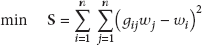
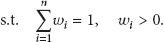
In order to minimize
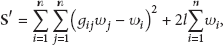
where l is the Lagrange multiplier. Differentiating

Equations (15) and (13) form a set of
By the way, using the numerical method to solve mathematical problems, due to almost inevitable rounding errors, the results obtained are generally inaccurate. Some other measures can be applied to estimate the error, but we will not go into detail here due to space limitations.
3. Simulation Results
In this research, we concentrate on the downlink traffic, since it normally requires higher bandwidth than uplink, especially for multimedia services such as video streaming through the HSDPA channel while connected to WCDMA.
The performance of different vertical handoff algorithms has been evaluated with the scenario illustrated in Figure 1, in which there are 7 BS and 12 AP placed at each WCDMA cell boundary. The WCDMA cell radius is 1200 meter. 200 randomly generated UEs are used inside the simulation area, whose position changes in the time interval depending on their moving speed and direction. The direction is uniformly distributed in the range of

Simulation scenario.
The V-shape with indifference criterion type preference function in PROMETHEE was adopted here. In case of this type, the thresholds of indifference
The system performance for different session arrival rates is shown in Figure 2. The simulated algorithms include the proposed LS-PROMSIS algorithm and the MASVH (

Performance of each algorithm.
4. Conclusions
In this paper, a novel PROMSIS vertical handoff algorithm is proposed and compared with the existing CSVH and MASVH algorithms. The vertical handoff of heterogeneous networks is a multiple attributes decision subject. With regard to the relations between all the attributes, the observed objects are the four 3GPP defined traffic classes. According to the features of diverse traffic classes, the weight of each attribute in the handoff criterion is determined by LS. The simulation results display that the performance of the algorithm is affected by the allocated weight vector. Consequently in practice, we should consider both the characteristics of the traffic and the preference of the user and weigh the advantages and disadvantages before making the decision. According to the analysis and simulation results, the PROMSIS algorithm can achieve the satisfactory performance for the network and the user.
For future work, more comparisons with other vertical handoff methods will be further discussed and other techniques to solve the decision problem, such as the game theory, will also be taken into account.
Footnotes
Acknowledgments
This work was supported by the National Natural Science Foundation of China under Contract no. 61271235 and Natural Science Foundation of Education Committee of Jiangsu Province (no. 11KJB510014).