




Abstract
Due to the low temperatures, the heating efficiency of air source heat pump systems during the winter is very low. To address this problem, a low-temperature solar hot water system was added to a basic air source heat pump system. Several parameters were tested and analyzed. The heat collection efficiency of the solar collector was analyzed under low-temperature conditions. The factors that affect the performance of the heat pumps, such as the fluid temperature, pressure, and energy savings, were analyzed for cases where the solar energy auxiliary heat pump and the air source heat pump are used independently. The optimal heating temperature and the changes in the fluid temperature were determined. The influence of the compression ratio and the coefficient of performance (COP) were investigated theoretically. The results revealed the parameters that are important to the performance of the system. Several measures for improving the COP of the heat pump units are provided for other applications and future research.
1. Introduction
Air source heat pumps use the low-grade energy in the ambient air, which is virtually inexhaustible, as a heat source [1]. When the temperature decreases during the winter, the outdoor coils suffer from extensive frosting, which results in low efficiency. Thus, the use of these heat pumps in northern China is limited. Martínez et al. investigated solar floor radiation heating systems in which the water temperature is approximately 50–60°C. These temperatures lead to low efficiency, which becomes worse on cloudy or snowy days [2]. Li et al. proposed adding a heater to a direct-expansion solar heat pump water system to alleviate the frosting problem and improve its efficiency and operational performance. However, the system had to absorb heat directly from the air in the vacuum tubes, and air is not a good medium to store heat. Thus, the performance of the system would largely depend on the solar radiation and would lack stability [3].
Based on the problems described above, this paper proposes a solar-assisted air source heat pump system for low-rise buildings and rural areas. The system utilizes low-temperature solar-heated water as a low-temperature heat source, so it both uses solar energy and avoids the frosting problem. The system improved the heat efficiency of the solar collector and the heat collection. Because of the increased evaporation temperature of the evaporator, the heat pump's coefficient of performance (COP) was improved.
2. System Presentation
The system was set up in a laboratory at the North China Institute of Science and Technology. A commercial air source heat pump system was modified, and the original electricity-assisted portion of the system was removed. The new system is composed of two loops: the water cycle loop and the refrigerant cycle loop. The water cycle loop exchanges heat with the refrigerant cycle loop through the plate heat exchanger. During the winter, the plate heat exchanger is regarded as the evaporator for the heat pump system, so the hot water that flows from the solar collectors brings heat to the refrigerant in the plate heat exchanger (Figure 1).
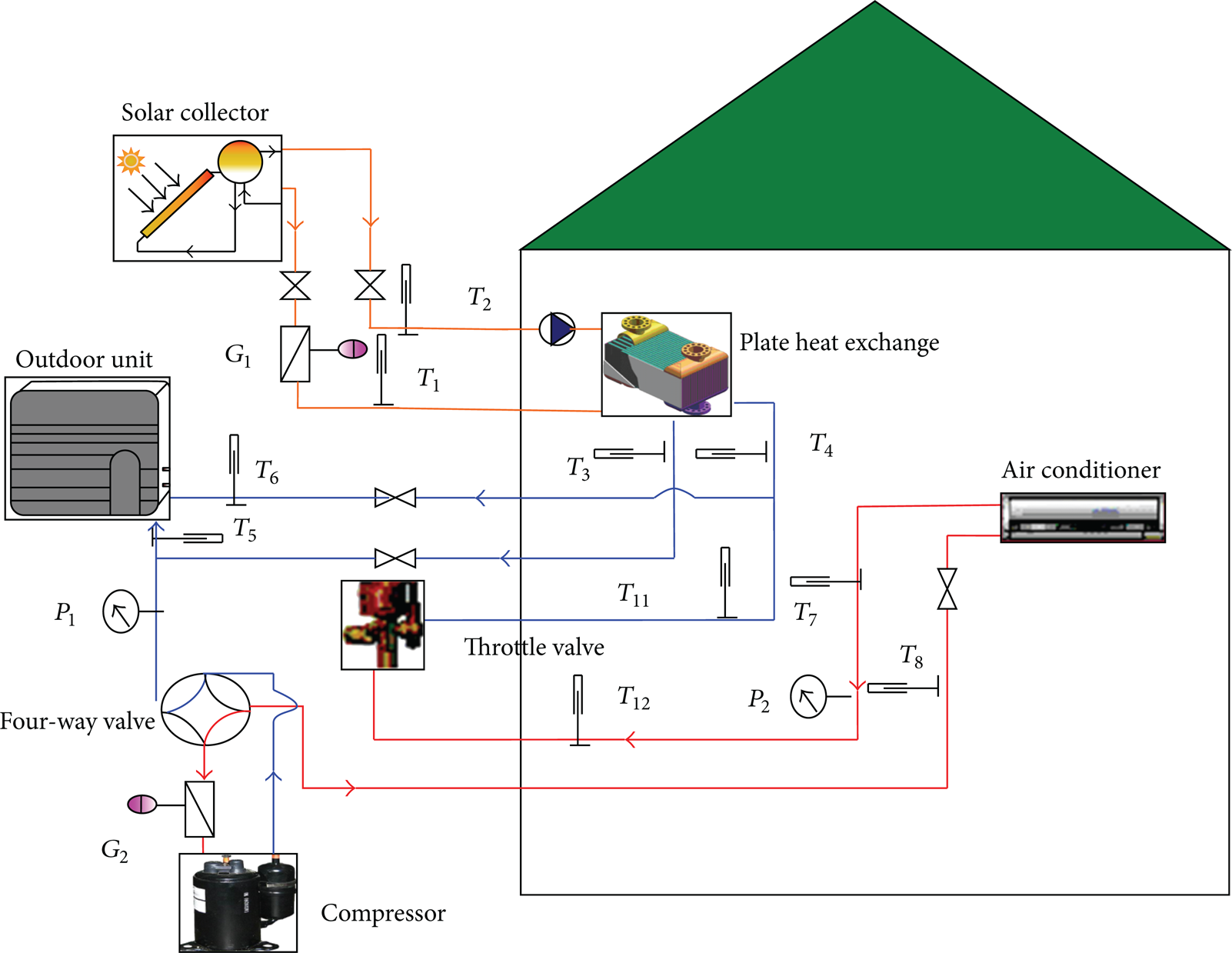
Diagram of the heat pump system.
2.1. Solar Collecting System
Vacuum solar thermal collectors were placed on the roof facing south. The collectors use two groups of vacuum tubes side by side in parallel and stand at a 60-degree angle, as shown in Figure 2. To avoid imbalances, the water network used the reverse return mode, and thermocouples were installed in the main supply and return water pipes. A sunshade cloth was installed to address the effects of changes in solar illumination on the heat pump. To prevent the pipes from bursting in cold weather, an open-loop system was used. To use the heat at night, the hot water in system was drained into the tank, providing heat to the system.

W-50 United Solar Water Heater.
2.2. Heat Pump System
The compressor, evaporator, and cooling fans were installed outdoors, and the fluorine water plate heat exchanger, air conditioner, monitoring equipment, tanks, electric meter, and pump were installed indoors. Thermocouple thermometers and pressure gauges were installed at the inlet and outlets of the air conditioner and the refrigerant water plate heat exchanger to record the power consumption of the system. The indoor portion of the system is shown in Figure 3.
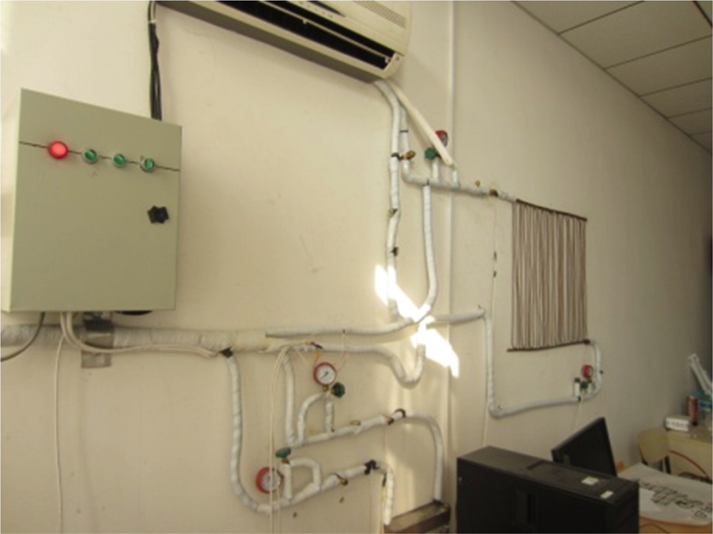
Picture of the experimental system.
Because the system was taken from a commercial machine, the outdoor and indoor equipment are 15 meters apart, and the pipe resistance, which can influence the compressor, will be very high. To reduce the resistance, the diameter of the inlet and outlet copper pipes that connect to the condenser was increased by 1 mm. The plate heat exchanger was installed in parallel with the outdoor evaporator, and the diameter of its pipes was 10 mm. Because the condenser and the heat exchanger contained different amounts of refrigerant, the corresponding valve had to be switched.
3. Solar Energy Collecting System
3.1. Solar Collector Efficiency Analysis
Solar heat storage and solar collector efficiency are two important parameters for the solar collector. Improving the heat and the heat efficiency of the heat collecting system is crucial to the solar system, especially during the winter [4]. For a given system, the heat storage is only related to the collector's efficiency, and the collector efficiency is simply related to the heat collection temperature. Equations (1) and (2) calculate the efficiency of the solar collector [5, 6]:

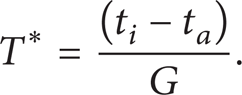
In (1), the heat collection coefficient is a function of the normalized temperature, which is given in

Equation (4) is obtained by differentiating equation (3):

Equation (1) shows that the thermal efficiency decreases with increasing normalized temperature, while (4) shows that when the normalized temperature increases, the rate of decrease of the collector efficiency increases linearly.
3.2. Determination of the Solar Collector Area
The collector area can be obtained using [7]:
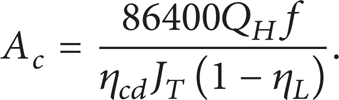
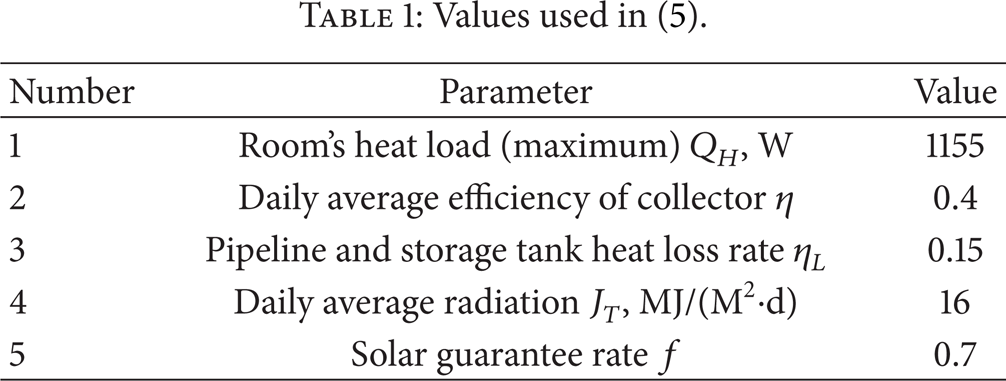
Using the data from Table 1 in (5), the area of the collector is calculated as 12.8 m2. The actual area of the collector is 12 m2, because of considering the use of heat pump system. The calculated area meets the heating requirements.
Values used in (5).
4. Heat Pump Performance Analysis
The main factors that influence the performance of the heat pump air conditioning system include the compression ratio, evaporation temperature, condensation temperature, and refrigerant flow. After the indoor heating temperature and the components of the heat pump system are determined, the cooling temperature and refrigerant volume are determined. The compression ratio and the evaporation temperature affect the performance of the heating unit [8].
4.1. Compression Ratio of the Heat Pump System
The compression ratio is an important parameter in measuring the operating characteristics of the heat pump system [9]. In general, the compression rate is less than P/P < 10. Under normal conditions, the discharge pressure and suction pressure are the main factors that affect compression ratio. The compression ration can be expressed by


When the indoor temperature remains constant, the temperature of the discharge gas will not change, and the exhaust pressure is also constant. Thus, (7) can be expressed as

4.2. COP of the Heat Pump System
During the winter, the COP can be used to evaluate the working performance of the heat pump units. A high COP indicates high efficiency and vice versa [10, 11]. When the outdoor temperature is low (below 0°C), the working efficiency of the units decreases significantly, frosting becomes serious, and it becomes difficult to evaporate the refrigerant. The heating effect is poor because of the low compression ratio. In contrast, after replacing the cold air with low-temperature solar water as the heat source, the working conditions improve significantly [12, 13]. The solar water-source heat pump cycle is shown in Figure 4. The heating capacity, COP, and the heating effect increase gradually.

Temperature-entropy (T-S) diagram of the solar water-source heat pump cycle.
The analysis indicates that changing the temperature of the low-temperature heat source has a great influence on the heating coefficient. Particularly in the heating mode, raising the temperature of the evaporator side improves the efficiency of the heating unit. The temperature of the low-temperature heat source increased from T0′ to T0. On the heat pump's evaporator side, using the low-temperature solar hot water instead of the low-temperature outdoor air greatly improves the evaporation temperature. It also improves the thermal efficiency of the system because the refrigerant has a certain amount of superheat.
5. Analysis of Measured Results
To analyze the unit's efficiency and energy savings and to validate the theoretical results of the previous section, the inlet and outlet temperatures of the solar collector, plate heat exchanger, the refrigerant of the plate heat exchanger, refrigerant of condenser, and the air conditioner were measured when the low-temperature solar hot water was used as the heat source for the heat pump.
5.1. Analysis of the Solar Collector
The solar collector stored heat from 9:21 am to 12:00 am on February 22, 2013. The hourly collection efficiency can be calculated from the measured hourly solar irradiation and the inlet and outlet water temperatures of the solar collector. Figure 5 shows the variations of the inlet and outlet temperatures measured in the solar collector and the solar collector efficiency. The system uses 220 kg of circulating water. The water temperature in the solar energy collector increased from 20°C to 50°C as the solar irradiance increased gradually, while the collection efficiency of the solar collectors decreased from 50% to 27%. The difference in temperature between the inlet and outlet water in the solar collector changed little over time and remained at approximately 5°C. We conclude that the accumulation of heat per unit time remained nearly constant.
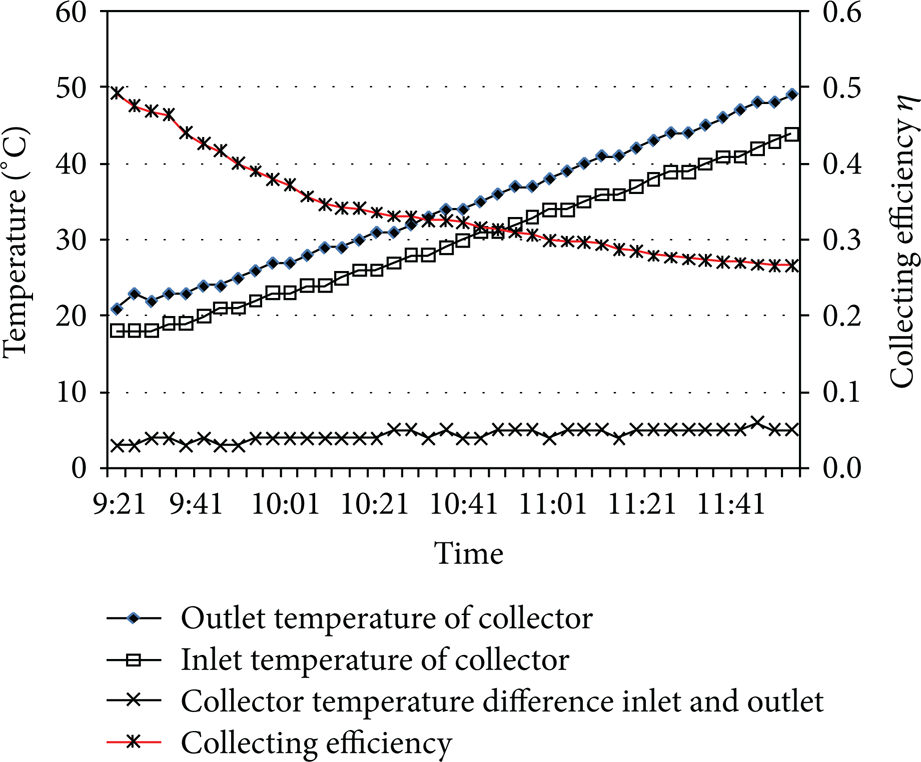
Inlet and outlet water temperatures and collection efficiency of the collector.
Figure 5 shows that the collection efficiency decreased as the temperature of water increased. The point at which the water temperature and the collection efficiency lines intersect represents the optimum water collector temperature. Different systems have different optimum points. In this system, 32°C is the optimum water collector temperature. The use of relatively high temperature inlet water as the heat source for the heat pump system is advantageous for the operation of the heat pumps.
5.2. Analysis of the Air Source Heat Pump
Figure 6 shows the changes in the inlet and outlet temperatures of the refrigerant in the condenser of the air source heat pump as well as the indoor and outdoor air temperatures. During the test, the average outdoor air dry bulb temperature was 2°C, and the temperature of the refrigerant in the condenser was 20–21°C. The difference between the inlet and outlet temperatures was approximately 1°C, which indicates that the efficiency of the heat pump was not sufficient. The indoor temperature was only 15°C. It is clear that the low outdoor air temperature makes it difficult to evaporate the refrigerant, which leads to the poor heating effect. The basic parameters of the heat pump are listed in Table 2.
Basic parameters of the heat pump unit.


Inlet and outlet temperatures of the refrigerant in the condenser and the indoor and outdoor air temperatures.
Figure 7 shows that the COP of the unit increased with the increase in the outdoor air temperature, but the COP remained low. The average COP was only 1.1. The unit's hourly power consumption remained unchanged at approximately 0.9 kWh, which is lower than the rated input power (1340 W). It is clear that the low evaporation temperature of the unit led to the deviation from the unit's rated capabilities.
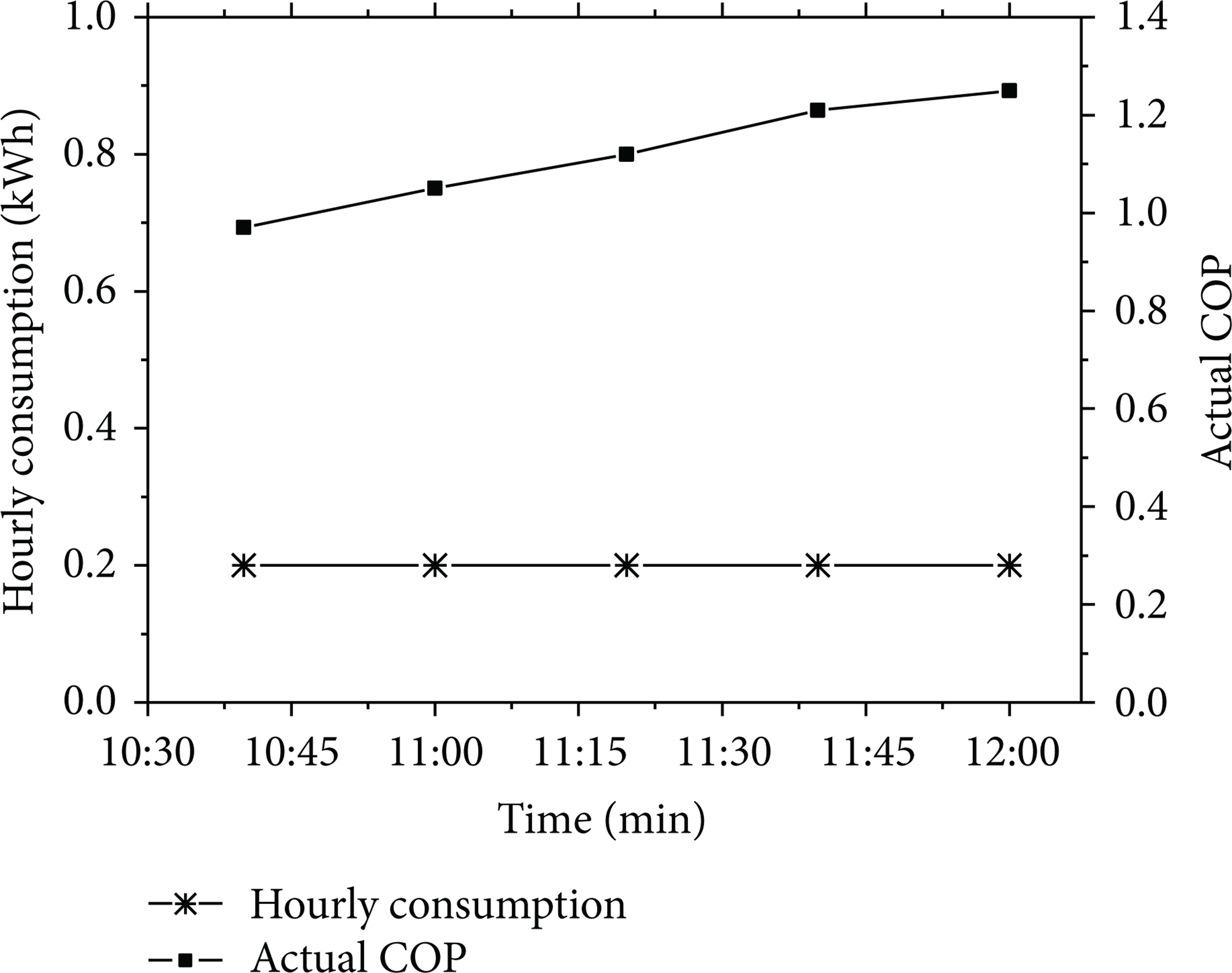
COP and the hourly consumption change for the air source heat pump unit.
5.3. Analysis of the Solar Low-Temperature Auxiliary System
Figure 8 shows the inlet and outlet temperatures of the condenser refrigerant and the indoor air temperature. The temperature of the refrigerant in the condenser reached 40°C. Compared with the air source heat pump, the evaporation temperature has increased, and the refrigerant circulation increased. As shown in Figure 9, the inlet and outlet temperatures of the low-temperature heat source are 30 and 17°C, respectively. The indoor air temperature reached 22°C, an increase of 9°C compared with the temperature of the air in the air source heat pump (15°C). At the same time, lack of refrigerant in the condenser also leads to lower condensing temperature.

Refrigerant temperatures at the inlet and outlet of the condenser and the indoor air temperature.
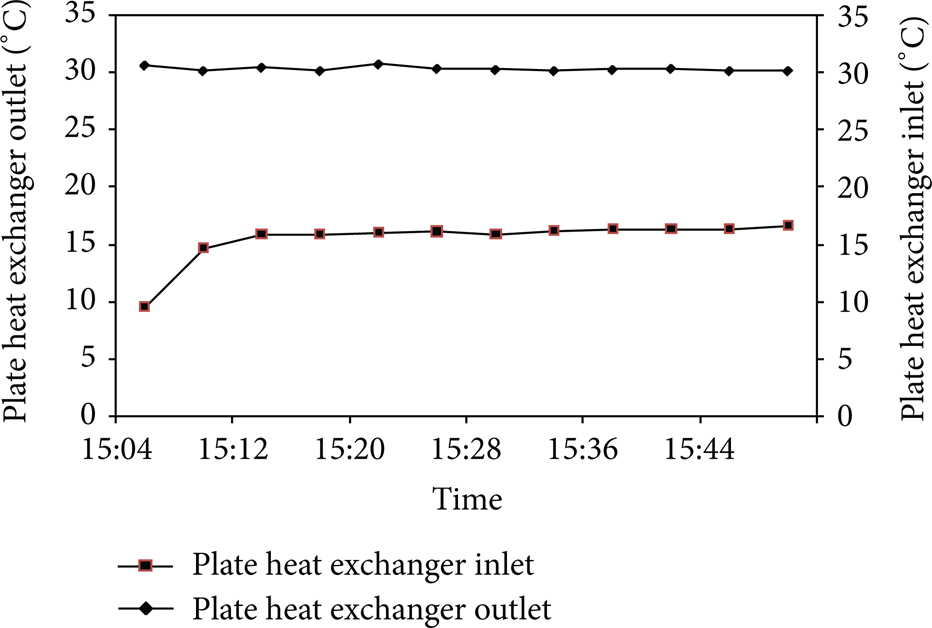
Water temperatures of the plate heat exchanger's inlet and outlet.
Figure 10 shows the refrigerant temperatures at the inlet and outlet of the evaporator. The temperature of the refrigerant decreased over time and stabilized, but the difference between the inlet and outlet temperatures remained constant at 4.2°C. This indicates that stable heat can be obtained from the low-temperature heat source, which is conducive to the stability of the system.

Refrigerant temperatures at the inlet and outlet of the evaporator.
Figure 11 shows the COP and power consumption. Because of the lower initial indoor temperature, the COP decreased with increasing indoor temperature, but the overall decline is small. The COP stabilizes at approximately 3.2, and the efficiency of the system is improved. The power consumption is constant at 0.7 kWh.

COP and power consumption.
5.4. Analysis of the Two Modes of Operation
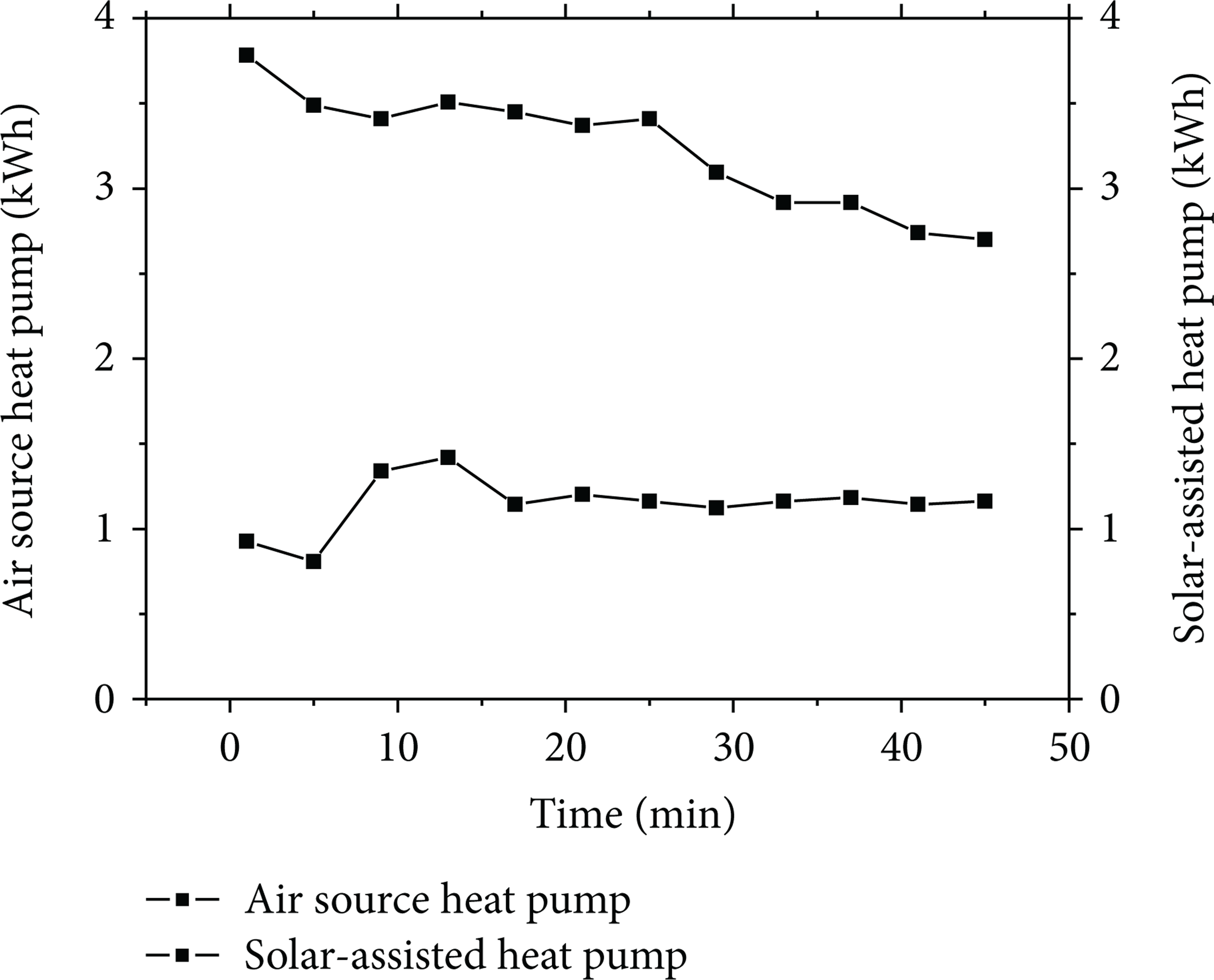
According to Figures 6 and 8, when the air source heat pump and the low-temperature solar water heating auxiliary system are effective, the condenser temperature difference is approximately 1°C. Because the hot water is warmer than the outdoor air, the low-temperature solar water heating system has three times the heat of the air source heat pump system. This leads to an improved evaporation temperature and refrigerant heat of evaporation and a more effective circulation system.
Figure 12 shows the difference in heat load between the air source heat pump and the low-temperature solar water heating auxiliary system. When the low-temperature solar hot water is used as the heat source for the heat pump unit, the amount of heat is greatly increased. The average heat load of the air source heat pump is 1.1 kW, while that of the low-temperature solar water heating system is 3.2 kW.
Comparison of the heat loads for the two modes of operation.
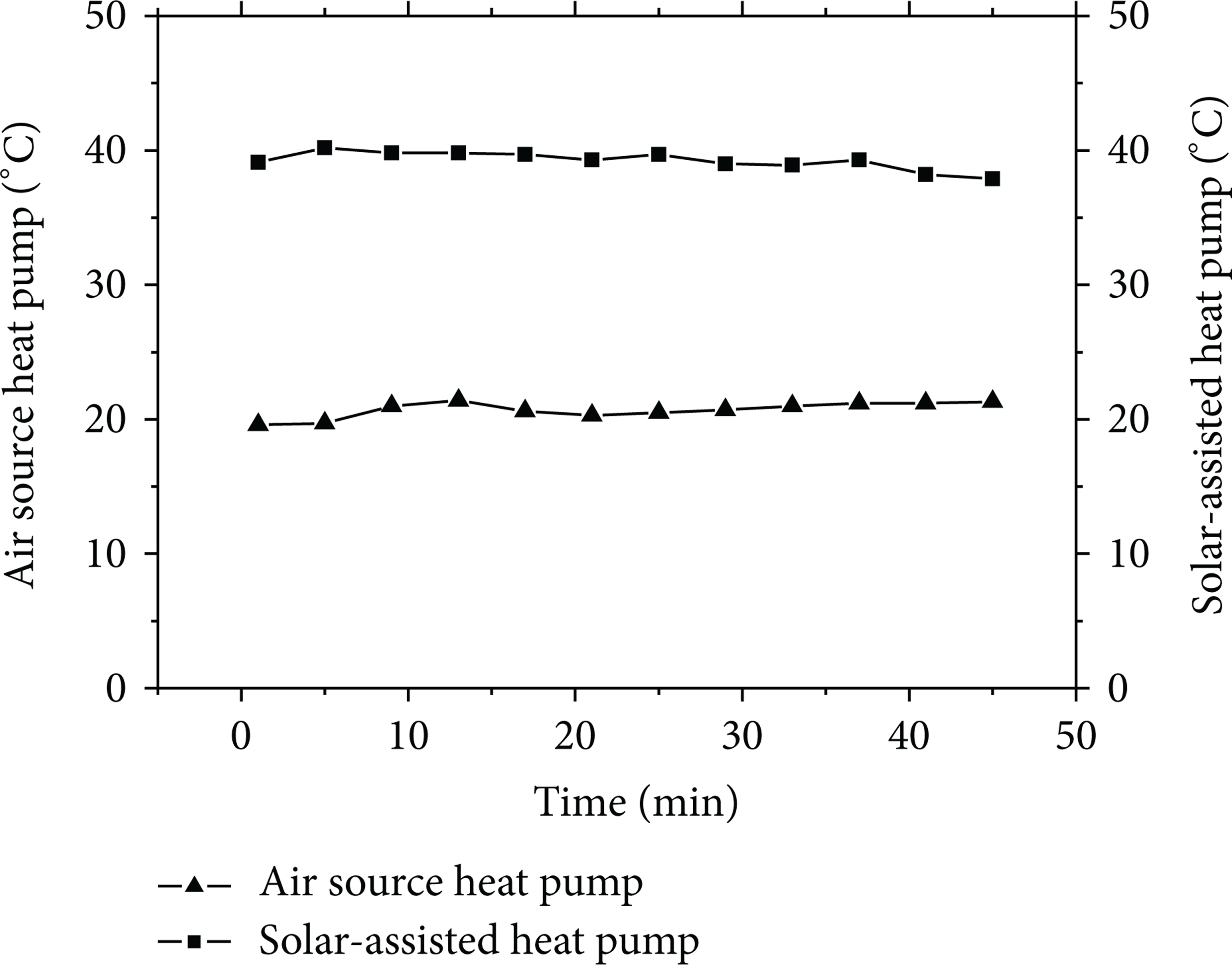
Figure 13 shows the air temperatures at the air conditioner outlet. When the air source heat pump is used, the outlet air temperature is 20°C. When the unit is assisted by the solar system, the outlet air temperature reaches 40°C, and the indoor temperature increases to 20°C. This illustrates the heating effect of the system.
Comparison of outlet air temperatures of the air conditioner for the two modes of operation.
Figure 14 compares the COP under the two sets of working conditions. When it is assisted by the solar system, the COP of the unit is 3.2, which is higher than when the air source heat pump is used. Using the solar system improves the efficiency of the system, increases the amount of warming, and saves energy.

Comparison of COPAS, COPSS, and COPSC.
6. Energy Savings and Economic Analysis
6.1. Analysis of Energy Savings
The analysis presented above indicates that when the air source heat pump is used for heating without the electric auxiliary unit, the air conditioning outlet temperature is only 20°C, which does not satisfy the heating requirements. However, the electric auxiliary air source heat pump system or the low-temperature solar hot water auxiliary system can both meet the demand. The seasonal heating power consumption per unit area for the two modes can be calculated using (9) with the parameter values given in Table 3. The energy consumptions of the air source heat pump and the solar-assisted water heating system are shown in Table 4:

Parameter values.

Energy consumption of the air source heat pump and the solar assisted heating system.

Note. (1) The heating season in Beijing is 120 days long, and the solar guaranteed rate is 0.7. The water source heat pump uses low-temperature solar water for 84 days. (2) This system is suitable for the heating of low-rise buildings, office buildings, villas, and shopping centers. There are 12 heating hours per day.
Because the low-temperature solar water auxiliary heating system does not need to use the air conditioner with the electric auxiliary equipment, the power consumption is decreased. The calculation shows that using the low-temperature solar water heating auxiliary system can save 46 kWh/m2.
6.2. Economic Analysis
(1) Economic Benefit of Heating per Square Meter (M). According to the analysis presented above, using low-temperature solar water heating as the auxiliary system saves 46 kWh/(m2·season) compared to using the auxiliary air source heat pump. Taking the cost of electricity in Beijing as 0.5 Yuan/kWh, the per square meter heating cost will be decreased by 23 Yuan/season (m2):

(2) Increase in Initial Investment (Γ). The low-temperature solar water heating auxiliary system requires a solar heating system, water pump, water tank, and a Fluorine-Water plate heat exchanger. The total cost of the system is 5700 Yuan. The heating load calculation showed that the system can be used to heat a building with an area of 54.6 square meters. Thus, the investment per unit of building area increases by 104.4 Yuan/m2.
(3) Recovery Period (T). According to the calculations shown above, the investment recovery period (T) for the Beijing area is 4.5 years. T can be calculated by

6.3. Environmental Analysis
The air source heat pump systems used in office buildings, villas, and new rural residential areas consume too much energy. In contrast, the low-temperature solar water auxiliary system releases no pollution to the environment and uses sustainable and clean solar energy. This type of low-carbon system protects the environment, saves energy, and can be used in many types of developments.
7. Conclusion
This paper describes a low-heat source heat pump system that is combined with a low-temperature solar thermal water source and air source to modify an ordinary commercial air conditioner. Based on the theoretical analysis and experiments, the conclusions of this study are as follows.
Compared with the air source heat pump system, the low-temperature water solar-assisted system improves indoor comfort by increasing the air conditioning outlet temperature from 20 to 40°C and the indoor temperature from 15 to 22°C. The heating capacity is increased by two times.
Using the solar low-temperature auxiliary system can increase the evaporation temperature and the effective circulating volume of the cryogen and will also increase the compression ratio. The COP of the heat pumps depends on the temperature of the high-low heat source and especially on the low-temperature heat source. Using low-temperature solar hot water instead of the outdoor air can increase the temperature of the low-temperature heat source and also improve the heating coefficient of the units.
Low-temperature solar water-assisted air source heat pump hot water systems are suitable for low-rise office buildings and rural heating. The system saves 46 kWh/m2 per heating season compared with using auxiliary air source heat pumps.
Conflict of Interests
The authors declare that there is no conflicts of interests regarding the publication of this paper.
Footnotes
Abbreviations
Acknowledgments
The authors are grateful for the support provided by the Beijing Key Lab of Heating, Gas Supply, Ventilating and Air Conditioning Engineering (no. NR2012K03), the Fundamental Research Funds for the Central Universities (no. 3142013095), and National Natural Science Foundation of China (nos. 50978002 and 51368060).