




Abstract
In ad hoc and sensor networks, reputation-based trust management schemes have been widely used to identify the malicious nodes. These schemes leverage each node's behaviors for malicious node detection and thus require a certain amount of time to observe the behaviors of nodes. In mobile sensor networks, however, malicious nodes frequently move to different locations, and thus it is likely difficult to collect enough evidence for them. Moreover, when reputation-based schemes are employed, it is not easy to revoke the malicious nodes due to the risk of false positives. To mitigate these limitations of reputation-based schemes, we propose mobile malicious node detection schemes based on software attestation technique, which virtually fulfills zero false positives. In particular, we propose a probabilistic detection scheme in which each node attests its neighboring node with a certain probability. In order to reduce the attestation overhead of the probabilistic detection scheme, we also propose the SPRT (Sequential Probability Ratio Test) based detection scheme that uses the SPRT to determine when to perform the attestations. Through analysis and simulation, we show that our proposed schemes detect mobile malicious nodes through software attestations in robust and efficient manner.
1. Introduction
In mobile sensor networks, the attacker may capture sensor nodes and subvert them to be malicious. With these mobile malicious nodes, he can distort the various operations of the mobile sensor networks. For instance, in order to disrupt data collection operation of the base station, the attacker can launch false data injection attacks by having mobile malicious nodes send false data into the base station. He can also make mobile malicious nodes ruin the local operations such as routing, localization, and clustering by contacting many benign nodes. To diminish this damage incurred by mobile malicious nodes, it is imperative to detect and revoke them as quickly as possible. To meet this need, many researchers have proposed a variety of malicious node detection schemes in the context of ad hoc and sensor networks [1–10].
Reputation-based trust management schemes have been proposed to deal with an individual nodes trust in accordance with its behaviors [2, 4, 8]. Although malicious nodes can be identified in these schemes, they are not easily revoked due to the risk of false positives. Moreover, mobile malicious nodes can control their movements in such a way to make it difficult for their malicious behaviors to be observed. Another approach to deal with the malicious node detection in sensor networks is software attestation [1, 3, 5–7, 9, 10]. In this approach, attester (the base station or a node) performs attestations against the software running on attestee (a node) to verify whether it matches the expected software image; subverted image codes can then be detected. From perspective that this approach achieves virtually zero false positives and does not require any node behavior knowledge, it is more suitable than reputation approach for mobile malicious node detection. However, the previous works on software attestation did not describe how frequently each node needs to be attested even though they proposed several attestation methodologies.
To efficiently and effectively perform software attestations against mobile nodes, we first devise a probabilistic attestation scheme in which each mobile node is probabilistically attested. We then improve the performance of the probabilistic scheme by developing a scheme based on the SPRT (Sequential Probability Ratio Test) [11]. We apply the SPRT to determine the frequency of attestations per mobile node in such a way that highly mobile nodes are more frequently attested than lowly mobile nodes, leading to fast detection of highly mobile malicious nodes. Our analytical results show that both schemes achieves high mobile malicious node detection capability at the reasonable attestation overhead. We also evaluate the proposed schemes by using ns-2 simulator. Our simulation results demonstrate that the SPRT-based scheme outperforms the probabilistic scheme in terms of the attestation overhead while incurring reasonable malicious node detection time. Moreover, our proposed schemes catch out the malicious nodes with at least 99.74% detection rate. This indicates that almost all malicious nodes are detected by our proposed schemes (a preliminary version of this paper was presented in [12]).
The rest of paper is organized as follows. Section 2 presents the relevant work of malicious node detection. Section 3 describes the network assumptions and attacker models for our proposed schemes. Section 4 proposes mobile malicious node detection schemes and analyzes the proposed schemes. Section 5 presents the evaluation results of our proposed schemes. Finally, Section 6 concludes the paper.
2. Related Work
In this section, we present the related work for malicious node detection in wireless sensor networks.
Reputation-based trust management schemes have been proposed to evaluate each node's trust based on its activities [2, 4, 8]. In particular, Ganeriwal and Srivastava [2] used a Bayesian formulation for trust management. Sun et al. [8] applied information theoretic frameworks for trust evaluation. Li and Wu [4] utilized node mobility to reduce an uncertainty in trust computation and facilitate trust convergence. However, the mobile malicious nodes are not easily revoked because of the risk of false positives when these trust management schemes are used. Furthermore, mobile malicious nodes can evade these schemes by adopting high mobility strategy for their malicious actions not to be observed.
Software-attestation based schemes have been proposed to discern the subverted software images of sensor nodes [1, 3, 5–7, 9, 10]. In particular, the base station checks whether the flash image codes have been maliciously corrupted by performing attestations against randomly chosen parts of image codes or the entire codes [5–7]. Yang et al. [9] propose a localized attestation process in which each node collaborates with its neighbors for node attestations. Tamer et al. [1] propose a group-based software attestation scheme in wireless sensor networks. In this scheme, the attestation process is localized and performed without the aid of the base station. Jin et al. [3] use dynamic node attestation chains to reduce checksum computation time required for node attestation in mobile sensor networks. Zhang and Liu [10] propose a dynamic software attestation scheme in sensor networks. The proposed scheme employs software attestation technique to detect the corrupted program data in run time.
3. Models
In this section, we first state the network assumptions and then present an adversary models.
We assume a mobile sensor network where sensor nodes freely roam throughout the network. Since every sensor node is mobile, for simplicity, sensor node or node will be used to indicate mobile sensor node in the rest of the paper. We also assume that the sensor nodes could directly or indirectly communicate with the base station. The base station is assumed to be a trusted entity. This is a reasonable assumption in the sense that the entire network operations are controlled by the base station, and thus the network operator will fail to correctly run the networks if the base station is compromised.
Attacker is able to capture a certain amount of sensor nodes and make them malicious. He then exerts the malicious nodes to mount a variety of attacks while keeping moving them to different locations. For example, they can launch denial of service attacks such as jamming and flooding to damage various services provided in mobile sensor networks. They can also inject fake data into the network, and thus the network operator will gather the false information from the network. Moreover, the attacker could make malicious nodes contact many benign nodes and undermine the normal operations such as routing, clustering, and localization executed by these benign nodes.
4. Robust Detection of Mobile Malicious Nodes through the Software Attestation
This section presents the details of our schemes to detect and revoke the malicious nodes using software attestation. We start with a probabilistic approach and then show how to reduce the attestation overhead with the SPRT.
4.1. Scheme I: The Probabilistic Approach
A straightforward attestation approach is that a node attests its neighboring nodes whenever it meets them. Although this approach quickly detects malicious nodes, it will incur a large amount of attestation overheads, leading to the delay in processing the network operations. To reduce this attestation overhead, we propose a probabilistic attestation scheme (Scheme I) in which node attestation is probabilistically performed. We first describe the details of Scheme I and present an analysis of it.
4.1.1. Protocol Description
(a) Phase I: Predeployment. Before deployment, the network operator generates a secret key shared between a sensor node and the base station and installs it into each node.
(b) Phase II: Attestation. After deployment, each time every attester u meets every attestee v within its communication vicinity while moving in the network, and it performs software attestation against v with probability
(c) Phase III: Postdetection. Once u determines v as malicious node, it generates a malicious node alert message on v, MNA
4.1.2. Analysis
In this section, we will first discuss the possible attack strategies on Scheme I and the corresponding countermeasures. We will then explore the malicious node detection capability of Scheme I. Finally, we will compute the attestation overhead.
We consider false alert injection attack in which malicious nodes inject false malicious node alert (MNA) messages into the base station. In particular, a malicious node
Next, we consider more severe attack, denial of attestation attack in which malicious nodes deny participating in attestation process and thus evade being detected. More specifically, an attestee v rejects the attestation attempts performed by an attester
Next, we compute an average number of attestations that are performed by
Finally, we investigate the probability that malicious nodes are detected.
Lemma 1.
Let one denote
Proof.
Let us define

We now investigate how the lower bound of

Affects of the number of malicious nodes (
4.2. Scheme II: The SPRT-Based Approach
Although the attestation overhead of Scheme I is reasonable, it could be reduced by using the attestation probability configured in line with nodes’ mobility rates, rather than using the same attestation probability. To do this, we propose the SPRT-based attestation approach (Scheme II) which adapts the SPRT to determine the attestation probability in accordance with nodes’ mobility rates. Note that SPRT [11] is a statistical decision process that reaches a decision with a few number of samples while maintaining low error rates. We start with the detailed description of Scheme II and then provide an analysis of it.
4.2.1. Protocol Description
The predeployment phase is the same as the one in Scheme I, and the attestation phase is described as follows.
Let us first consider the scenario that every node
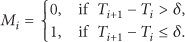
The success probability
If
Under this formulation, we present how node u performs the SPRT to make a decision on node v from the observed n samples,
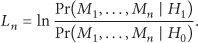
Assume that

Let

where
The rationale behind the configuration of
The SPRT for
where

When the SPRT terminates in the acceptance of
4.2.2. Analysis
In order to defend against the false alert injection and denial of attestation attacks, the same countermeasures are used as in Scheme I.
In this section, we first compute an average number of the attestations that an attester u performs against an attestee v. We then calculate the probability that u detects v when v is malicious.
Assume that u makes
5. Simulation Study
We use the ns-2 network simulator to evaluate the proposed schemes in a mobile sensor network. In our simulation, 100 mobile sensor nodes are placed within a square area of 500 m × 500 m. Moreover, we use the Random Waypoint Mobility (RWM) model to set up node movement patterns. In particular, we use the RWM model with the steady-state distribution provided by the Random Trip Mobility (RTM) model [13] for accurate performance evaluation. In the RWM model, each node moves to a randomly selected location with a randomly chosen speed between predefined minimum and maximum speeds. After coming to that location, it pauses there for a predefined time. After the pause time, each node then randomly chooses another location and moves to the selected location. This random movement process is repeated throughout the simulation period. We create a steady-state version of RWM model with the program codes of [14].
All simulations were performed for 1000 simulation seconds. We fixed a pause time of 10 simulation seconds and a minimum moving speed of 1 m/s of each node. Each node uses IEEE 802.11 as the medium access control protocol in which the transmission range is 50 m. We set
To study how node mobility affects the proposed schemes, we vary each node's maximum speed (
5.1. Simulation Results
We use the following metrics to evaluate the performance of our scheme.
Malicious Node Detection Time is an average time required to detect all malicious nodes in the network. Note that this time is represented in simulation seconds.
Number of Attestations is the number of attestations that are performed in the network.
False Negative is the error probability that a malicious node is not detected.
For each execution, we obtain each metric as the average of the results of the SPRTs that are repeated. The average of the results of 100 executions is presented as follows.
First, we found no false negatives except the case that
Second, as shown in Figures 2 and 3, Scheme I requires less malicious node detection time than Scheme II irrespective of the values of

Malicious node detection time versus

Malicious node detection time versus
Finally, as shown in Figures 4 and 5, the number of attestations tends to increase as
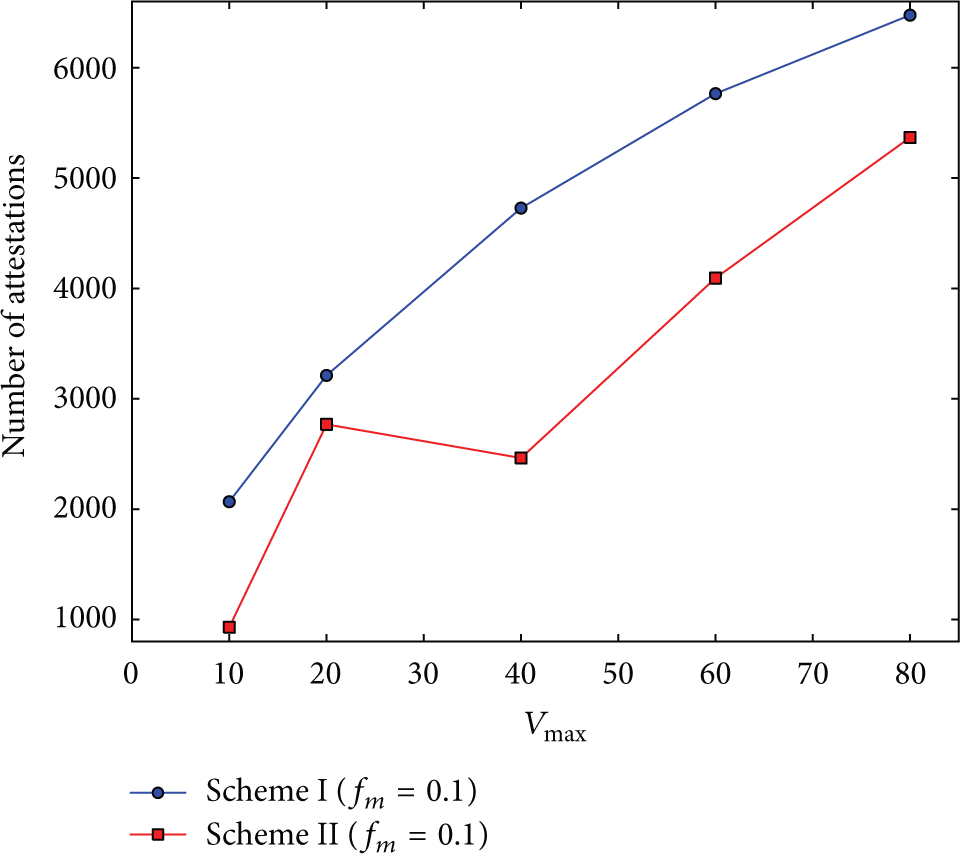
Number of attestations versus
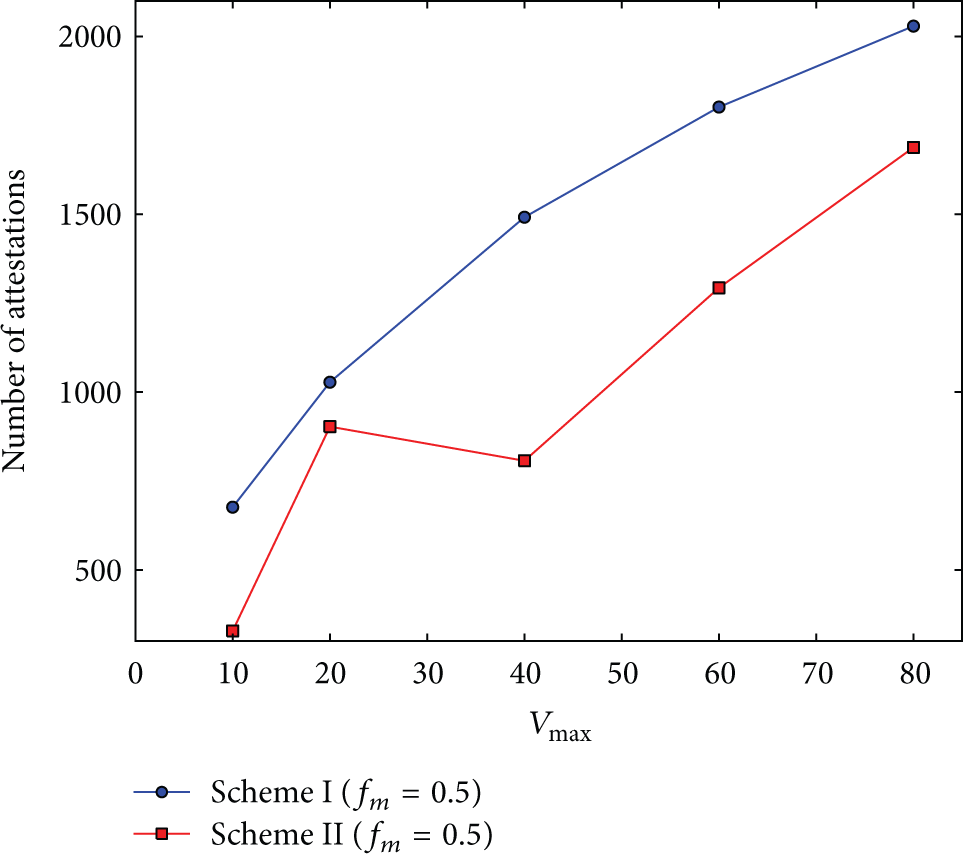
Number of attestations versus
6. Conclusions
In this paper, we propose malicious node detection schemes in mobile sensor networks. In particular, we first develop a probabilistic approach in which nodes are probabilistically attested. Moreover, we devise the SPRT-based approach to enhance the performance of probabilistic approach. Our analytical results show that the proposed schemes fulfill the robust detection capability at the reasonable software attestation overhead. Furthermore, our simulation results demonstrate that the SPRT-based approach detects malicious nodes within reasonable time while reducing the attestation overhead of the probabilistic approach.
Footnotes
Acknowledgment
This work was supported by a research grant from Seoul Women's University (2011).