



Abstract
RFID is a new trend in industrial technology such as manufacturing system and product flow management in the supply chain. A successful RFID application can enhance the industrial technology change in organizations and help to manage growth in an increasingly competitive environment. Recently, the RFID sensor tag has also recently received a great deal of attention. In general, the RFID sensor was designed to collect environmental information such as temperature, pressure, humidity, inclination, and acceleration into ordinary RFID tags for internal information processing. In this environment, to apply the RIFID technique to manufacturing systems successfully and efficiently, identifying accurate quality attributes and making a quality model for a RFID enabled application system are necessary. However the research in this area is lacking. This paper focuses on identification of the quality attributes for the RFID application system and making the corresponding model. Each criterion for the quality model was extracted in accordance with ISO/IEC 9126 and the DeLone and McLean model. The proposed quality model also considers the relationship between their criteria.
1. Introduction
Radio frequency identification (RFID) is one of several kinds of automatic identification sensor-based technologies consisting of three key elements: RFID tags, RFID readers, and a back-end database server that has the ability to identify or scan information with increased speed and accuracy. In a basic RFID system, the information transmitted in the air between the tag and the reader could easily be subject to interception and eavesdropping due to the nature of its radio transmission [1]. The application of a radio frequency identification (RFID) sensor tag or smart active label, which is a typical sensor-enabled semipassive RFID tag, has recently received a great deal of attention. RFID sensor tags are, in general, the integration of various sensors designed to collect environmental information, including temperature, pressure, humidity, inclination, and acceleration, into ordinary RFID tags, which are originally used only to identify products, with a film battery supplying power for internal information processing [2]. In this environment, radio frequency identification (RFID) has become a critical issue in the fields of manufacturing and logistics. This rapid development of RFID has led lots of companies to take a hard look at what RFID can do for commercial purposes. Moreover, RFID is regarded as a promising technology for the management of supply chain processes since it improves the efficiency of forecasting customer demands, production planning, managing inventory, and retail operations. Recently, RFID has become important in mobile and wireless communication technologies [3, 4] and has influenced various other industries also. But its range of application is going to be extended far beyond these areas. There is tremendous potential for applying it even more widely, and increasing numbers of companies have already started up pilot schemes or successfully applied it to real-world environments. Consequently, RFID is to be among the most exciting and fastest-growing technologies in terms of the scope of application in the next generation of business intelligence. However, RFID vendors are complaining that the business is not growing as fast as expected [5] and that the main system for the management and control of the processes of the RFID device signals sometimes cannot be trusted. Therefore, the method for identifying the QoS (Quality of Service) for RFID enabled applications is crucial for RFID manufacturers.
Quality can be defined as the possession by a product of the conditions that make it suitable to meet the expressed or potential needs of its users [6]. To determine the system quality, quality metric models have been studied by many researchers. This research selects six attributes with 27 subcriteria in ISO/IEC 9126-1, which is the revision of the 1991 version (ISO/IEC 9126, 1991). ISO/IEC 9126-1 defines the terms for the system quality characteristics and how these characteristics are decomposed into subcharacteristics. ISO/IEC 9126-1, however, does not describe how any of these subcharacteristics could be measured. To address this issue, three more parts are extended: ISO/IEC 9126-2, ISO/IEC 9126-3, and ISO/IEC 9126-4. ISO/IEC 9126-2 defines external metrics which measure the behaviors of the computer based system. ISO/IEC 9126-3 defines internal metrics which measure the software itself. ISO/IEC 9126-4 defines quality in terms of metrics which measure the effects of using the software in a specific context of use. However, a drawback of the existing international standards is that they provide very general quality models and guidelines but are very difficult to apply to specific domain [7].
DeLone and McLean [8] become aware of the complex reality that surrounds the identification and definition of the IS (Information System) success concept. They conducted a large number of studies on IS success and presented a comprehensive and integrative model [9, 10].
This research aims to identify the quality attributes and make a QoS model for RFID sensor technology enabled application system. For this process, each criterion of the quality attributes was extracted by ISO/IEC 9126 and we added characteristics to take into consideration RFID sensor technology in manufacturing systems. To make a quality model, the research used DeLone and McLean's model to consider their relation between criteria. The model will support the guidelines when the system engineer or developer wants to develop a RFID enabled application system.
The rest of this paper is organized as follows. Section 2 reviews the related works for RFID enabled application systems with manufacturing systems. Section 3 explains criteria which take into account their characteristics, the factors, criteria, and their correlation for QoS model in manufacturing systems with RFID technology. Section 4 describes the proposed QoS model by experiment. Finally, Section 5 presents the conclusions.
2. A RFID Enabled Application System
2.1. Manufacturing Systems and Their Processes
There is always a need for human expertise to combine components and system elements in order to build a purposeful manufacturing system that can produce a targeted class of products. In the content, a manufacturing system has to combine separate components or elements together to form a whole system and these synthesis activities are always related to human activities for creating artifacts [11]. Traditional mass manufacturing, also known as repetitive flow production, series production, or flow production, is the production of a large number of standardized products usually on automated production lines. The manufacturing procedure strictly follows a set of predefined standards that are generated from a test run of a small sample. These standards include those related to parts, human labor, processes, machinery operations, and the general working environment. Once the standards are defined and generated, mass produced goods are manufactured by strictly following these standards. The standards themselves are kept unchanged unless a large deviation in production occurs or a routinely scheduled test is arranged. Components that are part of the final product follow standards obtained during the testing phase and are treated uniformly at the mass production stage [12].
2.2. RFID and Sensor Technology
RFID is an automatic identification technology that can be used to provide a unique ID to a physical object. A typical RFID system consists of RFID reader(s), tags, RFID middleware, a RFID database, and RFID services as shown in Figure 1. Communication in RFID occurs through radio waves, where information from a tag to a reader or vice versa is sent via an antenna [13].

Typical RFID system.
The benefits of integrating two complementary technologies—RFID and sensor—are substantial, as pointed out by many researchers. First of all, from the information acquisition perspective, the richer information available from the addition of “environment traceability” to “object traceability” facilitates better decision support and responsive localized management. If the RFID technology is embedded in a wireless sensor network (WSN), RFID tags and readers can build more intelligent networks by sharing the sensing, logic, and transmission capabilities of the sensor networks. For example, longer-distance transmission can be achieved with lower power consumption and less interference by utilizing multihop transmission and clustered reading capabilities provided by sensor network technologies [2]. One WSN may be composed of hundreds or thousands of miniature sensor nodes, or motes, which are fitted with an onboard processor. The low-cost battery-powered sensor nodes have an extremely limited energy supply, stringent processing and communications capabilities, and scarce memory. Sensor nodes are usually densely deployed in a sensor field in order to continuously monitor surrounding areas. In a sensor application, each sensor has the capability to collect data such as temperature, humidity, light condition, and so on, depending on targeted applications. After sensor nodes collect data, they can locally carry out some simple computations and collaboratively route data to a base station for analysis. A base station may be a fixed node or a mobile node capable of connecting WSNs to a communications infrastructure (e.g., the Internet) where users can have access to reported data. In order to reduce the amount of raw data transmitted to a base station and to save energy, sensor nodes often need to perform aggregation operations so that only processed information, for instance, the mean, max, or min of sensed raw data, is transmitted [14].
2.3. A RFID Enabled Application System
Basically RFID systems consist of tags and readers. Tags, also named transponders, are attached to the item being tracked and have data (e.g., an identification number or temperature) stored in their memory. Readers, also named interrogators, are the devices that read data from, and depending on the RFID system write data to tags and are connected to a network, like a local area network (LAN) to transport their data to, for example, a central database installed on a server [15]. Poon et al. [16] depicted the configuration of material test using RFID as shown in Figure 2.

Configuration of material test.
In this environment, the reading performance of a RFID device is measured when the tags are placed on the front and back surfaces of various types of products in the actual environment.
In comparison to other well-known auto-ID technologies such as the barcode, RFID offers the following advantageous characteristics for the user [17].
Unique identification: applying, for example, the “Electronic Product Code” (EPC) standards, RFID tags can identify classes of products as well as individual items. No line of sight: RFID tags can be read without direct line of sight even if the tag is covered, dirty, or otherwise obscured from view. Bulk reading: If they are in range of a reader, multiple RFID tags can be read at the same time. Storage capacity: RFID tags can store significantly more information than just an identification number. Dynamic information: RFID tags with read-write capability allow information to be updated or changed whenever necessary.
3. A QoS Model for a RFID Enabled System
3.1. The System Quality with ISO/IEC Standards
RFID applications have evolved towards the need to provide information about the status of the item that its being uniquely identified. ISO/IEC 18000 defines a series of RFID air interface standards for item identification, operating at various frequencies and thus with different functionalities. The standard currently consists of seven parts. Part 1 is a reference architecture and definition of parameters to be standardized, while the other six parts describe air interfaces for various frequency ranges. The inclusion of sensors within the standard is mostly considered for parts 6 and 7, although most of the other parts make some provisions for the inclusion of sensor hardware. The objective of ISO/IEC 24753.2 is to provide common encoding rules for identifying sensors, their functions, and their delivered measurements (both simple and full-function sensors). It also defines the process rules for related functionality such as showing how to start and stop a particular sensor's monitoring function, how to access the sensor data, and how to carry out basic processing to convert the sensor data into meaningful information for an application. It specifies the physical interactions between interrogators and tags, the interrogator and tag operating procedures and commands, and the collision arbitration scheme used to identify a specific tag in a multiple-tag environment. ISO/IEC 18000-6 specifies four communication types as a simple sensor and full-function sensor [18].
Simple sensor: a simple sensor is factory-programmed. Its objective is to provide a simple sensor data block (SSD) appended to the object-related unique identifier, using the delivery mechanism defined by the air protocol interface. The SSD includes information about the type of sensor (temperature, relative humidity, impact, tilt, and time-temperature integration are supported), configuration, and alarm status (on/off). A more complex sensor output than an on/off alarm status is possible, such as 8-bit sensor values. Full-function sensor: Full-function sensors provide greater flexibility than simple sensors, supporting a greater variety of sensor types and measurement spans, enabling thresholds to be set within a wider range and enabling capturing and processing of different types of data. Unlike simple sensors, full-function sensors require a dedicated dialogue with the interrogator and may be programmed multiple times by the user.
The IEEE 1451 family of standards aims to provide a standard way of accessing any type of transducer regardless of the type, manufacturer, and underlying information network. An IEEE 1451 smart transducer has the capabilities for self-identification, self-description, self-diagnosis, self-calibration, location awareness, time awareness, data processing, reasoning, data fusion, alert notification, standard based data formats, and communication protocols [18]. However, despite the many standards for RFID technique, there are a few standards for RFID system quality.
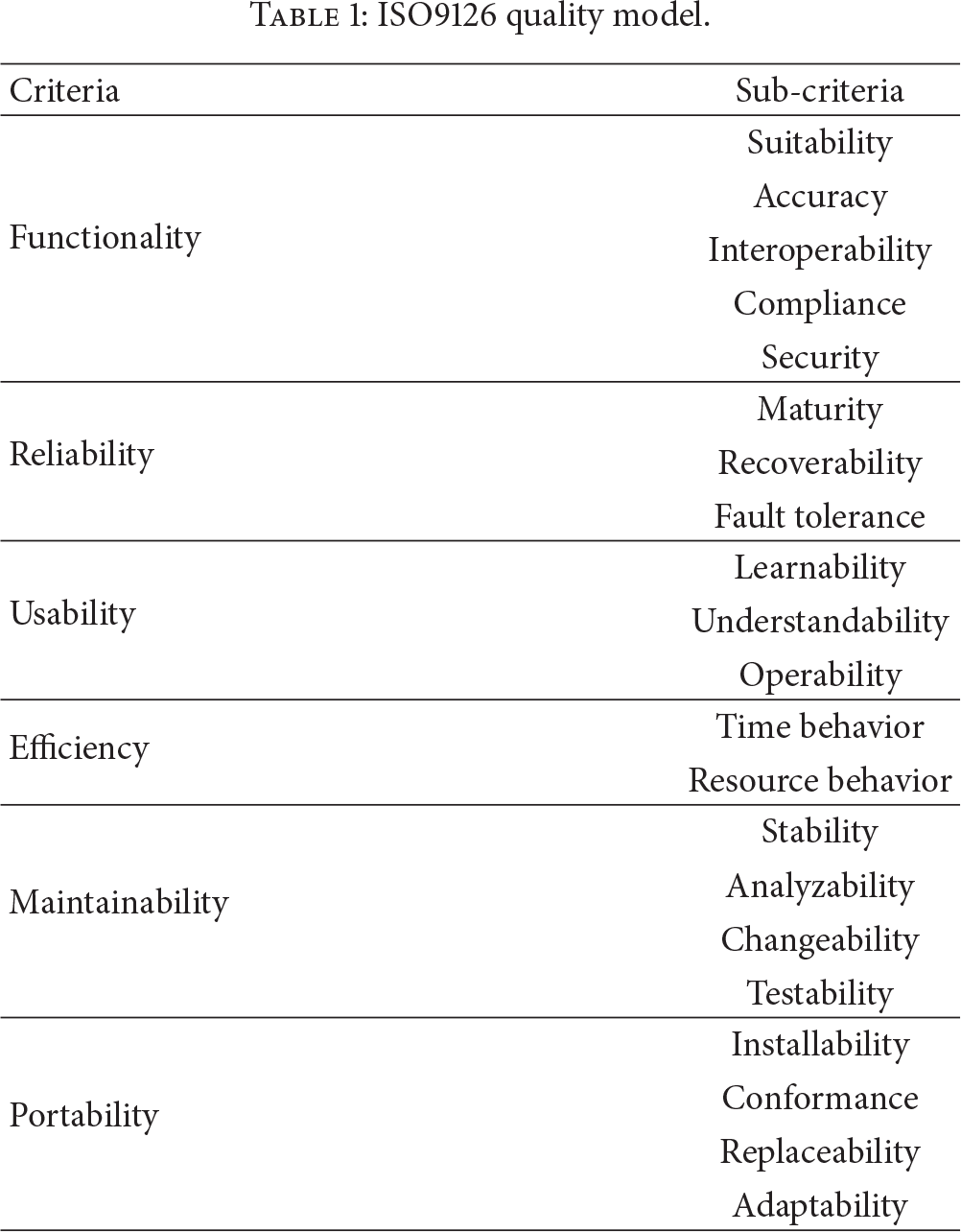
In an effort to identify attributes of system product quality that can be useful to developers, acquirers, and evaluators, a set of international standards have been developed. They are ISO/IEC 9126: Part 1 (quality model, 2001), Part 2 (external metrics, 2003), Part 3 (internal metrics, 2003), and Part 4 (quality in use metrics, 2004). ISO/IEC 9126-1 defines a quality model that includes six characteristics (functionality, reliability, usability, efficiency, maintainability, and portability), which are further subdivided into 27 subcharacteristics [19]. Table 1 shows ISO9126 quality model.
ISO9126 quality model.
This research extracts the RFID system quality from ISO9126 and Lee et al.'s model [20], as shown in Table 2.
Proposed RFID system quality attributes.
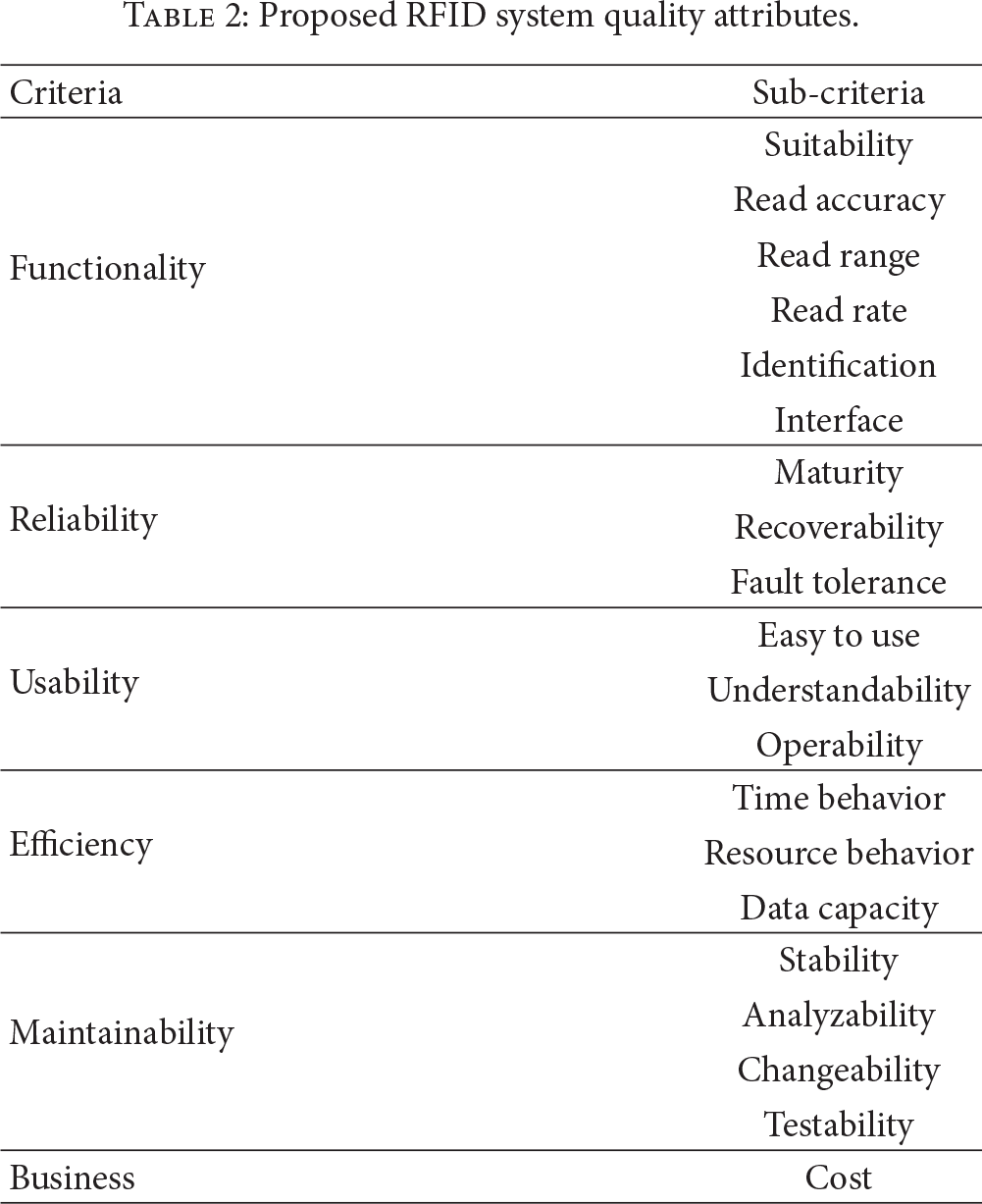
Particularly, the subcriteria were from Lee et al.'s model [20], such as read range, read accuracy, identification, and interference of functionality, data capacity of efficiency, and cost of business. Data capacity has 100s–1000s of characters. In read range, passive RFID case has Up to 25 feet and active RFID case has up to 100s of feet or more. The read rate has 10s, 100s or 1000s simultaneously. Read accuracy depends 90% on the relative orientations of the reader and tag antennas and their polarizations. In identification, it can uniquely identify each item/asset tagged in Interference, like the TSA (Transportation Security Administration) and some RFID frequency does not like metal and liquid. They can cause interference with certain RF frequencies. Cost normally has tag 5¢ RFID startup kit with RFID reader, antennas, alien gateway software, startup kit tag, and power supply/power cable for USD 2595.
4. QoS Model for a RFID System
We consolidated and synthesized the constructs using DeLone and McLean's model [21] as shown in Figure 3. Their model does not focus on the RFID system but proposes the relationships between each criterion for the general system. Their model consists of six distinct aspects of systems success: “system quality,” “information quality,” “use,” “user satisfaction,” “individual impact,” and “organizational impact.”
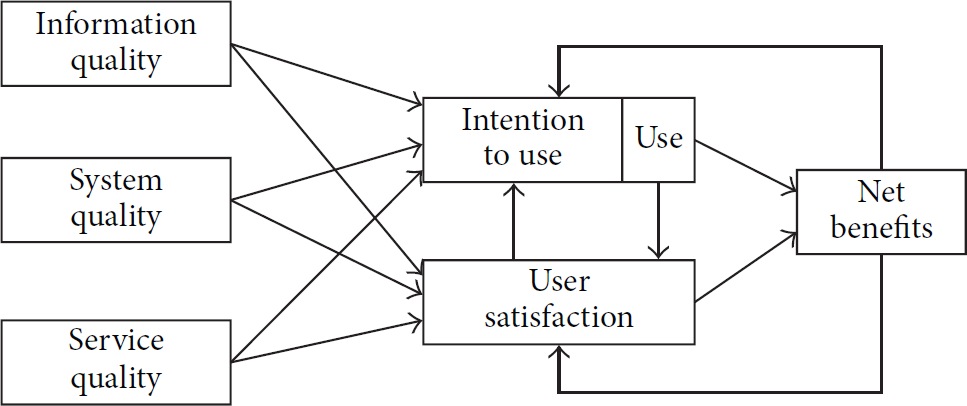
DeLone and McLean model [21].
Through this model and the criteria in Table 2, the quality model for a RFID system is depicted as shown in Figure 4. This model consists of 6 criteria: functionality, reliability, usability, efficiency, maintainability, and business. Each criterion affects the relationship between user satisfaction and developer satisfaction.

Quality model for a RFID system.
Because some studies provide Kendall's correlation coefficients instead of Pearson's correlation coefficients, Kendall's correlation coefficients are transformed into Pearson's correlation coefficients by using the formula suggested by Kruskal [22, 23]:


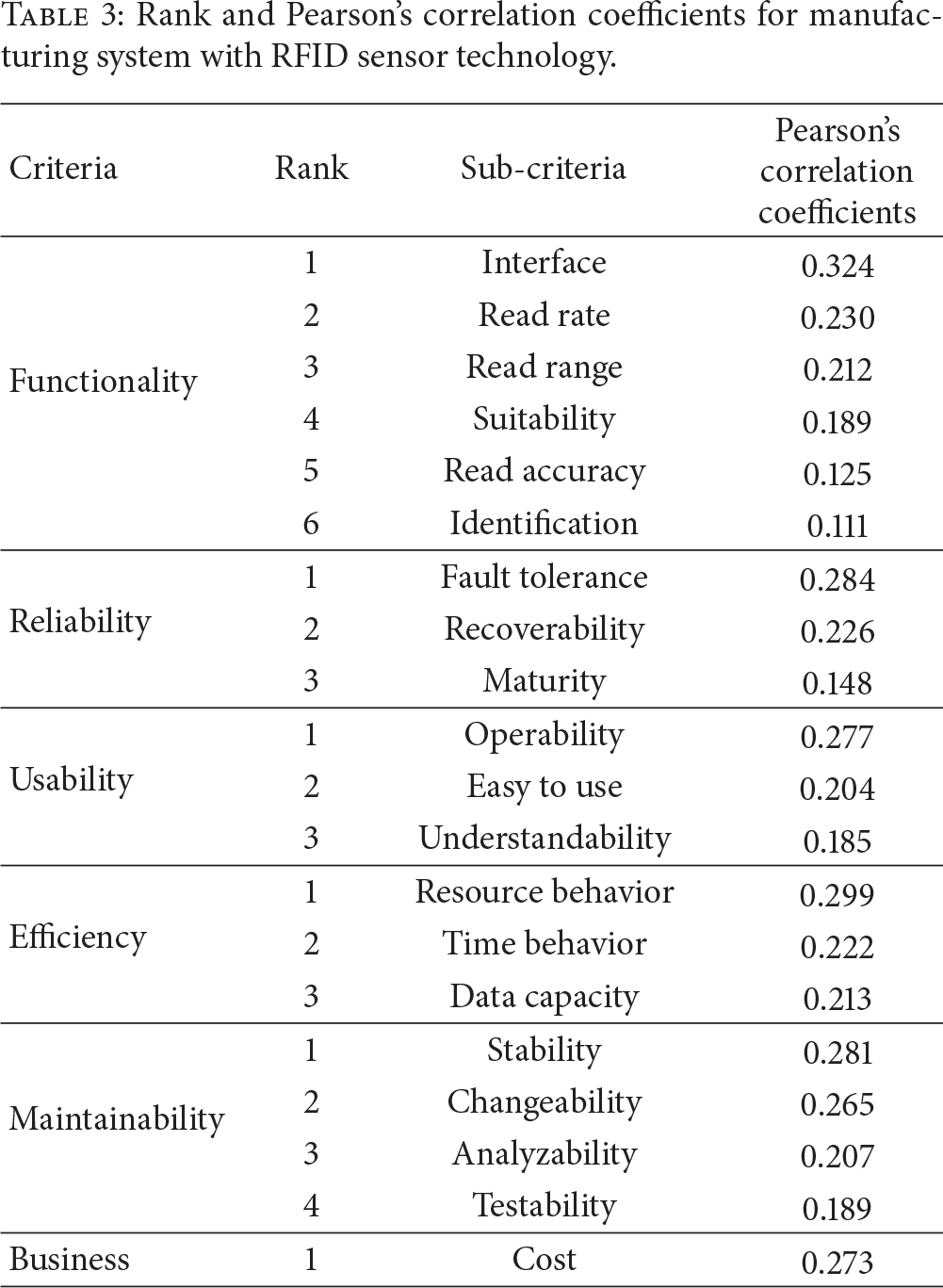
As for successful participants, user perceived benefits rank highly for two measures of success: Functionality (rank 1) and Efficiency (rank 1) as shown in Table 3. Actually, functionality has special characteristics such as interface for RFID sensor and suitability for RFID to manufacturing system.
Rank and Pearson's correlation coefficients for manufacturing system with RFID sensor technology.
5. Conclusions
RFID technology is a new trend for the industrial environment with IT (information technology). It has many benefits to us whether we are a user, a system developer, or an engineer. Therefore there are many standards for using the RFID sensor technique such as ISO/IEC 18000, ISO/IEC 24753.2, and IEEE 1451. However, they only consider system performance when the user or system engineer uses the RFID sensor technique for their system. In the contents, the research for RFID system quality model has been very lacking. This research focuses on making a quality model for a RFID enabled application system. Each criterion of the quality was borrowed from ISO9126 and Lee et al.'s model [20]. The quality model consists of 6 criteria; Functionality, reliability, usability, efficiency, maintainability, and business. All the criteria affect user satisfaction and developer satisfaction. And, finally, when the manufacturing system satisfies user and developer, RFID system benefit can be obtained.
Footnotes
Acknowledgment
This research is supported by the Ministry of Science, ICT and Future Planning (MSIP), Republic of Korea, under the Information Technology Research Center (ITRC) support program (NIPA-2013-H0301-13-4007) supervised by the National IT Industry Promotion Agency (NIPA).