




Abstract
Recent communications in wireless sensor networks (WSNs) have much new energy-efficient protocols specifically designed, where energy awareness is an essential consideration. In WSNs, large numbers of tiny sensor nodes are used as an effective way of data gathering in various environments. Since the sensor nodes operate on battery of limited power, it is a great challenging aim to design an energy-efficient routing protocol, which can minimize the delay while offering high-energy efficiency and long span of network lifetime. Low energy adaptive clustering hierarchy (LEACH) is one of the clustering key routing techniques used to reduce energy consumption. In this paper, we propose an energy-efficient node scheduling reclustering algorithm in clusters and rotating cluster-head positions to evenly distribute the energy load among all of the nodes by the node scheduling concept of node active and sleep system in both homogeneous and heterogeneous methods to get energy-saving result. Our proposed model is enhanced from LEACH protocol by adapting node scheduling scheme (active and sleep) in homogeneous and heterogeneous node topologies of WSNs, which yield better performance in energy saving and increased network lifetime. This node scheduling scheme is properly implemented, and simulation results show that our proposed model is giving improved energy efficiency and prolongs the lifetime of WSNs.
1. Introduction
In our new trend in communication, wireless sensor network (WSN) consists of number of sensor nodes small in size, which is used in distributed sensing, aggregation [1] and data propagation network to collect the sensing information on the physical environment of the sensor nodes. Wireless sensor network is used to collect reliable and accurate data information in the distance and risky environments and can be used in national defense and military services, industrial safety control, environmental monitor applications, traffic control management, medical/hospital care, smart intelligent Home, and so forth [2]. The sensor node resource is limited on battery to supply electricity, so this is very important for the routing protocols which is the environment to efficiently utilize its power in both military and civilian applications such as target searching and tracking, surveillance, and security system management. The sensor node contains four basic building blocks of components; those are the sensing unit, the processing unit, the radio unit, and the power unit. Depending upon the situation and their capabilities for monitoring and control, the sensor nodes are expected to be deployed in different area size. The main application of wireless sensor network is periodically observing and gathering data from remote places where each sensor node continually senses the environment study and sends back the collected data to the base station (BS) for further analysis of the required applications, which is considerably located in a long distance from the target area. The most required and to-be-maintained information is lifetime or lifespan of wireless sensor network which is a limited battery-operated energy resource of the deployed sensor nodes. The wireless sensor nodes carry limited power, and it cannot be an irreplaceable power source. The designed routing protocols for wireless sensor networks must have issue of energy efficiency, and that should be saved accordingly. The network routing protocol must take care of the issues and challenges [3] like self-configuration, reliability, quality of service, throughput, fault tolerance, delay, scalability, and so forth. The main important criterion in the design of wireless sensor network is data delivery time which is one of the critical issues in many types of applications like those in the battlefield, medical care, and security monitoring system. These systems are essentially required to receive the data from individual sensor nodes within some time limit and slot. Designed communication routing protocols affect the efficiency and the overall performance of wireless sensor networks by an equal distribution of available energy load and by decreasing their energy consumption and therefore extending their lifetime or lifespan. Thus, designing energy-efficient routing protocols is critical for extending the lifetime of wireless sensor networks. So, we described a novel innovative energy efficient and lifetime-increased proposed routing protocol, which is enhanced from the normal LEACH protocol. In the remainder of this paper, we introduce a novel variable reclustering-based data-gathering approach which is having the node scheduling of active and sleep nodes in each cluster at a period of time in the wireless sensor networks to increase the lifetime with total energy consumed. This paper is organized as follows. A brief introduction with related works to the LEACH protocol is presented in Section 2. Section 3 describes the design of our novel proposed protocol, namely, node scheduling LEACH protocol in detail. Simulation, and results are discussed in Section 4. Finally, conclusions are made in Section 5.
2. Related Works
2.1. Static Clustering Protocol
In our related work of research and its routing protocol implementation system, a wireless sensor network topology is shown in Figure 1. Here, the available sensor nodes are divided into several numbers of clusters; in each cluster after the cluster formation, the cluster head can be selected, the cluster-head nodes [4] communicate the aggregated data to the local base station, then next the local base station propagates data to the entire wireless sensor network of base stations, and finally; terminal user can access useful information as per the required applications. The distance between the local base stations, and the cluster-head nodes was very near, therefore effectively reducing the energy consumption of these nodes and send their information to the local base stations. So the static clustering protocol system seems to be a more efficient communication protocol which is used in the LEACH protocol. Here, the entire wireless sensor network lifetime or lifespan cycle can be calculated by these clusters and cluster-head nodes, which are fixed, and the local base station is having higher energy compared with other sensor nodes.

The LEACH protocol.
2.2. The Low-Energy Adaptive Clustering Hierarchy Protocol (LEACH)
The available routing protocol for wireless sensor network is classified into two major groups: one is network structure based, and the other one is protocol based. The network structure-based routing protocol can be divided into flat networks, hierarchal networks, and location-based routing protocol. For the hierarchical network routing protocol, the LEACH (low-energy adaptive clustering hierarchy) routing protocol is the base protocol for the research work. The LEACH, which was presented by Heinzelman et al. in [5, 6], is a low-energy adaptive clustering hierarchy for wireless sensor networks. The main operation of LEACH can be divided into the number of rounds. It has two phases, one is set-up phase, and other one is the steady-state phase. Each round begins with a setup phase when the clusters are formed, followed by a steady-state phase where several frames of data are transferred from the nodes to the cluster head and to the base station. At the time of the setup phase, each sensor node tries to select itself as a cluster head according to the probability model. Figure 2 describes the available phases in LEACH protocol.

The LEACH protocol phases.
For the selection of a cluster head, each sensor node generates a random number between 0 and 1. If the number is less than the threshold value

In (1), p is the predetermined percentage of cluster heads (e.g.,
2.3. Radio Model for Energy Calculation
In this paper, we use the first-order radio model. Here, some of the very essential and required assumptions are desired for our new implementation of the routing protocol. The assumptions are as follows. (a) The available sensor nodes in the network are within the wireless communication range to communicate with each other or the base station (BS). (b) All of the available sensors nodes are homogeneous in behavior of sensing, computing, communication, and other capabilities. (c) The random deployment scheme is applied to create the WSN topology. (d) In our system, the position of the base station (BS) is located in the center of the sensor networks, and BS has an infinity energy resource. (e) All of the available sensor nodes in the network have the same initial energy resource and dissipate their energy resource at the same rate at the time of iteration. (f) The main factor of total network lifetime is defined as the timespan from the deployment to the instant when the first sensor node dies or when the entire sensor nodes die. At the time of iteration, all of the sensor nodes would exhaust their energy resource at the same time. (g) The energy dissipation of sensing data and the energy dissipation for clustering are having negligible values and hence neglected. (h) The one iteration round is defined as the timespan when the BS collects the information from all of the sensor nodes and the cluster head communicating the aggregation of data once. In a round, each sensor node has only one sensed data with the same packet size which is defined in the network. (i) The sensor nodes in the network receive the data and combine one or more packets to produce a same-size resultant packet, and the number of data that needs to be sent by radio is reduced [8], because it is having much correlation among the data sensed by the different sensor nodes. (j) The sensor node energy dissipation of fusing one-bit data is a constant value. Equation (2) is used to calculate transmission costs, and receiving costs for a 1-bit message at a distance “d” are, respectively, shown in Figure 3. Radio energy dissipation model adopted wireless channel models in the reference. Thus, to transmit a 1-bit message at a distance d, the radio energy model expends the following:

The electronics energies

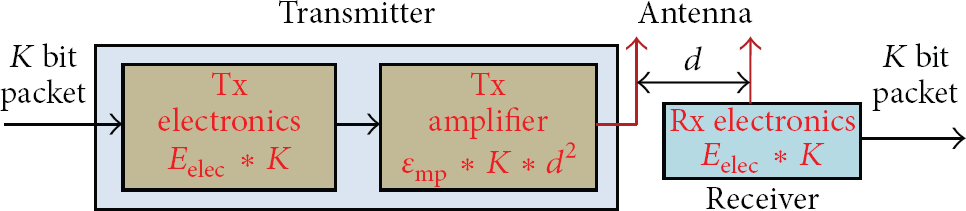
The radio energy model.
2.4. The Wireless Sensor Network Topology Initialization
The wireless sensor network includes some of the initial settings of the energy parameters used in our system of work, and the topology initializations of the sensor nodes are shown in Figure 4. The random generation and deployment of wireless sensor nodes are in the

The wireless sensor network initialization.
3. The Proposed Node Scheduling or Activation Routing Protocol Implementation with Results
In this section, we describe the implementation of the proposed routing protocol which incorporates the node scheduling or activation process in each cluster of the wireless sensor network. The structure of the proposed routing protocol for wireless sensor networks is shown in Figure 5. The number of sensor nodes shown in Figure 5 and the formation of the clusters are followed by (1) for the proposed protocol. The cluster head selection for each cluster is being done by comparing the residual energy of the individual sensor node in every round. From (1), below value of threshold, sensor nodes are elected as cluster-head nodes. The elected cluster-head sensor nodes are forming the cluster by sending the advertisement message to its communication range. The non-cluster head sensor nodes compare the strong signal strengths of the advertisement messages of the cluster heads, and then the individual non-cluster-head sensor node can decide to join in the cluster by giving acknowledgement information. At this moment, the node scheduling or activation process is being implemented in the wireless sensor networks.

The proposed node scheduling protocol.
3.1. Node Scheduling or Activation Technique Implementation
In node scheduling process, for each round of iteration in each cluster, half numbers of sensor nodes are being in active mode to sense the data, and the remaining sensor nodes are kept in sleep mode. In this process of implementation, two ways of node scheduling process are being adopted in the wireless sensor network. The first one is active then sleep mode node scheduling concept, and the second is active/sleep mode node scheduling concept.
Case 1.
Before simulation, forming the cluster heads and their clusters, half numbers of sensor nodes are activated to the active mode, and the remaining nodes are kept in sleep mode in each cluster. In the second time of iteration, active-mode nodes are activated to be sleep-mode nodes, and the sleep-mode nodes are activated to be active-mode nodes. Similarly, this change of mode activation of active to sleep and sleep to active is perfectly followed with forming of re-clustering of clusters and head selection is being done in each round. The sensor node in sleep mode consumes much neglected negligible energy.
Case 2.
Before simulation, forming the cluster heads and thier clusters, half numbers of sensor nodes are activated to the active mode, and the remaining sensor nodes are kept in the sleep mode in each cluster. After a certain number of rounds, the entire active-mode sensor nodes in the network are coming to the zero energy level that is, in die condition. At this time, available sleep mode nodes are activated to active mode to continue the simulation up to zero energy level. This process is called active then sleeps node scheduling method. The important information in each round of iteration is the process of re-clustering formation; cluster head selection and its cluster are being done. The reason for forming reclustering is due to the fact that cluster head selection in each round is based on the threshold value followed by (1).
This process is being implemented in homogeneous and heterogeneous wireless sensor networks. The heterogeneous wireless sensor network has higher-energy-level sensor nodes deployed in a certain percentage.
3.2. Description of Simulation Work with Results
The process of the proposed protocol implementation starts with the basic homogeneous LEACH protocol and the heterogeneous LEACH protocol, and its comparison without adaptation of node scheduling concept is shown in Figures 6 and 7. It is clearly evidenced that the number of live sensor nodes are indicated in blue color and the count of live sensor nodes after 1400 rounds attest the increased lifetime of the network. In Figure 6, six sensor nodes are alive, and in Figure 7 fourteen sensor nodes are alive after simulation.

The homogeneous LEACH protocol.
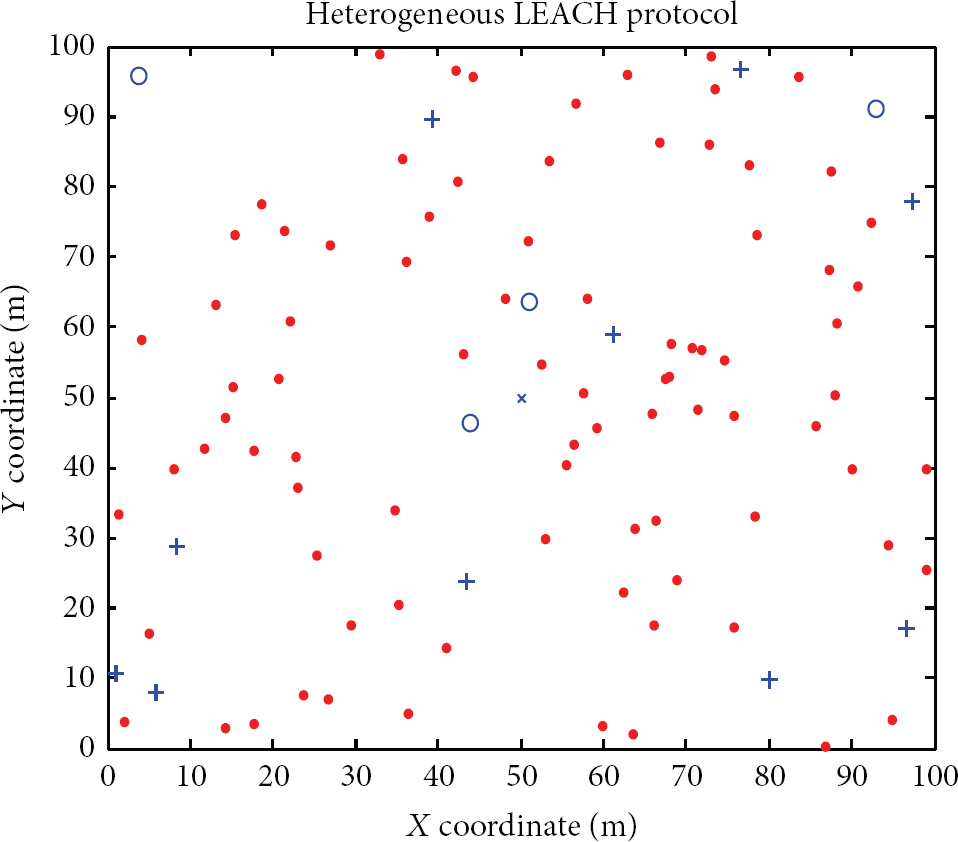
The heterogeneous LEACH protocol (after 1400 rounds).
For the normal homogeneous LEACH protocol in Figure 6 and the heterogeneous LEACH protocol (10% Heterogeneous sensor nodes) in Figure 7, their simulation [9] with comparison is presented in Figure 8. The heterogeneous LEACH protocol-incorporated WSNs have longer lifetimes by attesting the number of alive sensor nodes in Figure 7.

The homogeneous and heterogeneous LEACH protocol: comparison by simulation.
Under Case 1, the process of the proposed protocol is being adopted with active/sleep node scheduling or activation concept in the homogeneous LEACH protocol and the heterogeneous LEACH protocol in [10, 11]; implemented wireless sensor network and its simulation are shown in Figure 9. It is clearly evidenced that the number of a live sensor nodes is indicated in green and blue color, and the count of a live sensor nodes after 2500 rounds attests the increased lifetime of the wireless sensor network depicted in Figure 10. In Figure 9, after simulation of 2500 rounds, five sensor nodes are alive in the homogeneous node scheduling LEACH protocol active/sleep type, and eighteen sensor nodes are alive in the heterogeneous node scheduling LEACH protocol active/sleep type. This comparison is depicted in Figure 10. Hence, the heterogeneous node scheduling LEACH protocol active/sleep-type-incorporated WSNs have longer lifetimes by attesting the number of alive sensor nodes after 2500 rounds.

The homogeneous and heterogeneous active/sleep node scheduling LEACH protocols (after 2500 rounds).
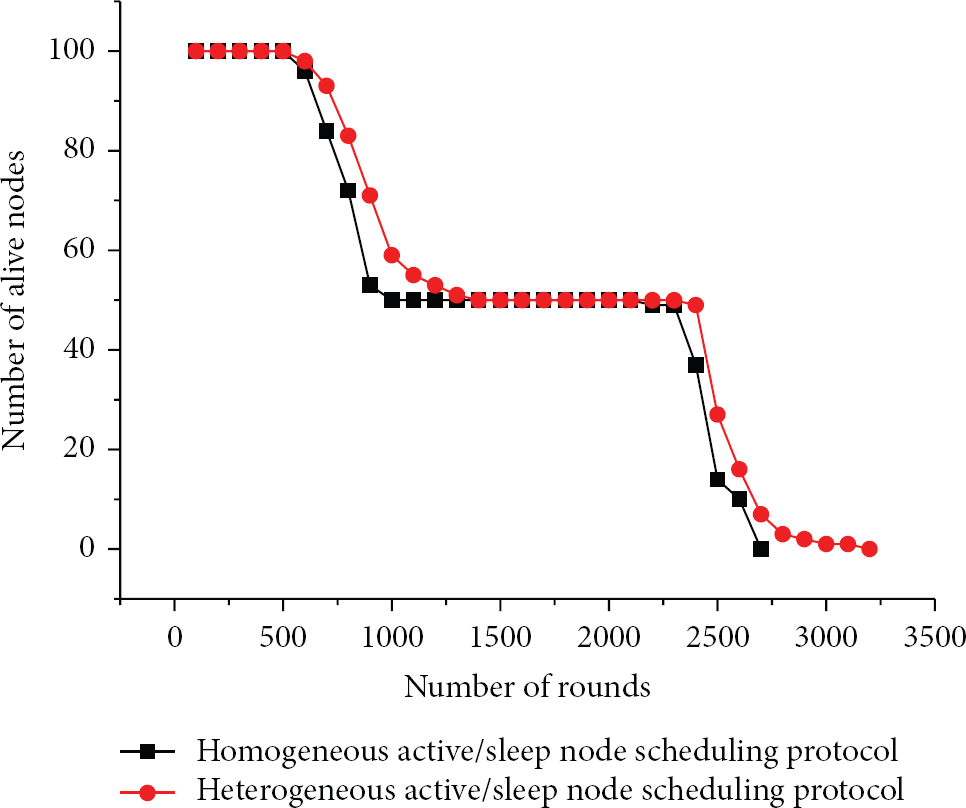
The homogeneous and heterogeneous active/sleep node scheduling LEACH protocol comparison by simulation.
Under Case 2, the process of the proposed protocol contains the adaptation of active then sleep node scheduling scheme in homogeneous LEACH protocol and the heterogeneous LEACH protocol in the wireless sensor networks. The scheme implemented sensor node deployment topology is depicted in Figure 11. It is clearly evidenced that the number of live sensor nodes is indicated in green and blue color, and the count of a live sensor nodes after 2500 rounds attests the increased lifetime of the wireless sensor network depicted in Figure 12. In Figure 11, after simulation of 2500 rounds, nine sensor nodes are alive in the homogeneous node scheduling LEACH protocol active then sleep type, and forty sensor nodes are alive in the heterogeneous node scheduling LEACH protocol active then sleep type. This comparison is depicted in Figure 12. Hence, the heterogeneous node scheduling LEACH protocol active then sleep-type-incorporated WSNs have longer lifetimes by attesting the number of alive sensor nodes after 2500 rounds.
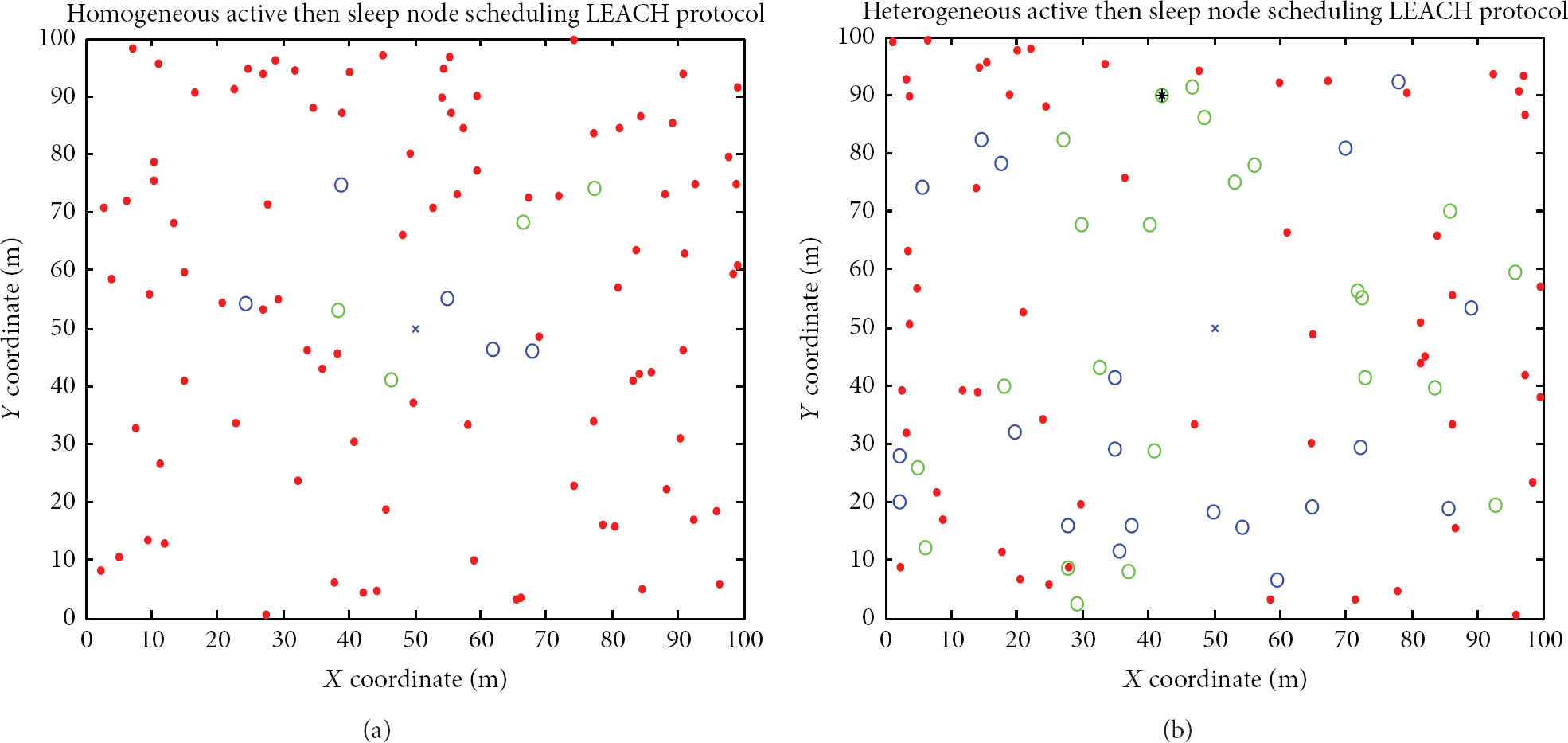
The homogeneous and heterogeneous active then sleep node scheduling LEACH protocol (after 2500 rounds).
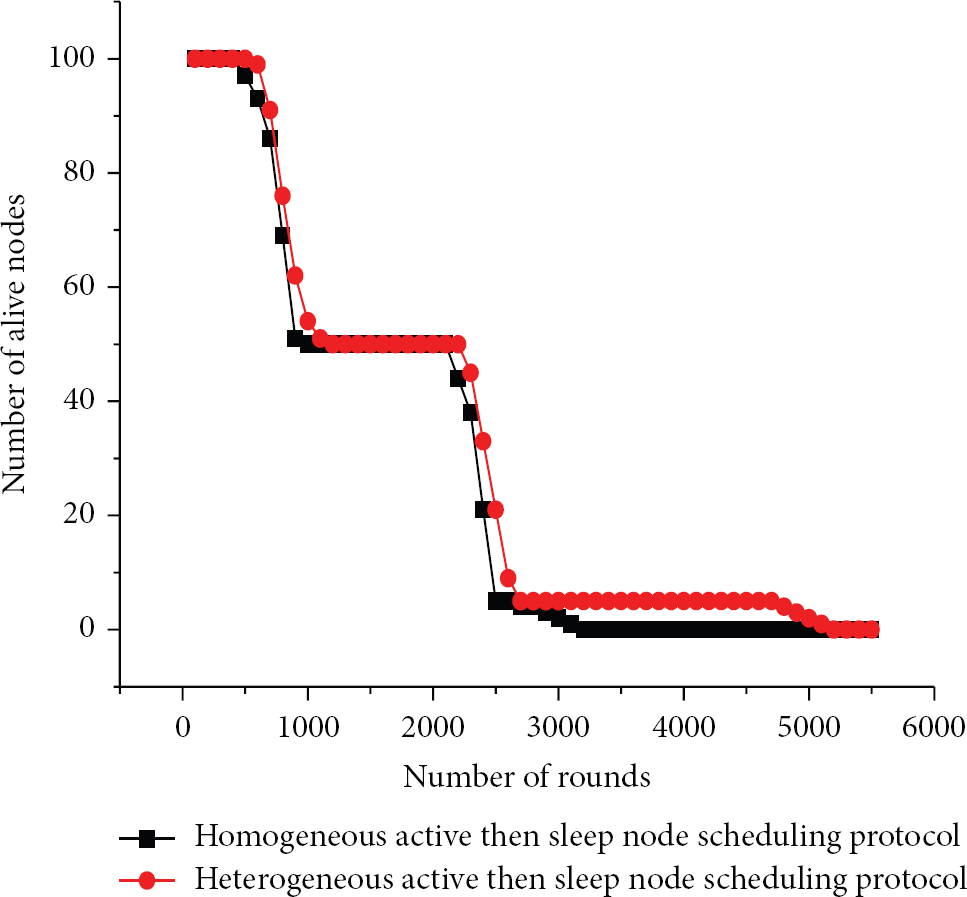
The homogeneous and heterogeneous active then sleep node scheduling LEACH protocol: comparison by simulation.
4. Overall Simulation Results with Simulation Parameters
The explained experimental simulations are giving the energy consumed, and lifetime improved in rank about the wireless sensor network system from the basic concept of the LEACH protocol. The basic homogeneous LEACH protocol and heterogeneous LEACH protocol and their simulation work attest that the heterogeneous LEACH protocol is giving better result of energy consumption, which is depicted in Figure 8.
Case 1.
The scheme that adopted the active/sleep node scheduling system of wireless sensor network is being implemented in the homogeneous LEACH protocol and the heterogeneous LEACH protocol. The comparison between these routing protocols regarding the implementation evidenced that the heterogeneous active/sleep node scheduling LEACH protocol lifetime is more by available count of a live sensor nodes in the network, which is depicted in Figure 10.
Case 2.
The scheme that adopted the active then sleep node scheduling system of wireless sensor network is being implemented in homogeneous LEACH protocol and the heterogeneous LEACH protocol. The comparison between these routing protocols regarding the implementation evidenced that the heterogeneous active then sleep node scheduling LEACH protocol lifetime is more by the available count of a live sensor nodes in the network, which is depicted in Figure 12. The previously explained methods are implemented from the basic concept of the LEACH protocol in both homogeneous and heterogeneous wireless sensor networks.
Among all of the implemented routing protocols, the heterogeneous active then sleep-type node scheduling LEACH protocol is giving the best result of energy consumption and increased lifetime of the overall wireless sensor networks. These complete comparison results of the simulation work of the proposed routing protocol are depicted in Figure 13. The simulation parameters used in the implemented routing protocol are available in Table 1.
The simulation parameters.


The overall types of homogeneous and heterogeneous node scheduling LEACH protocols with LEACH protocol simulation and comparison.
5. Conclusion
In this paper, we have proposed a novel active/sleep-type and active then sleep-type node scheduling or activation LEACH protocol which is developed from the normal LEACH protocol for both homogeneous and heterogeneous wireless sensor networks. These systems are giving better energy efficiency and total lifetime of the wireless sensor network is increased when compared with the normal LEACH protocol. Here, we have implemented the research work in both homogeneous and heterogeneous types of wireless sensor networks. Among all of the types of the implemented system, the heterogeneous active then sleep node scheduling LEACH protocol is giving better lifetime than other types of the LEACH protocols. By increasing the number of heterogeneous nodes and their initial energy levels in the wireless sensor network, the total lifetime of the wireless sensor network can be increased obviously. This is clearly proven, and the overall comparison is shown in Figure 13.