




Abstract
Embedded system is applied for the development of smart residential fire detection and extinguishing system. Wireless communication capability is integrated into various fire sensors and alarm devices. The system activates the fire alarm to warn occupants, executes emergency and rescue calls to remote residents and fire-fighting facility in an intelligent way. The effective location of extra-sprinklers within the space of interest for the fire extinguishing system is also investigated. Actual fire test suggests that the developed wireless system for the smart residential fire protection system is reliable in terms of sensors and their communication linkage.
1. Introduction
Every year residential fires occur practically around the world. For example in USA, recent estimates showed an average yearly of 371,700 residential structures fires causing 2,590 civilian deaths, 12,910 civilian injuries, and $7.2 billion in direct property damage. Majority (71%) of the reported residential fires occurred in one- or two-family homes with the remaining occurred in apartments or other multifamily housing [1]. In the UK, 43,500 residential (dwelling) fires were reported for the year 2011–2012. These fires caused 287 fatalities and 11,300 nonfatal casualties [2]. The damages to property, injuries, and loss of lives caused by residential fires have great impact on the economy and society. This impact has continuously encouraged the promotion and implementation of stricter fire safety requirements particularly in industrialized and advanced countries. With these facts, it is imperative that there is a persistent need for the development of technology for the protection of residential buildings against fire.
In an event of residential fire, smoke alarm can save lives and reduce the loss to properties by providing early warning alarms to residents. In many cases, smoke alarms are combined with other detection technologies (such as gas and heat sensors) to ensure an efficient and reliable detection of the early indicators of fire occurrence [3–6]. For extra protection against fire, however, in addition to smoke alarms, installation of fire sprinklers is recommended. It is reported that the risk of dying and property loss decreases by about 80% and 71%, respectively, when sprinklers are installed [7]. A wise approach, therefore, is to combine smoke alarms (and other sensors) with fire sprinkler system to obtain a reliable and more efficient fire protection system. Recently, the addition of fire sprinkler has become part of the building requirements for residential structures [8].
Recently, wireless system (ZigBee) has also received attention for its application in the fire early detection system [9]. This system is becoming more attractive to housing which accommodates elderly couple or elderly person living alone because it is perceived to be more secured. The fire alarm system using wireless technology is seen to be necessary in modern society as part of the fire-fighting equipment. In addition, inspired by the era of communication and data sharing, the wireless home network applications are now freely available. While the current communication technology within the fire-fighting industry is mostly still based on wired system, there is a growing need for the application of wireless communication between fire-fighting system components with the capability of home network integration. ZigBee-equipped wireless smoke sensors along with IT technology can activate alarms if a fire occurs. In this study, the ubiquitous technology is implemented for the purpose of ensuring fire safety in residential buildings through wireless fire detection and extinguishing system. This system also aimed at reducing installation cost due to space restriction and promoting ease and practicality of installation in existing residential buildings. Unlike wired interconnection which may only be practical for use in new construction, especially if the wires are laid out without cutting walls and ceilings (or floors in multistory residence), the wireless interconnected sensors can be conveniently retrofitted in buildings without costly wire installations. In effect, the building interior design is not compromised and total installation cost can be significantly reduced.
The main ideas of the proposed fire detection and extinguishing system were as follows: Firstly, in housing condition where it is not easy or impractical to install conventional fire detection equipment, a smart fire sensor network using wireless communication system that activates and sends warning alarm within the building, to the building residents or owner, and the fire department was developed. Secondly, to implement an improved compact water-based fire-extinguishing sprinkler system with higher discharge so that the fire can be effectively extinguished at the early stage. The compactness of the extinguishing system is believed to cut the total installation cost. The two systems were integrated for the development of practical wireless fire detection and extinguishing system for residential building applications. Experimental equipment for water supply with specific type of sprinklers and wireless communication were developed and tested to verify the system performance.
2. System Workflow
In residential structures, a potential fire can be indicated by the presence of smoke, heat, gas, or their combination. The smart fire protection system presented in this paper is initiated upon the detection of these early indicators of fire. Generally, a warning signal or alarm is produced when the concentration of detected smoke, carbon monoxide (CO), liquefied natural gas (LNG), or liquefied petroleum gas (LPG) has met the criteria for alarm activation, that is, above threshold values. These sensors are interfaced with the control system so an automatic fire notification system is executed at the instant the fire alarm is activated. Telephone networking is included in the control system thereby automatic notification call or message is sent to the fire department and residence owners who are off the premises. In an unlikely event of fire, the sprinkler system is activated allowing water to flow out of the sprinkler heads to extinguish the fire. Since the residential sprinklers are temperature-activated, only the sprinkler head closest to the fire source is set off, thus, reducing damage to properties. Water pressure information in the sprinkler line is sent into the control system through the standalone type alarm valve. The water pressure required to extinguish the ongoing fire is supplied by a water pump that is also interfaced with the control system. When fire is totally suppressed, the water supply is automatically shut off. In case that LNG or LPG leakage is detected which is attributed by the gas concentration above the preset limits of the sensor, the gas line is automatically shut off and the gas bureau and residence owner are instantaneously notified. Essentially, the system operation is illustrated in Figure 1.

Fire protection system operation schematic.
To minimize false fire alarm and rescue calls, the smart system has particularly utilized an integrated CO + Smoke sensor which follows an algorithm for identifying actual fire based on the combination of detected smoke and CO concentration. This is mainly based on the fact that CO is a product of an incomplete combustion that is characterized by the presence of smoke. In other words, the amount of CO present in the detected smoke is a determining factor for fire detection, fire extinguishing system activation, and subsequent notification calls. Various other algorithms for similar kind of sensor integration for fire detection are available in the literature (see [3, 6] among others). In the developed residential fire detection and extinguishing system presented herein the corresponding sensor triggers the alarm when threshold value is reached (as depicted in Figure 1). These threshold values are preset by the manufacturer. Additionally, the CO + Smoke sensors installed in the whole area can be wirelessly interconnected with each other, so that if one detects smoke or confirms fire, the alarm will sound on all sensors in the network. This setup improves the ability to get the residents alerted either they are on closed-door bedrooms or living two floors away from the location. Wireless linkage and networking of the CO + Smoke, LNG/LPG, and water pressure sensors with the control system is implemented using ZigBee technology as depicted in Figure 2. By having the sensors wirelessly interconnected, the technology allows the sensors to be retrofitted in a residential building without costly wire installations.
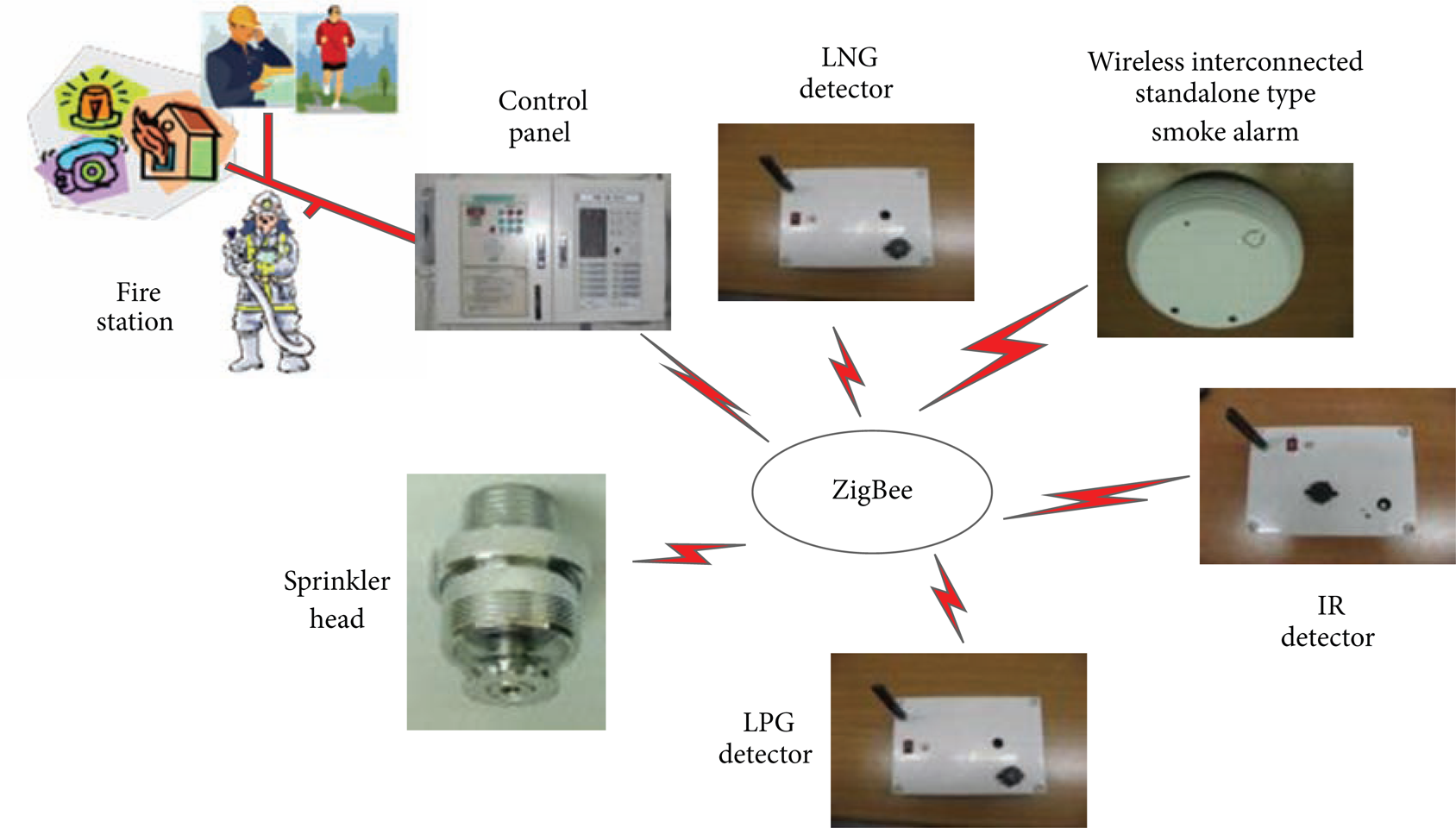
Wireless linkage system.
Conventional sprinkler system often gets its water supply from an overhead water reservoir or through connection to commercial water line which may need pump to maintain the required water pressure. The sprinkler system for this proposed smart fire protection system has implemented a compact cabinet-type design. That is except for the sprinkler heads and the corresponding water pipelines, all components of the sprinkler system such as water tank, pumps, pressure gauges, and valves, and even the control panel are housed in a steel cabinet. This feature has made the system highly mobile, and can be conveniently installed in residential buildings and transferred from one property to another. The fire extinguishing sprinkler system is depicted in Figure 3.

Sprinkler system connection with the control system.
The smartness of the developed system can be described by its ability to discriminate or make decisions when to trigger the necessary alarms, execute notification calls, or activate and regulate the fire extinguishing system automatically. Furthermore, it is capable of monitoring and storing information of all events in the system.
3. System Components
3.1. CO + Smoke Sensor
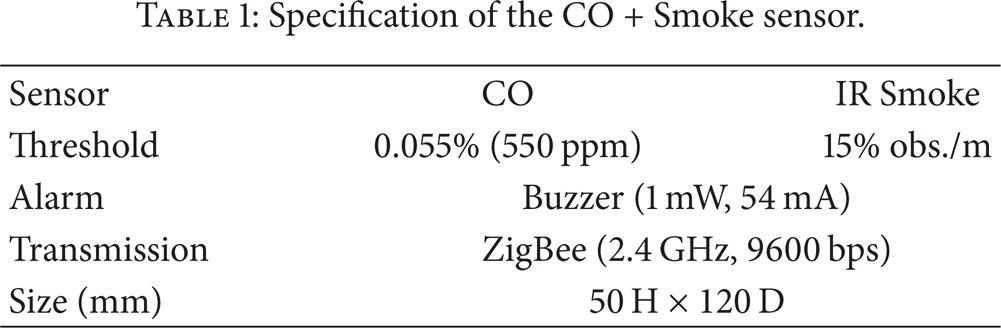
Existing standalone alarm-type fire sensor is basically capable of fire detection through smoke sensors with local alarm. In this study, wireless CO + Smoke sensor used for the proposed fire protection system enables wireless interconnection with other sensors which has added safety feature as has been described in the preceding section. It basically consists of two sensors, CO and infrared (IR) smoke sensors packed into a single unit. Using the compact single-unit CO + Smoke sensor is found to be less expensive than having two sensors installed separately. Wireless buzzer is added to activate sound alarm once detection is confirmed. Table 1 shows the specification of the CO + smoke sensor.
Specification of the CO + Smoke sensor.
3.2. LNG/LPG IR Sensor
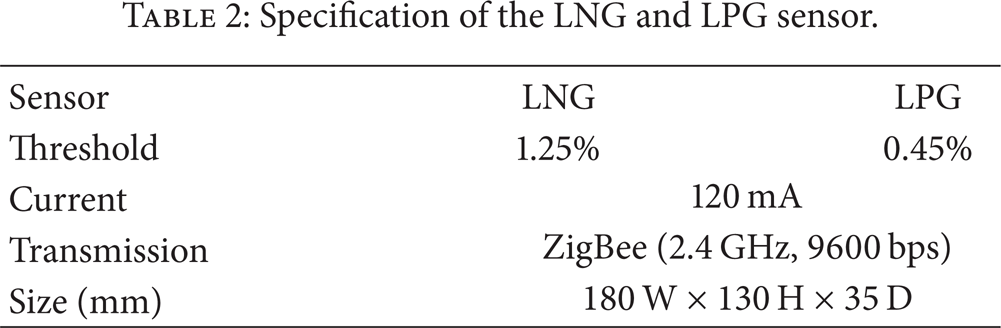
LNG or LPG leakage in the residential buildings is potentially hazardous. For instance, natural gas leaks can cause immediate death if high concentration is inhaled. These gases are highly flammable. The developed system includes LNG and LPG IR sensors. Table 2 shows the specification of the LNG and LPG sensors.
Specification of the LNG and LPG sensor.
3.3. Wireless I/O and TCP/IP Interface
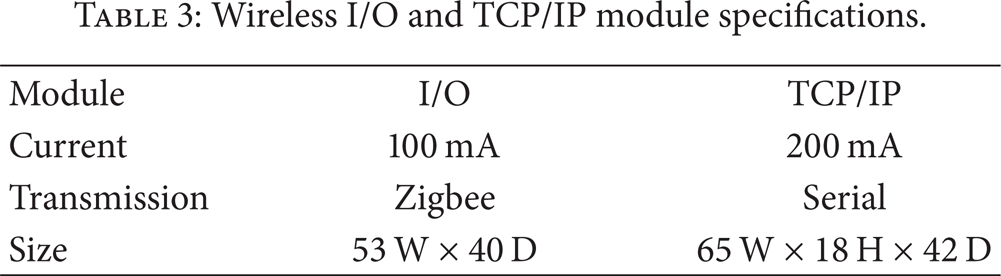
Wireless sensors are linked to the control panel through wireless I/O module. ZigBee wireless technology is used to receive wireless signal from each sensor and initiate the alarm system in case of fire. The test result obtained with the communication program indicates that the wireless module can cover area within 7-meter radius. The notification system is connected with the control panel through serial ports. Through telephone line, the system automatically calls the fire department for notification and fire extinguishing assistance if needed. Subsequently, the residence owners are also automatically notified. Emergency notification system includes voice transmission, manual call, and communication recorder. Table 3 shows the wireless I/O and TCP/IP module specifications.
Wireless I/O and TCP/IP module specifications.
The CO + Smoke sensor with the wireless module was tested at a house fire environment. It was still operational and works stable when the temperature was over 400°C. Furthermore, the wireless model has installed the reciprocal checking function and they will communicate with each other periodically. If there is no response from the neighbor sensor, a notification will be sent to the residents or owner. If one sensor module is in alarm status the other alarms will be activated also.
3.4. Sprinkler System
Existing sprinkler system is used for the proposed residential fire protection system. For the purpose of testing, flush type sprinklers are used. Figure 4 shows example of the flush type sprinkler head and its activation mechanism (fuse metal melts at known temperature, set off the heat collector and discharges pressurized water).

Flush-type sprinklers (leftmost) and its activation mechanism during fire.
4. System Testing
4.1. Wireless Communication Linkage Test
Figure 5 shows the location configuration of the sensors and control panel installed for wireless communication linkage test. A monitoring program was developed for testing purpose. To test the functionality of the devices described earlier, smoke and gas were introduced into each area where corresponding sensors were installed. Once the triggering substance is detected, wireless signal was received and the fire alarm was activated. The test has been shown to confirm the wireless communication capability of the system. In the fire test with a single-floor three-bedroom residential building, four CO + smoke sensors and one LNG/LPG sensor were found to be the optimal configuration. In such sensor location, configuration wireless communication can be established within 7-meter radius.

Test room configuration for wireless linkage and sprinkler system test.
4.2. Fire and Wireless Linkage Test
At high-temperature environment, the operational reliability of the sensors and linkage capability are highly critical. Hence, the system linkage test was carried out with fire occurrence scenario. In this study, computer program was developed for the room fire monitoring test. The program also facilitates the connection between the fire detection system and automatic fire notification system. Figure 5 shows the layout of the sprinkler heads in the test room. Wooden materials commonly found in residential buildings were contained in a metallic bin situated in the room as shown in the leftmost of Figure 7. The wooden material (fuel) was manually ignited. As the smoke ascended and spread into the ceiling and reached the CO + Smoke 52 seconds after ignition the fire alarm was triggered. The status monitor reported an active status (active = 1; standby = 0) of the CO + smoke sensor. The fusible material in the nearby sprinkler head melted when ceiling temperature reached 405°C opening the head and allowing water to spray down into the fire source.Figure 6 depicts a sequence of fire buildup, sprinkler head activation, and finally fire suppression.

Fire ignition and suppression sequence during the actual fire test.

(a) Temperatures at various test points during fire suppression with the corresponding CO + smoke sensor status monitor (1-active; 0-standby) and (b) water pressure and flow rate data at fire suppression.
As can be seen in Figure 7(a), smoke detection status continued to be reported while the fire was ongoing with temperature over 400°C which appears to indicate that the CO + Smoke sensor linkage was operational and stable at such critical condition. Due to water flow in the pipe line, standalone alarm-type valve sent pressure signal to the control panel. The control panel automatically adjusted the pump speed so that the required instantaneous water flow and pressure were supplied into the sprinkler. As the fire temperature gone down which indicated fire suppression, the amount of water being discharged was properly regulated. Test revealed that fire is completely extinguished within 247 sec (4.11 minutes) as shown in Figure 7.
5. Conclusions
In this study, the development of a wireless fire detection and extinguishing system for residential application has been presented. Wireless connectivity and communication capability were added to the basic features of various kinds of fire sensors using ZigBee wireless technology. The developed system allows wireless home networking that can send fire notification to residents and fire department automatically. Through actual fire test, the performance of the integrated wireless fire detection and extinguishing system has been verified even at critical conditionhigh temperature condition. Wireless communication among devices in the fire test room was established within 7-meter radius. The improved compact fire extinguishing system has the ability to suppress fire at the early onset within less than 5 minutes. The result of this study can be used for the development of smart, effective, and efficient fire safety and fire-fighting system to address the related demands of a modern society.