




Abstract
Based on the constitutive models of expanded polyethylene (EPE) and C-flute corrugated paperboard (CCP), the drop impact model for expanded polyethylene in series with CCP was established to consider the effect of cushioning action for CCP box. A numerical procedure was adopted for the optimization of the product packaging system by considering the action of the corrugated paperboard box. Then the optimal results were obtained and compared without considering the effect of CCP. Finally, the calculation reliability was proved by the comparison between calculated results and experimental data.
1. Introduction
Package cushioning materials are popularly used to protect some kinds of products. The most commonly used method of designing packaging structure is dynamic cushion curve, namely, the maximum-static stress curve method [1], which shows how a particular packaging material of a given thickness behaves at different impact loading. However, the cushion curves are commonly obtained through abundant experiments that would consume much time and expenditure. In practical examples of cushion packaging, polymeric foams are fruitfully utilized to protect products against shock and drop loading. In order to overcome this drawback, constitutive relationships have been carried out. Zhang et al. [2] established constitutive relationships for expanded polypropylene, expanded polystyrene, and expanded polyurethane considering several factors such as density, strain rate, and environment temperature. Liu and Subhash [3] and Avalle et al. [4] proposed a mathematical model to characterize three regions of common foam. Jeong et al. [5] investigated the strain rate dependent behavior of polyurethane foams and formulated a new constitutive model in order to improve the fit of the experimental data at various strain rates. Gao and Lu [6] explored the constitutive behavior for expanded polyethylene. Because of the environmental advantage and demand, there has been interest in recyclable, reusable, and biodegradable packaging material; Lu and Gao [7] built a phenomenological model for single flute corrugated paperboard. Huang et al. [8] presented a constitutive model for double flute corrugated paperboard considering relative humidity. From a damage boundary curve viewpoint, Wang et al. [9] investigated the impact response of corrugated paperboard, which is the actual application of the three-dimensional shock response spectrum and provided an important method for studying the nonlinear response of coupled packaging systems based on critical components [10, 11]. The dropping damage boundary surface concept as well as the traditional damage boundary concept helps the researcher model the damage potential of shocks to packaged products.
In most cases, corrugated paperboard is used to make the corrugated paperboard box as the containers to store the products, and interpackaging is inserted as cushioning pads within the box [12–14]. Because of the cushioning properties of the corrugated paperboard, it can play favorable roles to protect products during storage and transportation, which is often ignored while designing the packaging structure [15].
In this paper, a series of procedures to describe practical protective packaging systems are presented. Firstly, the compression tests were undertaken to determine the constitutive models for expanded polyethylene (EPE) and C-flute corrugated paperboard (short for CCP). Secondly, a drop impact calculation method of EPE in series with CCP was introduced to examine the effects of outer packaging box on the product packaging system. Lastly, an optimization model considering the action of outer box made of corrugated paperboard was established.
2. Compression Constitutive Models of EPE and CCP
The test samples of EPE were made with the cubic dimensions of 100 × 100 × 30 mm and the average density 21 kg/m3, and specimens of CCP were cut into 100 × 100 mm with thickness 4.6 mm. The static tests and drop impact test were conducted on the universal machine and drop tower, respectively, to obtain the constitutive model.
The constitutive model of EPE was reported in our previous paper [16] as

where a1, a2, and a3 are the model parameters to be identified. For the studied cushioning material, the parameters of the static model were solved to be a1 = 0.0894 MPa, a2 = 1.92, a3 = 0.011 Mpa, and a4 = 112.3 Pa · s using the iterative least square method. The calculated curve is plotted in Figure 2 as solid line, agreeing well with the experimental data.
Figure 1 shows the static stress and strain curve of CCP measured by the universal machine at compression speed of 2 mm/min. The curve indicates that the compression stress is near linearly proportional to the strain, while the strain is smaller than 0.27, and the peak stress is available at the strain 0.27. As the strain increases from 0.27 towards 0.6, the compression stress decreases slightly, and then it will increase rapidly on account of the CCP starting to be compacted at this time. A constitutive model for CCP was proposed as follows:

where b i (i = 1,2, …, 7) are the model parameters which can be identified by fitting the experimental data into (2), and these parameters were solved as b1 = 1.4845 MPa, b2 = – 1.1090 MPa, b3 = – 6.6793 MPa, b4 = 7.3762 MPa, b5 = 0.9153 MPa, b6 = 0.0159 MPa, and b7 = 1.93. The calculated data is shown in Figure 1.

Static compression stress and strain curves of CCP.
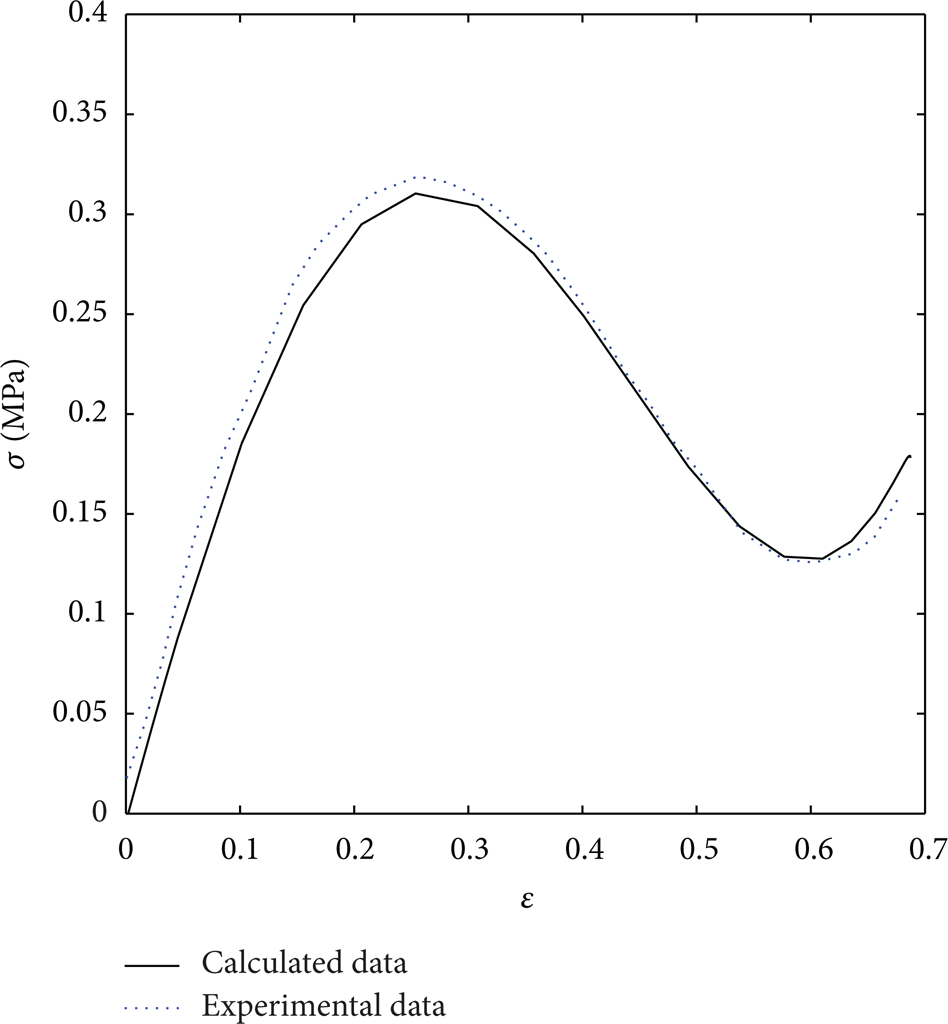
Dynamic compression stress and strain curves of CCP.
In addition, the dynamic compression data and curve were measured for drop impacts with a heavy hammer of 2.1 kg from 30 cm, shown in Figure 2. The dynamic compression curve exhibits similar regularity to the static compression curve. Therefore, it was proposed to characterize the dynamic behavior of the cushioning material by using the following dynamic constitutive model:

where b i (i = 1,2, …, 7) are the same as that of (2); b8 are parameters identified as b8 = 0.00073 s. The calculated dynamic stress-strain curve is described in Figure 2.
3. Series Model of EPE and CCP and Optimization Design
A complete packaging system is composed of product, cushion material, and outer packing box. CCP begins to be deformed when subjected to dynamic compression load and it acts to absorb the energy from drop impact. We established the mechanical model of EPE in series with CCP, shown in Figure 3, for taking into account the effect of outer packaging box. The origin of coordinate y1 was selected at the top of EPE cushion, and the interface between EPE and CCP was used to construct the origin of coordinate y2 to accout for the cushiong effect of CCP.

Schematic of product packaging system considering CCP.
Because the masses of the two cushion layers are negligible compared with the product mass, the resistive force from the first cushioning material is the same as that from the second. Based on the above assumption, the dynamic equations of packaging system can be expressed as

where A is the contact area of the EPE or CCP. The initial condition of the equation is given as

The structure optimization of series system could be designed based on two requirements: (1) response acceleration of the product should be smaller than the allowable value and (2) material consumption should be minimized; the object optimization function of the cushion package series structure was put forward and was shown as falling equations [15]
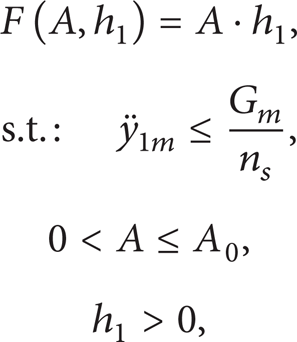
where G
m
is the maximum safe acceleration, n
s
is safety factor,
The steps to solve (6) are as follows:
give the range of A to be A i ~ A f , and designate h1 from h i to h f , where A i is the initial value of the area A, A f is the final value of A, h i is the initial value of the thickness h1, and h f is the final value of h1,
increase A from A
i
to A
f
with step length ΔA, and h1 from h
i
to h
f
with step length Δh to solve (6), and store A and h1 to be feasible solution if
finally, obtain the minimum value of function F(A, h1).
4. Results and Experimental Verification
4.1. Effect of Cushion Size on Product Response
Because thickness h2 is constant, area A and thickness h1 can be varied. We studied the effect of parameters A and h1 on product response from drop impacts. In order to research the effect of cushion size, the maximum acceleration value
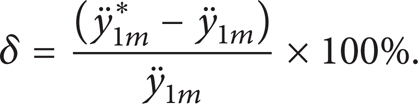
Figure 4 (a) shows the relation between δ, h1, and H under conditions of m = 7 kg and A = 0.012 m2, and the contour lines of relative error are presented in Figure 4 (b). It is clear that the relative error of the upper left-hand corner is smaller than 5%, meaning the cushion characteristic of this packaging system is dependent on CCP. But the effect of CCP is noticeable in the lower right-hand corner, for example, the value can be up to 142%, while h1 = 0.022 m and H = 0.55 m. Figure 5 (a) illustrates the compression deformation of cushion materials with respect to time t under H = 0.25 m and h1 = 0.045 m during impact compression. We can find that the deformation of CCP is almost zero by comparison with EPE, so the packaging system uses EPE to absorb energy during drop impact. Yet Figure 5 (b) demonstrates that the CCP begins to deform rapidly at time of 0.0053 s, so the packaging systems are dependent on EPE and CCP to achieve the function of package cushioning.
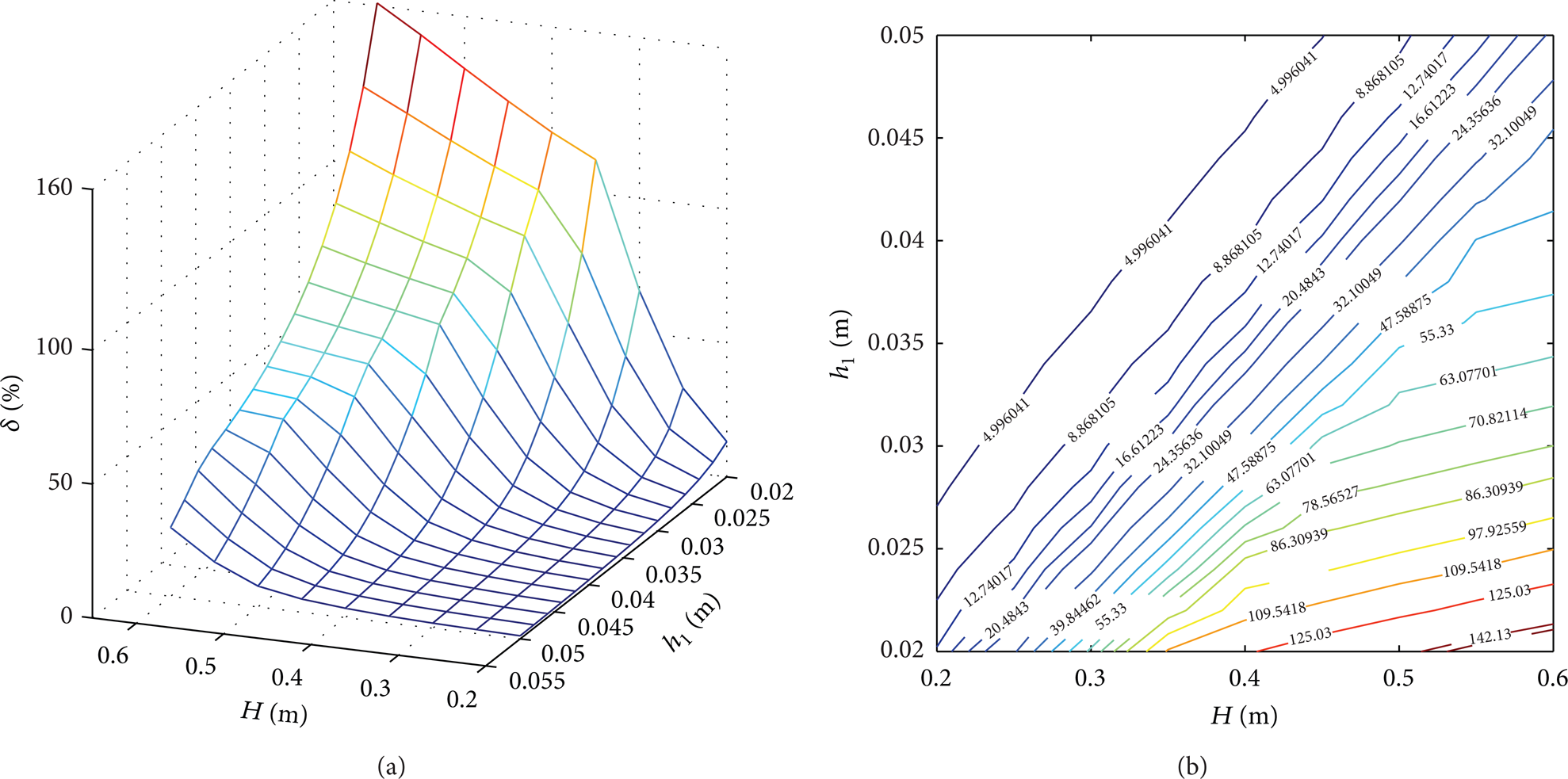
Relations between δ, h1, and H (a). Contour lines of δ (b).

Deformations of cushion materials at (a) H = 0.25 m and h1 = 0.045 m and (b) H = 0.55 m and h1 = 0.022 m.
4.2. Cushion Optimization Design
In Section 4.1, we studied the effect of given area and thickness h1 on the cushion characteristics of packaging system. Given some requirements, this section introduces optimization design of cushion structure considering the effect of paperboard. There is a product with its mass m = 6 kg, safe acceleration G m = 100 g, and undersurface area A0 = 0.011 m2, dropping from the height H = 0.6 m on the packaging cushion system, which is divided into two categories, considering the influence of CCP and not considering the effect of that. The safe factor is 1: 1 and satisfies the need of optimization for the cushion structure.
Table 1 shows that the cushion structure optimization results in two categories, where V1 denotes the volume of EPE when paperboard is not considered.
Optimization results of cushion structure.

We calculated the relative error that is equal to 24.4% between the two categories under the above conditions. In order to investigate the effect of outer box deeply, we calculated δ1 presented in Figure 6 under the conditions of H = 0.4 ~ 0.8 m and G m = 50 ~ 150 g. The values of δ1 are higher than 10%, even 40%, when drop height H is 0.4 m and G m is 150 g.

Relation between δ1, G m , and H.
5. Conclusions
The parameters of constitutive relations of EPE and CCP were obtained by experimental studies and some identifying techniques for mathematical expressions were put forward. Drop impact model of product that uses EPE as cushion material in series with CCP was constructed, and the series optimization model was proposed on the basis of impact model considering the two requirements that one is; response acceleration of the product should be smaller than the allowable value, and the other is that material consumption should be minimized. The following conclusions can be drawn:
CCP acts with a smaller cushioning effect under thicker h1 and higher h, but the effect becomes noticeable under thinner h1 and lower h (Figure 4),
at certain drop height and safe acceleration, the optimization structures of packaging system were calculated considering or not considering the effect of CCP. Difference between the consumption of the two categories was significant (Figure 4). So it will avoid or reduce overuse of package materials if the cushioning effect of outer CCP box is considered.
Conflict of Interests
The authors declare that they have no conflict of interests.
Footnotes
Acknowledgment
This work was supported by the Twelfth National Five-Year Science and Technology Projects (nos. 2011BAD24B01 and 2012BAD32B02).