




Abstract
Machine-to-machine (M2M) technology that allows machine devices to communicate directly with each other without human intervention has emerged as a cutting-edge technology for next-generation communication. As its applications become more and more popular, the number of users grows quickly and the quality of service needs to be improved. The traffic allocation problem may lead to many other problems such as low utilization ratio of the bandwidth and the jitter. When we tried to analyze the load on different paths using the simplest multipath routing algorithms, we found that the load changes just like simple harmonic motion, which inspires us to use physic and mathematic methods and tools to analyze the loading balance problems. And then, we designed a new traffic allocation algorithm. Compared with other algorithms, the algorithm proposed in this paper has much wider applicability. And the performance comparison experiment shows that DBTAs can really achieve improvement in decreasing the packet delay variance.
1. Introduction
Machine-to-machine (M2M) technology that allows machine devices to communicate directly with each other without human intervention has emerged as a cutting-edge technology for next-generation communication [1]. M2M technology enables the next generation of wireless sensor networks and global connectivity to billions of processes, devices, and machines through the Internet and it is considered the most promising solution for revolutionizing future applications [2]. However, the wireless M2M networks are composed of a large number of small and power-limited machine devices, which can only transmit low-power signals. Due to the propagation loss between the source devices and the destination devices, it is very challenging to guarantee the quality of service (QoS) requirements of the destination devices [3]. Recently, considerable effort has been put into this problem. Here, we discuss several issues that need to be considered in the design of a framework of wireless M2M communications network to meet the above requirements.
The first issue pertains to the MAC protocol, which plays a key role in determining the network throughput, delay, power consumption, and so forth. A large number of MAC protocols have been proposed for sensor networks and personal area networks, with energy efficiency as the primary design criterion. The most common of these protocols are the contention-based carrier sense multiple access (CSMA) scheme [4] and the schedule-based time division multiple access (TDMA) scheme [5].
The second issue concerns the routing path of data from end devices to an M2M gateway, which is the main content of this paper. Network design has traditionally followed the principle of layering. Previous work in this area has focused largely on the design of link-level protocols [6], and some previous papers address routing for such a network [7]. A large number of studies have shown that the routing protocols based on the criterion of minimum number of hops cannot meet the requirements of M2M network for throughput and guarantee the quality of service.
In recent years, many wireless M2M communications network routing protocols have been proposed: the multiradio link quality source routing protocol [7] is a multichannel routing protocol, which uses weighted cumulative expected time as the routing performance; predictable wireless routing protocol [8] by comparing the data packet error rate and other network state parameters to select the optimal path under certain circumstances; single transceiver device and multichannel routing protocol [9] support multichannel resources in the same area at the same time without disturbing each other so that the network performance can be enhanced; routing protocols combined traditional DSR [10] with the ETX [11] criterion are limited to enhance the throughput, so high-throughput routing protocol makes various improvements to enhance the network throughput; based on the ETX criterion RF-aware routing protocol introduces RF-aware routing information as the judgment of the path.
According to how many paths a routing algorithm uses, we can divide all routing algorithms into two classes: single-path routing and multipath routing [12]. Single-path protocol is simple but prone to path overheating (such as multiple clients sending data to the Internet through the same router; all data will be passed along the same path when using a single-path protocol), so that network performance and stability are difficult to be guaranteed; multipath protocols establish multiple paths to transfer data and distribute traffic on multiple paths; thereby they can enhance network throughput, lower packet loss rate transmitted over the network, improve delay and jitter performance indicators, and are better able to achieve network quality of service requirements.
However, most multipath algorithms pay much attention to the multipath discovery and multipath maintenance, while ignoring the traffic allocation problem, which is just the problem we focus on. The traffic allocation problem may lead to many other problems such as low utilization ratio of the bandwidth and the jitter. When we tried to analyze the load on different paths using the simplest multipath routing algorithms we found that the load changes just like simple harmonic motion, which inspires us to use physic and mathematic methods and tools to analyze the loading balance problems [13]. And then we designed a new traffic allocation algorithm. Compared with other algorithms, the algorithms proposed in this paper have much wider applicability.
The structure of this paper is as follows. In Section 1, we first analyze the present algorithms of the wireless M2M communications networks. And an appropriate physical model for the network of multipath traffic allocation problem has been built in Section 2. In Section 3, we combine the conclusions deduced from the physical model with a more mature routing algorithm and design some new multipath routing protocol traffic distribution algorithms for wireless M2M communications networks. The performance comparison experiments are noted in Section 4. And in Section 5 we give the conclusion of this paper.
2. Theoretical Model
2.1. Network Model
We use the graph model to represent wireless M2M communications networks in this paper: wireless network routers and end devices are abstracted as vertices in the graph; the wireless or wired links used by wireless network nodes to communicate with each other are abstracted as edges in the graph. In this model we ignore the phenomenon that the wireless network transmission capacity may be unequal in different directions, because its effects on flow allocation and load balancing are very small; we can simplify the theoretical model and use an undirected graph
There are two original intentions to design new algorithms in this paper. Firstly, reduce the network transmission delay jitter and secondly load balancing. The rules of the action and reaction between the path load condition and its delay are the starting point to design algorithms in this paper. Path load condition is related to the number of data packets per unit time passing, and the number of packets per unit time passing in the path affects the path delay through the impact on the queue length of each node in the path. By the above, we can infer that the queue lengths of the nodes in the path are the bridge linking the load on the path and the path delay.
Therefore, in the theoretical model proposed in this paper, each vertex in the graph uses an integer to describe the queue length of the network node. In addition, the reason for the wait queue of the network node is that a node needs a period of time that cannot be ignored to forward a data packet. Therefore, in the theoretical model, we will also add a constant as the time nodes need to forward a data packet. It needs to be noted that the time for forwarding data packets cannot be ignored, but since the source node can send new packets to the path at any rate, we assume that the time for the source node sending data packets can be ignored. The purpose of this assumption is to design the algorithm in this model that can increase network throughput as much as possible. Its practical significance is that it is usually the wireless network clients that initiated to send data in wireless M2M communications networks; in this case, the first hop node of the path is typically the wireless access point becuase multiple clients may send data packet to access point simultaneously; we can abstract the clients through the same access point connecting to the wireless M2M communications networks as a source node, and the time of the source node sending data packets can be ignored.
In summary, this theoretical model can be described as

2.2. Theorems
Theorem 1.
One assumes that none of vertices on the path is in other data packets transmission paths and the queue length is
Proof.
Based on the assumption that the time for the source node sending data packet to initiate the transmission can be ignored, the residence time of the data packet on the path is the product of the number of intermediate nodes in the path and the time for each intermediate node forwarding the data packet. In order to facilitate the description, c is identified as the unit of time; that is,
Theorem 2.
Considering the data packet transmission path
Proof.
Node does not receive data packets from the nodes outside the path, so in unit time, one node can only receive a data packet except
Theorem 3.
Considering the data packet transmission path
Proof.
Given c for the unit time, the queue length of node
2.3. Theoretical Model
According to these three theorems, we can associate network transmission model with vibration model in physics [14, 15]. First of all, we express the path delay as the location x; the rate of change of the path delay must correspond to the speed the difference of delay time of the two paths the rate of change of the difference between the two path delays
Therefore, we can make the difference of the two path delays change in accordance with harmonic vibration model in physics by changing the rate of data packets sent to paths in accordance with the following formula:

Obviously, using the formula (2) and other similar traffic shaping policies in the qualitative analysis would lead to endless vibration load on the different paths until the end of the network transmission task. We try to design an algorithm that can make the load vibration gradually flatten and eventually remain stable at the load balancing point. As a motivation, we consider introducing the concept of resistance into the system, so that the load vibration model with its initial state transition similar to the harmonic vibration can transform into damping vibration state in finite time. The physics model used to explain this is shown in Figure 1.

Damping vibration.
In physics, the significance of the friction is to impede the movement of objects, that is, to hinder the change of objects location. In the network data transfer model, change in the location of objects is related to the change of path delay. Intuitively, the significance of the introduction of friction into the network data model is to maintain the delay on the path unchanged. From the qualitative point of view, the idea to design the algorithm is on the one hand to transfer traffic to the path with lower delay and on the other hand to inhibit this shift to some extent. Through the interaction of these two aspects, we can ultimately achieve the purpose of vibration tending to stationary.
In the following, we will introduce the flow allocation algorithm damping based traffic allocation algorithm (DBTA) in detail. One thing that should be pointed out is that the flow allocation algorithm according to the vibration model designed in this paper is also an algorithm framework that can be used in other network protocols. Therefore, the algorithms proposed in this paper have wider applicability.
3. Damping Based Traffic Allocation Algorithm
3.1. Damping Based Traffic Allocation Algorithm (DBTA)
We design a new algorithm to make the network transmission model run in accordance with damping vibration law. Consider the differential equations describing the damping of vibration:

Based on the assumption of the network environment in this paper, there is only one data sender and only one recipient in the network and there are two paths from the sender to the recipient, and then you can get the above three theorems. Because the issue of this paper is the network load oscillation and the purpose of the algorithm is to eliminate this phenomenon, we omitted other complex situations to simplify the problem.
According to Theorem 2, we learn that the path delay is only related to the queue length of the next hop node of the source node in this hypothetical network environment. In dynamic source routing protocol [10], each node only interacts with its next node to receive confirmation, so the design algorithm based on dynamic source routing protocol is easy to access the queue length information of the next hop node of the source node and then to estimate path delay. We have illustrated how to obtain all things needed to be calculated including the path delay and the data packet rates of the source node sending to different paths. Taking into account in practical applications, the source node sending rate usually has an upper limit; it may be decided by the amount of data that needed to be sent or by the hardware capacity. After joining this assumption, the process of the allocation algorithm based on the flow of damping vibration process is as Algorithm 1.
(1) (2) Check the path cache of the source node, and find two paths (3) (4) In the next unit of time, send data packets to get the queue length information of the next hop node from the received confirmation; update (5) (6) Enable path discovery mechanism to find the two path the next hop node of the source node on the path with lower delay: (7) (8) Calculate (9) Set (10)
Algorithm 1 is a damping based traffic allocation algorithm. This algorithm makes the load on the path vibrate in the form of damping vibration by adjusting the change rate of the data packets sending to different paths, and ultimately the delay on the two paths is converging. In physics, acceleration is proportional to the size of force and the work in this paper is precisely to control acceleration.
What should be noted is the set of parameters

3.2. Improved Damping Based Traffic Allocation Algorithm (Improved-DBTA)
As the actual situations which DBTA applied to are relatively simple, we proposed more complete improved-DBTA on the basis of DBTA to make the algorithm able to achieve better results in a complex network environment. Firstly, improved-DBTA no longer applies only to two paths but to any multiple paths; secondly, improved-DBTA will no longer be simple to use the queue length of the second node on the path as the evaluation of the path but take the path delay which the target node feedback as a basis for adjustment of the rate of sending data to the path.
The delay in the network transmission mainly consists of four parts: the processing delay, queuing delay, sending delay, and propagation delay. To simplify the problem, assuming that the size of packet in the network is similar and the path complexity is analogous to each other, then the processing delay, sending delay, and propagation delay can be regarded as constant. Therefore, the delay of packets in the network is


The process of the improved damping based traffic allocation algorithm in this section is as follows: first, set the equilibrium position of the path delay
Consider


In the flow control section, we take all the k paths as one path and then use the single-path algorithm previously described, where
In the flow distribution section, divide the path into two parts, recursively, and then take the difference of the average delay time between these two parts as a displacement of the oscillator to minimize
(1) Set the parameters output rate of every path; (2) Set (3) Set (4) (5) Calculate (6) Calculate the average sending rate of the source node in the tth period: and calculate the total sending rate of the source node in the tth period: (7) Calculate the input rate of the first path: (8) Calculate the input rate of the ith path: for (9) In the tth period, the source node sends packet to the ith path at the rate of (10) Set (11)
Algorithm 2 is the process of the improved-DBTA. In order to simplify the algorithm, we take the first path as the first part and the rest of the path as the second part during dividing the paths into two parts recursively. If the number of the rest paths is greater than 1, then in the second division, we take the second path as one part and the other paths are composed of the remainder and so on. In the case of using this classification method, we take the difference of the average delay time between the two parts as the displacement relative to the equilibrium position of the damped oscillator, so we can deduce all formulas in the algorithm.
3.3. Adaptive Damping Based Traffic Allocation Algorithm (Adaptive-DBTA)
In improved-DBTA, we need to estimate the maximum output rate of the path in advance. It is relatively easy to determine the maximum output rate of the path when the type of nodes is single in the network and the communication between nodes is similar. However, usually the network conditions would be more complex in the actual applications, and, therefore, the maximum output rate of the path is difficult to estimate in advance. Even if the effects of the incorrect estimated maximum output rate of the path on the algorithm are not significant (from the model perspective, the difference between the estimated value and actual value can be filled with a hypothetical data stream, which is equivalent to a constant force with unchanged size and direction applied to the oscillator in the vibration model), we still hope to be able to design a simple algorithm to find the balance point of the sending rate adaptively.
Supposing a path p from the source node to destination node, the source node sends data to the destination node at the rate of


In adaptive-DBTA, we record the average sending rate of the source node and multipath average delay in the first two periods of time and calculate the equilibrium position in accordance with the above formula, and then, the next period of time, the source node sends data at the sending rate of the calculated equilibrium position. In order to facilitate description, use the symbol
(1) Set the parameters γ and (2) Gradual increase the rates to each path in the time period of 1 to 3 to send data, and record the sending rate and the average delay of three time periods; (3) Set (4) (5) Calculate (6) Calculate the average sending rate of the source node in the tth period: and if the denominator in the equation is 0, then tth period (7) Calculate the input rate of the first path: (8) Calculate the input rate of the ith path: and (9) In the tth period, the source node sends packet to the ith path at the rate of (10) Set (11)
Algorithm 3 is the process of adaptive-DBTA. The method distributing the load to each path after calculating the total sending rate of previous period is the same as improved-DBTA. In addition, both in improved-DBTA and adaptive-DBTA, the delay information of the paths used in the calculation has some degree of lag, but due to calculation methods, adaptive-DBTA will have a greater lag than improved-DBTA. This is also a major drawback of the adaptive-DBTA. However, adaptive-DBTA does not need to set complex parameters and thus can be more convenient in practical network applications.
4. Experiment
In this paper, we use the NS-2 network simulation software to do the experiments. We do a slight modification on DSR protocol: record the multiple paths in the path finding stage and then use this design algorithm to choose the right path for data packages to be sent. The aim of the simulation experiments is to view whether the flow allocation algorithms designed in this paper are able to reduce the path delay and throughput fluctuations or not.
In the experiments, we established
In the DBTAs network simulation experiments, we selected some particular paths for comparison to observe the difference between DSR protocol and the flow allocation algorithm in delay when collecting the experimental results.
Figure 2 is the delay comparison chart over time of a path whose absolute value of delay is approximately equal to avoid the effects of the absolute value of delay on the volatility. From the experimental results, we can see that the load vibration using the DBTA algorithm is much smoother than that when just using DSR protocol. The effect of DBTA algorithm on delay jitter is obvious.

The transfer delay of DSR and DBTA.
Figure 3 is the throughput comparison chart over time of a path whose throughput is approximately equal to avoid the effects of the size of throughput on the volatility.
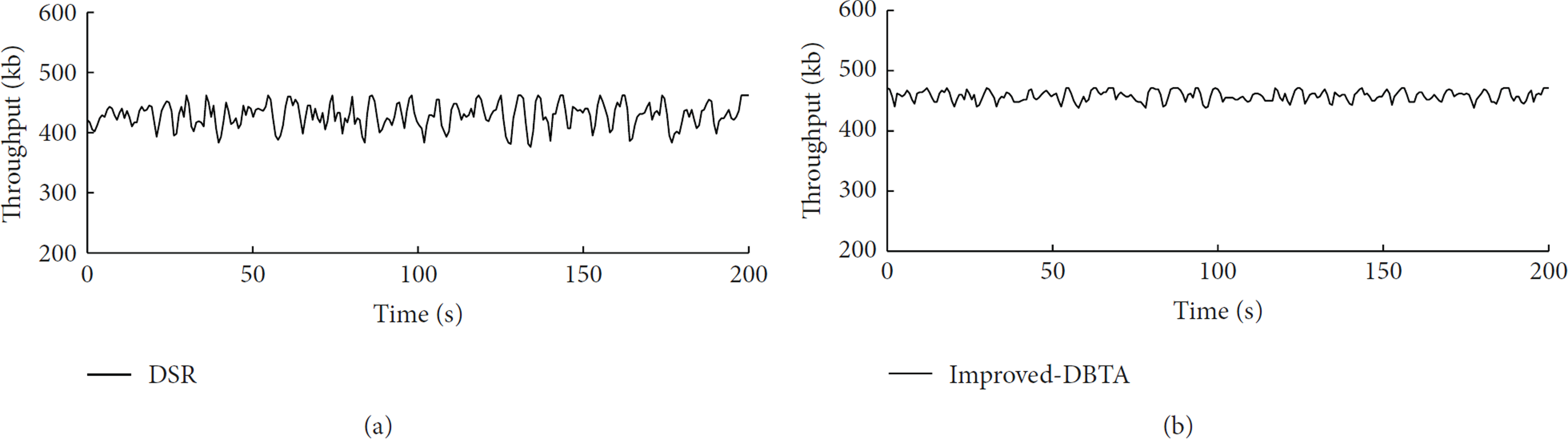
The throughput of DSR and improved-DBTA.
In contrast to the delay fluctuations, we still use similar methods and choose the path whose absolute value of delay is approximately equal to avoid the effects of the absolute value of delay on the volatility. The transfer delay result is shown as Figure 4.
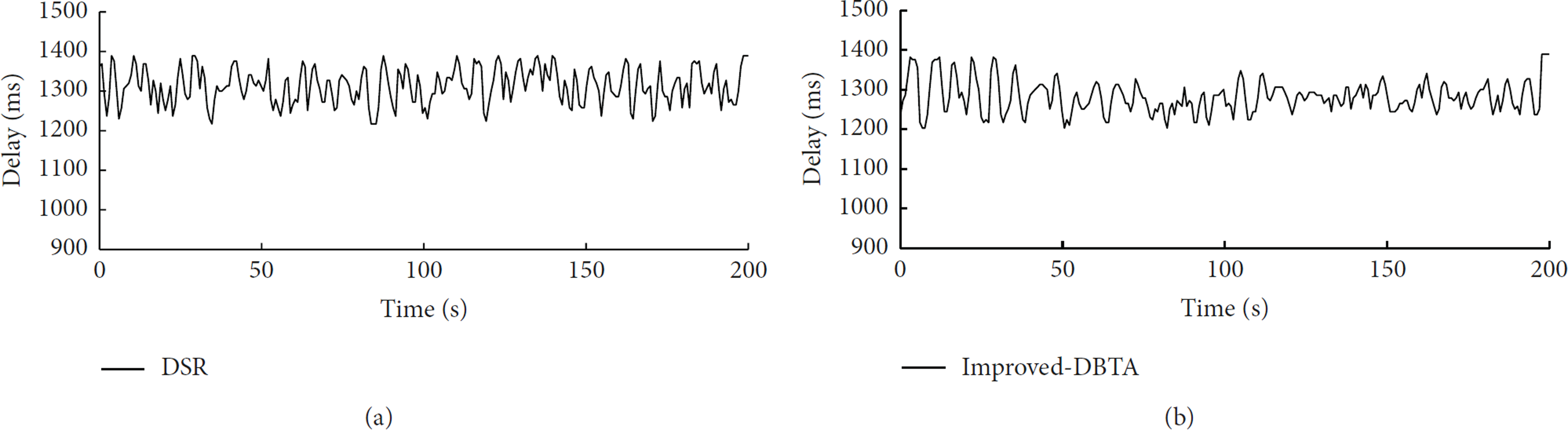
The transfer delay of DSR and improved-DBTA.
In the third part of the experiment, we used our own program written in C language to compare the difference of improved-DBTA and adaptive-DBTA in the delay and throughput. Similar to the principle of NS-2 principle, we used priority queue to implement event-driven simulation. The aim of the simulation is to study the difference between adaptive-DBTA and improved-DBTA, and the throughput comparison results are shown in Figure 5.

The throughput of improved-DBTA and adaptive-DBTA.
From the above experimental results, we can see, compared with the improved-DBTA, that the throughput jitter of adaptive-DBTA is slightly serious; this result is because each time adaptive-DBTA directly adjusts the sending rate to the equilibrium position calculated, while improved-DBTA gradually adjusts the sending rate to simulate the process of damped vibration. The comparison of these two algorithms in terms of path delay results is shown in Figure 6.

The transfer delay of improved-DBTA and adaptive-DBTA.
From the above experimental results, we can see, compared with the improved-DBTA algorithm, that the delay jitter of the adaptive-DBTA is slightly serious. And it is related to the experimental results of adaptive-DBTA throughput jitter. The delay of the two algorithms trends to increase, which is also related to the growth trend of throughput.
In addition, we also compared improved-DBTA with DCJOTA in [16], and the purpose of the experiment is to check the difference of effect between the algorithm in this paper and the other algorithms. The results of these two algorithms contrast experiment are shown in Figure 7.

The throughput of improved-DBTA and DCJOTA.
In addition, in the last part of the experiment, we did an experiment to compare the difference in the path delay jitter between improved-DBTA, the DCJOTA, the OPNET in [17], and the COTA in [18]. The path delay comparison results of all these algorithms are shown in Figure 8.

The throughput of DCJOTA, COTA, OPNET and improved-DBTA.
From the above experimental results, we can see that the control effect of the improved-DBTA on the throughput and delay jitter is similar to DCJOTA and COTA algorithms, all of which are indeed achieving the aim to control the delay jitter and are better than the effect of OPNET algorithm.
5. Conclusion
Wireless M2M communications network is a promising network access technology and has broad prospect of applications. The multipath transmission and load balancing problems that related to service quality and throughput of wireless M2M communications network have become a hot spot issue for many researchers. In many studies, people used complex mathematical models to analyze the problem. But we think that the physical model may be more applicative and easy to understand.
In this paper, we analyzed the traffic allocation problem of wireless M2M communications networks and built an appropriate model using physics method. We proposed new traffic allocation algorithms based on damping model, and the algorithms can reduce the network transmission delay jitter and load balancing. Here, we simply applied the damping model of classical mechanics; the more in-depth and effective application of the model to analyze and solve problems remains to be explored.
Footnotes
Acknowledgments
This research is supported by the National Science Funds of China Grant no. 61170305 and is part of Project of Education Information Strategy supported by Educational Commission of Tianjin, China, 2013, under Grant no. x2013-005.