




Abstract
A wireless sensor network (WSN) has become an important technology and has been deployed in many emerging applications, including home automation, health care, and precision agriculture. To deploy more service applications, the WSN must solve the internetworking problem (difference in speed, protocol stack, beacon collision etc.). In this study, we propose a redundant-path scheme based on a multichannel WSN for an efficient interworking among the heterogeneous networks. We evaluate the performance of our proposed scheme through a real-world simulation, and the results show an improvement in data throughput, packet delay, and beacon loss ratio.
1. Introduction
A wireless sensor network (WSN) has been a key technology in recently emerging services (e.g., home automation, smart building, health care, precision agriculture, and surveillance) [1–5]. Moreover, the rapid advances in the wireless networks, embedded systems, and sensor technologies have introduced various WSN-related industries that are becoming more important in everyday life [6–8]. These recent emerging services and the various WSN-related industries require interworking capability between the WSN and the Internet [9]. Figure 1 shows the conceptual service network model with WSN.

Conceptual service network model.
In this internetworking capability, we must solve the following problems: different speeds, protocol stacks, beacon scheduling, and data traffic. First, these two network types are very different in terms of speed and protocol stacks. To deal with the speed difference and to cope with the network protocol variations, we implement an internetworking node equipped with two types of network interfaces and conversion functions.
Second, to cover wide areas and survive for a long time in applications, such as environmental monitoring, WSNs must be scalable and efficient in terms of power consumption. Scalability and power savings in the IEEE802.15.4/ZigBee are usually achieved by constructing a cluster-tree topology using a beacon-enabled mode [10, 11]. However, the detailed construction scheme and the beacon scheduling algorithm have not yet been completely resolved [12]. Therefore, serious problems such as beacon collision occur frequently. Three factors cause this problem: direct beacon collision, indirect beacon collision, and collision with the data frame [12]. Beacon collision causes the loss of synchronization between the nodes and their coordinator; thus, the network will be broken.
Furthermore, constant and burst traffics can happen simultaneously on the service network. These traffic characteristics are dependent on the application and heterogeneous traffic aggregates on the network.
To reliably transfer the traffics without a significant packet loss, we need to develop a redundant-path scheme based on a multichannel MAC protocol to increase the throughput, decrease the delay, and prevent packet loss.
2. Proposed Scheme
2.1. Structure and Functions
The internetworking node consists of a gateway unit with an internet interface and a sink unit with a ZigBee/IEEE802.15.4 interface. The gateway and the sink units are connected by a serial communication link. The sink unit functions as a personal area network (PAN) coordinator (PNC) [13]. The gateway unit has a high-speed network interface for interworking with the Internet, and the sink unit has a low-speed network interface for interworking with WSN. A flow control mechanism on the serial communication link between the gateway and sink units is desired. Furthermore, the address translation function between the gateway and the sink units is desired.
2.2. Redundant-Path Scheme Based on Multichannel
To cover wide areas and survive for a long time in applications such as environmental monitoring and smart building, the WSN must be scalable and efficient in terms of power consumption. The scalability and power savings in IEEE802.15.4/ZigBee are usually achieved by constructing a cluster-tree topology using the beacon-enabled mode. However, the detailed construction scheme and the beacon scheduling algorithm have not yet been introduced [12].
Moreover, the IEEE802.11-based WLAN can increase its performance using the multichannel [14]. However, no attempt has been made for the IEEE802.15.4/ZigBee. Even if the IEEE802.15.4/ZigBee has 16 channels in the 2.4 GHz ISM band, only one channel is used to construct a PAN. Every member node in a cluster must contend with this single channel within the scheduled superframe duration (SD), which is equivalent to an active period. Although the clusters are separated, they use the same channel within the PAN except during the exclusive scheduling of their SD. Therefore, many problems arise, such as beacon loss, loss in synchronization, longer delay, and interference [12].
To overcome these problems, we propose a redundant-path scheme based on multichannel.
2.2.1. Beacon Scheduling
Figure 2 shows our proposed beacon frame structure. We slightly modified the beacon frame of the IEEE802.15.4/ZigBee. By using the payload field, the coordinator sends information to the other nodes about the depth, the number of associated devices (NOAD), its schedule, and its neighbor's schedule of the SD. The other fields are defined in [10, 11] as the standard. CH [itself] indicates that this beacon is sent by this channel number itself. CH [other-k] and CH [other-l] indicate the channel numbers that can be detected as one-hop neighbors by the coordinator. Offset denotes the relative time to start their beacon frame from this modified beacon frame. Depth means the hop count from the PNC. The NOAD field denotes how many devices are associated.

Beacon frame structure.
Figure 3 shows an example of the channel assignment and scheduling. The PNC sequentially schedules the SD of a channel (CH2 of the first cluster) during the inactive period of the other channel (CH1 of the first cluster). The SD for CH2 of the first cluster can be scheduled simultaneously with the SD for CH1 of the second cluster. After CH1 of the second cluster and CH2 of the first cluster become inactive, the SD for CH3 of the first cluster is scheduled simultaneously with the SD for CH2 of the second cluster. After CH2 of the second cluster and CH3 of the first cluster become inactive, the SD for CH1 of the first cluster should be rescheduled at every beacon interval. It can be scheduled simultaneously with the SD for CH3 of the second cluster.

Channel assignment and scheduling example.
The use of multichannel (different channels per cluster) alleviates the contention and interference problem by decreasing the number of nodes in a cluster. As a result, the throughput can be increased, and the delay will decrease.
Analogous to a child, a coordinator should at least be joined with the two parent coordinators. One is the primary link to the home channel, and the other is the secondary link for load sharing or alternating purpose. This multipath scheme provides a reliable connectivity and shorter delay.
2.2.2. Joining Procedure
Figure 4 shows the procedure for a new node to become a coordinator or a device. The depth and the NOAD fields can be used by the new device to choose which coordinator is suitable for associating with. When the new device wants to join the PAN, it first scans the channels to obtain a list of PAN descriptors. Then, it chooses a coordinator that has a smaller depth and a smaller number of associated devices. The coordinator with a smaller depth is the nearest to the PNC than the other coordinators. The cluster controlled by the coordinator that has a smaller number of associated devices is not crowded as compared with the other clusters.

Joining procedure.
2.2.3. Redundant-Path Operation
In the example shown in Figure 5, the gateway-sink node functions as the PNC. It can construct its own first cluster, including the three coordinators (or ZigBee routers) and the devices assigned to three different channels. Each coordinator on the different channels can also construct its cluster like a tree. In this way, the WSN coverage can be expanded.

Illustration of the effect of the redundant-path scheme.
Figure 5 also shows the effect of the redundant-path scheme. Device 23D sends a packet to its coordinator 22C during the SD of CH2 of the second cluster. In the normal operation case, 22C will relay the packet to its parent coordinator 21C during the SD of CH2 of the first cluster. On the other hand, in abnormal cases, such as the loss of synchronization, failure of node 21C, and congestion by heavy load, the packet will be blocked at 22C until the problem is resolved, or it will be discarded because of lack of buffer space. In the case when intermediate node 21C fails, several nodes will become orphans even if they can continue to serve. The intermediate coordinator must find another association link on a different channel as soon as possible. With this secondary link, we can prevent several nodes from becoming orphans and continuously transfer important information.
After choosing a coordinator, when the new device wants to be a new coordinator to expand the network scalability, it must schedule its SD not to overlap with its parent coordinator's SD.
The new candidate coordinator can calculate its SD schedule with the offset information from its neighbor.
3. Implementation
3.1. Structure
Figure 6 shows the hardware and software structure of the gateway-sink node, which consists of the gateway unit with an internet interface and a sink unit with a ZigBee/IEEE802.15.4 interface. The gateway and sink units are connected by a serial communication link.

Gateway-sink node HW/SW block.
The sink unit functions as a PNC [11]. It is made of an 8-bit MCU with a 128 kB small memory size similar to other commercial sensor nodes. As the gateway unit deals mostly with the interworking tasks between the two network types, the 32-bit MCU is adopted and a 256 MB of memory is provided for the TCP/IP stack and the packet buffering for the flow control. Figure 7 shows the implementation of the gateway and sink units.
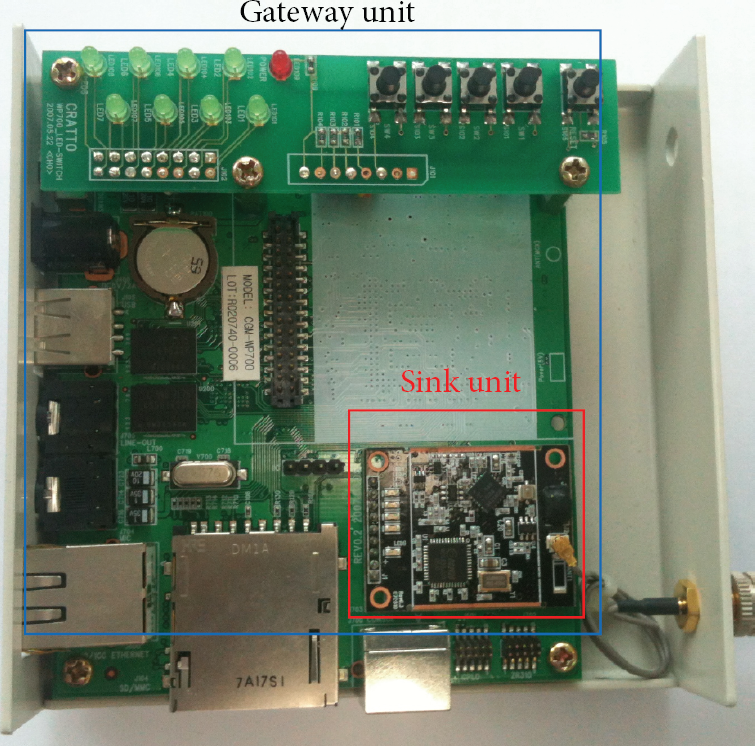
Gateway and sink units.
3.2. Flow Control and Protocol Conversion Function
The WSN has different requirements as compared with the other network types. The WSN follows a pattern of multihop networks organized by distributed nodes. Since each node is usually activated by a battery and replacing the battery is very difficult, a shortage in the battery power stops the node operation. Eventually, the WSN will be broken. Therefore, the most important challenge is to provide energy efficiency. To reduce energy consumption and to extend the network lifetime, the ZigBee/IEEE802.15.4 usually uses a low duty cycle consisting of a short active period and a long inactive period [10, 11]. However, the gateway unit does not suffer from any energy constraint because it is located at the wired internet backbone and it has abundant power. Furthermore, the gateway unit has a high-speed network interface for interworking with the Internet. The transmission speed of a high-speed Internet (e.g., 100 Mbps Ethernet) is much faster than that of the ZigBee/IEEE802.15.4 (e.g., 250 kbps).
The difference in the transmission speed of the networks can be overcome using a buffer between the gateway and the sink units. The gateway unit cannot know the state of the sink unit whether the latter is in an active or inactive period. During the active period, the sink unit is in a busy state, engaging in communication with its associated devices analogous to its children. Therefore, preventing traffic from being transferred to the sink unit is necessary during the active period. A flow control mechanism on the serial communication link between the gateway and the sink units is designed. When the sink unit stays in the active period, it transmits an X-OFF to prohibit the gateway unit from sending data. Otherwise, it transmits an X-ON to receive data being buffered in the gateway unit side.
We implemented the address translation function such as Network Address Translation (NAT) [15]. The Internet uses the IPv4 or IPv6 address schemes. The ZigBee uses the short or long address scheme depending on its application. The address translation function matches the IP address with the ZigBee short address.
4. Result and Discussion
We evaluated the performance of our proposed scheme, which was configured with three-hop clusters with three different channels in the two network topologies. Figure 8 shows the test topologies.

Test topologies.
In Topology 1, each node is well placed to avoid interference, and in Topology 2, most nodes are placed very close so that their placement almost overlaps.
According to [10, 11], the configuration parameters are set as shown in Table 1.
Configuration parameters for the evaluation.

We assumed that no mobile nodes existed. The data packet had a 64 B fixed length. Each channel bit rate was 250 kbps. To measure some performance parameters such as the throughput and the delay according to the traffic load, we generated the traffic of data packets with a constant bit rate and increased the generation rate by 0.05 kbps. All nodes generated the data packet except the PNC. The range of transmission was 15 meters, and the range of the RF interference was 30 meters.
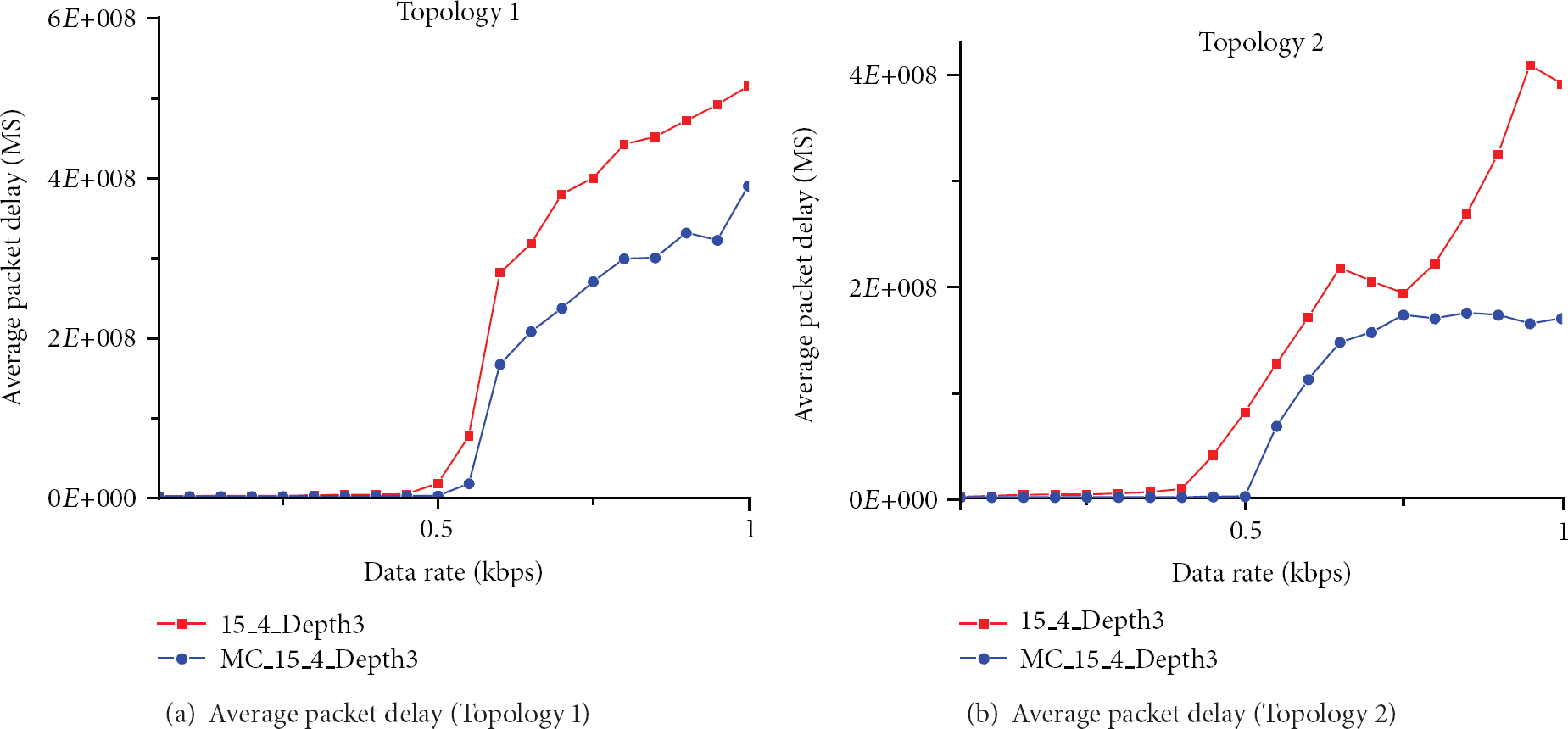
Our proposed scheme was compared with the conventional IEEE802.15.4/ZigBee using a single channel. The results in terms of throughput, beacon loss, packet delay, and queue size are shown in Figures 9–12, respectively.

Throughput.

Beacon loss.
Average packet delay.

Average queue size.
Since the proposed scheme used three channels simultaneously, the density of the member contending with a channel became sparser than that of the IEEE802.15.4/ZigBee. Therefore, Figure 9 shows that the proposed scheme yielded approximately two times higher throughput. The throughput in Topology 1 was higher than that in Topology 2.
As shown in Figure 10, the beacon loss of our proposed scheme is less than that of the IEEE802.15.4/ZigBee. As a result, our proposed scheme can provide a more reliable and scalable service.
Figures 11 and 12 show the average transmission delay time of the data packet in the third cluster and the average waiting queue length in the third cluster, respectively. The delay time and queue length of our proposed scheme are shorter than those of the IEEE802.15.4/ZigBee. These results are attributed to the same reason as that in the aforementioned throughput case. In the case of the IEEE802.15.4/ZigBee, collision and back-off occur more frequently than those in our proposed scheme, because all nodes have to contend with the single channel using the CSMA/CA. This collision and the back-off make both the transmission delay time and the queue length longer. As a result, our proposed scheme is an efficient interworking scheme in the interference (Topology 1) and noninterference (Topology 2) environments.
5. Conclusions
In this paper, we have proposed the interworking architecture, which was composed of the flow and protocol conversion functions, as well as the redundant-path scheme based on multichannel, which was slightly modified from the conventional IEEE802.15.4/ZigBee design. Its performance was evaluated by a real-world simulation. Our proposed redundant-path scheme based on the multichannel can increase the throughput, decrease the delay, and prevent network failure from beacon loss and node failure in the two topologies. From these results, it is verified that our proposed scheme in WSNs is more suitable for providing automation and remote control application service through an efficient interworking method between the WSN and the Internet.
Footnotes
Acknowledgment
This work was supported by the government funded R&D program under the Ministry of Strategy and Finance, Republic of Korea.