




Abstract
Ambient and forced vibration tests are proposed to evaluate dynamic characteristics of a caisson-type breakwater, including natural frequencies and modal damping ratios. The feasibility of a numerical analysis model with fluid-structure-soil interaction effects, which play an important role in evaluating structural performance and safety, was investigated by comparing the numerical results with experimental results. The Oryukdo breakwater in Busan, Republic of Korea, was employed as the target structure. This breakwater was once heightened by installing additional parapet structures of about 4 m tall to improve the harbor tranquility in 2005. Vibration tests were carried out in 2000 (before heightening) and in 2011 (after heightening). Most caissons were tested in the first test, while only one caisson was tested in 2011. It was found that natural frequencies were reduced by 1.7%–4.3% after heightening, and similar results were observed from the numerical analysis. It was also found that forced vibration tests can yield more reasonable results than ambient vibration tests. Even though there is some discrepancy between experimental and numerical results, numerical analysis can be carried out to analyze dynamic characteristics and evaluate structural performance and safety.
1. Introduction
In the recent years, strong typhoons (e.g., Typhoon Maemi in 2003 and Typhoon Bolaven in 2012) have slammed into the Korean Peninsula. Tremendous economic losses were incurred, including the severe damage to harbor structures. To protect harbor infrastructures and facilities from future typhoons and storms, design specifications for breakwaters should be revised to take into account gradually increasing extreme wind speed and wave height during typhoons due to climate change in the northeast Asian region [1]. Accordingly, existing structures designed to old design specifications need to be upgraded to meet the recently revised design codes based on performance evaluations.
It is possible to evaluate existing structures by carrying out numerical analysis with simulation models based on design drawings. However, it would be very difficult or infeasible to quantitatively evaluate structural performance when design drawings are unclear or when the structure is modified without documentation. In such cases, the structural performance can be evaluated using nondestructive techniques or loading tests, which can also be applied to assess the reusability of deteriorated facilities (e.g., armor blocks, tetra pods, and caissons) in harbor remodeling projects. Among available methods, visual inspection is a practical and widely applied means of inspecting caisson-type breakwaters and can be supplemented with nondestructive evaluation when necessary. Loading tests such as static and dynamic tests allow for loading conditions similar to service loading states and hence can more accurately evaluate structural performance. However, such tests require a lot of time and expense to be carried out and are very difficult or impossible to apply to large infrastructures like caisson-type breakwaters. Alternatively, ambient and forced vibration tests (AVTs and FVTs), which are actively applied to large inland infrastructures such as bridges and buildings, can be also applied for performance evaluations of caisson-type breakwaters.
Vibration tests on caisson-type breakwaters were previously reported by many researchers [2–5]. Boroschek et al. [6] evaluated a pile-supported breakwater using AVTs and FVTs to identify the dynamic characteristics of a pile-supported breakwater. Gao et al. [2] analyzed dynamic characteristics such as natural frequencies in the 0–30 Hz range for a newly constructed caisson-type breakwater in Shandong Province, China, using six tons of exciter, and identified two rigid body modes at about 3.8 Hz and 8.0 Hz. Lamberti and Martinelli [3] carried out FVTs using impact loading on two breakwaters in Genoa Voltri Port and Punta Riso Port in Italy using a sand bag of 2 tons and tugboats of 100 and 500 tons as a part of PROVERBS, a research project to develop reliability-based design guidelines. It was found that the estimated natural frequencies, that is, 1.4–1.8 Hz for the first mode and 2.3–3.6 Hz for the second mode, were very close to the numerically calculated values. Furthermore, it was observed that the horizontal and rotational modes are highly correlated. Boroschek et al. carried out similar vibration tests on a pile-supported breakwater in Ventanas Port, Chile, through pull-back tests (a type of FVTs) and AVTs. It was reported that clearer and more distinct peaks were observed from FVTs than AVTs, and the first and second natural frequencies were estimated to be around 1.6 Hz and 2.7 Hz, respectively. They also investigated the effects of the external loading level (i.e., pull-back force) on natural frequencies, damping ratios, and initial deflections.
In this study, vibration tests were performed on the caisson-type Oryukdo breakwater in Busan, Republic of Korea, which was heightened about 4 m by installing additional parapet structures to increase harbor tranquility. Two rounds of tests were carried out: in 2000 before heightening and in 2011 after heightening. The first tests were FVTs via tugboat and were conducted to investigate the structural safety of most of the caissons. The stochastic subspace identification method was applied to estimate natural frequencies and modal damping ratios of the caissons. The more recent vibration tests were carried out to investigate the effect of the additionally installed parapets. The practicality of the numerical analysis model was then investigated by comparing the analysis results with experimental results.
2. Theoretical Background
2.1. Experimental Modal Analysis Method
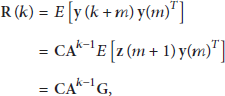
The stochastic subspace identification method utilizes the singular value decomposition of a block Hankel matrix with a cross-correlation matrix of responses. The fundamental basis is the stochastic state-space equation, which expresses the system dynamics under the stochastic random excitation as



2.2. Numerical Modal Analysis Method
Dynamic analysis with fluid-structure-soil interactions was carried out to analyze the dynamic characteristics of a caisson-type breakwater. In this method, the region of the structure and near-field soil is modeled using finite elements, and the far-field soil medium is modeled using infinite elements as shown in Figure 1. The fluid region is modeled with inviscid and incompressible fluid elements for the near-field region and viscous dampers at the interface between the near-field and far-field regions.

Modeling of fluid-structure-soil interaction system.
The dynamic stiffness matrix for structure and near-field soil medium (






Herein, because the bending mode can reduce the accuracy of the fluid element associated with volumetric deflection, (1 × 1)-reduced integration and mass projection techniques were applied for constructing stiffness and mass matrices, respectively, to resolve the accuracy problem. The spurious zero-energy modes in rotational displacement were solved by forcing a rotational penalty method with irrotational flow conditions. Finally, the stiffness and mass matrices for the four-node quadrilateral displacement-type fluid element can be obtained as follows [12]:



3. Dynamic Characteristics by Forced Vibration Tests
3.1. Layout of Target Structure and Experimental Setups
Vibration-based structural tests were carried out on the Oryukdo breakwater in Busan, Republic of Korea, in 2000, as a part of a structural safety assessment project on that breakwater. At that time, FVTs using impact loading applied by a tugboat were carried out on most of the caissons. Three successive caissons were combined into one test case, and 14 test cases were conducted as shown in Table 1. The center caisson in each group was excited with a tugboat, and impulse responses were measured using eight accelerometers, as shown in Figure 3(a). The caisson IDs and case numbers are indicated in Figure 2(a) and Table 1. The accelerometers were installed on the top surface of the cap concrete, as shown in Figure 3(a). Meanwhile, in 2005, the height of this breakwater was increased by constructing additional parapet structures of 4 m to protect naval facilities in the harbor. To investigate the effect of the additional parapet structures on the dynamic characteristics, AVTs and FVTs were performed in 2011 using the experimental setup shown in Figure 3(b). Details of the setup are described in Yoon et al. [14].
Test cases and caisson IDs.


Location of target breakwater and impact vibration test.
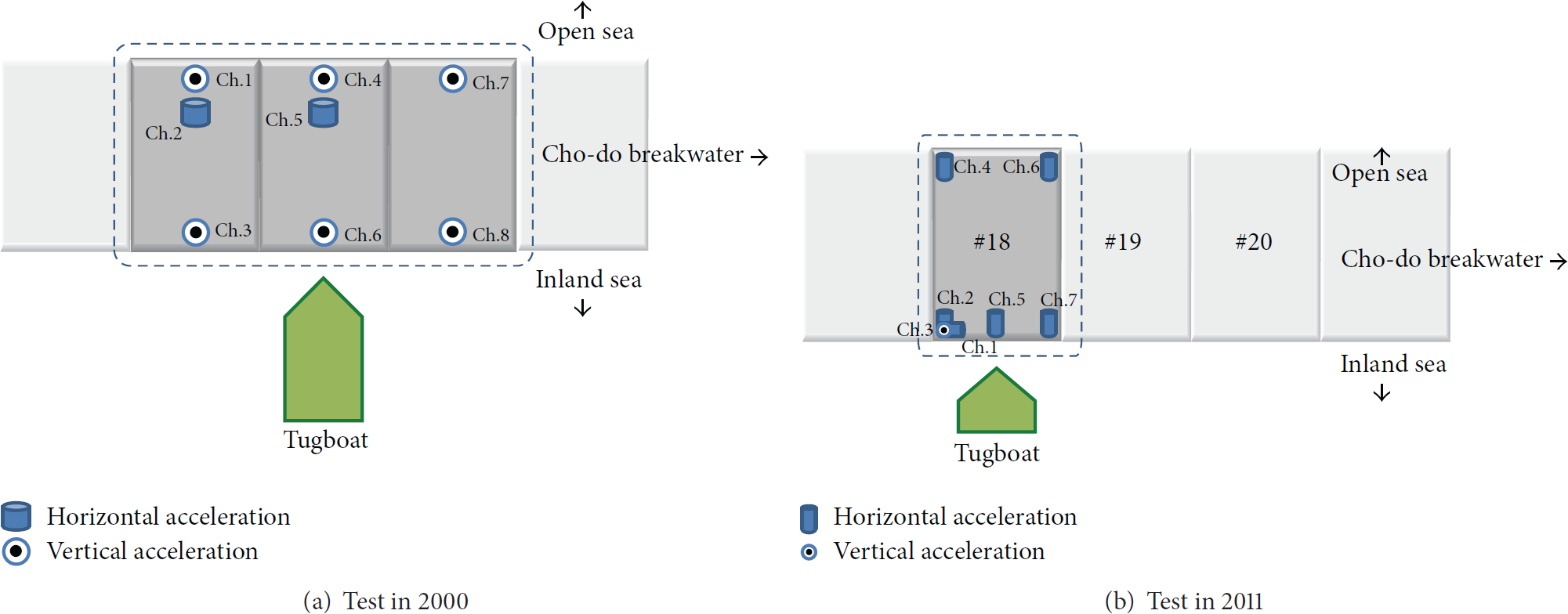
Experimental setups.
3.2. Vibration Tests in 2000 before Parapet Installation
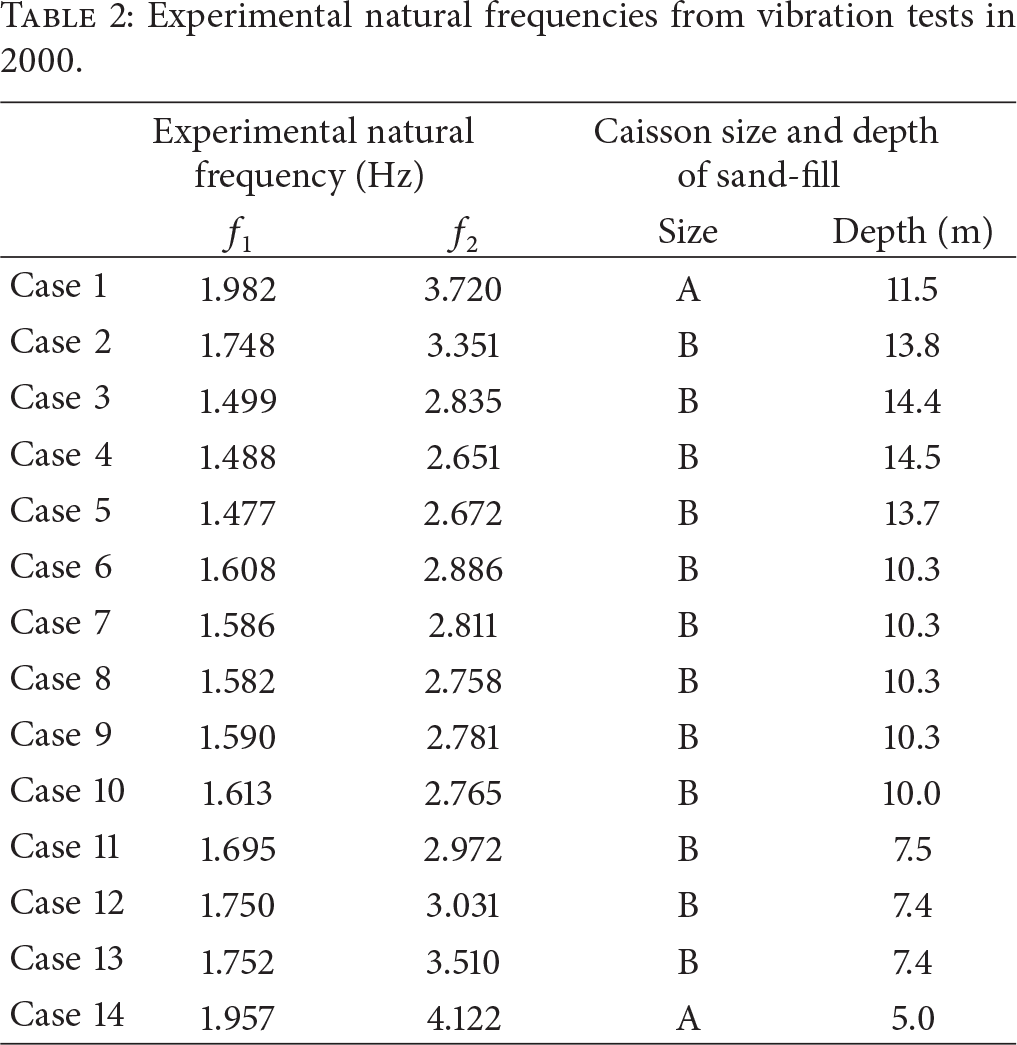
Figures 4(a)–4(c) show impulse responses for Cases 3 and 4, and Figure 4(d) shows the stabilization chart for selecting stable modes and an appropriate model order [15] by stochastic subspace identification during the experimental modal analysis. From this stabilization chart, it can be seen that there are two clear and distinct modes around 1.5 Hz and 2.7 Hz. The estimated natural frequencies are listed in Table 2 along with the modal damping ratios.
Experimental natural frequencies from vibration tests in 2000.

Measured impulse responses and stabilization chart.
From Table 2, it can be observed that the estimated natural frequencies are obviously reduced as the sand-fill layer is thickened as shown in Figure 5. It means that the structural system becomes more flexible as the thickness of the sand-fill layer increases. This is because of the larger flexibility of the sand-fill layer (shear wave velocity of about 250 m/s) compared to that of the bedrock (shear wave velocity of about 400 m/s). Figure 6 shows the estimated modal damping ratios. Although there is no clear relationship between the damping ratios and depth of the sand-fill layer, it can be observed that the modal damping ratios for the second mode are generally higher than those for the first mode. Furthermore, the estimated damping ratios are in the range of 4%–15%, which is relatively higher than the range for general concrete structures. This is attributed to the additional hydrodynamic damping effects owing to the adjacent sea water in this structural system.

Estimated natural frequencies and thickness of sand-fill.

Estimated modal damping ratios and thickness of sand-fill.
3.3. Vibration Tests in 2011 after Parapet Installation
Figures 7 and 8 show the measured acceleration responses and their corresponding stabilization charts for the 18th caisson structure, with the results of AVTs shown in Figure 7 and the results of FVTs shown in Figure 8. For the field works, wireless system is good to reduce installation time and cost [17]. Therefore, instead of the wired system used in the earlier test in 2000, wireless sensors were used in the tests. Seven high-sensitivity ICP-type accelerometers with a measurement range of ±0.5 g were used, and the acceleration responses were sampled at 100 Hz. Ambient vibration responses were also measured for three minutes after impact-based FVTs. The estimated dynamic characteristics are listed in Table 3.
Experimental natural frequencies from vibration tests in 2011.


Measured responses and stabilization chart for AVTs.

Measured responses and stabilization chart for FVTs.
The natural frequencies for the first and second modes are estimated to be 1.471 Hz and 2.753 Hz, respectively, from AVTs; they are estimated to be 1.430 Hz and 2.695 Hz, respectively, from FVTs. From the results, it is observed that the estimated natural frequencies from FVTs are lower than those from AVTs by 2.1%–2.8%. This can be explained by considering the level of external forces: in the case of AVTs, the external force is relatively small, and, hence, the responses are also very small and the soil behaves relatively stiffer owing to the initial stiffness effects. Similar trends were found in the research by Boroschek et al. [6], who reported that the estimated natural frequencies from a pull-back test were 1.63 Hz and 2.74 Hz for the first and second modes, respectively, and that these values were lower than those from AVTs (1.68 Hz and 2.82 Hz) by 2.8%-2.9%. Considering these observations, it can be preliminarily concluded that the natural frequencies estimated from FVTs are slightly lower than those obtained from AVTs by about 2%-3%. Considering that strong typhoons generate high levels of external loads, FVTs can exert more realistic loading conditions. In other words, the structural stiffness can be overestimated by AVTs. Compared with the previous results obtained in 2000, the first and second natural frequencies decreased by about 1.7%–4.3% after heightening owing to the additional mass effects as shown in Table 4.
Changes in natural frequencies after parapet installation.

4. Numerical Modal Analysis Results
4.1. Layout of Numerical Analysis
Figure 9(a) shows the sectional dimension of the Oryukdo breakwater after it was heightened, and Figure 9(b) represents the corresponding numerical analysis model using finite, infinite, and viscous damper elements. This numerical analysis model built for the heightened structure was constructed by simply adding the installed parapet (circled in Figure 9(b)) to the model of the unheightened breakwater. In 2011, only one caisson (the 18th) was tested among the 46 total caissons for the purpose of this comparison study. It is noted that the sand-fill depth is 14.8 m, the region of the structure and near-field soil was modeled using 2D plane finite elements, the fluid region was modeled using quadrilateral four-node displacement-type fluid elements, and the horizontal infinite far-field soil region was modeled using 2D dynamic infinite elements. A viscous damper was also added for simulating the radiational energy dissipation.

Sectional dimension and numerical model of breakwater after parapet installation.
The material properties used in the numerical analysis are listed in Table 5, with general concrete properties, assigned to the cap concrete, caisson, and concrete block, and ordinary sea water properties used for the fluid region. The soil properties listed in Table 5 were assigned for the armor blocks, sand-fill, and infinite homogenous half-space region.
Material properties of caisson and soil for numerical analysis.

4.2. Analysis Results
In this study, the KIESSI-2D software (a computer program for soil-structure interactions using finite and infinite element techniques) was used for forced vibration analysis on the breakwater structure considering fluid-structure-soil interactions [18]. The dynamic characteristics were analyzed using numerical models of the structure before and after parapet installation, and the results were compared with experimentally evaluated natural frequencies.
To excite this structural system, impulse loading was applied, where the loading spectrum has unit amplitude at all frequencies (
Figures 10 and 11 show the calculated horizontal and vertical responses and the corresponding FRFs, respectively. The resonant frequencies obtained for the first and second modes are 1.514 Hz and 2.441 Hz, respectively, for the cases of the unheightened breakwater. The frequencies are 1.416 Hz and 2.344 Hz for the heightened case. Compared with the measured values shown in Table 6, the natural frequencies of the first mode are closely matched, while the second mode frequencies deviate by about 10%. Moreover, the frequency changes after structural heightening were 1.7%–4.3% in the experimental tests and about 4.6%–6.5% in the numerical tests. Hence, further studies are recommended for reducing discrepancies between experimental and numerical results to some extent.
Experimental and numerical natural frequencies before and after parapet installation.


Impulse responses at upper-right corner of cap concrete by FSSI analysis (Dotted line: before installation, solid line: after installation).

FRFs of responses at upper-right corner of cap concrete by FSSI analysis (dotted line: before installation; solid line: after installation).
5. Conclusions
Dynamic characteristics were analyzed using experimental and numerical tests for the caisson-type Oryukdo breakwater, in Busan, Republic of Korea, and the practical applicability of a numerical analysis model was investigated by a comparison study. From the tests, it was found that the natural frequencies decrease as the sand-fill layer is thickened as a result of the lower shear wave velocity of sand-fill (
It was also found that the estimated natural frequencies after heightening are lesser by 1.7%–3.7% compared to those before heightening owing to the additional mass effect to the parapet structure, which is not affected by stiffness change. A similar trend was found from numerical analysis as well. However, there is some degree of discrepancy (about 2%-3%) between the experimental and numerical results. Hence, further studies are recommended to investigate the source of this discrepancy and identify effective remedies. It is noteworthy that the methods presented in this study can be applied in the global monitoring of damage such as scouring at the foundation of caisson-type structures. Moreover, vibration tests can be a good alternative to the visual inspections popularly performed by divers, which are generally time-consuming and dangerous.
Footnotes
Acknowledgments
This work was supported by the KIOST Research Program (PE98974) and Basic Science Research Program through the National Research Foundation of Korea funded by the Ministry of Education, Science and Technology (NRF-2013R1A1A2A10012040). The authors would like to express their appreciation for the financial support.