




Abstract
This paper investigates the entropy generation of a nonisothermal, incompressible Newtonian fluid flowing under the effect of a constant pressure gradient in plane Poiseuille flow. The effects of variable viscosity and thermal conductivity are also included. The viscosity and thermal conductivity of the fluid exhibit linear temperature dependence and the effect of viscous heating is included in the analysis. Channel walls are kept at constant temperatures. Velocity, temperature, and entropy generation profiles due to heat transfer and fluid friction are plotted. The effects of Brinkman number, Peclet number, pressure gradient, viscosity, and thermal conductivity constant on velocity, temperature, and entropy generation number are discussed. Discretization is performed using a pseudospectral technique based on Chebyshev polynomial expansions. The resulting nonlinear, coupled boundary value problem is solved iteratively using Chebyshev-pseudospectral method.
1. Introduction
Entropy generation due to different sources of thermodynamic irreversibilities destroys available energy and causes decreasing efficiency of processes. These thermodynamic irreversibilities can cause decreasing net power output and increasing net power input. If the causes of entropy generation can be identified, it can be minimized so that available energy can be saved. The available work can be lost in many components such as heat exchangers, mixers, turbines, and compressors due to irreversibility [1]. Intrinsic irreversibilities can be identified by a useful tool such as entropy generation analyses or second law analyses in any given system [2]. Mahmud and Fraser [3] investigated thermodynamic analysis of non-Newtonian flow and heat transfer inside a channel with two parallel plates. They considered fully developed forced convection. They solved governing equations analytically and investigated the effects of different parameters on entropy generation, velocity, and temperature distributions. The distribution of entropy generation in 2D laminar Poiseuille-Benard channel flow was studied by Abbassi et al. [4]. They showed variations of entropy generation and the Bejan number and found that the maximum entropy generation is localized at areas where heat exchanged between the walls and the flow is maximum. Demirel and Kahraman [5] investigated the entropy generation due to heat transfer and friction has been calculated for fully developed, forced convection flow in a large rectangular duct, packed with spherical particles, with constant heat fluxes applied to both the top (heated) and bottom (cooled) walls. They determined the distributions of the volumetric entropy generation and displayed graphically fully developed velocity and temperature profiles. Entropy generation for a fully developed laminar viscous flow in a duct subjected to constant wall temperature is investigated analytically by Şahin [6]. He considered the temperature dependence on the viscosity in the analysis. The variation of total exergy loss due to both the entropy generation and the pumping process is studied along the duct length. Şahin [7] determined the optimum duct geometry which minimizes losses for a range of laminar flows and constant heat flux by using a second-law comparison of irreversibilities. Circular, square, and equilaterally triangular and rectangular duct geometries are examined in this study. It was pointed out that circular geometry is the best especially when the frictional contributions of entropy generation become important. Yürüsoy et al. [8] formulated the entropy generation due to fluid friction and heat transfer with considering non-Newtonian fluid flow in annular pipes. They presented velocity, temperature, and entropy fields and found that entropy generation number increases with reducing non-Newtonian parameter. Vogel model was employed to account for the temperature-dependent viscosity in another study of Pakdemirli and Yilbas [9].
Because of its fundamental importance in many process components, extensive studies have been conducted to analyze entropy generation for flowing fluids in a channel and pipe, but most studies have been confined to constant viscosity case. Makinde and Aziz [10] reported steady state solutions for flows of a variable viscosity fluid through a plane Poiseuille flow with asymmetric convective cooling. They focused on the effect of heat generation due to viscous dissipation by using an efficient numerical shooting technique with a fourth-order Runge-Kutta algorithm. Şahin [11] studied a numerical investigation to determine the entropy generation and pumping power requirements for a laminar crude oil flow in a pipe with consideration of effect of viscosity on temperature. Makinde [12] was concerned with the analysis of inherent irreversibility in hydromagnetic boundary layer flow of variable viscosity fluid over a semi-infinite flat plate under the influence of thermal radiation and Newtonian heating. The effects of magnetic field parameter, Brinkman number, the Prandtl number, variable viscosity parameter, radiation parameter, and local Biot number on the fluid velocity profiles, temperature profiles, local skin friction, and local Nusselt number were presented in this study.
The present study combines the effect of variable viscosity and thermal conductivity to determine the flow profiles and temperature profiles in a plane Poiseuille flow and subsequently use that information to establish the entropy generation patterns. The governing equations are solved iteratively using Chebyshev-pseudospectral method. The effects of Brinkman number, Peclet number, and pressure gradient on the entropy generation are also determined.
2. Velocity and Temperature Profiles
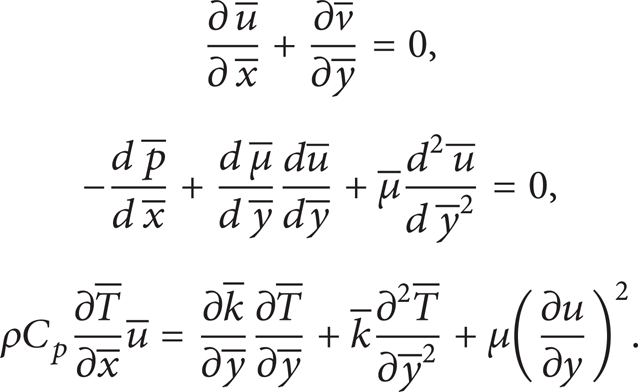
The velocity distribution of flow can be obtained from the continuity and momentum equations. In order to obtain temperature distribution, energy equation is also used. Two-dimensional, nonisothermal, and steady flow of an incompressible Newtonian fluid in a channel is considered. The flow is driven by a constant pressure gradient acting along the channel axis. Upper and lower walls of the channel are kept at the same constant heat flux. Fluid viscosity and thermal conductivity depend only on the local temperature. The continuity, momentum balance, and energy balance for a fluid can be expressed in the dimensional form as
In the present investigation two semiempirical formulas are used for viscosity and thermal conductivity, which were introduced by Charraudeau [13], as follows:


It is more convenient for the subsequent analysis to write the governing equations in dimensionless form by introducing the following parameters:
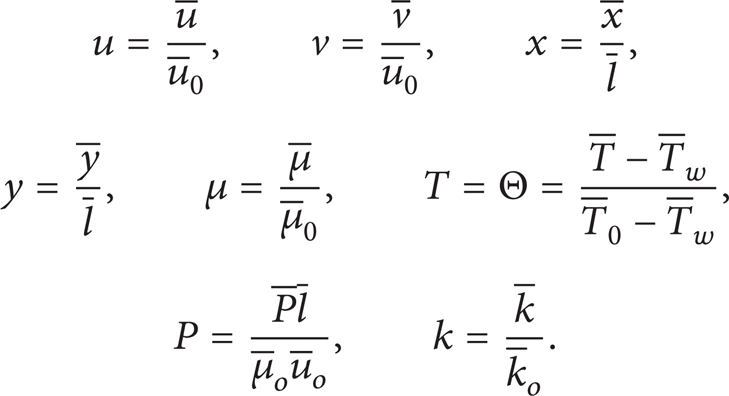
In the above equations x shows the flow direction, y is the coordinate normal to flow direction, u is the velocity parallel to the plates, v denotes the velocity perpendicular to flow direction, P is the pressure, θ shows dimensionless temperature,
Using the dimensionless parameter, the nondimensional form of the continuity, momentum balance, and energy balance equations including the effect of viscous heating can be expressed in the dimensionless form as

where Reynolds number (Re), Prandtl number (Pr), and Brinkman number (Br) are defined as
Continuity and momentum equations are solved simultaneously with the energy equation to determine velocity and temperature distribution for constant heat flux. In the case of constant heat flux, the continuous heating to the fluid flow continuously changes the viscosity which, in the case of variable viscosity, couples momentum equations with energy equations.
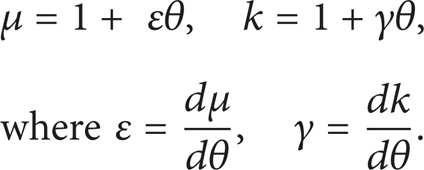
In the previous equations, viscosity and thermal conductivity are linear functions of temperature
The dimensionless boundary conditions are

Differential equations, along with the boundary conditions, constitute the governing equations to determine the base-flow velocity temperature profiles for the Poiseuille fluids. The boundary-value problem is solved numerically using a Chebyshev-pseudospectral method.
The nonlinear boundary value problem described previously was solved numerically by using Chebyshev-pseudospectral method. In this method, the 0 ≤ y ≤ 1 physical domain is first transformed to – 1 ≤ Y ≤ 1 spectral domain
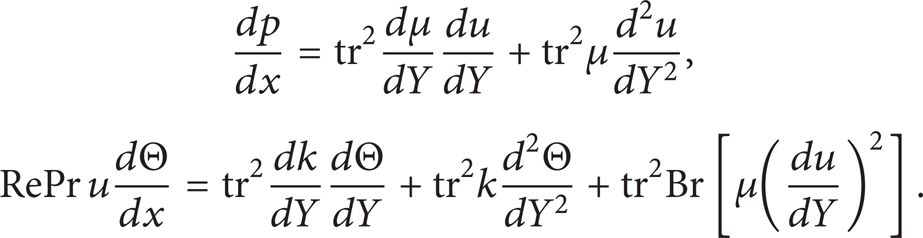
Here tr is transfer coefficient and its value is 2.0. As a second step, the velocity u and temperature θ are expanded in a series of Chebyshev polynomials

where a n and b n are the expansion coefficients and T n (Y) is the Chebyshev polynomial of the first kind defined as

then

and second derivatives

where c o = 2 and c n = 1 for n ≥ 1.
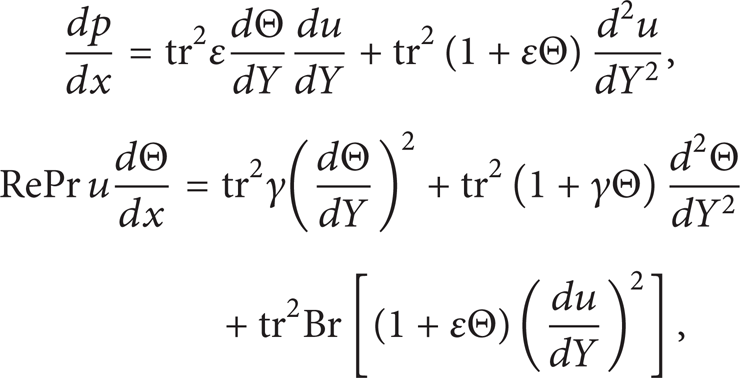
The temperature and velocity governing equations become
and the equations are expanded into Chebyshev polynomials
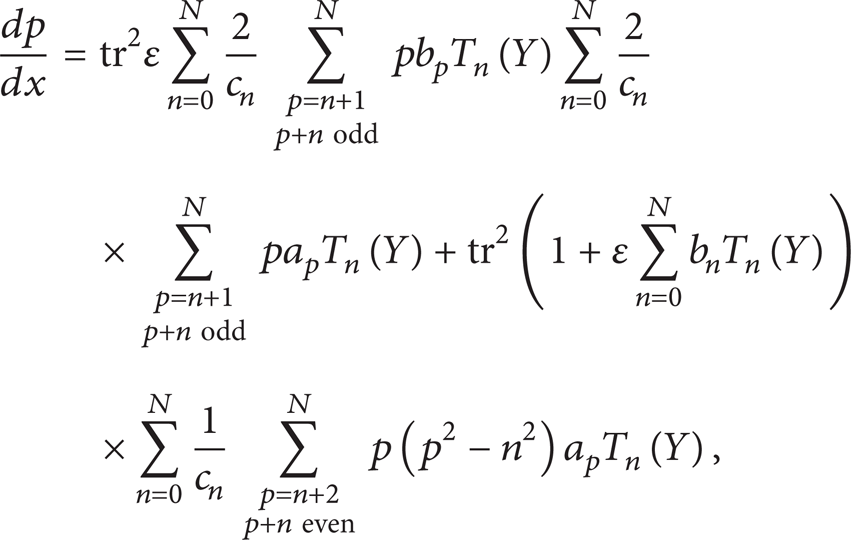

On the last step a proper choice of collocation points has to be made to solve 2N + 2 unknowns, N + 1 from a n and N + 1 from b n . For this case

is chosen. The Pseudospectral method requires that momentum and energy equations can be satisfied exactly at the previous collocation points. These results in 2N – 2 equations with the addition of four boundary conditions (2N + 2) equations are obtained. Since the momentum and energy balance equations are coupled, they are solved iteratively using a nonlinear equation solver from IMSL subroutine software.
3. Entropy Generation
Entropy generation is calculated from velocity and temperature profiles that are obtained from numerical solution of momentum and energy equations. The equation of entropy generation for two-dimensional flow of a Newtonian incompressible fluid is as follows [14]:

In this study due to assumptions (

Dimensionless entropy generation can be expressed as

where the ratio
4. Results and Discussion
Entropy generation in the flow field due to fluid friction and heat transfer is investigated. There are various parameters here whose effects on the flow behavior must be investigated. They are dimensionless parameters γ and ε that characterize the dependence of the thermal conductivity and viscosity, respectively, on temperature, Brinkman number (Br) that is a measure of magnitude of viscous heating, dimensionless pressure gradient dp/dx = G that denotes the degree of fluid driving force, dimensionless constant temperature gradient in axial direction dΘ/dx, and Peclet number (Pe) that signifies axial conduction of thermal energy [15]. During this study temperature gradient in axial direction is kept as a constant value.
Pressure gradient affects the velocity profiles as well as temperature profiles. To see the effect of pressure gradient on velocity and temperature profiles, Figures 1 (a) and 1 (b) are illustrated. Constant parameters are Pe = 7.0, Br = 5.0, ε = 0.01, γ = 0.01, and Br/Ω = 1.0 while G = – 0.5, −1.0, and – 2.0. It is clearly seen that the pressure gradient has the considerable effect on velocity and temperature profiles in Figures 1 (a) and 1 (b). Figures 2 (a) and 2 (b) depict the entropy generation due to heat transfer and fluid friction for different pressure gradient values for the same constant parameters. Entropy generation arising from fluid friction effect increases if the pressure gradient increases. At a location on the wall entropy generation due to fluid friction is expected to be higher than any location in the channel because of viscous friction between the walls and fluid.
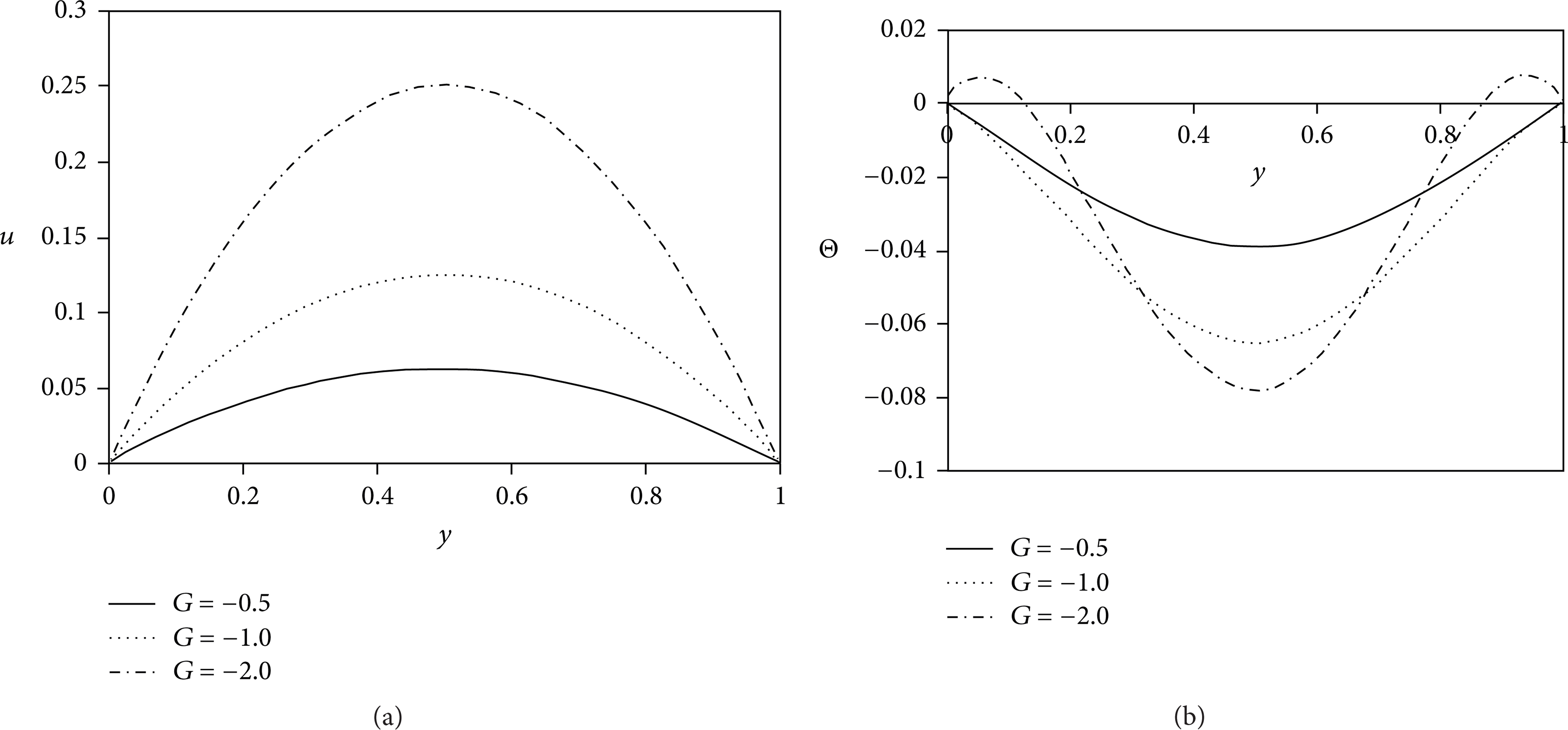
(a) Effect of pressure gradient on velocity profile. (b) Effect of pressure gradient on temperature profile.

(a) Effect of pressure gradient on entropy generation due to fluid friction. (b) Effect of pressure gradient on entropy generation due to heat transfer.
The entropy generation due to heat transfer is plotted in Figure 2 (b). For pressure gradient values – 0.5 and – 1.0, entropy generation increases from the center of channel to a maximum value and then decreases towards the channel walls. Since sudden change of temperature occurs, maximum entropy generation due to heat transfer is not generated on the wall; instead it is generated at a location near the wall. For dp/dx = – 2.0, entropy generation is zero at a centerline of channel and at a location close to the walls. Between these regions maximum entropy generation is generated.
The effect of Pe number on entropy generation due to heat transfer and fluid friction is shown in Figures 3 (a) and 3 (b), respectively. Constant parameters are Br = 5.0, ε = 0.01, γ = 0.01, G = – 0.5, and Br/Ω = 1.0 while Pe = 7.0, 15.0, and 50.0. Figure 3 (a) shows that increasing Pe number has no effect on entropy generation due to fluid friction. Entropy generation due to heat transfer is presented in Figure 3 (b) for different values of Pe number. This figure shows that entropy generation decreases sharply towards the centerline of channel for Pe = 50.0 and gradually decreases for Pe = 7.0 and 15.0.

(a) Effect of Peclet number on entropy generation due to fluid friction. (b) Effect of Peclet number on entropy generation due to heat transfer.
The effect of Br number on velocity and temperature profiles is shown in Figures 4 (a) and 4 (b), respectively. Constant parameters are Pe = 7.0, ε = 0.01, γ = 0.01, G = – 0.5, and Br/Ω = 1.0while Br = 3.0, 5.0, and 10.0. Figure 4 (a) shows that increasing Br number has no effect on velocity profile. Since the group parameter determines the relative importance of viscous effects, viscous irreversibility is illustrated in Figure 5 (a) for different values of group parameter for Br = 5.0. In all cases, no entropy is generated at the center of channel. Magnitude of entropy generation takes higher value for higher group parameter. However, Figure 4 (b) shows that the increase in Br number causes increase in the fluid temperature. This, in turns causes a decrease in the entropy generation due to heat transfer. The effect of Br number on entropy generation due to heat transfer is given in Figure 5 (b). This figure shows that entropy generation is zero at channel center line since velocity and temperature gradient are zero at center line of channel. It is also shown from the figure that for all Br number values, entropy generation firstly increases from near to far of the wall and then gradually decreases towards the center of channel. The distance, which maximum irreversibility occurs, increases with the increase of Br number.
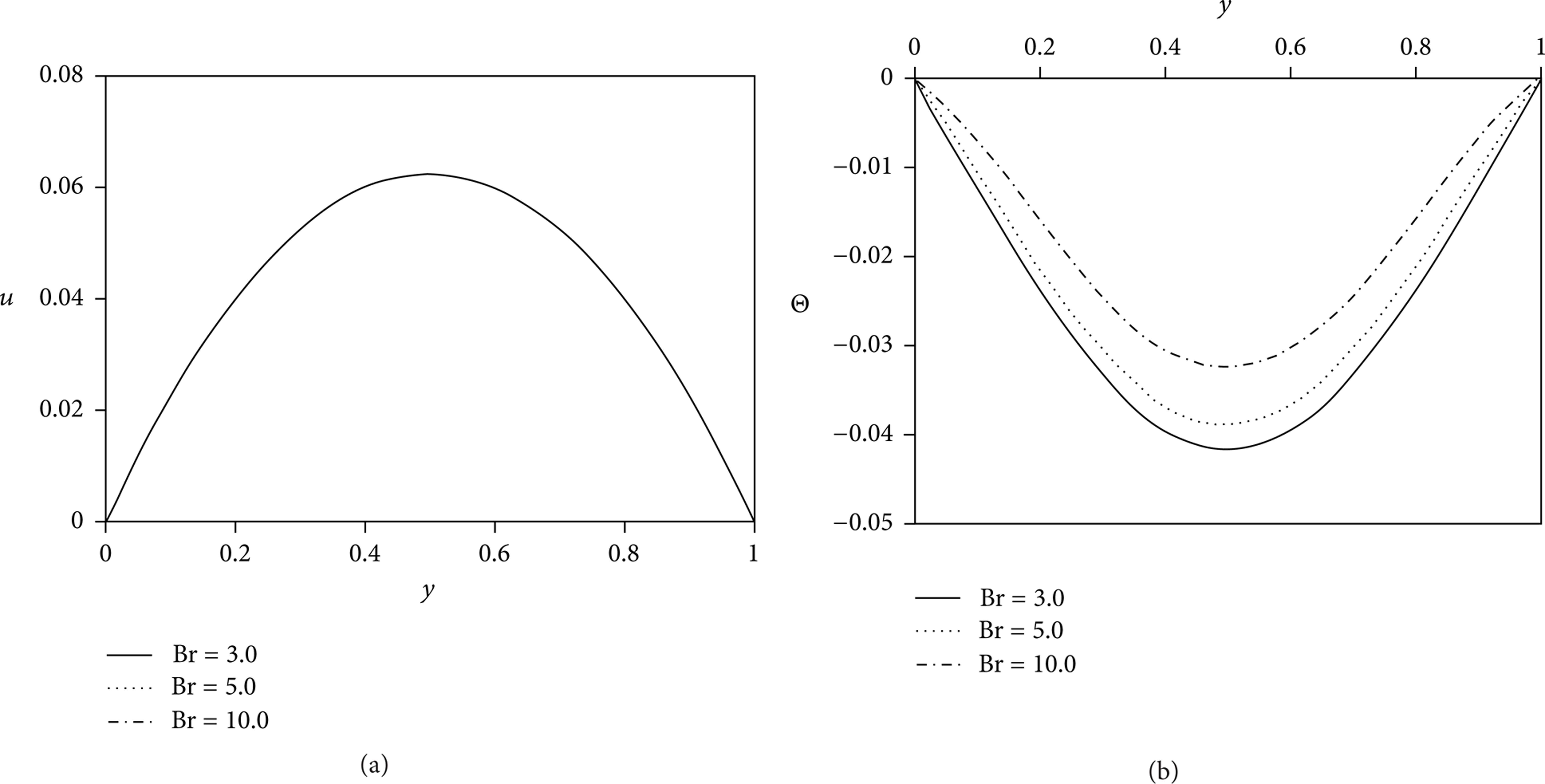
(a) Effect of Br number on velocity profile. (b) Effect of Br number on temperature profile.

(a) Effect of Br number on entropy generation due to fluid friction. (b) Effect of Br number on entropy generation due to heat transfer.
Figures 6 (a) and 6 (b) depict the effect of dimensionless viscosity constant (ε) on dimensionless velocity and temperature profiles. Constant parameters are Br = 5.0, Pe = 50, γ = 0.01, dp/dx = – 0.5, and Br/Ω = 1.0while ε = 0.0, 0.005, and 0.01. With increasing ε values, velocity profile increases slightly.

(a) Effect of ε on velocity profile. (b) Effect of ε on temperature profile.
Absolute value of temperature decreases slightly as well with increasing ε. Figures 7 (a) and 7 (b) are plotted to show the effect of dimensionless viscosity constant (ε) on entropy generation due to fluid friction and due to heat transfer. Figures 7 (a) and 7 (b) present the effect of dimensionless viscosity constant (ε) on entropy generation. With increasing ε values, both entropy generation due to friction and entropy generation due to heat transfer slightly increase. Increase in entropy generation due to heat transfer is greater at the channel walls than far from the channel center.

(a) Effect of ε on entropy generation due to fluid friction. (b) Effect of ε on entropy generation due to heat transfer.
Figures 8 and 9 illustrate the effect of thermal conductivity (γ) on dimensionless velocity and temperature profiles. Constant parameters are Br = 5.0, Pe = 50, ε = 0.01, dp/dx = – 0.5, and Br/Ω = 1.0 while γ = 0.001, 0.005, and 0.01. An increase in γ values results in a slight increase in absolute value of temperature profile and this directly causes a slight change in entropy generation. Figures 8 (a) and 9 (a) show that changing γ values has no effect on velocity profile and entropy generation due to fluid friction.

(a) Effect of γ on velocity profile. (b) Effect of γ on temperature profile.
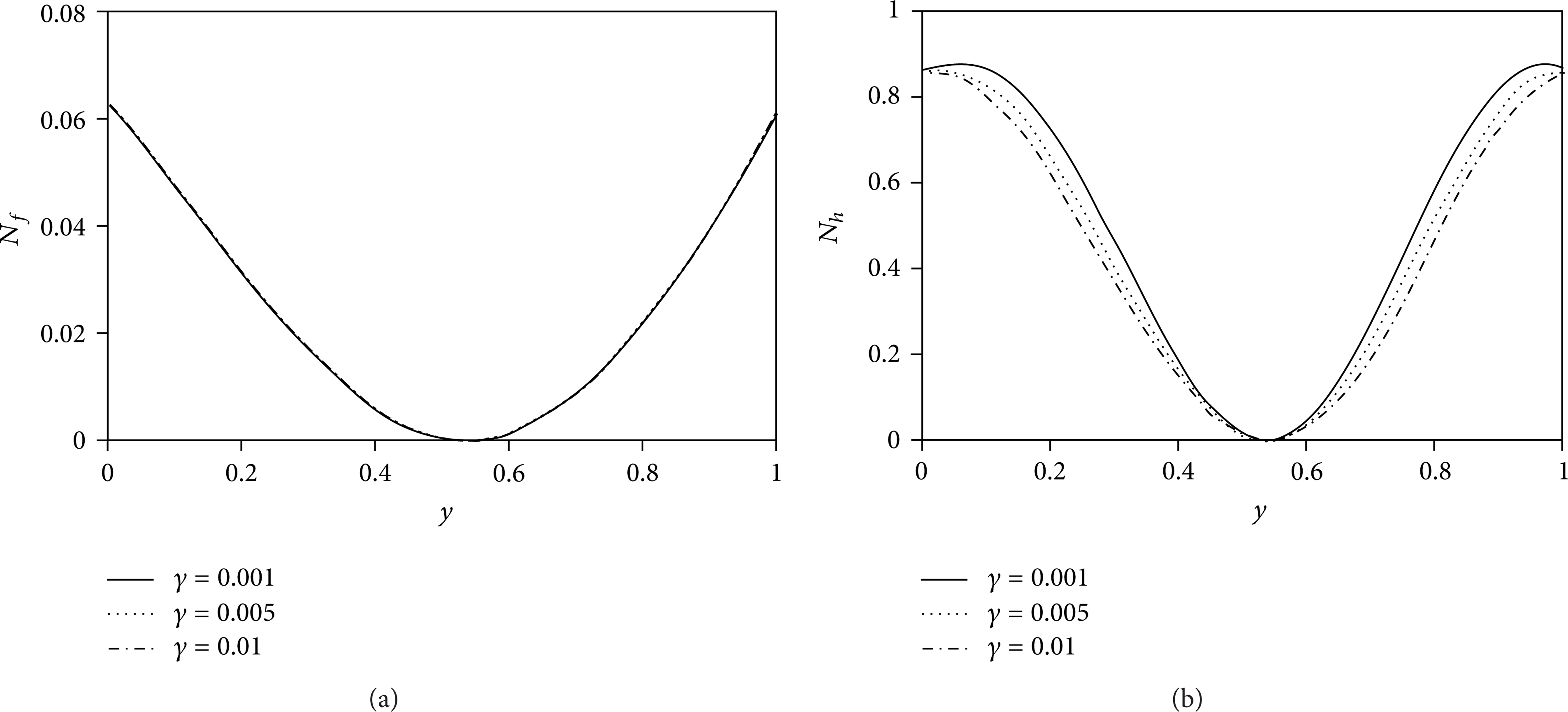
(a) Effect of γ on entropy generation due to fluid friction. (b) Effect of γ on entropy generation due to heat transfer.
5. Conclusion
In this paper, numerical study is performed to investigate the entropy generation in Plane poiseuille flow with constant heat flux at the wall for Newtonian, incompressible fluid. The effects of dimensionless viscosity constant (ε), thermal conductivity (γ), Pe number, Br number, and pressure gradient on flow and entropy generation are discussed. It is found that although Peclet number and Brinkman number have some degree of effect on entropy generation due to heat transfer, the entropy generation due to fluid friction is not effected much with these parameters. With increasing dimensionless viscosity constant and thermal conductivity, entropy generation due to heat transfer slightly increases. Entropy generation due to fluid friction is not affected much with the increase in viscosity constant and is not affected with the increase in thermal conductivity. On the other hand, an increase in pressure gradient (dp/dx = G) has a considerable effect on both Nh (entropy generation due to heat transfer) and Nf (entropy generation due to fluid friction). It is also found that magnitude of entropy generation due to fluid friction takes higher value for higher group parameter except for the center of channel.