




Abstract
Rolling bearing is widely used in rotating mechanical system, and its operating state has great influence on accuracy, reliability, and the life of the whole mechanical system. Therefore, fault diagnosis of rolling bearing is indispensible for the health monitoring in rotating machinery system. Wavelet package transform (WPT) and envelope demodulation have been common methods in diagnosis of bearing fault, but the precision of diagnostic results is limited by the degree of damages on bearing. In this paper, a method based on WPT and ensemble empirical mode decomposition (EEMD) is proposed to detect the fault of rolling bearing and solve this problem. According to simulation and experimental results, it is effective in fault diagnosis of rolling bearing and is better than the method based on WPT and envelope spectrum while the faults get more serious.
1. Introduction
Rolling bearing is a very important unit in rotary machinery, which has been used in various applications, such as aero-engine, wind turbines, and steam turbine [1–3]. As the component damaged most easily, many breakdowns of rotating machinery are associated with rolling bearing. Moreover, the function of bearing has great influence on the working state of mechanical system. Therefore, fault diagnosis of rolling bearing is of great importance in health monitoring of machinery.
Bearing failure is often accompanied by abnormal vibration and noise that can be detected. Hence diagnostic methods based on vibration signal are the most suitable and popular methods mentioned and studied by Immovilli et al. [4]. Vibration signals mainly include three types of feature related to fault bearing, which have been always analyzed in time-domain, frequency-domain, and time-frequency domain, respectively. In time-domain analysis, Wang and Zhang [5] indicated that amplitude and kurtosis coefficient are less time consuming. Moreover, the relationship between kurtosis coefficients and the speed, size, and load of the bearing was discussed by Ma et al. [6]. However, this method is only used for the simplest case of qualitative analysis conclusively. In frequency-domain, resonant demodulation has been widely applied according to the modulation characteristics of bearing vibration signals. Su et al. [7] indicated that the resonance demodulation method is a common method for fault diagnosing of rolling bearings element but is difficult in determining the resonance frequencies of mechanical system. In time-frequency domain, Tse et al. [8] proposed fault diagnosis based on wavelet analysis method, which is the improvement of fast fourier transform (FFT) with envelope detection (ED). Then Wang and Zhang [9] extensively studied on wavelet package transform (WPT) and envelope analysis for rolling bearing fault diagnosis. However, the demodulation property of these methods is limited by the degree of damages on bearing.
To solve problems mentioned above, a method based on WPT and ensemble empirical mode decomposition (EEMD) is presented for rolling bearing fault diagnosis in this paper. In Section 2, the methods of WPT and EEMD are introduced simply and then the procedures of bearing fault diagnosis based on WPT and EEMD are illustrated in detail. The results in simulation and experiment based on the method are described in Section 3, and the comparison between our method and WPT with envelope spectrum is also included. Finally, the discussion and conclusion are provided in Section 4.
2. Methods
2.1. Wavelet Package Transform
WPT is a development of wavelet decomposition that offers a richer range of possibilities for the signal analysis. This analysis is obtained as a result of successive time localization of frequency subbands generated by a tree of low-pass and high-pass filtering operations. As a result, the frequency resolution becomes higher, while the time resolution is reduced along with the increase in the number of used filter banks. Vong et al. [10] studied the spark ignition in engine with the analysis of WPT and case-based reasoning. The mother wavelet was applied to detect and diagnose the gear and bearing fault automatically by Rafiee et al. [11]. A combination of WPT and neural network was employed to establish an expert system for fault diagnosis in internal combustion engines by Wu and Liu [12]. And Saleh et al. [13] presented an innovative implementation of the WPT using the Butterworth passive filter for differential protection of power transformers, which is able to provide a low-cost, good diagnosis and fast response to the internal fault currents.
The procedure of WPT starts with original signal x d [n] of length N in the first level j = 1, which is decomposed into two subband signals described as follows:


where a1[n] is the approximations on the first level, d1[n] is the details, k is an integer, and g[n] and h[n] are the response functions of low-pass filter (LPF) and the high-pass filter (HPF), the parameters of which are directly related to the selected wavelet function. In order to increase the frequency resolution and ensure the time localization of each frequency subband, the outputs of both the LPF and HPF are downsampled to half of data length on the upper level at the end of each filtering stage. Figure 1 shows that the response functions G(ω) and H(ω) transformed by g[n] and h[n] are decomposed by LPF and HPF with two successive levels in WPT [14].

The structure of 3 layers of WPT in decomposing a discrete signal x d [n].
2.2. EEMD
EMD, proposed by Huang [15, 16], is an innovative method applied to decompose the intrinsic mode functions (IMFs) from a complex time series. This decomposition is called the sifting process, which uses the mean of the upper and lower envelopes that are formed by connecting the local extrema (e.g., the maxima and minima) with cubic spline to produce a difference from the original data, and the difference is the first component. The sifting process should be repeated until the component satisfies two conditions:
in the whole time series, the difference between numbers of the extrema and the zero-crossing must be equal to zero or one;
at any point, the mean value of the upper and lower envelopes is zero.
When the component satisfies those two conditions, an IMF is noted by c1. The difference between the data and the first IMF is the first residue noted by r1 and treated as the data for decomposing the next IMF. The decomposing process should be repeated to find the nth IMF until the residue becomes monotonic. The original data can be reconstructed by the summation of n IMFs and the nth residue and expressed as follows:

where X(t) is the original data, c i is the ith IMF, and r n is the nth residue. As useful as EMD proved to be, it still leaves some annoying difficulties unresolved.
However, a major drawback of the original EMD is the mode mixing, which is defined as a single IMF either consisting of signals with widely disparate scales or a signal of a similar scale residing in different IMF components. The phenomenon of mode mixing is a consequence of signal intermittency. As discussed by Huang [15, 16], the intermittence could not only cause a serious aliasing in the time-frequency distribution but also makes the physical meaning of individual IMF unclear. To overcome the scale separation problem, Huang and Wu [17, 18] proposed the EEMD, which can indeed ameliorate some of the difficulties.
The detailed procedures of EEMD are described as follows:
add a white noise series to the targeted data;
decompose the data with added white noise into IMFs;
repeat step 1 and step 2 again and again, but with different white noise series each time;
obtain the (ensemble) means of corresponding IMFs of the decompositions as the final result.
The effects of the decomposition using the EEMD are that the added white noise series cancel each other in the final mean of the corresponding IMFs and the mean IMFs stay within the natural dyadic filter windows and thus significantly reduce the chance of mode mixing and preserve the dyadic property.
In EEMD, the numbers of ensemble and the noise amplitude are the two parameters that need to be prescribed. The effect of the added white noise should decrease following the well-established statistical rule:

where N is the number of ensemble members, ε is the amplitude of the added noise, and ε n is the final standard deviation of error, which is defined as the difference between the input signal and the corresponding IMF (s).
2.3. Fault Diagnosis Based on WPT and EEMD
The basic idea of WPT is to concentrate energy of signal into part of trees [19]; then it chooses the frequency band adaptively by the characteristics of the selected signal discussed by Wang et al. [20]. EMD decomposes any time series into simple intrinsic modes; each mode of index (k + 1), k ≥ 2, occupies a frequency domain which is roughly the upper half of that of the previous residual of index k studied by Flandrin et al. [21] and applied in fault diagnosis of rotating machinery by Wang et al. [22]. The EEMD succeeding the capability of scale separation of EMD enables the EMD to be a truly dyadic filter bank for any data [18]. It decomposes time series into many IMFs; the frequency band of the first IMF can be obtained by the FFT, set as B1; then the frequency band of the IMFkth can be estimated approximately according to the scale separation capability of EEMD; the frequency band B k is
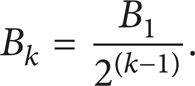
Therefore, the WPT and EEMD are combined together to detect the fault frequency in vibration signals.
When the failure of bearing emerges, the energy of vibration signal in different frequency bands has obviously big differences from normal condition. The frequency band with the maximum energy contains the most fault features, such that WPT is used to choose the frequency band containing maximum energy firstly. Subsequently, EEMD is employed to extract specific frequency component from complicated signal adaptively. The flow chart of bearing fault diagnosis based on WPT and EEMD is shown in Figure 2.

Flow chart of bearing fault diagnosis.
The procedures of method based on WPT-EEMD include
to calculate theoretical fault frequency of bearing according to the size and structure of detected bearing;
to extract the fault feature from vibration signals:
setting WPT with wavelet db10 and 3 layers to decompose vibration signal of bearing; selecting the decomposed node with maximum energy to reconstruct the vibration signal including fault features; demodulating the reconstructed signals for its envelope through the Hilbert transform (HT) [23],
to refine the fault features:
decomposing the envelope by EEMD; calculating fault frequency and then choosing the particular IMFs involving the bearing fault frequency according to (5), and the sum of chosen IMFs is analyzed by FFT for amplitude spectrum analysis; recognizing the fault frequency and comparing to the theoretical value.
3. Simulation and Experimental Results
There are many kinds of rolling bearing fault, such as surface fatigue damage, wear, and bonding. Among the three kinds of faults, the most common one is the surface fatigue damage; moreover, it includes surface spalling, surface crack, and other abnormal conditions. When the localized defects appear on the surface of bearing element in the motor process of rolling ball and inner race, cyclical impulsive vibration will emerge consequently. The frequency of impulsive vibration in detected vibration signals is called fault frequency, value of which relies on the size, rotating speed, and damage position of bearing analyzed by Ma and Li [24]. Therefore, due to different faults corresponding to different fault frequencies, the type and position of damage is able to be identified on the condition of known rotating speed and size of bearing.
Outer-race defects are easy to be produced on the bearing in the laboratory and its salient fault signatures are also simple to be detected by some condition-monitoring schemes. Thereby, the bearing inner-race fault is taken as a case to study and verify our method in this paper. The experimental data of bearings monitoring were collected by Case Western Reserve University, and the bearing type is SKF6205, sampling frequency is 12 KHz, and sample number is 6000 [25].
3.1. Features Analysis of Inner Race Fault
In the process of loading operation, there is a circulating strike in defected part when the localized defect appearing in the bearing inner race, so a series of damped oscillation are generated by impulsive excitation, which has the fault frequency of inner-race. The equation of calculating the fault frequency in theory [26] is displayed as

where D is the diameter of bearing pitch, d is the diameter of rolling ball, α is contact angle, n is the number of rolling ball, and f a is the rotating speed of bearing.
Due to the special features of physical structure in bearing, impulsive vibration is always influenced by the system and surrounding interference, so that the vibration signal shows modulation feature, especially amplitude modulation. The impulsive vibration generated by modulated signal is able to stimulate one inherent frequency of bearing system and lead to resonance. Consequently, after the WPT decomposition and reconstructing of signals at the node with maximum of energy, then gaining the envelope, the frequency band of amplitude modulation signal is easy to be extracted by EEMD. Therefore, the method based on WPT-EEMD is feasible to demodulate and detect the fault frequency accurately.
3.2. Simulation Analysis
A simulation analysis of bearing inner race fault is essential before experiments on practical data. If pitting fault exists on the bearing inner race, the frequency of impulsive vibration is n*f i (n = 1,2, …) while the rolling ball passes the damage place of working surface, where f i is fault frequency of inner race. Owing to the damage position contacting with rolling ball continuously, the periodic changes happen in the amplitude of impulsive vibration, causing the amplitude modulation. Thus, the modulation frequency is f a , and the carrier frequency is n*f i (n = 1, 2, …) [26]. Besides that the inherent frequency and resonance of bearing system triggered by the amplitude modulation signal, a double modulation is generated as well; then the amplitude modulation signal locates on both sides of resonance frequency with the same distance, acting as sideband in spectrum.
Thereby, the simulated amplitude modulation signal is computed by (7), the simulated vibration signal of inner race fault is calculated by (8), in which f a is modulation frequency, n*f i (n = 1, 2, …) is the carrier frequency, f g is an inherent frequency of bearing system [24], and N(t) is white noise:


In (7), A = 1, B = 0.2, C = 0.4, n = 1, and f a = 30 Hz, f i = 160 Hz, f g = 2500 Hz. Sample frequency is set to 12000 Hz, length of sample is 6000, and the frequency band of the first IMF of envelope analyzed by EEMD is 0~2000, according to (5); IMF4 is chosen as the component concluding fault frequency. So the simulated signal, amplitude spectrum based on WPT envelope, and amplitude spectrum of IMF4 based on our method are all shown in Figure 3.

Simulated signal of inner race fault: (a) simulated signal, (b) amplitude spectrum by WPT and envelope and (c) amplitude spectrum of IMF 4 by our method.
It is apparent that the frequency with peak of amplitude spectrum is 160 Hz in Figures 3 (b) and 3 (c), which is the same as the setting fault frequency. In the simulation analysis, it is verified that the method based on WPT-EEMD is effective in extracting fault frequency and diagnosing fault type.
3.3. Experimental Results
In practice, the rotating speed of machinery system ranges from 1730 to 1797 r/min, and the fault diameter of inner race bearing gets bigger and bigger, from 0.007 to 0.021 inch. The data with the quickest speed and the biggest fault diameter are chosen as the analyzed object, so the innerrace fault frequency is 162.2 Hz calculated by (6). The original signals of normal condition and inner race fault bearing are shown in Figure 4.

Original signals of bearing working in different conditions: (a) normal signal and (b) inner race fault signal.
In fault condition, the vibration signal includes many periodic impulsive components and shows amplitude modulation feature displayed in Figure 4 (b), compared to Figure 4 (a). And then, the energy distribution of each node in the third level is shown in Figure 5, after fault data are decomposed by WPT. It is obvious that the maximum energy is located at the second node, and the corresponding frequency band is (1500, 2250) Hz [20], so that the fault impulsive signal is modulated to that frequency band. In order to achieve the fault features, it is necessary to reconstruct vibration signal in the specific frequency bands and gain it envelope through HT.

Energies of nodes in third level through WPT decomposition.
Secondly, the envelope of reconstructed vibration signal is decomposed into IMFs by EEMD. Analyzing the envelope by EEMD, the frequency band of the first IMF of envelope analyzed by EEMD is 0~2000, the fault frequency of inner race is 162.2 Hz, according to (5), IMF four is chosen as the component concluding fault, and its amplitude spectrum is shown in Figure 6 (a). Wang and Zhang [9] presented the fault diagnosis based on WPT and envelope spectrum; however, it is just adaptive to slight bearing fault. While the degree of fault gets more serious, some interference frequencies make it difficult to get fault frequency of bearing. Compared to the result obtained by WPT and envelope spectrum in Figure 6 (b), the fault frequency 162 Hz is not only clearly depicted in Figure 6 (a), there are not also other interference frequencies in it. The method proposed in this paper is the improvement of WPT and envelope spectrum methods; it can reduce interference and increase accuracy of identifying fault type. Finally, according to simulation and experimental results, fault diagnosis based on WPT and EEMD is effective in fault diagnosis of rolling bearing and is better than WPT and envelope spectrum methods while the faults get more serious.

Amplitude spectrum: (a) amplitude spectrum of IMF 4 by our method and (b) amplitude spectrum by WPT and envelope.
4. Discussion and Conclusion
In this paper, we studied fault diagnosis method of rolling bearing and proposed a new method based on WPT and EEMD, which can overcome the limitation of WPT and envelope detection methods to the degree of fault. In conclusion, according to simulation and experimental results, fault diagnosis based on WPT and EEMD is effective in fault diagnosis of rolling bearing and is better than WPT and envelope spectrum methods while the faults get more serious. Although the bearing inner race fault is analyzed firstly in this paper, the method based on WPT and EEMD is also useful for the fault diagnosis of outer race. However, it still has some difficulties in diagnosing rolling ball fault because of its irregularity in collected data. Therefore, it is significant to improve this method in further study and to enhance the accuracy in bearing fault diagnosis.
Besides, the calculation in EEMD is time consuming and memory intensive. It is suggested that a very large internal memory is necessary if it is calculated on a desktop style computer. Also, there are several tricks in Matlab for more efficient computation; for instance, if there is a multiple-core processor in your computer, you can specify that in the preamble of Matlab and then computation will be more efficient. Moreover, the general-purpose computing on the graphics processing unit (GPGPU) is also able to enhance the performance of computation, which has already been applied in calculating the EEMD to improve its efficiency [27]. Therefore, a desktop style computer with more powerful and large internal memory can solve these problems in the computation of fault diagnosis based on WPT and EEMD in the near future.
Footnotes
Acknowledgment
The authors wish to thank the support of the National High Technology Research and Development Program (863 Program) of China under Grant no. 2012AA041203.