




Abstract
We consider a distributed power control scheme for wireless sensor networks. To derive decentralized solutions that do not require complete information and any cooperation among the users, we formulate this problem as a supermodular game, which each user maximizes its utility function provided transmission rate constraints. Through analyzing the supermodular property of the game, the existence and uniqueness of the Nash equilibrium (NE) are established. Furthermore, we propose a distributed price and power update algorithm (DPPA) to compute the solution of the game which is based on myopic best response. Performance evaluations via numerical simulations verify the existence of theNE and the convergence property of the DPPA algorithm.
1. Introduction
Wireless sensor networks (WSN) have broad application prospects, that is, widely used in health care, military, environmental monitoring, and forecasting, as well as intelligent home, building condition monitoring, and so on. The power control problem with interference management, throughput maximization, or energy efficient target, is an interesting issue and attracts tremendous attention [1–6]. Since different power levels result in a different performance and fundamentally affect many aspects of the operation of the networks, the power control problem becomes a complex and intriguing problem. Since the sensor networks are totally distributed and have no fundamental infrastructures, the traditional centralized power control mechanisms are not feasible. It is well known that game theory is a good tool to handle the distributed problems. Game theory techniques have widely been applied to engineering problems in which the action of one component has impact on and perhaps conflicts with that of any other component [7]. More particularly, supermodular games are interesting since they have several desirable properties, such as they encompass many applied models, have the remarkable property that many solution concepts yield the same predictions and have nice comparative statics properties and behave well under various learning rules [8].
In this paper, we study the power control problem, focus on distributed algorithms with no centralized control using a supermodular game framework, and investigate if any optimality is achievable. Our work is motivated by the following points.
The networks have no central infrastructures; a distributed power control mechanism is desired.
The game theoretic formulation is a useful tool to design distributed algorithms. And it is amenable to prove the convergence for the distributed algorithm.
Supermodular game model has several desirable properties.
To formulate the power control design, we take the rate constraints into account and propose a strategic game, where all rational users maximize their own utilities by choosing appropriate power levels. We refer this game to distributed power control game (DPCG). By building the supermodular property of the DPCG, the existence of the Nash equilibrium solution is established. Furthermore, we present an analysis for users’ myopic best response (MBR) dynamics. Based on the MBR dynamics, a distributed price and power update algorithm (DPPA) is proposed. Then we prove the convergence of the algorithm and show the uniqueness of the NE.
The rest of this paper is organized as follows. In Section 2, the related works are discussed. We depict the system model in Section 3. In Section 4, the proof of the existence of the NE is provided. The proposed pricing mechanism and the distributed convergence algorithm are presented in Section 5. The simulation results are given in Section 6. Finally, Section 7 draws the conclusions.
2. Related Work
There has been a rich literature to study power control in wireless networks. In [9], the authors proposed a joint power and channel resource allocation iterative optimization algorithm. References [1–6] illustrate power allocation problems using traditional game theory and take different factors into account. Evolutionary game theory was used to depict the power problem in [10, 11]. In particular [10] established an evolutionary power mechanisms for W-CDMA and WIM wireless systems. With the analytical limitations of evolutionary game, we can just analyze low-dimension strategy space. Shamik et al. proposed a game theoretic framework for power control in wireless sensor network. They showed the performance differences between continuous levels and discrete levels and gave a framework to find the best transmit power span. However, they did not show the convergence of the power control mechanism. In [12], they used potential game theory and replicator dynamics learning scheme to analyze the distributed power allocation problem in parallel multiple-access channels, and they depicted the sufficient conditions for the unique NE and showed the convergence property. The interaction of several radio devices aiming to obtain wireless connectivity by using a set of base stations was modeled as a noncooperative game in [13]. They showed the existence of the Nash equilibrium of two situations, that is, BS selection and BS sharing. The authors of [14] considered the power control for open-loop overlaid network MIMO systems in a game theoretical perspective. They viewed the problem as a noncooperative game, and the numerical simulations verified the significant performance advantages of the proposed scheme.
3. System Model
3.1. Link Capacity
The links between nodes are modeled by a set

Therefore, the instantaneous signal to interference plus noise ratio (SINR) of node j is

Denote the link capacity of link j by

To guarantee the communication quality, we assume that

where
3.2. Distributed Power Control Game
The power control game is modeled as a strategic game, in which the players are the links and the payoff is the difference between their transmission gain and the power consumption cost. To maximize its own utility, each player chooses transmission power with a given constraint on the minimum achievable information rate to compete against others. The strategy of each player is one-dimension subset of R. The strategy of player i is denoted by

where

where

where

where
Given the power allocation of the others

We refer to the game ϑ with maximization problem (9) by distributed power control game (DPCG). The strategy space of the game is
Now we define the Nash equilibrium of this game. An NE of the DPCG game ϑ is defined as follows.
Definition 1.
Consider an L-player game, each player maximizing its individual cost function

In the following sections, we will discuss whether the NE solution exists. If it exists, is it unique and how to reach it in a totally distributed way?
4. Existence of the NE
Herein, we prove that the DPCG game has the NE solution by establishing the supermodular property for it. By verifying the Hessian matrix of the game, we prove the uniqueness of the NE. Following [8], we have the following.
Definition 2 (supermodular game).
The strategic form game
With the above definition, we can get the following.
Theorem 3.
The game ϑ defined by (5)–(9) is supermodular and admits a compact sublattice NE solution.
Proof.
Apparently, the strategy set

Let
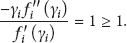
For all

Obviously,
5. Distributed Convergence Algorithm and Uniqueness of the NE
5.1. Pricing Mechanism
In the above section, we did not depict the pricing parameter precisely. Herein, we define the price charged to other users for generating interference to user i as follows:
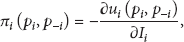
where

5.2. Distributed Update Algorithm
In Section 4, the DPCG game has been shown to admit an NE. Now we focus on distributed algorithm to compute the NE solutions. In patricular we employ asynchronous myopic best response (MBR) update rules; that is, the users update their strategies according to their best response assuming that other player's strategies are fixed. Given
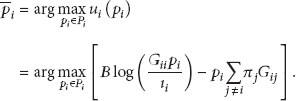
Theorem 4.
As the other player's strategies are fixed, the users’ MBR is single-valued. Moreover, the user's MBR dynamics can be given as follows:

Proof.
The MBR updates (16) are as follows:

subject to

The Lagrangian function associated with problem (18) can be given as follows:

where

Consider these two situations:
In situation 1, all the constraints are not active and we cannot get a desirable solution. It is necessary to let the constraints to be active, and thus we can easily get the solution of problem (18) as follows:
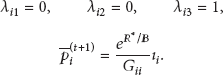
Based on the above analysis, the MBR dynamics can be simplified as (17), and thus the proof is completed.
From these expressions, we can conclude that to implement the update process, each user only needs to know the following information:
its own utility
the channel gains
the price profile π.
These pieces of information are not difficult to get due to the SINR
Based on Theorem 4, the detailed implementation of the asynchronous distributed power control algorithm can be shown in Algorithm 1.
Note that the power and price need not to update simultaneously. And for each user, the two update processed also need not have to be at the same time. We referes to this distributed power control algorithm as DPPA.
5.3. Uniqueness of the NE
Theorem 5.
The power control game DPCG ϑ has a unique Nash equilibrium.
Proof.
The Hessian matrix of each user,

for all

for all
5.4. Convergence of the Distributed Algorithm
We characterize the convergence of the distributed algorithm in this section. We consider it in a game theoretic framework. Each user i specifies a power

where the players are from the union of set


Here,
In
Proposition 6.
Proof.
The proof of the proposition is straightforward. For the player in

Let
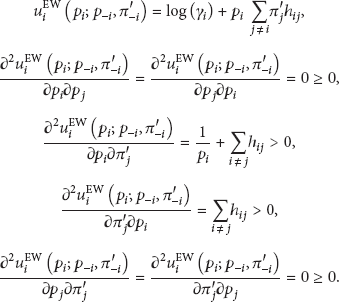
Similarly, the player's utility in

Then the
With Proposition 6, we can conclude that the fictitious game
The NE set of the game is a nonempty and compact sublattice, and there exists a component-wise smallest and largest NE. (Followed by Lemmas
If each user starts from feasible strategy and uses MBR update rule, the strategy profile will eventually locate in the set bounded by the smallest NE and the largest NE. And if the NE is unique then the MBR update rule globally converge to the NE (followed by Theorem 8 in [17]).
In this case, Theorem 1 in [15] can again be used to characterize the structure of
Proposition 7.
The DPPA algorithm is globally convergent to the unique NE of the DPCG.
6. Numerical Results
We provide some numerical results to verify the performance of the distributed update algorithm. The simple sensor network example considered here consists of four pairs of links. The maximum power value
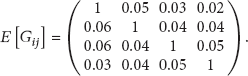
We evaluate the convergence properties of the proposed distributed update algorithm with the same and heterogeneous rate constraints, respectively. Figure 1 illustrates the situation that the four users have the same rate requirement, which means

Convergence of distributed update algorithm. The rate constraints are the same.
The results in Figure 2 are nearly the same but with different rate constraints for users, that is,

Convergence of distributed update algorithm. The rate constraints are different.
The utility of each user is depicted in Figure 3. In the same rate requirement situation, we can see that the payoff of the users converges to a stable state, and the system reaches the NE state after iterations. Similarly, the utility of the users with different rate target is shown in Figure 4. We can conclude that after the system reaches the NE, the users cannot get extra profit by changing their strategies unilaterally.
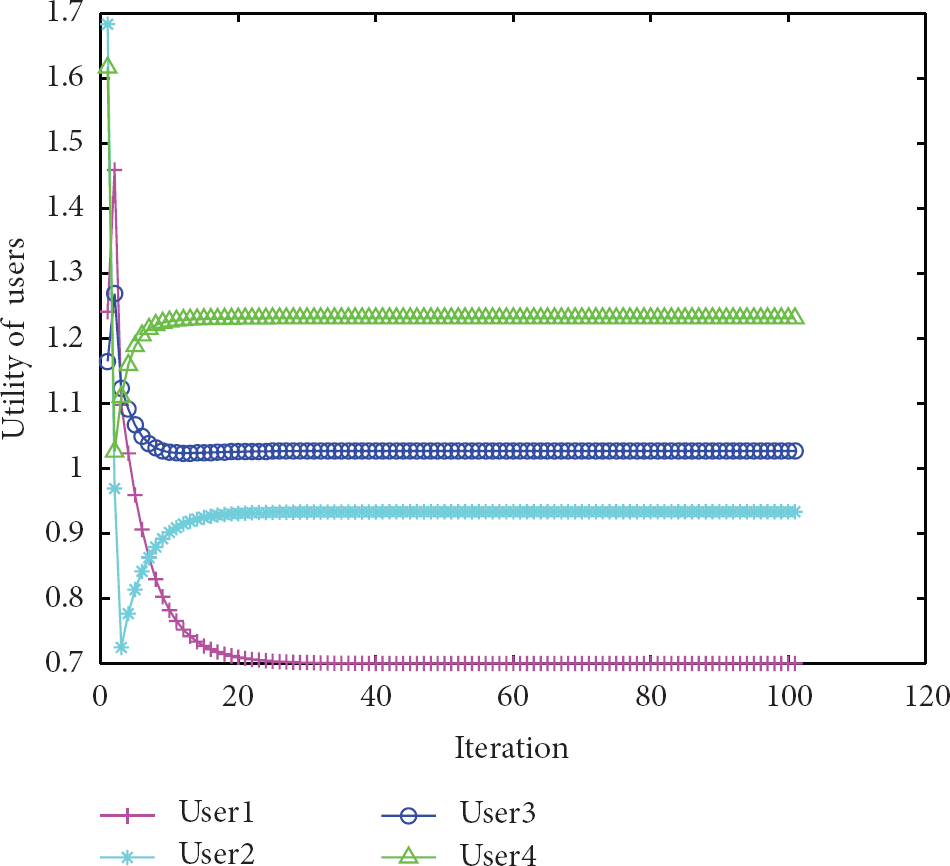
The utility of users. The rate constraints are the same.

The utility of users. The rate constraints are different.
7. Conclusion
In this paper, we use game theory to address the issue of power control in wireless sensor networks. We formulate the distributed power control game as a noncooperative game, where each user maximizes its own utility by choosing a power level from the feasible area. The existence and uniqueness of the NE are established by building the game's supermodular properties. A distributed power and price update algorithm is proposed which is based on MBR update rules. By correlating to another supermodular game, we show that the proposed distributed update algorithm converges to the unique NE. Numerical experiments have been done to evaluate the algorithm. The results indicate that after relatively little iteration, the game converges to the NE, and the users cannot get extra profit by changing their strategies unilaterally.
Footnotes
Acknowledgments
This work was supported by Natural Science Foundation of Fujian Province with Grant no. 2012J01252; National Natural Science Foundation of China Grant no. 61072080; the development project of Fujian provincial strategic emerging industries technologies: key technologies in development of next generation integrated high performance Gateway; Fujian development and reform commission high-technical