




Abstract
This paper presents the study on natural frequency characteristics of a multiple layered cylindrical shell with ring support under internal pressure. The multiple layered cylindrical shell configuration is formed by three layers of isotropic materials where the inner and outer layers are stainless steel and the middle layer is aluminum. The isotropic multiple layered shell equations with ring support and internal pressure are established based on first order shear deformation theory (FSDT). The governing equations of motion were employed by using energy functional and by applying the Ritz method. The boundary conditions represented by end conditions of the multiple cylindrical shell are simply supported-simply supported (SS-SS), clamped-clamped (C-C), free-free (F-F), clamped-free (C-F), clamped-simply supported (C-SS), and free-simply supported (F-SS). The influences of internal pressure and ring support and the effect of the different boundary conditions on natural frequencies characteristics are studied. The results are validated by comparing them with those in the literature.
1. Introduction
Shells structures are light weight constructions commonly used as structural components in engineering applications. Basically, a shell structure is a three-dimensional structure. In comparison with plates and beams, shells usually exhibit more different dynamic behaviours because they can carry applied various loads effectively by their curvatures [1]. The dynamic characteristic of shells has been studied by many researchers. It was first introduced by Love [2]. Love employed Kirchhoff hypothesis for shells. Kirchhoff hypotheses were developed for plate bending, assuming small deflection and thinness of the shell.
A special kind of shells is the cylindrical shell. Cylindrical shells have been used for many years in different engineering applications including large aerospace, naval construction, and civil and mechanical structures to small electrical components [3]. They are used as structures in aircrafts, ships, rockets, submarines, missile bodies, pressure vessels, oil tanks, buildings, and so forth. The vibration problems of cylindrical shells have been of great interest to many engineers in industries. The study of vibration of multiple layered cylindrical shells with one ring support and internal pressure is an important aspect for a successful application of cylindrical shells. More than one ring support are used in long cylindrical shells, such as body of airplanes, submarines, and pipelines for undersea transmission oil, to increase their stiffness. Without the rings support, these cylindrical shells will undergo large deformation, due to their low stiffness, and will finally lead to failure [4–12].
There is a collection of works on vibration of cylindrical shells including effects, such as anisotropy, variable wall thickness, and initial stress, that can be found; but the study of vibration of multiple layered cylindrical shells with ring support and internal pressure is limited.
Extensive works on vibration of cylindrical shells have been reported that include Arnold and Warburton [13] who studied thin cylindrical shells and derived the equations of motion. Leissa [14] presented and illustrated various theories for cylindrical shells under vibration. Analysis of natural frequencies and mode shapes of cylindrical shells was reported by Blevins [15]. Scedel [16] and Chung [17] worked on circular cylindrical shells. Reddy [18] and Soedel [19] have discussed thickness changes of cylindrical shells and plates under vibration. Forsberg [20] studied effects of boundary conditions on frequencies characteristics. Among various cylindrical shell structures, the dynamic behavior is the subject of some of the researches [21–26]. The effect of buckling on cylindrical shells was presented by Prabu et al. [27]. Najafizadeh and Isvandzibaei [28] employed various theories for the analysis of vibration of cylindrical shells with FGM materials. Malekzadeh et al. [29] presented the dynamic response of circular cylindrical shells made of composite materials. Arshad et al. [30] investigated the vibration of cylindrical shell made of two layers which were functionally graded.
The objective of this research is to investigate and understand the natural frequency characteristics of a multiple layered cylindrical shell, which is very often more effective and useful than the single layered type of shells, because of the improvements in the mechanical properties due to the layers. Multiple layered structures are able to redistribute the energy effect among the layers due to their higher stiffness, compressive strength, fatigue limit, better damping, and shock absorbing characteristics. Reported works on vibration of multiple layered cylindrical shells composed of stainless steel and aluminum with ring support subjected to internal pressure could not be found in the literature.
The aim of this paper is to present a study on the natural frequency characteristics of multiple layered cylindrical shells with ring support under internal pressure for different boundary conditions. The analysis is carried out using first order shear deformation theory. The governing equations of motion are derived using Ritz method with energy functional. The analysis is carried out on the natural frequency characteristics with the different boundary conditions by using beam functions as the axial modal functions. The multiple layered cylindrical shell is made up of isotropic three layers where the inner and outer layers are made of stainless steel and the middle layer is aluminum. The boundary conditions of the multiple layered cylindrical shell considered are the combination of simply supported-simply supported (SS-SS), clamped-clamped (C-C), free-free (F-F), clamped-free (C-F), clamped-simply supported (C-SS), and free-simply supported (F-SS). The influences of internal pressure and ring support and the effect of different boundary conditions on natural frequencies characteristics are discussed. The results obtained from this method are validated by comparing them with the results for cylindrical shells without pressure and ring support reported in the literature.
2. First Order Shear Deformation Theory
Consider a multiple layered cylindrical shell supported with ring subjected to internal pressure with the thickness h, radius of the shell R, length L, position of ring support b, internal pressure P, mass density ρ, modulus of elasticity E, and Poisson's ratio ν, as displayed in Figure 1. An orthogonal coordinate system is established at the mid-surface of the multiple layered shell along x, θ, and z, the axial, circumferential and radial directions, respectively. The corresponding displacement deformations from the multiple layered shell mid-surface are defined by u, v, and w. Thickness of the multiple layered cylindrical shell is divided into three layers where the inner and outer layers are of stainless steel and the middle layer is aluminum.
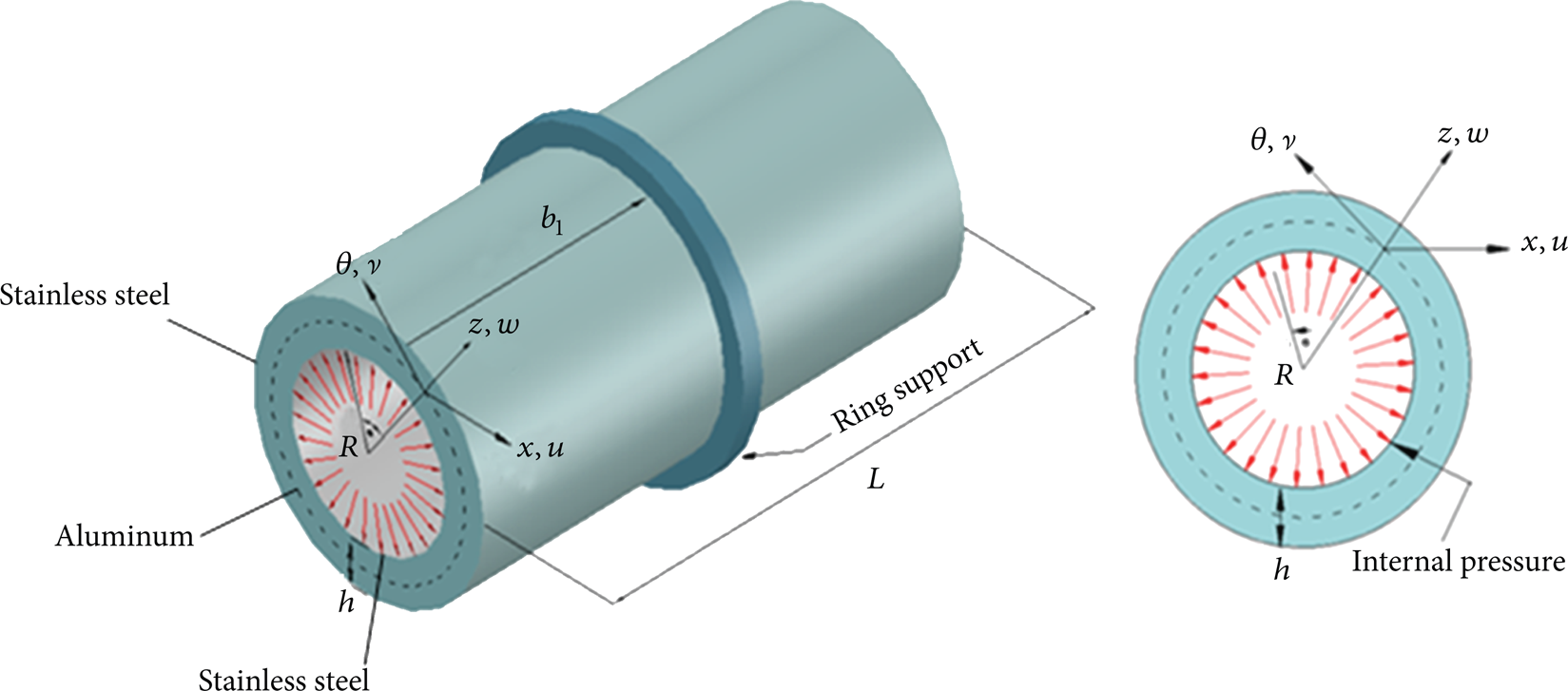
Geometry of a multiple layered cylindrical shell supported with one ring subjected to internal pressure.
The displacement fields based on first order shear deformation theory (FSDT) for an arbitrary point in the cylindrical coordinate system using Kirchhoff hypothesis are expressed as follows:

where u(x, θ, z), ν(x, θ, z), and w(x, θ, z) are the components of displacement in the x, θ, and z directions, respectively, u0(x, θ), ν0(x, θ), and w0(x, θ) are the displacements of the mid-surface of the multiple layered shell, and ψ x (x, θ) and ψθ(x, θ) are the rotations of the normals to the mid-surface of the multiple layered shell around the x and θ axes, respectively.
2.1. Strains-Displacement Relations
The strain-displacement relationships for multiple layered cylindrical shell are expressed by






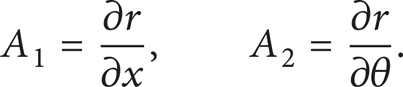
where A1 and A2 are the parameters of Lame and expressed by [31]
Substituting (1) into strain-displacement relationships (2)–(6) and applying the cylindrical coordinate system,
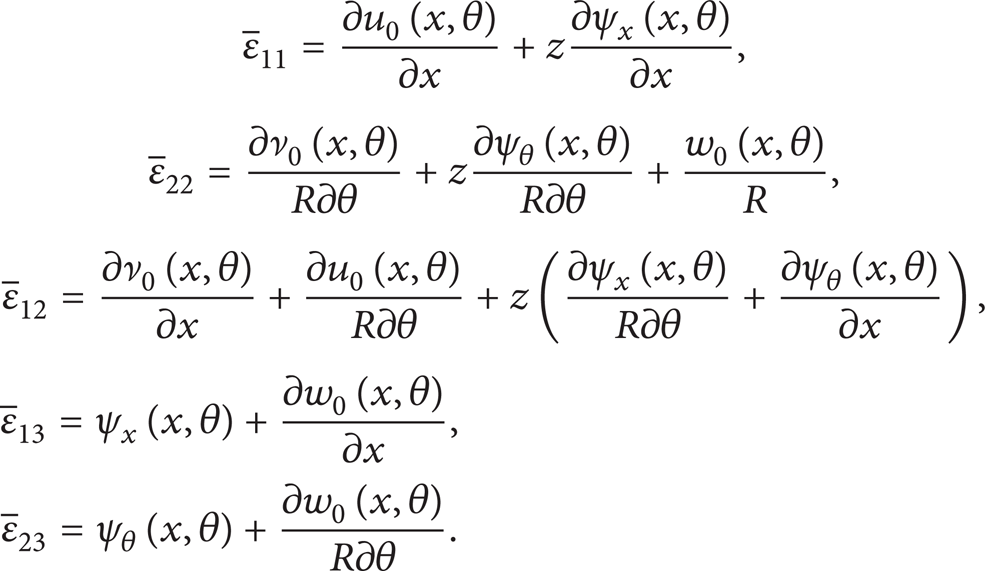
Considering the relations of strain-displacement for first order shear deformation theory, it can be construed in matrix form

where

in which ε110 and ε220 are the normal strains at the mid-surface, ε120, γ13, and γ23 are the shear strains at the mid-surface, L11 and L22 are the mid-surface changes in curvature, and L12 is the mid-surface torsion of multiple layered shell.
2.2. Equations of Stress-Strain
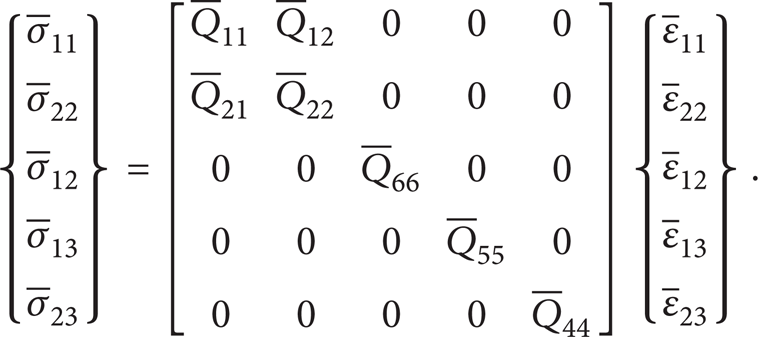
The stress-strain relation for a multiple layered cylindrical shell with plane-stress conditions is expressed by

where

Then (12) can be expressed as
For multiple layered cylindrical shells, the stiffness

The stress and moment resultants are defined, respectively, by

Applying (9) into (14) and then substituting it into (16), the stress and moment resultants combined as

where {N} and

[I] is the matrix of stiffness and can be written as
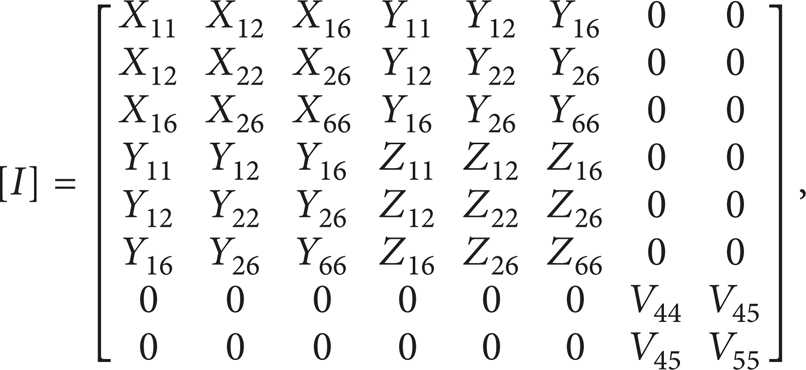
in which X ij , Y ij , and Z ij are the extensional, coupling, and bending stiffness matrices and V ij is thickness shear stiffness matrices and is defined as

For a multiple layered shell composed of different layers of isotropic material, the X ij , Y ij , Z ij , and V ij are given by
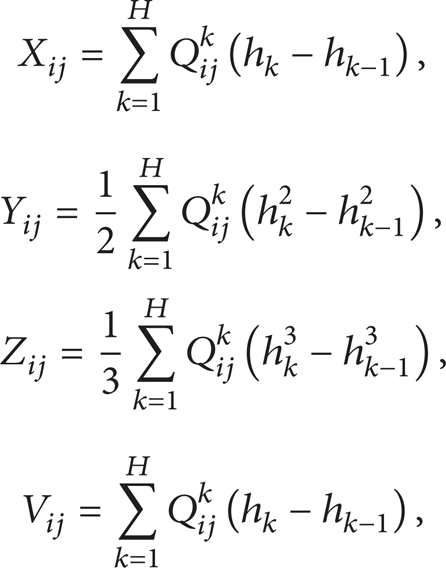
where h k and hk – 1 are the distances from the middle surface of the multiple layered cylindrical shell to the outer and inner surfaces of the kth layer, respectively. Q ij k is the reduced stiffness for the kth layer, defined as in (15). H is the number of layers in the multiple layered cylindrical shell.
Substituting (18)–(19) into (17) can be expressed in the following form:

3. Energy Equations
The expressions for strain energy, potential energy of internal pressure, and kinetic energy depend on the theory chosen to describe the multiple layered cylindrical shell behaviour during vibration.
3.1. Strain Energy
Based on FSDT, the strain energy of the multiple layered cylindrical shell U is expressed as

Substitution of

3.2. Kinetic Energy
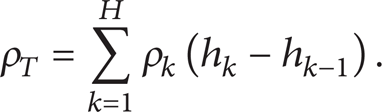
Based on FSDT, the kinetic energy for multiple layered cylindrical shell during vibration is given by

where ρ T is the density of unit length and is defined as
3.3. Internal Pressure Energy
The potential energy of the internal pressure P for multiple layered cylindrical shell with FSDT is

Therefore the energy functional for vibration of multiple layered cylindrical shell with ring support and internal pressure can be written as

4. Displacement Field and Axial Modal Function
The displacement field for vibration of multiple layered cylindrical shell with ring support and internal pressure can be expressed as
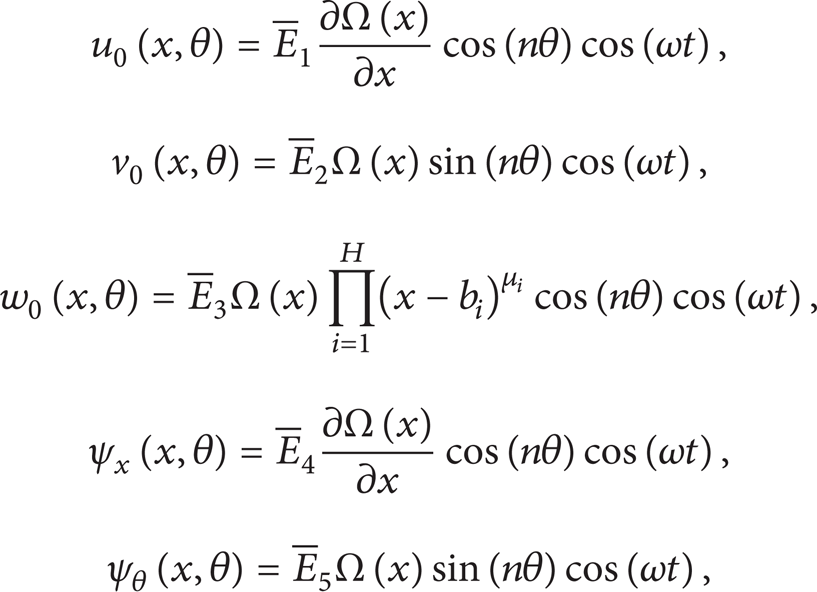
where
The axial modal function Ω(x) is selected as the beam function is given by [32]
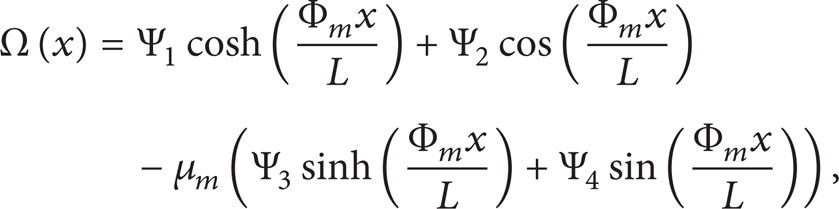
where the values of Ψ i (i = 1, …, 4), Φ m , and μ m for multiple layered cylindrical shell with ring support and internal pressure for the six boundary conditions are given in Table 1. In this table, m represents the axial wave number.
Values of Ψ i , Φ m , and μ m for ten boundary conditions.

The boundary conditions for simply supported, free, and clamped that satisfy x = 0 and x = L can be expressed as
Simply supported boundary condition

Free boundary condition

Clamped boundary condition

5. Ritz Method
Ritz method is commonly used as an approximation method for a solution of various boundary value problems in mechanics. This method is based on variational principles. The energy method was developed by Ritz. To determine the natural frequency of vibration for multiple layered cylindrical shell with ring support and internal pressure, the Ritz technique is used. The energy functional F is defined by the Lagrangian function as

Substituting (29) into (24), (25), and (27) and applying Ritz technique with minimizing the energy functional F gives

There are five equations of motion in (5) characterizing the vibration characteristics of multiple layered cylindrical shell with ring support under internal pressure. Therefore, the governing eigenvalue equation can be written in a matrix form as

The solution is obtained by setting the determinant of matrix C equals to zero; that is,

The solution for (37) is obtained and a characteristic of the multiple layered cylindrical shell with ring support and internal is expressed in the power of ω as

where δ i are the coefficients that depend on the boundary conditions. The solution of (38) consists of ten roots and the five positive roots are the natural frequencies. The smallest of the five positive roots is the natural frequency of the multiple layered cylindrical shell with ring support under internal pressure of interest in this study. The material properties of the three layered multiple cylindrical shell are given in Table 2.
Material properties of the three layered isotropic cylindrical shell.

6. Validation
In order to validate the predictive accuracy of the present analysis, the results for multiple layered cylindrical shell without ring support and internal pressure are compared with the results available in open literature. Table 3 shows the comparison of natural frequency parameter
Comparison of the frequency parameters,

Table 4 shows the comparison between natural frequency of multiple layered cylindrical shell without ring support and internal pressure found in the literature and the three layered cylindrical shell model developed in this paper for different circumferential wave numbers. The boundary condition of the geometric cylindrical shell used is simply supported-simply supported (SS-SS).
Comparison of natural frequency of three layered cylindrical shell without ring support and internal pressure with simply supported-simply supported boundary condition (L/R = 20, h/R = 0.002).
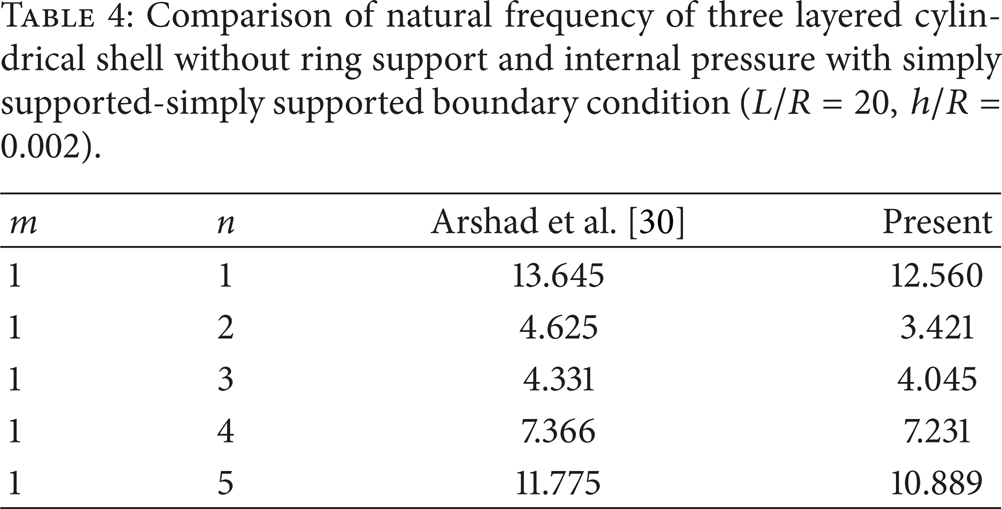
The comparisons presented in Tables 3–4 show good agreement with published works. The purpose of this comparison is to ensure that the obtained magnitudes of the natural frequencies are of the same order as those reported in the literature. However, deviations are observed because in this study first order shear deformation theory is used but in references [17, 30] classical shell theory was used. Another difference is related to the kind of materials used in this study, stainless steel and aluminum. The comparisons between cylindrical shells supported with ring subjected to internal pressure are not presented as the results for a multiple layered cylindrical shell are not found in the literature.
7. Results and Discussion
7.1. Multiple Layered Cylindrical Shell without Ring Support
In this study, initially a multiple layered cylindrical shell is subjected to internal pressure without ring support being analysed. The analyses are conducted by assuming internal pressures equal to 400 and 600 kPa. Altogether, the six boundary conditions are discussed in this paper. The effects of the six boundary conditions on the natural frequencies for multiple layered cylindrical shell subjected to internal pressure without ring support as the function of circumferential wave numbers (n) are studied.
Figures 2, 3, 4, 5, 6, and 7 show the variation of the natural frequency of a multiple layered cylindrical shell without ring support for different circumferential wave numbers (n) with and without internal pressure for the six boundary conditions. All of these graphs show the vibration behaviour of the multiple layered cylindrical shells without ring under the effects of pressure. For all the six boundary conditions when the internal pressure is zero, the natural frequency initially decreases and then increases. The results show that for the six boundary conditions all natural frequencies are the same when the circumferential wave numbers are large. The results also showed that in cases without pressure the natural frequency of free-free multiple layered cylindrical shell is higher than that of the multiple layered cylindrical shell of other boundary conditions; and similarly, natural frequency of clamped-free multiple layered cylindrical shell is lower than that of the shell of any other end conditions. Natural frequency of clamped-clamped multiple layered cylindrical shell is very close to that of free-free multiple layered cylindrical shell; and similarly, natural frequency of clamped-simply supported multiple layered cylindrical shell is very close to that of simply supported-free multiple layered cylindrical shell. In the case of multiple layered cylindrical shell without pressure, the minimum frequency occurs In circumferential wave numbers 2 and 3. Boundary conditions will have an effect when the circumferential wave number is low, while for large value of n all multiple layered shells with different boundary conditions will have the same natural frequencies. Thus, the effects of the six boundary conditions can be seen to be more significant at small circumferential wave numbers than at high ones.

Variation of the natural frequency with SS-SS boundary conditions (h/R = 0.002, L/R = 20, and R = 1).
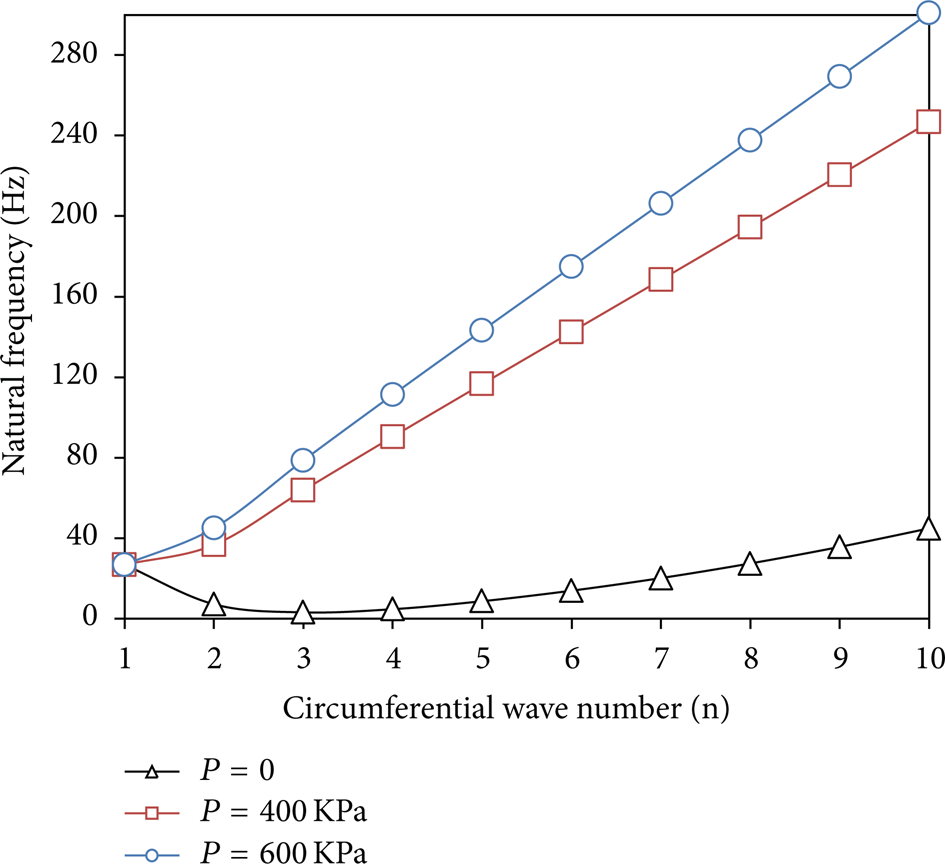
Variation of the natural frequency with C-C boundary conditions (h/R = 0.002, L/R = 20, and R = 1).

Variation of the natural frequency with F-F boundary conditions (h/R = 0.002, L/R = 20, and R = 1).

Variation of the natural frequency with C-SS boundary conditions (h/R = 0.002, L/R = 20, and R = 1).
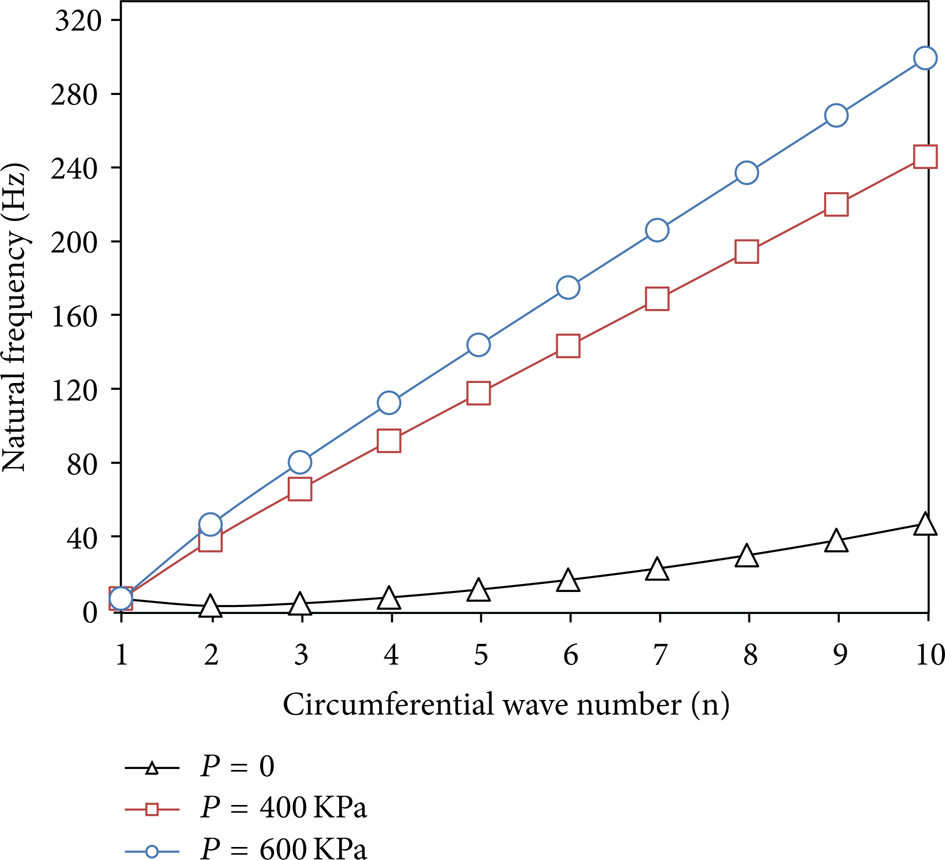
Variation of the natural frequency with C-F boundary conditions (h/R = 0.002, L/R = 20, and R = 1).

Variation of the natural frequency with F-SS boundary conditions (h/R = 0.002, L/R = 20, and R = 1).
When a multiple layered cylindrical shell is subjected to internal pressure, for all six boundary conditions the natural frequencies increase as the circumferential wave number n is increased. The results show that internal pressure has an effect on the natural frequency of a multiple layered cylindrical shell and causes the natural frequency to increase. When the value of the internal pressure is large, the natural frequency is higher. The results obtained also show that the natural frequency characteristics of a multiple layered cylindrical shell with and without internal pressure are different for different boundary conditions. It should be noted that the natural frequencies of multiple layered cylindrical shells with and without ring support subjected to internal pressure for all the graphs are calculated for m = 1.
7.2. Multiple Layered Cylindrical Shell with One Ring Support
Figures 8, 9, 10, 11, 12, and 13 depict the variation of natural frequency with the circumferential wave numbers n for a multiple layered cylindrical shell subjected to one ring support at b = 0.3L with and without internal pressure for the six boundary conditions. The multiple layered cylindrical shell length to radius ratio L/R is taken to be 20, the thickness to radius ratio is h/R = 0.002, and the location of the ring support is at b/L = 0.3. It can be seen that, with the use of ring support, the natural frequencies of the multiple layered cylindrical shell with and without internal pressure are significantly increased for all the six boundary conditions. In these graphs when the ring support is used, significant changes in the natural frequency of multiple layered cylindrical shell with and without internal pressure are observed at low circumferential wave numbers.

Variation of the natural frequency with SS-SS boundary conditions (h/R = 0.002, L/R = 20, R = 1, and b = 0.3L).

Variation of the natural frequency with C-C boundary conditions (h/R = 0.002, L/R = 20, R = 1, and b = 0.3L).

Variation of the natural frequency with F-F boundary conditions (h/R = 0.002, L/R = 20, R = 1, and b = 0.3L).

Variation of the natural frequency with C-SS boundary conditions (h/R = 0.002, L/R = 20, R = 1, and b = 0.3L).

Variation of the natural frequency with C-F boundary conditions (h/R = 0.002, L/R = 20, R = 1, and b = 0.3L).
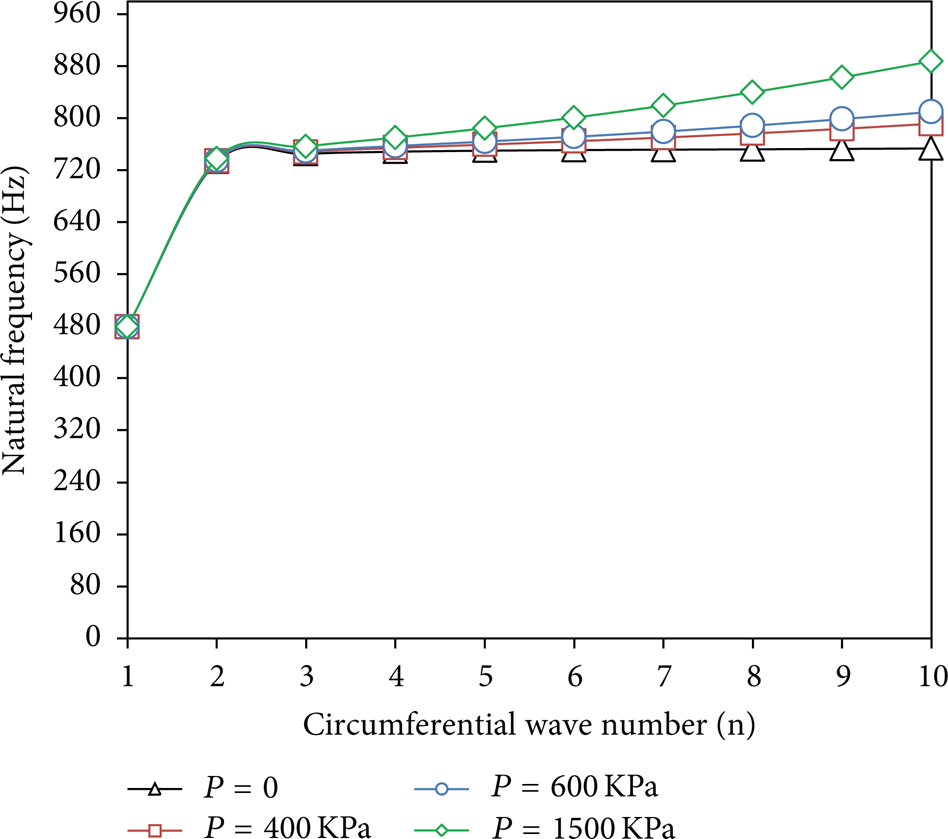
Variation of the natural frequency with F-SS boundary conditions (h/R = 0.002, L/R = 20, R = 1, and b = 0.3L).
Similar to the case without internal pressure, the natural frequencies for the six boundary conditions of the multilayered shells with internal pressure increase as the circumferential wave number n is increased. It can be seen from these figures that the increase in natural frequencies is significant when n increased from 1 to 2, and for n greater than 2 (n > 2), the natural frequencies increased gradually as the circumferential wave number n is increased. The results show that, for the multiple layered cylindrical shell with ring support with and without internal pressure, the natural frequencies for free-simply supported boundary condition are higher than those of other boundary conditions and similarly natural frequencies of clamped-free boundary condition with ring support with and without internal pressure are lower than those of the shell of any other end conditions.
The results show that internal pressure has an effect on the natural frequency of a multiple layered cylindrical shell with one ring support and causes the natural frequency to increase; and when the value of the internal pressure is large, the natural frequency is higher. The results obtained also show that one ring support with internal pressure has influenced the natural frequency and this influence is different for different boundary conditions.
Figures 14, 15, 16, 17, 18, and 19 depict the variation of the natural frequency against the position of the ring support b/L for a multiple layered cylindrical shell with and without internal pressure for the six boundary conditions. Positioning the ring support along a multiple layered shell is very important and the effect on the natural frequency characteristics needs to be investigated. As shown in these figures, for the shells with and without internal pressure with symmetric boundary conditions such as SS-SS, C-C, and F-F boundary conditions, the natural frequency curves for both cases with and without internal pressure are symmetrical about the center of the shell. The natural frequency increases as the position of the ring support is moved away from the first position of the shell towards the center and decreased from the center towards the end of the shell. This indicates that, for symmetric boundary conditions for both cases with and without internal pressure, the maximum natural frequency is obtained when the ring support is in the middle of the shell (b/L = 0.5). These natural frequency curves are symmetric because the end edges have the same conditions.
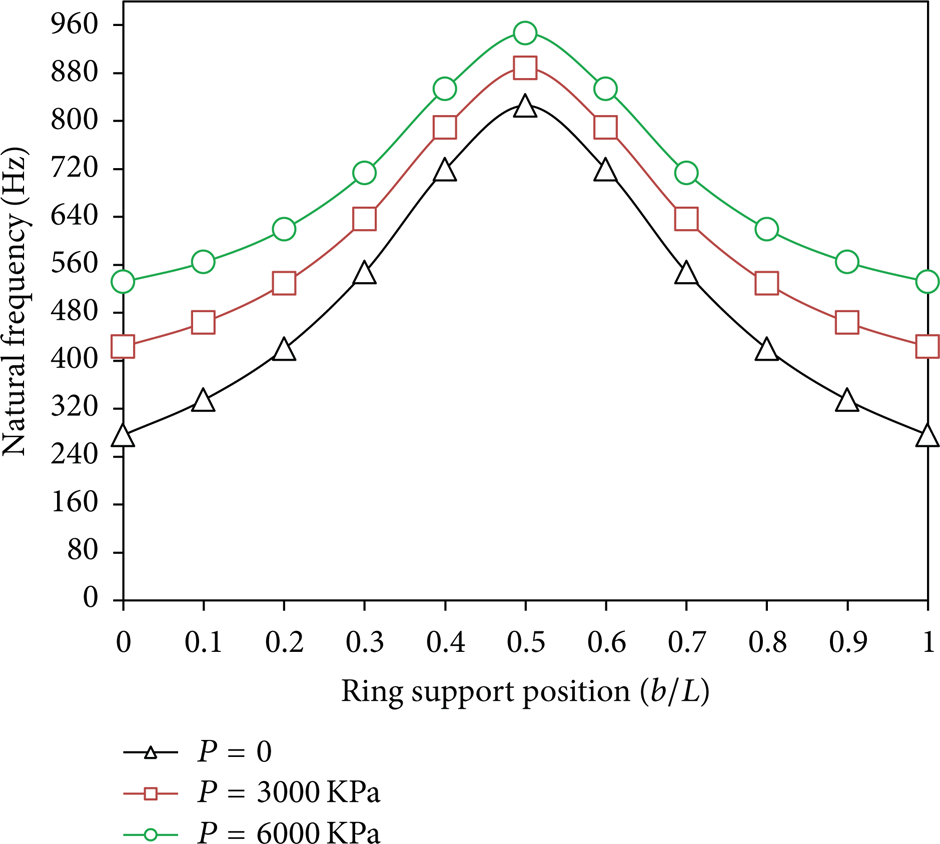
Variations of the natural frequency with the ring position b/L for SS-SS boundary conditions (h/R = 0.002, L/R = 20, and R = 1).
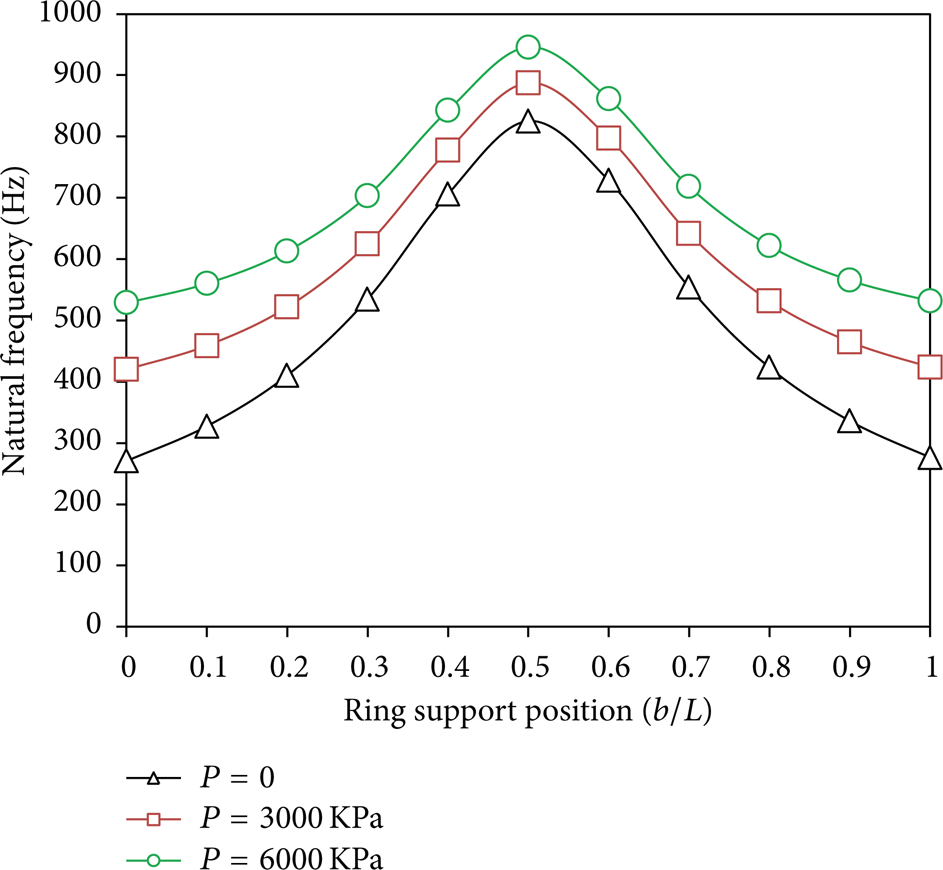
Variation of the natural frequency with the ring position b/L for C-C boundary conditions (h/R = 0.002, L/R = 20, and R = 1).

Variations of the natural frequency with the ring position b/L for F-F boundary conditions (h/R = 0.002, L/R = 20, and R = 1).

Variation of the natural frequency with the ring position b/L for C-SS boundary conditions (h/R = 0.002, L/R = 20, and R = 1).
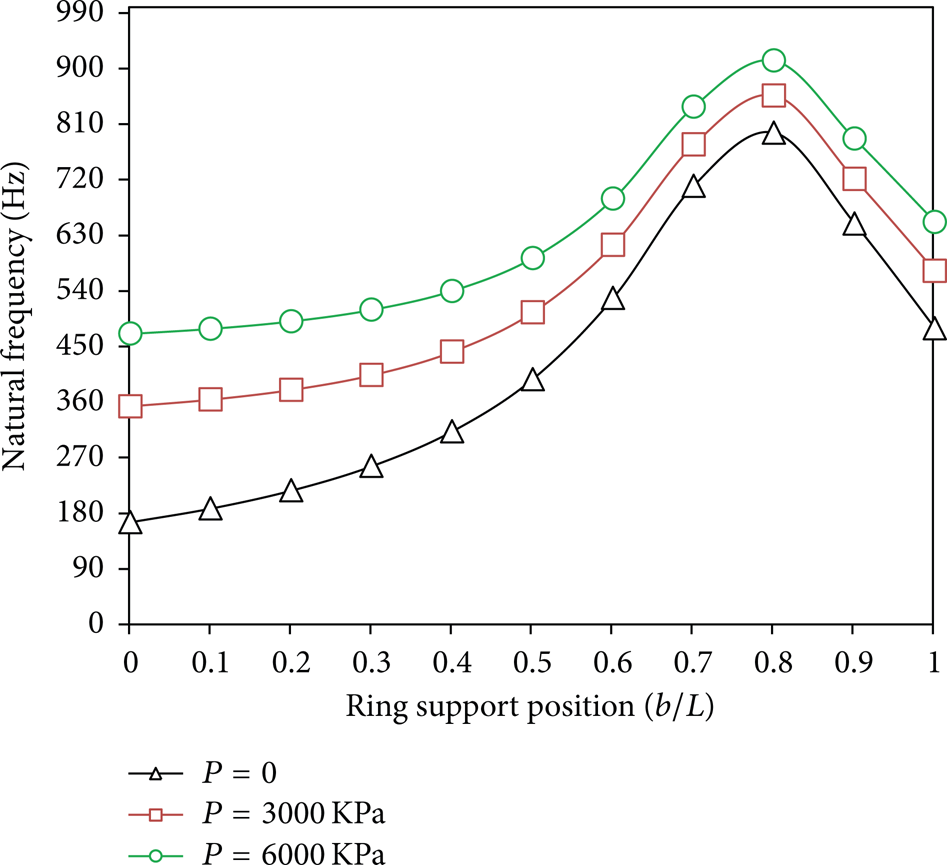
Variations of the natural frequency with the ring position b/L for C-F boundary conditions (h/R = 0.002, L/R = 20, and R = 1).
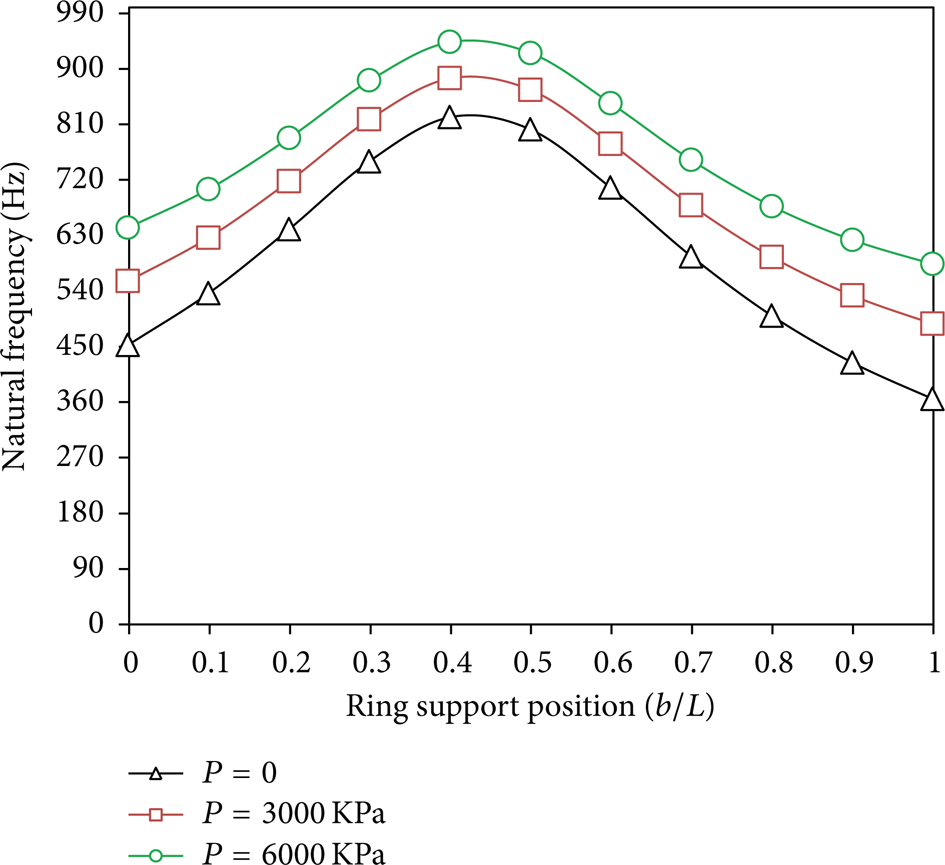
Variation of the natural frequency with the ring position b/L for F-SS boundary conditions (h/R = 0.002, L/R = 20, and R = 1).
For the multiple layered cylindrical shell with and without internal pressure with asymmetric boundary condition such as C-SS, C-F, and F-SS boundary conditions, the natural frequency curves for both cases with and without internal pressure are not symmetrical about the center of the shell as expected. It is seen that the maximum natural frequency is shifted away from the shell centre for both with and without internal pressure and is in the ranges of b/L = 0.6 for C-SS, b/L = 0.8 for C-F, and b/L = 0.4 for F-SS. The natural frequency curves are asymmetric because the end edges are of different end conditions.
The results show, for all positions of the ring support b/L for both cases with and without internal pressure, the natural frequencies of free-free boundary condition are higher than the other boundary conditions and similarly the natural frequencies of clamped-free shell are lower than the other conditions.
The internal pressures used in this study are 3000 and 6000 KPa. The results show that internal pressure affects the natural frequency of the shell when the position of the ring support is changed and causes the natural frequency to increase. When the internal pressure is large, the natural frequency is higher. The results obtained also show the natural frequency characteristics as the function of ring location along the shell for both cases with and without internal pressure and that the characteristic is different for different boundary conditions. It should be pointed out that the circumferential wave number used in these figures is n = 5.
8. Conclusions
In this study, the vibration characteristics of multiple layered cylindrical shell with ring support subjected to internal pressure for six different boundary conditions were investigated. The first order shear deformation theory is employed and the governing equations of motion were derived, using energy functional applied to the Ritz method. The boundary conditions represented by the end conditions are simply supported-simply supported (SS-SS), clamped-clamped (C-C), free-free (F-F), clamped-free (C-F), clamped-simply supported (C-SS), and free-simply supported (F-SS). The influence of internal pressure, ring position, and six boundary conditions on vibration characteristics of multiple layered cylindrical shell is discussed. This study shows that the ring support and internal pressure have effect on the natural frequency of multiple layered cylindrical shell and cause the natural frequency to increase. When the value of the internal pressure is large, the natural frequency is higher. Another point deduced here is that the natural frequency characteristics of multiple layered cylindrical shell with and without internal pressure and ring support are different for the six different boundary conditions. The authors believe that vibration frequencies results for multiple layered cylindrical shells supported with ring subjected to internal pressure are useful in engineering applications.
Footnotes
Acknowledgment
The first author would like to sincerely thank the Universiti Teknologi Malaysia (UTM) for the support provided to this project.