




Abstract
An efficient wireless sensor network (WSN) should maintain full sensing coverage and topology connectivity within its sensing field. Once holes occur due to failed sensors, the functionality and performance of the WSN will be affected. In this work, the proposed hole healing strategy aims to shorten the delivery hop count by a dynamic hole healing process in order to improve the data delivery time while maintaining the coverage ratio and topology connectivity. The criteria used to determine which hole should have the highest priority for healing in the next round include the weighted distance, angle magnitude, and depth of the hole. This study proposes a mobile robot, operating within the WSN, which carries redundant sensors to patch the holes by an optimum healing path. This path is determined based on the proposed EDPS (equally divided path selection) algorithm. Simulation results show the superiority of the proposed hole healing scheme over other general methods.
1. Introduction
A wireless sensor network (WSN) [1] consists of many sensing devices; however, each device only has limited resources. Under the constraint of these limited resources, these wireless devices have limited abilities, such as environment information sensing around itself, simplified computation capacity, and shorter communication distances [2, 3]. Even so, by cooperating with neighboring devices, nodes can form a network topology for WSN applications, which is important for guaranteeing the integrity and reliability of the environmental information in sensor network applications. Therefore, WSN applications usually deploy a large number of devices to guarantee full coverage and topology connectivity [4, 5]. After the wireless devices have been deployed, a network topology will be constructed via the devices' autonomous exchange of information with neighboring devices. WSN applications always require complete coverage [6], but as the abilities of wireless devices and their battery energy are limited, device failures are unavoidable. A single failed device is called a hole, which induces a coverage hole and reduces the system efficiency. Additionally, when the conveyance path is established, environment information will be sent along this path to data receiver center. In order to prevent the data transmission being interrupted because of node failures, two methods for ensuring data transmission are to reroute, or to patch nodes. The latter method (patching nodes for hole healing) is chosen in this study. The hole-healing approach was chosen over a rerouting approach for two main reasons. The first is that once the sensors near the sink, or a considerable number of sensors malfunction, either the rerouted path will become much longer, or it will not be possible to find a path for data transmission by a rerouting approach. The second reason is that a rerouting approach cannot avoid or solve the problem of coverage ratio decreases. A hole healing approach, however, will be able to keep routing paths and coverage ratios properly maintained for data transmission and the sensing tasks in a WSN. This study therefore used a hole healing approach and focused on the design of the healing strategy and mechanism. In addition, it was assumed that the WSN would always have enough reserved backup sensors for the hole healing process.
This study proposes a healing scheme that is not only able to solve the above problems but is also able to improve the delay time for data transmission. Some WSN applications require a real time response, for example, the protection of bridges, railway track security, traffic surveillance, rescue operations, or battlefield reconstruction. When an event occurs, the information must be sent to the data center as soon as possible. Therefore, the propagation time of event response in the surveillance field is an important factor in WSN applications. Data is conveyed directly or indirectly to a data receiver center, and if a node fails during this process, it will either induce data loss or postpone the propagation delay time. Therefore, failed nodes must be healed in order to increase the coverage rate and to rebuild the topology connectivity, the latter of which is more important. Before the hole is healed, carefully calculating which hole must be selected for healing, with special attention paid to the data propagation time.
This paper considers an asymmetrical WSN topology. This consists of a data collection center called a sink, and many wireless sensor devices called nodes. Nodes are responsible for collecting information on their surrounding environment and forwarding data from neighbor nodes. The information is transmitted to the data center by one-hop or multihop methods. The information flow structure is called multi-to-one topology, which differs from peer-to-peer architecture. In the multi-to-one architecture, node loading is very unbalanced, because sensors need to sense environmental information and forward others' data to the sink. Therefore, a node closer to the sink will have a heavier traffic load. As shown in Figure 1, the direction and thickness of the arrows represent the data flow direction and volume, respectively. Consequently, coverage holes occur due to node failures owing to the limited node energy being exhausted, or other accidental events. As a result, data will be lost, the conveyance time will be increased, and the topology may be separated. Because of the lack of infrastructure backbone, WSN applications usually use an ad hoc network mode. When nodes do not work together, however, it will be difficult to maintain a topology connection. To make matters worse, when they do communicate with each other, they use up their limited energy, causing node failure. As a result, there will be communication problems.

The multi-to-one data flow concept.
The remainder of this paper is organized as follows. Section 2 introduces relevant works. Section 3 makes system model statements concerning assumptions made in this study. Section 4 presents the proposed healing scheme algorithm. Section 5 summarizes the simulation results, and Section 6 draws conclusions.
2. Related Works
In WSN applications, connectivity and coverage are two major problems. Specifically, increasing the coverage rate and maintaining the topology connectivity can reduce node energy consumption and prolong the network lifetime. Based on limited energy resources and the nature of wireless networks, node failure is unavoidable. Therefore, reactivating failed nodes is an effective method to keep WSN applications working continuously. To do this, it is necessary to know the positions of failed nodes or holes. The Voronoi diagram concept [7] is used to detect a coverage hole and to calculate the hole size [8, 9] or improve the coverage [10, 11]. The article in [12] proposed a triangular oriented diagram to detect holes and calculate the hole size and then determine which mobile sensor should have priority for healing. Additionally, articles in [13–15] proposed a method for discovering failed nodes and estimating hole positions by periodically collecting and updating the surveillance information at the data receiver center.
In terms of hole deployment, authors in [16] utilize redundant dynamic nodes that have been distributed within the field and use dynamic scheme technology to fix the holes, based on a centralized computer to drive the appropriate dynamic nodes to holes. In [17] a TSP-Delaunay re-deployment method was proposed for repairing holes. Also, a BFNP (best fit node policy) method [18] was proposed for fixing holes by activating inactive nodes around holes. In [19], the bidding contention protocol was proposed, which enables redundant nodes in dense deployment areas to move to sparsely covered areas during the contention process. Unlike redundant nodes, static nodes are able to identify field holes. Active redundant nodes must derive hole information and calculate the healing efficiency before moving, a method which may induce erroneous movement and result in wasted energy. Besides the problem of energy consumption, the speed of the mobile nodes' movement is a critical issue which will affect the efficiency of the healing scheme; see [20] for further details. Authors in [21] considered a small group of mobile robots operating in WSNs and proposed the randomized robot-assisted relocation of static sensors (R3S2) and a grid-based variant (G-R3S2) algorithm for hole identification and coverage repair. However, these studies did not consider the delay time induced by data transmission in the hole healing process.
3. Preliminary
This study considers a centralized WSN architecture, with nodes uniformly deployed within the
Vacant grids are areas uncovered by sensors; adjacent and continuously vacant grids are called coverage holes (HOLEs, which also include single vacant grids), and each HOLE is assigned a serial number i. For ease of reference,
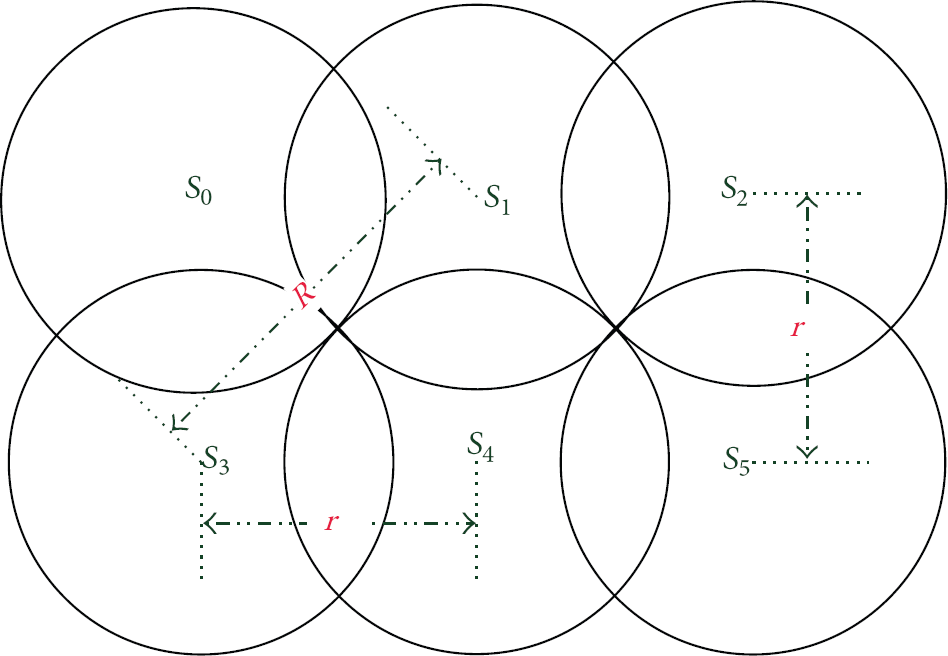
The distance relationship of nodes under grid topology.
With the centralized WSN architecture, the sink knows the HOLE distribution in the surveillance field. To explain the node locations, Cartesian coordinates (

To make the paper more readable, the term “HOLE angle” is defined as
To maintain the topology connectivity and ensure the integrity of the environment sensing information with a shortened postponement time for data transmission, a HOLE healing scheme is proposed. Specifically, this scheme has two phases, the first is to select one HOLE while at the same time calculating a healing path, which is based on the three properties of the HOLE, and the second phase is to drive a robot to patch the HOLE along the healing path decided by the first phase. The robot is equipped with a positioning component and has the ability to move to the appointed location. Terrain obstacles are not considered, and the mobile robot only carries out and finishes an established healing path each time; the shortest route is determined by the Dijkstra algorithm.
4. Hole Healing Scheme
The purpose of the proposed scheme is to select a HOLE and to include one optimized healing path for this HOLE. In WSN applications, when the connected topology is disrupted, the connection must be restored for data transmission to continue; otherwise the environment information will either be lost or delayed at the sink. The results of the hole healing scheme are not only expected to increase the coverage rate but to also improve the data propagation time. In fact, when a HOLE is healed, the sequence will affect the system efficiency, especially used in real time applications.
Optimizing the area coverage and topology connectivity is a very complicated process. First, the Cartesian coordinates are used to describe the location of the nodes as described above. The position of the node is expressed as
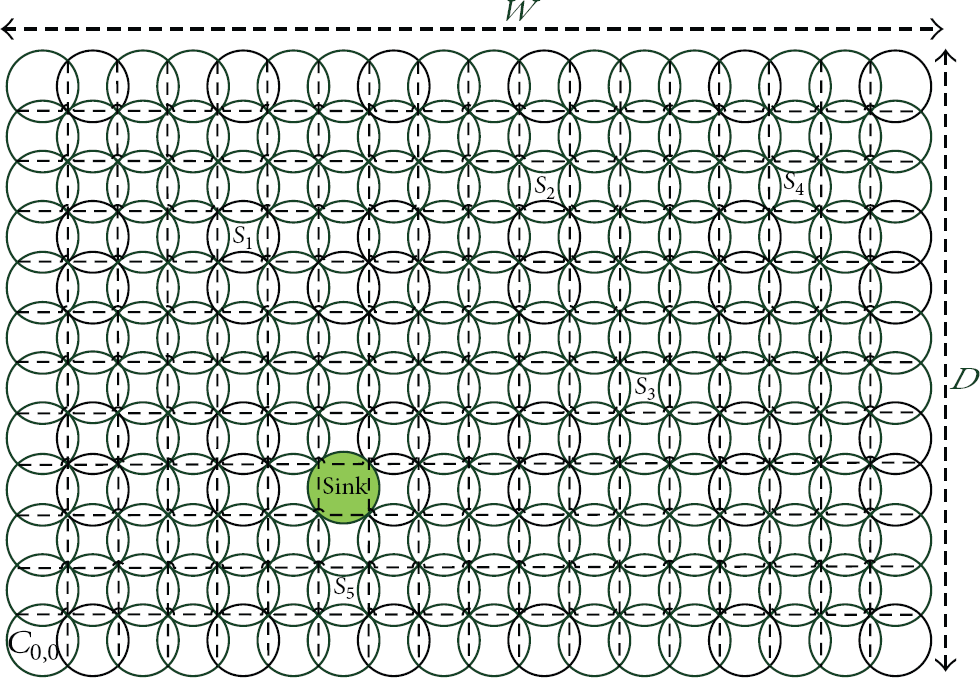
The ruled grid structure with Cartesian coordinates.
To calculate the sequence of HOLEs to be healed, three weighted metrics are considered, which are the properties of a HOLE. The first metric is the HOLE angle,
4.1. Discussion of the HOLE Angle
The authors of [23] proposed the boundary node detection scheme, which uses the LVP (localized Voronoi polygons) algorithm to find border nodes. By using the algorithm, the nodes will know whether they are a border node or not by neighboring nodes' information only, and these nodes will transmit their status information to the sink. Figure 4 shows a typical example of HOLE distribution in the field, which results from the sink collecting information in the surveillance field.

The HOLE distribution in the surveillance field.
However, the angle can provide information on how the data flow will be hindered by a HOLE. Specifically, if a hole occurs in the middle of a transmission path, this will cause a conveyance interruption, and more time for rerouting will be required in order to maintain the data transmission path. The data are conveyed to the sink from all sides, and the data transmission influence is directly proportional to the HOLE width; that is to say, a larger HOLE width will mean more interference. In this study, the HOLE angle is considered equivalent to the HOLE width.
Before computing
The algorithm applies the slope of the ray to find the upper border node

Let (1) For j from 1 to n do (2) (3) if (4) (5) else if (6) (7) End For (8) (9)

Illustration of the relationship between
4.2. The Distance Metric
The proposed hole healing scheme is based on a centralized topology. Obviously, the environmental information is conveyed to the sink, and if any HOLE exits within the field, then the data transmission will be hindered. Influence on the fixed size of a HOLE owing to the different influences of various positions depends on how close the sink is. If the HOLE position is closer to the sink, then the interference will be more serious, and if the HOLE is far away from the sink, the interference will be much less. Therefore, HOLE healing must first consider the influence intensity of data transmission. Figure 6 illustrates the HOLE distribution by Euclidean distance in the field, where


The HOLE distribution by Euclidean distance.
The metric of the HOLE distance is denoted as
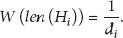
4.3. The Metric of the HOLE Depth,
When the HOLE area is small, it is clear which HOLE must be selected, with the path healing determined by the metrics
To determine the depth of the HOLE, the nearest border nodes
Definition 1.
A ray [Sink,
To calculate both nodes
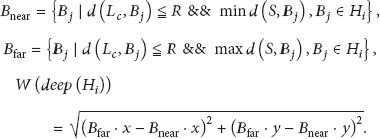

Illustration of the relationship between
As discussed above, an established path from
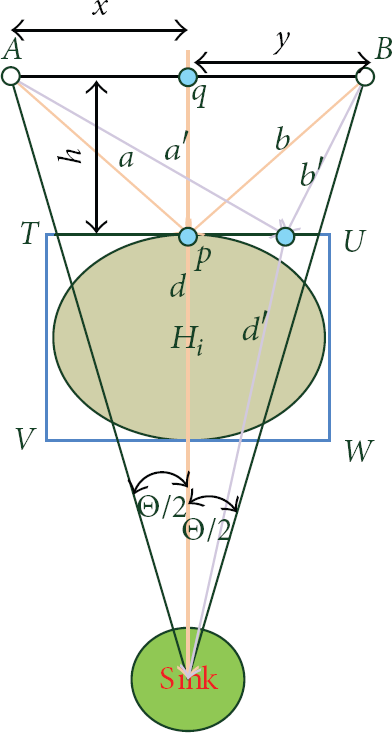
Illustration of the path selection by EDPS.
Theorem 2.
The shortest healing path in
Proof.
In Figure 8, the parallelogram TUWV contains a HOLE
Point q is one point on segment


Both (6) and (7) substitute for


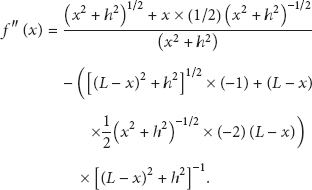
According to the extreme value theorem, it is known that the function
4.4. The Selection of the Optimal Healing Path
The healing path will be selected according to the three factors described above, that is, the angle, the distance, and the depth of the HOLE. Here, it is worth noting to patch one node in the HOLE, if we pay attention to the position needed to be healed. Even though the coverage increase is fixed with a maximum size of the sensing range of a node, the delay time for the data transmission may vary with different healing positions. To extend the analysis of the proposed scheme to various applications, three parameters, α, β, and γ weighting on the three HOLE metrics, respectively, are used. The formula of the total healing metric is denoted as

(1) (2) Adding (3) (4) (5) Add the vertex P to Path (6) (7) Repeat step 4 until (8) Adding
In Algorithm 2,
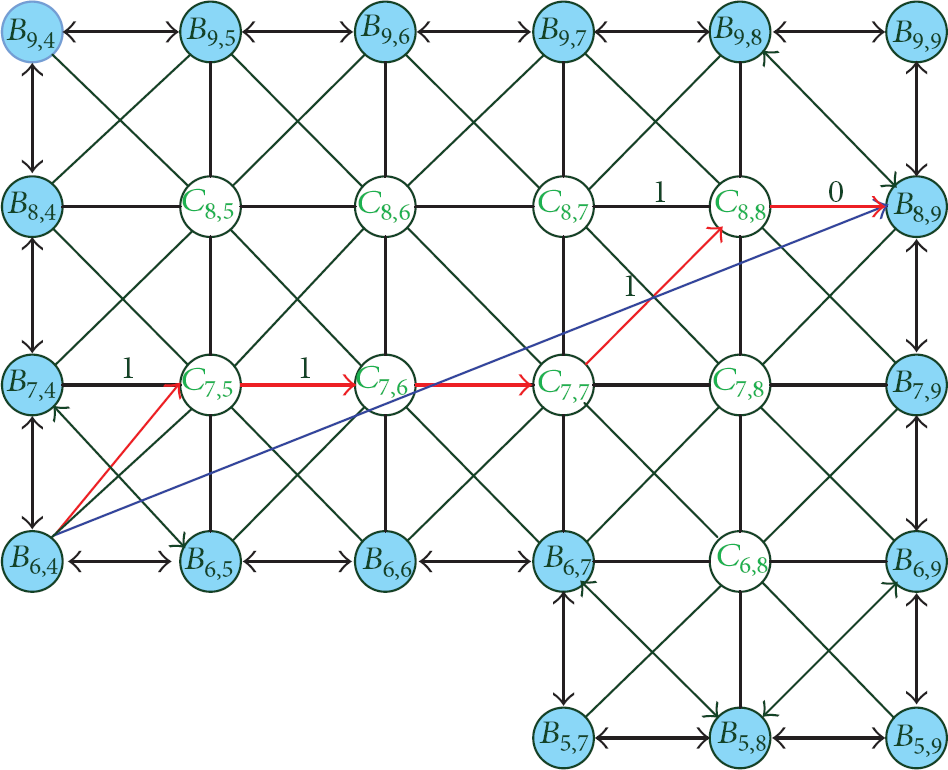
Illustration of the real healing path.
5. Simulation Results
The hole healing scheme proposed in this paper considers three weighted metrics, which are the angle, random selection for healing hole, nearest distance selection for healing hole, maximum size selection for healing hole.
First, in this simulation let the three weight values of α, β, and γ be equal; in other words, all of them are equal to 1/3. The average delivery hops (ADH) of the proposed weighted method were calculated and compared with those of the other methods. In the simulations, sensor nodes were initially deployed in the ruled fields of
ADH (random HOLE = 15,
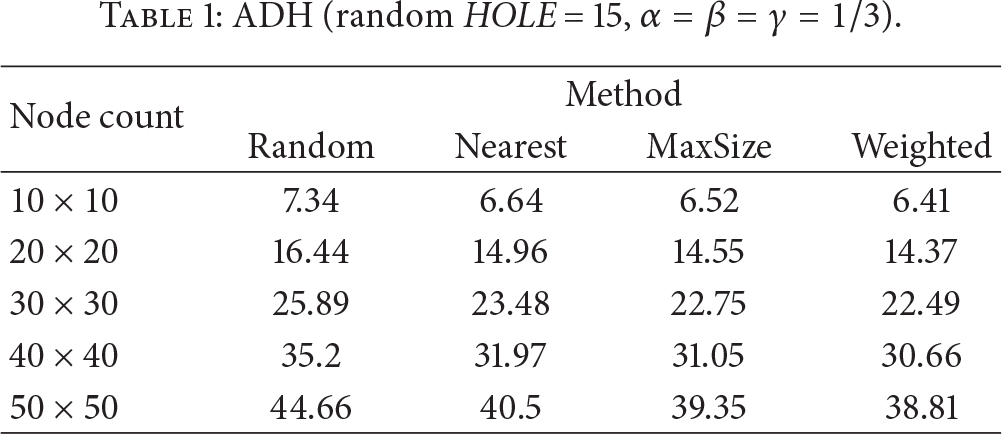

ADH (random

Obviously, the longest average transmitted path was obtained by random selection; the second longest path was achieved by nearest distance selection; the third longest path was achieved by maximum size selection; and the best result (the shortest route) was obtained by the proposed weighted selection scheme. It also can be observed from the results that the number of ADH increased proportionally according to the number of nodes, and the result differences between the four methods were more conspicuous in larger areas.
To discuss the decrement rate (
Decrement rate of ADH (random HOLE = 15,
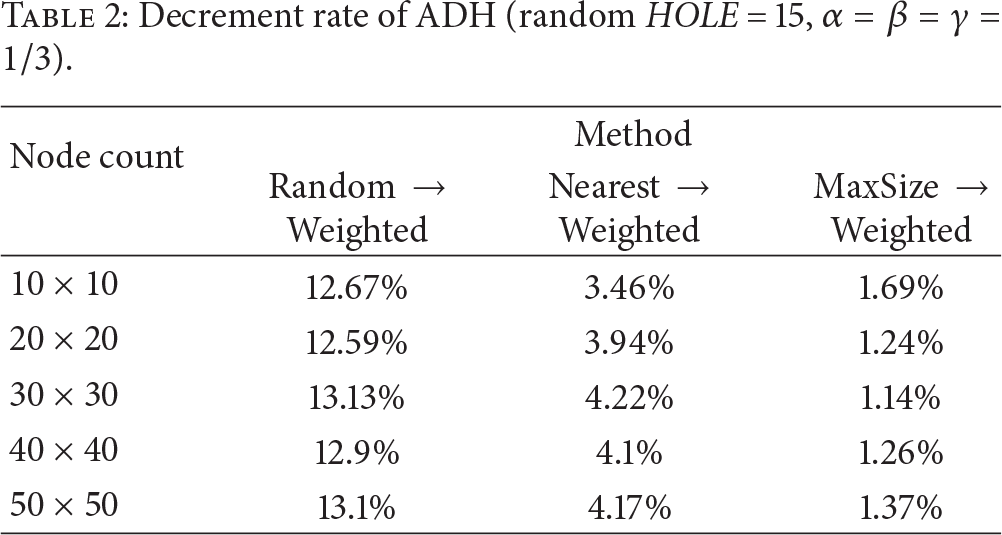
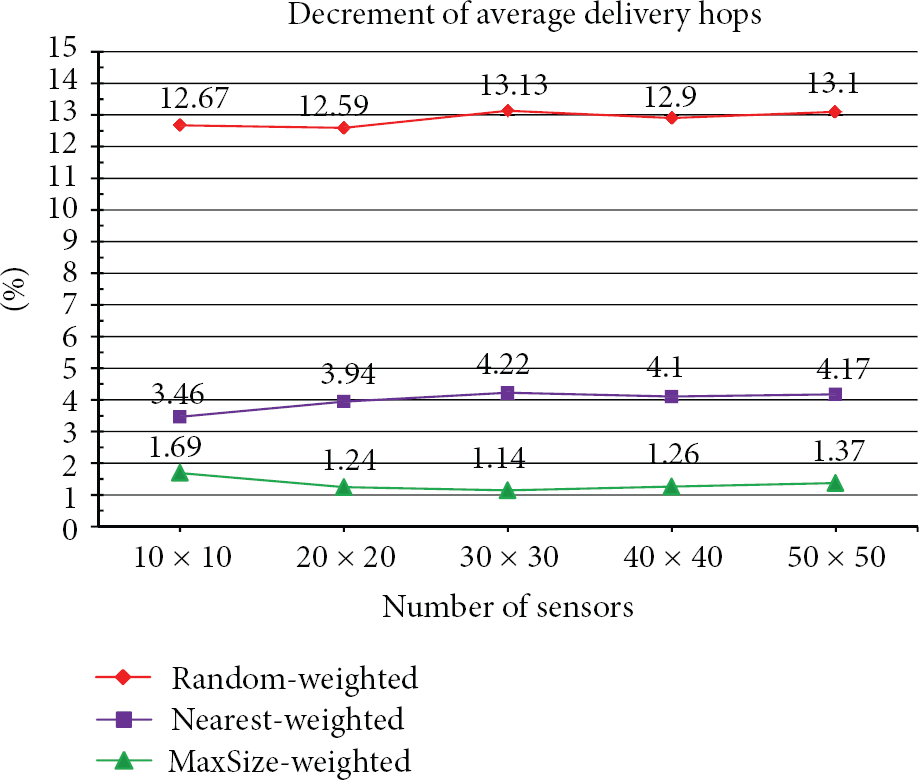
The above simulation results were based on a fixed number of HOLEs and various numbers of deployed nodes. The next simulations were conducted with a fixed number of
ADH (node count =
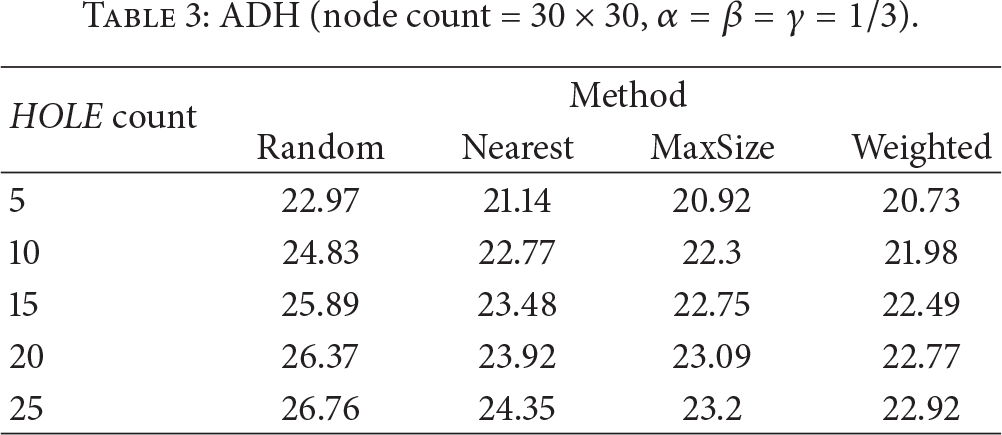

Average delivery hops (node count =
Similarly, a fixed number of
Decrement of ADH (node count =


Decrement of ADH (node count =
The simulation results shown above are compared with the different methods. However, Table 5 and Figure 14 show the varied ADH results based on the simulations of simultaneously changing both the number of nodes and HOLEs in the weighted method. It is clear that if the number of nodes or HOLEs increases, the ADH count will also increases. It is also clear that an increased number of nodes results in a more significant increase of ADH than does an increased number of HOLEs.
ADH for proposed weighted HOLE selection method (


ADH for proposed weighted HOLE selection method (
The results discussed above were under the condition of three equal weighting coefficients, 
ADH count (node count =
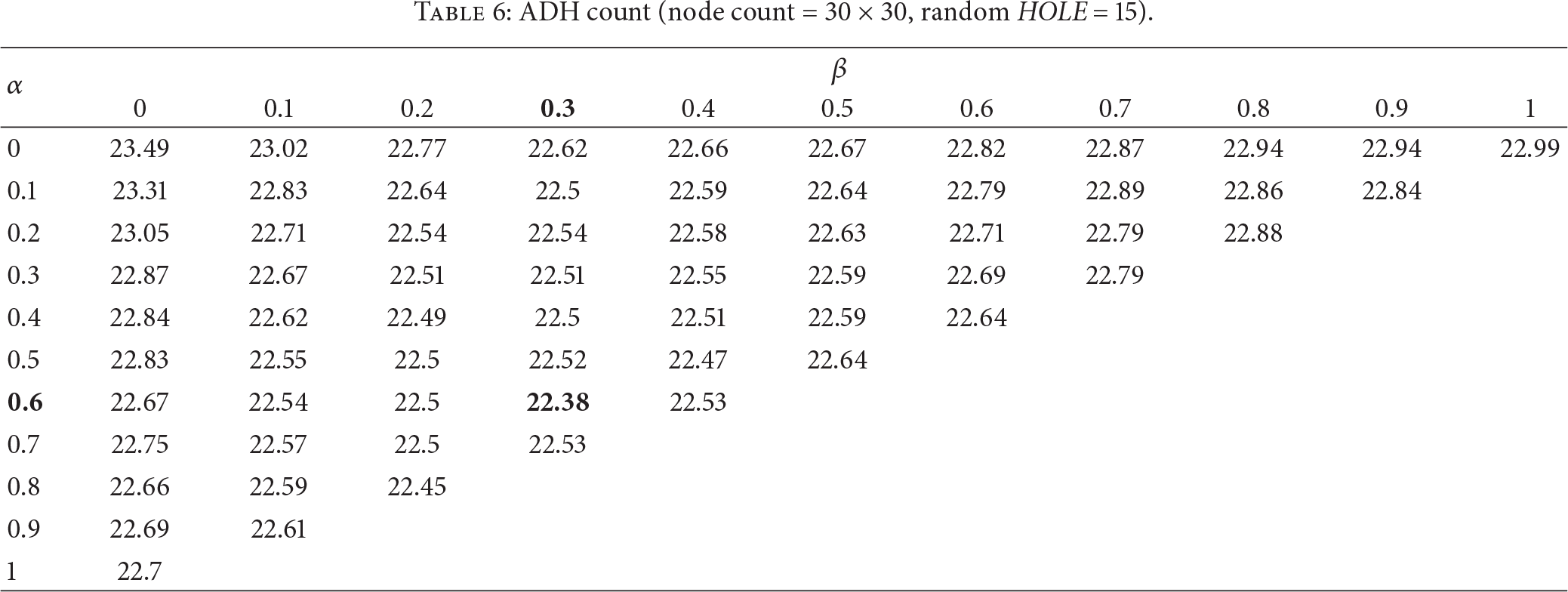
Table 6 and Figure 15 illustrate the change of the ADH count with variously changed weighting values of α, β, and γ. The result is also the average of 1000 iterations in each simulation case. The numbers of nodes and HOLEs are

ADH (node count =
According to the above simulation results, it clear that the proposed weighted method has demonstrates significantly better performance than the other methods. In addition, the simulations with adjusted of weighting values were able to obtain the optimum values for α, β, and γ in order to obtain the shortest ADH and apply the proposed weighted HOLE healing strategy to practical applications.
6. Conclusion
The focus of this paper is the rebuilding and maintenance of network topology connections. Reducing the time of postponement in the data transmission process is the purpose of the proposed hole healing scheme. Three properties of HOLEs for HOLE selection are proposed to improve the data conveyance time. They consider factors such as the angle of a HOLE, the distance between the sink and a HOLE, and the depth of the HOLE. In addition, the proposed EDPS algorithm is able to find a shorter path for healing the selected HOLE. This idea is quite useful for the healing process, especially when large HOLEs occur in the field. To ensure the accuracy of node location calculation, the field is imagined as a virtual ruled grid, and a robot is utilized to patch sensors in order to rebuild the topology connection. The performance of this proposed strategy is evaluated according to the average delivery hops. By comparing the proposed method with the random selection, nearest selection, and maximum size selection methods, the simulation results show that the proposed strategy outperforms the others. We believe that our proposed method of hole healing with data delivery awareness (HHDDA) is a valuable maintenance method for WSN applications.
Footnotes
Acknowledgment
The authors would like to thank the Research Center for Energy Technology and Strategy (RCETS) of National Cheng Kung University for financially supporting this research under Grants no. D102-23015 and no. D102-15103.