




Abstract
EPCglobal network is used to share product data between trading partners, which was proposed by EPCglobal. Object Name Service (ONS) in EPCglobal framework raises two critical security risks: the authenticity of IP addresses for Physical Markup Language (PML) servers and the privacy of Electronic Product Codes (EPCs). Existing work considers either the IP address authentication or the EPC privacy. In addition, that work mainly relies on cryptographic tools, in which key distribution is not a trivial task and also causes a large amount of computation overhead. In this paper, we make the first attempt to solve those two security risks together without relying cryptography. We propose a scheme, namely, APP (authenticate ONS and protect EPC privacy), to guarantee the authenticity of IP addresses for PML servers as well as EPC privacy and to maintain ultralightweight computation cost. Moreover, we give formal definition of the authenticity and the privacy in ONS context. The security achievements are strictly analyzed and proved. The extensive analysis results justify the applicability of the proposed scheme.
1. Introduction
EPCglobal is a typical network framework for the Internet of Things (IoT), machine to Machine (M2M), and RFID networks. It has been envisioned as a key method to recognize, locate, and trace EPC-enabled physical objects (e.g., RFIDs or sensors). Moreover, it is used to facilitate supply chain management, food trace back, logistics, and so forth.
Concretely, EPCglobal relies on Object Name Service (ONS) to map Electronic Product Code (EPC) to an IP address of a server. The server, called Physical Markup Language (PML) server in EPCglobal, provides detailed product information of the EPC. To do so, an EPC tag reader obtains EPCs from tags and submits the EPCs to ONS. Based on the received EPCs, ONS returns the IP address of the corresponding server. Generally speaking, the architecture of ONS consists of distributed server systems and can support iteratively query for scalability and flexibility.
ONS architecture raises two security concerns: one is the authenticity of returning results. If the returning results are fake, the product information will be detoured to a forged server with garbage information. The other is the privacy of EPC. If EPC is revealed by ONS server, the user's privacy may be damaged. For example, a user looks up an EPC for a bottle of medical tablets that is privacy sensitive. Unfortunately, above security risks have not been largely recognized, and rare works exist to address both risks at the same time.
Currently, a few works use some similar methods for DNS security [1], rely on Public Key Infrastructure (PKI) [2], or depend on P2P architecture [3]. Those solutions experience many difficulties: The schemes relying on cryptography usually induce extensive computation overhead. The key distribution and management issues raise many deployment hurdles. The assumption of existing PKI is unrealistic in the current situation. Some solutions such as P2P solution require the migration of underlying network architecture. In addition, all schemes can only solve either of the aforementioned security concerns and not both. Moreover, as smartphones start to equip RFID reader function, the EPC reader will become portable. To save the power consumption of such hand-held devices, ultralightweight solutions are desired.
In this paper, we propose an ultralightweight solution to authenticate the ONS record and protect the user's privacy without cryptography. In addition, we strictly prove its security strength in terms of authenticity and privacy. Moreover, we adapt a formal and rigorous method to state, present, and analyze the security goals. That is, we formulate the definition of authenticity and privacy in EPCglobal. We formally prove the achievement of proposed scheme with respect to authenticity and privacy strength. All presentations strictly follow the formal expressions for better clarity and rigorous generality.
The contributions of the paper are listed as follows.
We make the first attempt to propose an ultralightweight scheme in terms of computation overhead without cryptography to solve both aforementioned problems in one solution. We make the first attempt to strictly define authenticity and privacy in EPCglobal and provide formal proofs for the achievement of security goals. We propose a general scheme to represent all possible solutions for the problem.
The rest of the paper is organized as follows. Section 2 gives an overview on relevant prior work. In Section 3 we discuss the basic assumption and models used throughout the paper. Section 4 provides the detailed description of our proposed models and analysis. Finally, Section 5 concludes the paper.
2. Related Work
The security in ONS starts to attract more and more attention. Fabian and Günther [4] reviewed the security challenges of the EPCglobal network. Sun et al. [2] proposed a lightweight Public Key Infrastructure (LPKI) for trustworthy ONS. They proposed to use a new encryption encode or decode strategy of EPC and improved the reliability of the certificate authority by a new multiple customer relation model. Fabian [3] and Fabian and Günther [5] proposed to use structured P2P systems with distributed hash tables (DHT) to replace ONS architecture. They found that the strength of privacy protection slightly increased by using DHT compared to DNS, but strong protection still relied on secure key distribution mechanisms. Rosenkranz et al. [1] compared two mechanisms to improve the trust level of ONS, DNSSEC and DNSCurve. DNSSEC enables integrity and authenticity; DNSCurve additionally enables confidentiality and higher availability. Their security goals are different from our paper, and ONS security cannot be achieved by DNS security enhancement with optimal performance. Schapranow et al. [6] proposed to protect the privacy of querying parties. Their module can smoothly integrate into existing network infrastructures without major efforts. Kurkovsky et al. [7] proposed to use wearable tags embedded in badges or clothing for employee's tracking at the workplace. It may hurt the privacy of employee after continuous authentication. This kind of privacy problem of RFID has been discussed in many papers [8–11]. Shi et al. [12] proposed SecDS, a secure EPC discovery service system in EPCglobal network. They developed a secure and efficient search engine (SecDS) based on EPC Discovery Services (EPCDS) for EPCglobal network. Their work is independent of ours.
3. Problem Formulation
3.1. Network Model
There exist two major entities in ONS context: requester (denoted as ℛ) and ONS server (denoted as 𝒮). The requester reads RFID tag to obtain EPC and submits it to ONS server. The ONS server subsequently returns the IP address of the server who can provide detailed product information on that EPC. The requester then consults the server with returned IP address so as to fetch the detailed product information.
Although the architecture of ONS is very similar to DNS, we observe that there still exists a major distinction between ONS and DNS: the content on the server returned by ONS for a given EPC is usually fixed and shorter than that in the server returned by DNS as it is the information for a product. The content on the server returned by DNS may be changed frequently as it is the information for a web site.
3.2. Attack Model and Trust Model
We only consider adversaries at ONS servers as the paper concentrates on the authenticity of returned records (IP addresses) and EPC privacy. The adversary is denoted as 𝒜. We point out following possible attacks.
Definition 1 (ONS pollution attack (
)).
ONS server returns a fake IP address upon being requested for an EPC. The PML server at the fake IP address provides forged product information. In shorthand,

Definition 2 (ONS leakage attack (
)).
ONS server reveals the pair of submitted EPC and requester's IP address to other third parties who are interested in them. In shorthand,

Definition 3 (ONS inference attack (
)).
ONS server deduces the activities related to submitted EPCs and reveals those activities and requester's IP address to other third parities who are interested in them. In shorthand,

ONS server is untrustworthy as we assume adversaries at ONS server are interested in the user's privacy and intend to break the authenticity. Requester must be trustworthy, as it is a prerequisite requirement for further discussion; otherwise, the discussion is meaningless and no solution exists.
3.3. Security Definition and Design Goal
Informally speaking, the authenticity is guaranteed if adversaries cannot fool the requester to believe a fake IP address. More specifically, we formally state the definitions as follows.
Definition 4 (perfect authenticity of mapping IP address (
)).
In shorthand, it is

Definition 5 (computational authenticity of mapping IP address (
)).
For any probabilistic polynomial turing machine (PPTM) adversary 𝒜, given any

Definition 6.
Authentication attacking experiment on scheme Π defending against adversary 𝒜- Scheme Π is executed with security parameter z in the presence of adversary 𝒜. ℛ sends If and only if ℛ outputs 1, the experiment outputs 1.
Definition 7.
Scheme Π guarantees perfect (computational) authenticity in the presence of any (PPTM) adversary 𝒜 (denoted as

The EPC privacy defending against
The EPC privacy defending against
Definition 8 (user activity).
It is a behavior related to certain products that are attached with requested EPCs, denoted as
Definition 9 (seduce).
It links an activity to a serial of EPCs, called
Definition 10 (perfect privacy).
Simply speaking, adversaries cannot link to anyone in

Computational privacy can be defined similarly like computational authenticity.
Definition 11.
Privacy attacking experiment on scheme Π defending against adversary 𝒜- Scheme Π is executed with security parameter z in the presence of adversary 𝒜. ℛ sends If and only if 𝒜 outputs 1, the experiment outputs 1.
Definition 12.
Scheme Π guarantees perfect (computational) privacy in presence of any (PPTM) adversary 𝒜 (denoted as

Therefore, the design goal is to propose a scheme Π satisfying

4. Proposed Schemes
4.1. Basic Schemes
Before we propose our advanced scheme, we review some basic schemes to illustrate our motivations.
(1) Protect Authenticity via Digital Signature. The straightforward method to protect authenticity of EPC is relying on the digital signature. Suppose there exists Trusted Third Party (TTP). TTP signs the signatures for each pair of
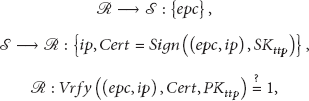
This method requires TTP to sign a large number of signatures previously and deploy them to 𝒮. It is not scalable and flexible when the number of EPCs is large.
(2) Protect Authenticity via PKI Online. If there exists PKI, the certificate for public key can be fetched, and the signature of TTP can be generated on-line. The authenticity of EPC can be achieved by the following method:

This method requires that TTP exists and signs signatures on-line. It may be scalable when the number of EPCs is large, but more delay and communication overhead are induced.
(3) Protect Privacy via TTP's Encryption and Online Decryption. For protecting the privacy of EPC, the straightforward method is via encryption. The database on pairs of (
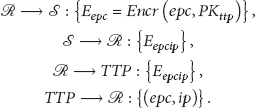
This method requires TTP to encrypt a large number of
(4) Protect Authenticity via P2P Redundancy. If there does not exist PKI or TTP, the authenticity of EPC has to rely on redundancy information that can be provided from P2P network. The authenticity of EPC can be achieved by the following method:

With the above warmup, we next propose an advanced scheme to achieve the design goal. We list major notations used in the remainder of the paper in Table 1.
Notation.

4.2. Advanced Scheme: APP
We propose an advanced scheme APP (authenticate ONS and protect EPC privacy)—an ultralightweight scheme for both authenticity and privacy—as follows.
At ℛ the Following Happens
Step 1.
ℛ has been predeployed by an authenticated set of 

Step 2.
Select 

Step 3.
Suppose the requested EPC is 
Step 4.
ℛ sends the mixed set 
At 𝒮 the Following Happens
Step 5.
𝒮 searches its database and returns corresponding IP addresses to ℛ:

At ℛ the Following Happens
Step 6.
ℛ checks the correctness of IP addresses, namely 
Step 7.
If all IP addresses in
4.2.1. Extension
(1) The above can be conducted by ℛ for more rounds. If in all rounds
(2) 
(3) The verification for IP address can be extended to the verification of EPC information. In case the IP address corresponding to certain EPC is changed, the verification can be migrated to EPC information. The table
(4) The parameters a, b in scheme APP can be extended to adaptive tuning according to the observation on the trustworthiness of ONS server. If accumulative trustworthiness is over a threshold value, the security parameter a, b can be changed to smaller ones for better performance (with respect to communication overhead).
4.2.2. Discussion
(1) As an EPC is short (no more than 96 bits), it does not obviously damage communication performance when submitting multiple EPCs. Similarly, an IP address is short (no more than 128 bits), and it does not obviously damage communication performance when returning multiple IP addresses.
(2) The above discussion is independent to buffered ONS architecture. If buffered ONS is available, ℛ does not need to explicitly request 𝒮, instead of requesting the buffered ONS. It thus can defend against poisonous ONS buffers. Indeed, buffered ONS records can be looked upon as an imaginary ONS server.
(3) It is better to let authenticated set
Algorithms proposed for APP scheme are as in Algorithms 1–3.
Analysis
Proposition 13.
The authenticity strength of APP with one round is
Proof.
If and only if adversaries correctly answer the testing set
Proposition 14.
The authenticity strength of APP with r rounds is
Proof.
The probability that adversaries can cheat requesters in all r rounds is the probability of a successful guess in all r times, which is
Proposition 15.
The privacy strength of APP with one round is
Proof.
If and only if adversaries correctly guesses the location of
Proposition 16.
The privacy strength of APP with r rounds is
Proof.
Straightforward.
Claim 1. Scheme APP is ultralightweight.
Proof.
The computation overhead for authenticity protection is merely the verification of string comparison; no cryptographic computation is induced. Besides, no computation overhead for privacy protection is induced. The induced communications are
If the elements in testing set are recurrent, the security will be damaged. k is also a security parameter influencing the authenticity and privacy strength. For simplicity and security, let
Proposition 17.
The probability that
Proof.
View the selection of
Proposition 18.
The probability that x items in
Proof.
Suppose
Proposition 19.
The probability that x items in
Proof.
Suppose
Lemma 20.
Any required strength for authenticity and privacy can be achieved by APP scheme via selecting a proper security parameter (i.e., APP is sufficient for the authenticity and privacy).
Proof.
Suppose the authentication and privacy strength requirements are Select b such that Select a such that Select
Proposition 21.
APP scheme can guarantee the authenticity and privacy (i.e.,
Proof.
According to the Lemma, a security parameter (denoted as z in the definition of authenticity and privacy) can be selected for scheme APP to guarantee the required strength for authenticity and privacy.
4.3. A General Scheme
We finally propose a general scheme to unify all possible schemes to protect authenticity and privacy in ONS context to defend against adversaries in ONS server and channels. The attacks such as ONS pollution attack, ONS leakage attack, and ONS deduction attack can be mitigated.
(1)
Purpose: the privacy of
(2) Request
Purpose: for adversaries in communication channels, the authenticity of
(3)
Purpose: 𝒮 authenticates received
(4)
Purpose: 𝒮 searches
(5) Response
Purpose: For adversaries in communication channels and at ℛ, the privacy of
For adversaries in communication channels, the authenticity of
For authenticated channels,
(6)
Purpose: ℛ authenticates received
(7)
Purpose: ℛ obtains final inquired result
Next, to simplify the discussion and concentrate on adversaries only at 𝒮, we propose a simplified general scheme to unify all possible schemes to protect authenticity and privacy in ONS context to defend against only adversaries in ONS server. The attacks such as ONS pollution attack, ONS leakage attack, and ONS deduction attack can be mitigated.
(1)
(2) Request
(3)
(4) Response
(5)
Figure 1 illustrates the processes in general scheme.
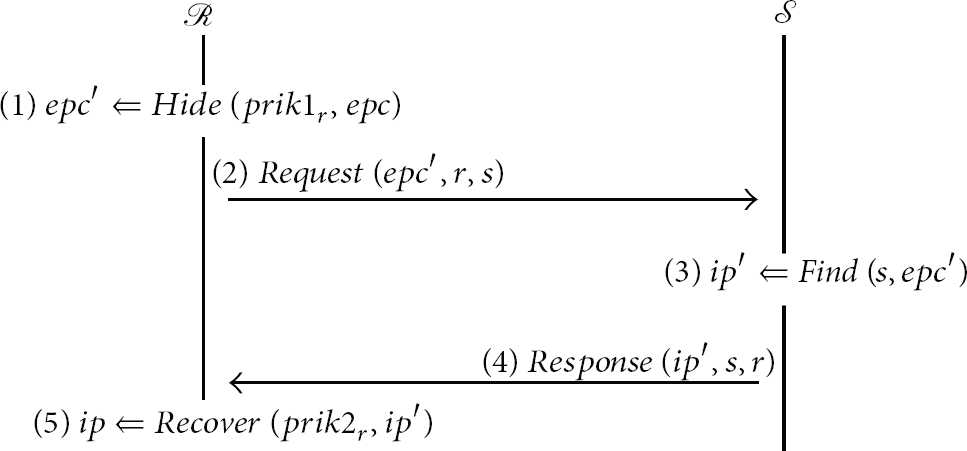
A general scheme to protect authenticity and privacy defending against adversaries at 𝒮.
Proposition 22.
The APP scheme is an illustration of the simplified general scheme.
Proof (straightforward).
We list the elements in scheme APP corresponding to the elements in the simplified general scheme as follows:
Proposition 23.
APP is the necessary condition for authenticity and privacy protection without any cryptographic computation and TTP.
Proof (sketch).
As there does not exist TTP, the authenticity and privacy have to be achieved by ℛ and 𝒮 themselves. As there do not exist cryptographic operations,
5. Conclusions
In this paper, we proposed an ultralightweight scheme to authenticate requested IP address of EPC and to protect the user's privacy in EPCglobal network without relying on any cryptographic computation or TTP. We also proposed relevant algorithms and a general scheme that can unify all possible schemes. Moreover, the security of the scheme in terms of authenticity and privacy was strictly proved, and the performance was extensively analyzed. Both justified the applicability of the proposed scheme.
Footnotes
Acknowledgments
Wei Ren's research was financially supported by the National Natural Science Foundation of China (61170217), the Open Research Fund from the Shandong Provincial Key Laboratory of Computer Network (SDKLCN-2011-01), Fundamental Research Funds for the Central Universities (CUG110109), and Wuhan Planning Project of Science and Technology (2013010501010144). Yi Ren's research was sponsored in part by the Aim for the Top University Project of the National Chiao Tung University and the Ministry of Education, Taiwan.