




Abstract
The free molecule point source and Simons models coupled to the particle Lagrangian trajectory model are employed, respectively, to establish the fast solving method for gas-particle two-phase vacuum plumes. Density, velocity and temperature distributions of gas phase, and velocity and temperature of particles are solved to present the flow properties of two-phase plumes. The method based on free molecule point source model predicts the velocity and temperature distributions of vacuum plumes more reasonably and accurately than the Simons model. Comparisons of different drag coefficients show that Loth's drag formula can calculate exactly particle initial acceleration process for high Re r and M r two-phase flows. The response characteristics of particles along their motion paths are further analyzed. Smaller particles can easily reach momentum equilibrium, while larger ones accelerate very difficultly. The thermal response is more relaxed than momentum response for different particle sizes. The present study is guidable to consider the effects of two-phase plumes on spacecraft in engineering.
1. Introduction
Spacecraft engines generate vacuum plumes, which result in dramatic impacts on components of spacecraft and hence a series of serious damage. Therefore, it is necessary to accurately evaluate the impact force, moment, and heat fluxes induced by plumes and supply theoretical basis and guidelines for flight control as well as protective designs of sensitive optical surface for spacecrafts. Especially, a two-phase vacuum plume can exist, if combustion exhaust includes particles or droplets. The effects of two-phase plumes on spacecrafts are different due to the presence of particle phase.
The investigation approaches on plumes are mainly by means of ground experiments, numerical simulation, and theoretical analysis. For nozzle exhaust flows of rocket engines, there are plants of ground experimental data, which can be referred by the researchers for establishing experience formulas. But it is very difficult and expensive to maintain the vacuum environments in experiments. Direct Simulation of Mento Carlo (DSMC) method is an effective means to simulate nozzle plumes. However, because the development of vacuum plume experiences the continuum, slip, transition, and free molecular flows successively, the calculation cost is also very high for DSMC. It is necessary to establish models for realizing the fast calculation and analysis of plumes, which are valuable to meet the requirements in engineering.
For engineering calculation methods, Simons proposed a simple approach, regarding the nozzle flow of rocket engine as a point source, which is also called as the cosine method [1]. Amount of experimental data is used to modify and improve this theoretical model. The other methods proposed by researchers based on the free molecule flow are more complex than Simons method [2]. There are several typical works using the free molecule flow model. Noller applied the solid angle method to calculate the density field of the nozzle plume [3]. Brook predicted the annular density fields induced by the sealing leakage of cabin door [4]. Woronowicz and Ghaarian calculated the density and velocity distributions through expanding the single point source to a series of uniform point sources [5]. Cheng et al. [6] then improved Woronowize's method, considering the flow nonuniform of nozzle exit. Cai and Boyd [7, 8] proposed approaches to solve two-dimensional collisionless round plumes. In addition, Cai and Wang regarded that the method of Cai and Boyd is more reasonable than the Simons method after carefully comparing the calculations of a vacuum plume [9]. However, establishing a method based on the free molecule flow and applying it on calculations of gas-particle two-phase vacuum plumes are not yet done.
The motion of a particle in the rarefied flow is different from in the continuum flow. The drag is the main force for particle motion, but the calculation of drag coefficient needs a modification in compressible and rarefied flows. Loth indicated that the rarefaction dominates the modifications of drag force for low slip or small particle Reynolds number flows, but the compressibility dominates the effects on drag force for high particle Reynolds number flows [10]. However, there are few investigations on two-phase vacuum plumes utilizing particle Lagrangian tracking method.
Therefore, this paper performs numerical computations of vacuum plumes employing the free molecule point source method and Simons method, respectively. Based on the single phase plume, particles are released and tracked by means of Lagrangian trajectory model. The particle acceleration and thermal response process are analyzed in two-phase vacuum plumes. The comparisons of different drag coefficient models are also carried out in the present study.
2. Physical Model and Numerical Method
2.1. Computation Method of Gas-Phase Plume
2.1.1. Free Molecule Point Source Model
For a given point source of nozzle n, the density fields are calculated by, in the free molecule point source model proposed by Woronowicz,

where
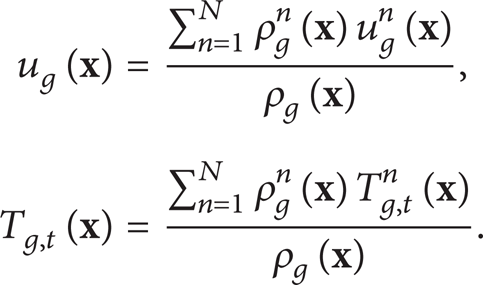
Therefore, the velocity u
g
at

where
Finally, the superposition of results for all point sources is taken as the ultimate forecasting value of the velocity and temperature, respectively,
2.1.2. Simons Model
Simons regarded that the plume is developed from a virtual point source if the exhaust flow domain is very larger than the nozzle scale. The calculation of density reads as

where r and θ define the space position and ρ* is the density of the throat with a radius of R*. A is the plume constant, depending on the nozzle configuration and gas prosperities. The f(θ) is expressed as, in the isentropic core region,

while f(θ) is expressed as, in the expansion regions of boundary layer,

where β is the coefficient constant, θ0 is the limit deflection angle of the flow in the isentropic core region, and θ∞ is the limit deflection angle of the nozzle flow. They can be approximately obtained according to the Prandtl-Meyer function. All the other physical variables can be calculated by the isentropic equations.
2.2. Calculation Method of Particle Phase
Because the drag force is in several orders of magnitude larger than the other forces imposing on a particle, the particle Lagrangian trajectory model reads as

where
C D is the drag coefficient, with different corrections as follows:
Millikan's expression [11]:

Clift's expression [12]:

with a correction by Schiller-Naumann:

Loth's expression [10]:

where CD, Kn, Re r is the same as (10) and C D, FM is formulated as

In the above expressions,
The overall tendency of particle drag coefficient decreases with an increase of particle Reynolds number Re r as shown in [10]. Before the Nexus point, Re r = 45, the rarefaction effects are leading, whereas after that the compressibility effects dominate. If rarefaction effects are stronger, drag decreases with an increase of Kn number. However, if compressibility effects are stronger, drag increases with an increase of M r number.
The rarefaction effects on heat transfer between gas and particles are also considered. The particle temperature equation reads as
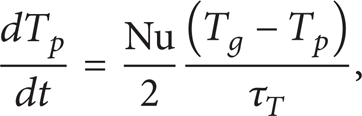
where τ T = ρ p c p d p 2/(12k f ) is the thermal relaxation time, ρ p is particle density, c p is the specific heat capacity, and k f is the heat conduction coefficient.
The Nusselt number with a correction is expressed as [13]

where Nu0 = 2 + 0.6Re r 0.5Pr0.33 and Pr = ν/α.
The u g and T g in (7) and (13) are obtained by a fourth-order interpolation method.
3. Results and Discussions
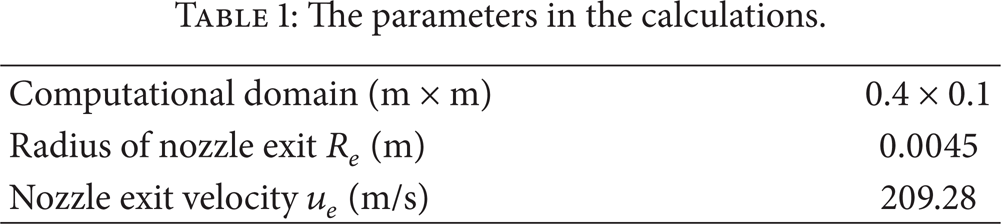
The physical model and computation domain are shown in Figure 1. Half of the nozzle with axisymmetric configuration is taken in the present study. The outlet physical variables of nozzle flow are obtained by solving Navier-Stokes governing equations. The initial calculation parameters are shown in Table 1.
The parameters in the calculations.

Schematic diagram of calculation model and computation domain.
3.1. Gas-Phase Plumes
The streamwise, transverse velocity, and temperature distributions of gas-phase plumes are shown in Figures 2, 3, and 4, respectively. We first analyze the results obtained by the free molecule point source method. The streamwise velocity is larger close to the nozzle axis, but its gradients decrease. The transverse velocity is distributed within a specific deflection angle with its maximum value. The temperature remains unchanged within a fan-shaped region. Away from the axis, the temperature increases, and the gradients become larger. The exhaust expands outside the nozzle, and both the streamwise and transverse velocities increase, but the temperature decreases.

Streamwise velocity (m/s) ((a) results obtained by free molecular point source method, (b) results obtained by Simons method).

Transverse velocity (m/s) ((a) results obtained by free molecular point source method, (b) results obtained by Simons method).

Temperature (K) ((a) results obtained by free molecular point source method, (b) results obtained by Simons method).
The results of velocities obtained by Simons method are similar to those predicted by free molecule point source method. But the former values are larger. Closer to the axis of nozzle, the streamwise velocity is larger, but its gradients are smaller; however, the transverse velocity is smaller.
On the contrary, the predictions of temperature are quite different for two methods. The common point is that, along the radial direction, the temperature of gas and its gradients both decrease due to the free expansion of exhaust in vacuum.
3.2. Particle Phase Motion
The steady drag model is not applicable for rarefied flows since the drag coefficients decrease because of rarefaction effects. In the present study, a single particle is tracked in the plume by employing the model of (8)–(11), respectively. The particle parameters are shown in Table 2.
Particle parameters.

Figure 5 shows the variations of physical variables of U*, Re r , M r , and Kn along a particle trajectory by means of free molecule point source method. If a particle has the same initial velocity and the same inlet position, its velocity is different in the beginning, but same in the end using different drag coefficient models. The velocity calculated by Loth's model has the most significant acceleration in the beginning. Re r or M r has the similar tendency. But the velocity difference between two phases cannot be obtained by means of Milikan's or Clift's models. In the initial acceleration process, the maximum value of Re r is larger than 45 (Nexus point), so the particle motion is influenced by flow compressibility. This then show that the model of Milikan or Clift cannot yield the calculation of particle motion if the flow has very strong compressibility. The variation of Kn number shows that the rarefaction effects become stronger away from the nozzle exit. Hence, the drag coefficient model must be applied in a wide range of Kn number because the particle experiences the continuum, slip, transition, and free molecule flow successively. Compared with the models of Milikan and Clift, Loth's model has the best applicability for two-phase plumes.

The variations of physical variables of U*, Re r , M r , and Kn along a particle trajectory by means of free molecule point source method.
From results of Simons method, as displayed in Figure 6, only Loth's model can reflect the response of particles to high Re r gas flows. Different drag coefficient models result in particles' different variable motions, but they finally keep different constant velocities. The difference of ultimate velocity is due to the disparity of particle motion trajectories and different surrounding gas velocity. Since the gas-phase temperature surrounding a particle decreases gradually when the particle moves downstream, the variations of M r are complex, but, in general, they increase finally.

The variations of physical variables of U*, Re r , M r , and Kn along a particle trajectory by means of Simons method.
The momentum and thermal responses of different sized particles to gas phase are shown in Figures 7 and 8, respectively. With an increase of particle diameter, both the velocity and temperature differences between two phases increase. It is shown that the momentum and thermal responses to gas phase become difficult for large particles. The 200 μm particle almost keeps its initial velocity and temperature as it moves downstream. The 2 μm particle has the fastest response and obtains a consistent velocity with the gas-phase quickly. However, even if the 2 μm particle reaches the momentum equilibrium, it is still very difficult to realize thermal equilibrium with the gas phase. It means that the thermal response is more relaxed than the momentum response.

Momentum response of particle with different diameter to gas phase.

Thermal response of particle with different diameter to gas phase.
4. Conclusions
This paper successfully performed a fast numerical calculation of two-phase vacuum plumes. The free molecule point source and Simons models coupled with particle Lagrangian trajectory model were employed, respectively. Different drag coefficient models were considered in the calculation to reveal their effects on particles' motion in rarified flows. The following conclusions were obtained.
Both the free molecule point source and Simons models could compute similar velocity distribution in plumes, but the former predicted better. The vacuum plume experienced continuum, slip, transition, and free molecule flow. The drag coefficient model needed applicative modifications, considering both rarefaction and compressibility effects. The model proposed by Loth showed a better applicability, with better predictions for higher Re r and M r flows.
Particles were immediately accelerated by the dense plumes close to the nozzle exit. The momentum and thermal responses became more relaxed as particles' diameter increased. The thermal equilibrium was more difficult to achieve than the momentum equilibrium.