




Abstract
Passenger transfer is one of the important research contents after the network operation of high-speed railway. Due to the high operation speed and high frequency, delays at transfer stations may occur frequently, leading to some potential safety problems. Main influence factors such as schedule time, transfer buffer time, waiting time, and delay time of delay and passengers classification during transfer were analyzed. A delay adjustment model of passengers at a transfer station was presented with minimal delay cost, waiting time cost, and adjustment cost as the optimization goal. Two adjustment strategies were proposed, including transfer passengers departure time adjustment and connecting trains departure time adjustment. And a delay adjustment algorithm at transfer station was designed for the optimal adjustment scheme. A case study proves the effectiveness of the method on optimal scheme design for passengers transferbased on the lowest delay cost of all passengers.
1. Introduction
For the high-speed railway network, it is impossible to operate direct train between two stations, especially between the long distance lines and feeder lines. So the passenger transfer is an important research problem of transportation organization. The passenger delays will not only easily lead to safety problems and affect the normal transportation, but also cause the negative effects on society. So an effective delay adjustment method is very critical both for passengers and railway operators.
In the past, much research has been dedicated to compute optimum railway timetables to research the train delays and reliability of timetables. Su and Nigel [1] mainly analyzed the frequent minor disruptions (usually last no longer than 10–20 minutes) caused by random disturbances. And they described an integrated real-time disruption control model for a single line on rail transit systems, which includes holding, expressing, and short-turning strategies. Vromans et al. [2] examined reliability in public railway systems. And they decreased the interdependencies between trains by reducing the running time differences per track section and by this creating more homogeneity of a timetable. Huisman et al. [3] discussed some recently developed topics such as shunting and reliability of timetables. And then many studies with a view to optimize timetable synchronization for rail transit and transfer optimization problem [4–7]. They researched the transfer optimization problem by minimizing the passenger transfer time or transfer waiting time of the public transport.
Then, many researchers realized that much research has been dedicated to compute optimum railway timetables and train delays. So they studied the passenger delay management problem of railway network. Gatto et al. [8] analyzed a waiting policy for the connecting trains minimizing the weighted total passenger delay by three conditions. They treated it as a reduction to min-cut problems if there is a single delayed train and passengers transfer at most twice with fixed routes, treated it as dynamic programming problem if delayed passenger flows on a railway network with a path structure, and treated it as a NP-Hard problem if passengers are allowed to adapt their route to waiting policy. Liebchen et al. [9] regarded delay management as delays have been rather treated mainly in an online context and solved as a separate optimization problem. And they provided the first computational study which aims at computing delay resistant periodic timetables. Schöbel [10] treated the passenger delay management problem as a mixed integer linear program and solved the problem by minimizing the sum of all delays over all customers using the public transportation network. Otto et al. [11] researched the evaluation and forecast method of punctuality for passengers on railway system; a passengers route choice model was built based on the schedule timetable, and an optimal path search algorithm was used to solve the model. The model not only could measure passenger delays in the existing network, but also could forecast passenger delays related to future timetables.
About the passenger delay control and adjustment problem, Goverde [12–14] researched the reliability of the passenger transfer on the railway network. He presented a model with minimal passengers' waiting time and used two methods to adjust the transfer delay which is adjust departure time of connecting train and break(s) the relationship between the transfer train and connecting train. Then in 2011, Goverde and Hansen [15] analyzed arrival delay time, departure delay time, transfer time, and transfer walking time under the operation on time and on delay condition, respectively. Vansteenwegen and Oudheusden [16, 17] built the transfer optimization model based on the waiting time and delay time. And they rebuilt the new timetable by linear programming method. To improve the robustness of timetables for a network of passenger train services, they seek to minimize a waiting cost function that includes running time supplements and different types of waiting times and late arrivals. Alex [18] presented different methods and models that can be used to calculate these passenger delays. He analyzed development process of the methods to calculate the passenger delay and developed a method to combine passenger delay models with simulation software (in this case RailSys) for railway operation on the microscopic level. And he could generate a number of timetables that can be used as input when calculating the expected passenger delays in a future situation. Zhou et al. [19] present a coordinated train arrival-departure time control strategy for transfer stations of urban rail networks, by selecting the minimized transfer waiting time and transfer dissatisfaction as objectives and giving priority to major passengers. The proposed strategy is based on the analysis results of passenger transferring processes and train movements and the research on synchronized and coordinated train connecting optimization for transfer stations under the mode of networks.
These research works had many achievements for the passenger transfer delay management. But they mostly put emphasis on how to calculate the passenger delay time and waiting time and how to improve the reliability of the timetable. Passengers' overall benefits and the utilization of the trains were neglected. So, for the rail network, it is important to research the delay adjustment method concretely by combining passengers and trains. The paper's main idea is how to minimize the delay time costs and waiting time costs of all passengers by adjusting the passengers' transfer. The delay time cost is the product of each delay time and the delayed passenger. By analyzing related time factors and classification of passengers, two delay adjustment methods are designed including adjusting departure time of connecting trains and adjusting departure time of passengers transfer. Then, we build the passengers transfer delay adjustment model and algorithm to solve this problem effectively.
2. Definition
2.1. Basic Definitions
For the research, we define three main definitions firstly.
Transfer Train. The train that arrives at the transfer station and has some passengers that need transfer to the other trains.
Connecting Train. The train that departures from the transfer station and has some passengers from transfer train that need to get on the train.
Transfer Relationship. The relationship between one transfer train and one connecting train and has only one transfer train and connecting train.
2.2. The Classification of the Passengers
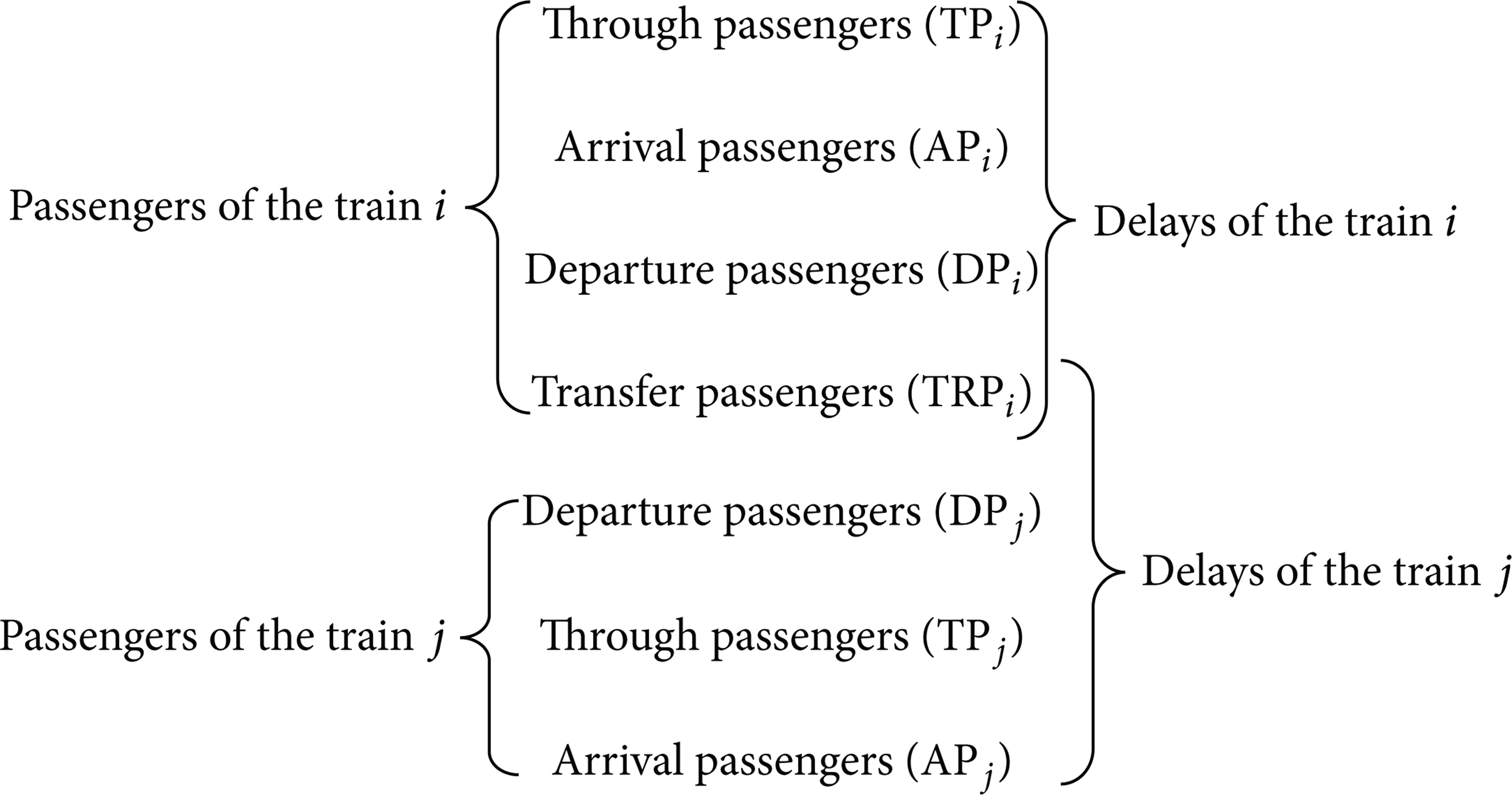
Assume that the train i is the transfer train and the train j is the connecting train. And we define four kinds of passengers as follows:
transfer passengers (TRP), who transfer from the transfer train i to the connecting train j;
through passengers (TP), who remain on train i or train j and get on the train before the transfer station;
departure passengers (DP), who get on train i or train j at the transfer station and the transfer station is their starting station;
arriving passengers (AP), who get off from the train i or train j and the transfer station is their terminal station.
As shown in the Figure 1, it is the reasons of getting different kinds of passengers delay on the transfer train and connecting train as the right bracket.
Relationships and delay reasons of different kinds of passengers.
2.3. Related Time Definitions
(1) Scheduled Operation Time. Scheduled operation time is the time decided by the schedule. It includes the arrival time (A i ) and departure time (D i ) at each station on the line without the delay.
(2) Stop Time. Stop time t i stop is the stop time of the train i. It includes the opening time of doors, alighting and boarding time of passengers, dwell buffer time, closing time of doors, and reaction time of the driver. The minimal stop time is the sum of these previous times except buffer time. So if there is not buffer time or the time is too small, it is a source of delay, whilst large dwell buffer time means larger travel time and high station capacity utilization.
(3) Transfer Walking Time. Transfer walking time from train i to train j (t i, j walk) is the average walking time of transfer from the passengers transferring train to connecting train for each transfer relationship.
(4) Transfer Buffer Time. Transfer buffer time from train i to train j (t i, j buffer) is the extra time of the passenger transfer. It can reduce some influence by the trains' delays. The transfer buffer time is decided by the arrival time of passangers transfering trains, departure time of connecting train, and the transfer walking time of the passengers.
(5) Waiting Time of the Different Kinds of Passengers. The waiting time is the time that the transfer passengers have to wait for the actual departure of the connecting train. If the transfer train arrives on time or within the transfer buffer time, the waiting time is the deduction of the transfer buffer time and delay time.
For the distribution of different kinds of time, the waiting time of different kinds of passengers is shown in the Figure 2.

Waiting time of different kinds of passengers.
With different delay conditions, the waiting time is different. There are mainly two delay conditions as in Figure 3 and Figure 4.
Train i arrives on schedule or the delay time is less than the transfer buffer time.
As in Figure 3, under this condition, the waiting time is a part of transfer buffer time and it does not affect the normal transfer relationship. Besides, it even can reduce the waiting time of transfer passengers but increase the waiting time of departure passengers of the train i.
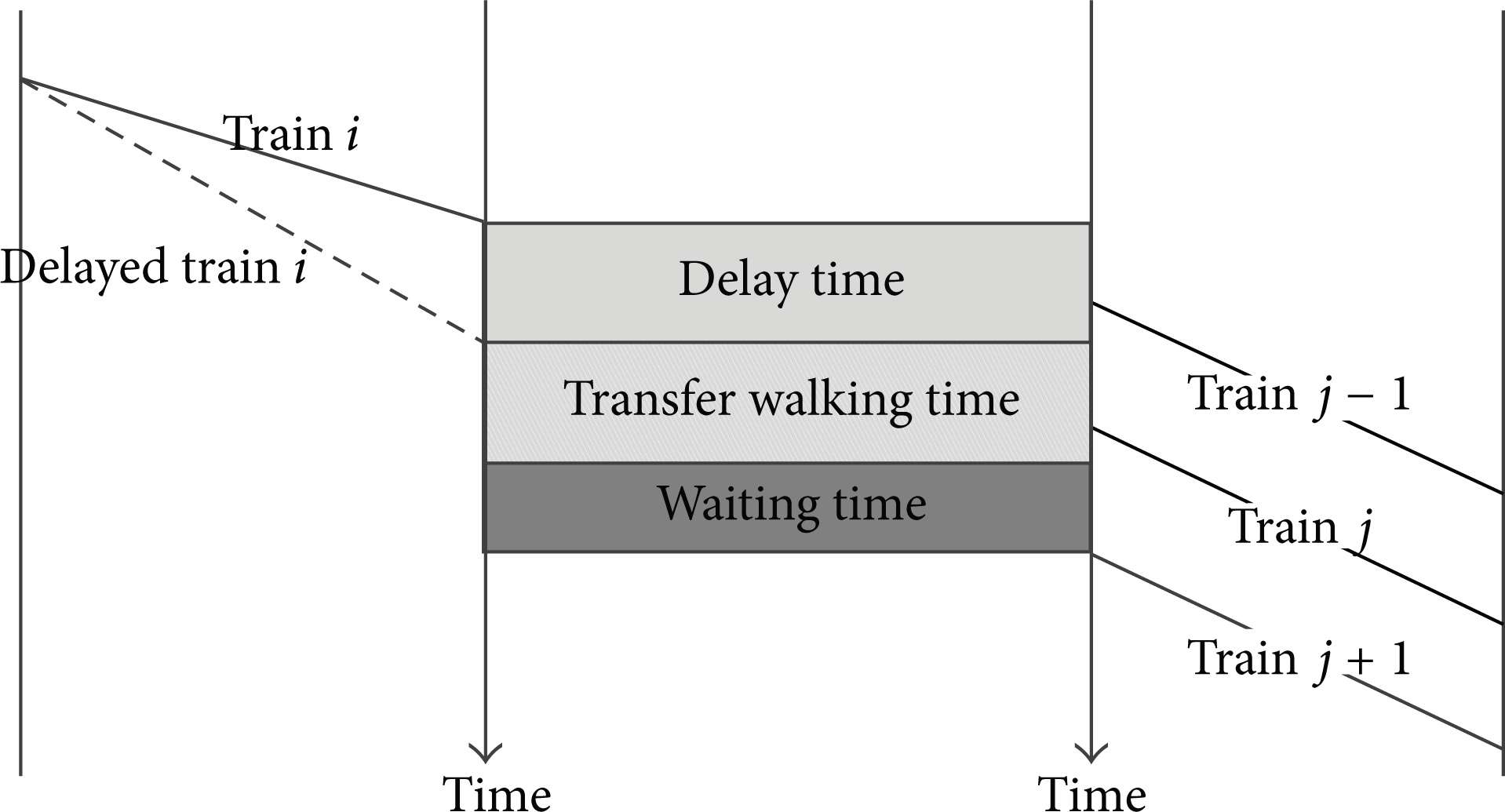
Delay time is more than transfer buffer time and transfer passengers must wait for the trains behind the connecting train on the connecting line. By this condition, the waiting time is related to the departure time of the train j + 1 as shown in Figure 4.

Delay condition which does not break the transfer relationship.
Delay condition of breaking the transfer relationship.
(6) The Final Delay Time of Different Kinds of Passengers. The delay time of the different kinds of passengers is shown in Figure 5. As shown in Figure 5, the left bracket means the delay time of different kinds of passengers on transfer train, and the right bracket means the delay time of different kinds of passengers on the connecting train. But the transfer passengers are influenced by both the transfer train and connecting train; the delay time of transfer passengers is the sum of TRP i and TRP i + in Figure 5.

Delay time of different kinds of passengers.
3. Delay Adjustment Model on Transfer Station
3.1. Adjustment Strategies
For the adjustment cost, we design two strategies: one is adjusting departure time of connecting trains and the other is breaking the transfer relationship and adjusting the departure time of transfer passengers.
(1) Adjusting Departure Time of Connecting Trains. We keep the original transfer relationship, but the connecting train needs to wait for the delayed transfer passengers. This method will cause some trains on the connecting line after the connecting train delayed. At the same time, the connecting train will stay on the arrival and departure tracks for some time, so it is also restricted by the capacity of the arrival and departure tracks on the transfer station and produces some delay costs and waiting time costs for passengers on the train j. The calculation method of delay adjustment costs is as follows:

where Icon is the minimal interval time between the trains on the connecting line. j + l is the lth train behind train j.
x ip is the number of passengers of the pth kind of passenger on ith train (p = 1: the arrival passengers; p = 2: the departure passengers; p = 3: the transfer passengers; p = 4: the through passengers). It is calculated by the ratio of different kinds of passengers. Assume that f a , f d , f tr , and f t are the ratio of arrival passengers, departure passengers, transfer passengers, and through passengers, respectively. DY i is the seat capacity of the train i. So x ip can be calculated by
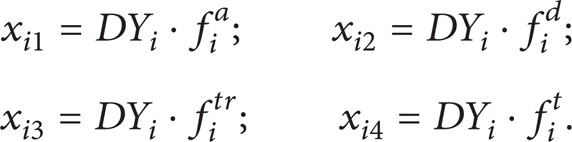
And it must be ensured that the number of all kinds of passengers on the train at the same time is less than the seat capacity of the train.
For the transfer train i, before the transfer, there are arrival passengers, transfer passengers, and through passengers on the train i. And after the transfer, there are departure passengers and through passengers on the train,

For the connecting train j, before the transfer, there are arrival passengers and through passengers on the train. And after the transfer, it has through passengers, departure passengers, and the transfer passengers from the train i,

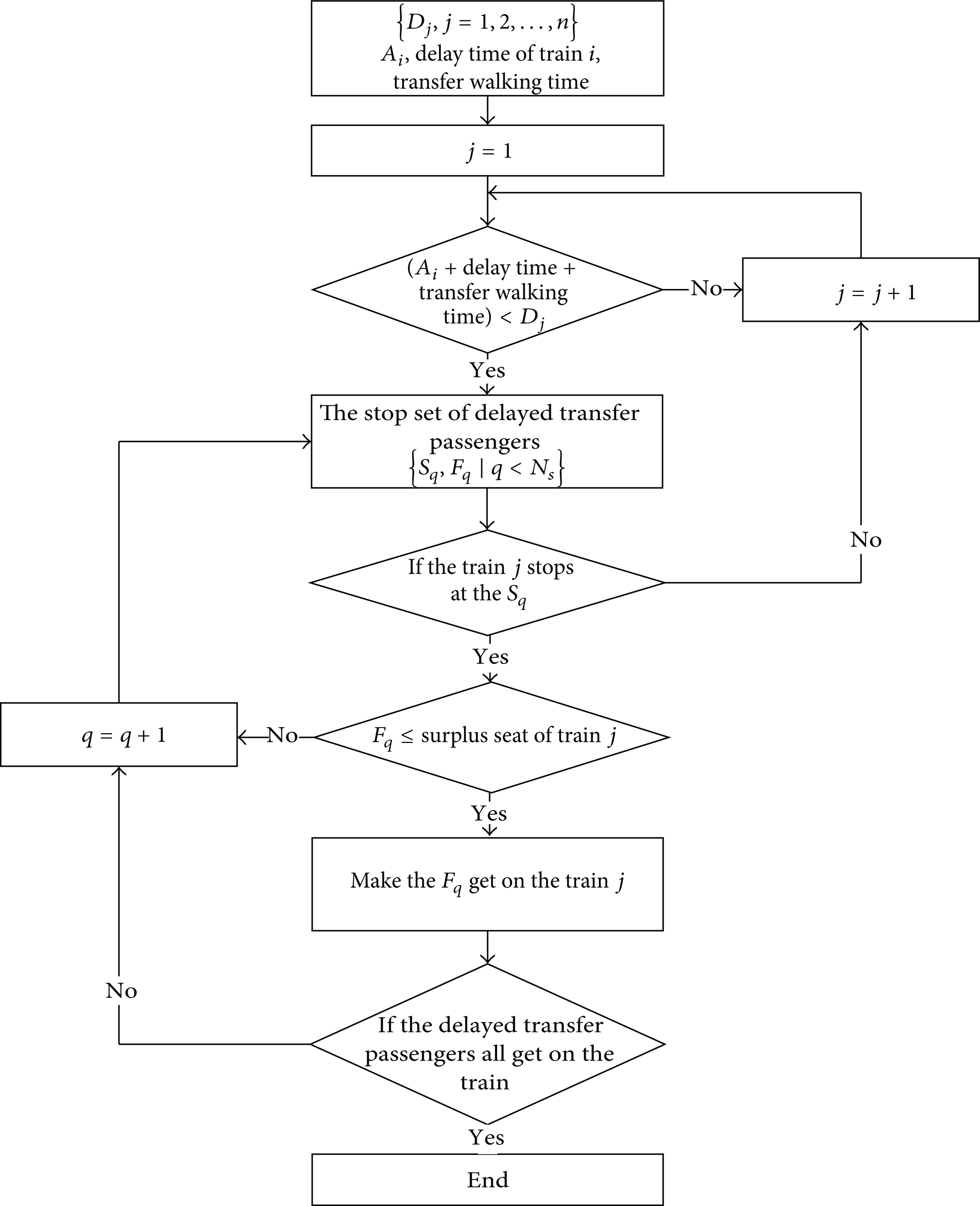
(2) Adjusting Departure Time of Transfer Passengers. If the delay time is larger than the maximal control time of the connecting train, the connecting train departs on time and the transfer passengers transfer to the other trains. It is assumed that S q is the set of stations which the transfer passengers will arrive at on the connecting line. F iq ≤ xi3 is the number of transfer passengers that will arrive at the station q ∈ S q .
If it is needed to break the transfer relationship, the transfer passengers must transfer to the trains that can arrive at the stations they want to go to. Because of being limited by the stop and capacity, how to make the delayed transfer passengers choose their suitable connecting train needs some principles and selection of flow as shown in Figure 6. Under the capacity constraint, we choose the train behind the train j on the connecting direction which could stop at the station of the set S q by the order of departure time at transfer station as early as possible.
Flow chart where transfer passengers choose the connecting trains.
The calculation method of delay adjustment costs is as follows:

3.2. Objective Function of the Delay Adjustment Model
We get the final least costs of all passengers as the optimization goal. The costs include the initial delay costs, delay adjustment costs, and waiting costs. And the cost is the product of number of delayed passengers and delay time or waiting time for each kind of passengers


Formula (6) is the final optimization goal among the different delay adjustment schemes of set AS.
Formula (7) is the initial delay costs caused by the train initial delay, where m and n are the numbers of delayed trains on transfer line and on connecting line, respectively. t i, p delay is the initial delay time of the pth kind of passenger on ith train.
Formula (8) is the waiting time costs. And it mainly includes the waiting time costs of transfer passengers and departure passenger of the trains on the connecting line, where η ij is 0–1 variable. If it equals 1, the transfer passengers transfer to the train j, else it is equal to 0. δ j is the 0–1 variable. If it equals 1, the train j is delayed, else the train j departure on time. D j after is the departs time after adjustment.
Formula (9) is the delay adjustment costs, where J i tr is the delay adjustment cost of the ith transfer train if we adjust the departure time of transfer passengers. J j con is the delay adjustment cost of the jth connecting train if we adjust the departure time of connecting trains.
3.3. Constraint Conditions
(1) The Control of Departure Time of Connecting Trains. If need to adjust the departure time of connecting trains, we at least maximal time should be adjusted. Assume that


where K j is the set of delayed trains caused by the delay of train j (including train j).
(2) Window-Time Constraint. This constraint aims at controlling the time scope of adjustment and including two sides. One side is according to the transfer time of the transfer passengers: it ensures that it still has trains on the connecting line when the transfer train arrived at the transfer station and the transfer passengers can get to their destination,

The other side is according to the departure time of connecting trains after adjustment. Namely, it ensures that all of the trains cannot run in the window-time because of delay adjustment. Consider

where Twint e is the start time of window-time. n c is the total number of the delayed trains because of the adjustment on the connecting line.
(3) Capacity Constraint. It is constraint by the last set capacity of the trains on the connecting line. It ensures that each transfer passenger can get on the other trains behind the primary connecting train on the connecting direction and have one seat.
4. Delay Adjustment Algorithm on Transfer Station
The input values of the algorithm include all of transfer relationships, timetable of each line, transfer walking time of the transfer passengers at the transfer station, transfer buffer time, train delay time, train stop time at the station, and ratios of all kinds of passengers (Figure 7).

Delay adjustment algorithm flow graph.
Step 1. Based on the timetable, is added the delay time for the trains randomly.
Step 2. Based on the delay time of each transfer train and connecting train, the delayed train set and different transfer relationships sets for different transfer direction are built by ordering the transfer trains by the arrival time at the transfer station.
Step 3. Initialing the parameter includes delay cost J = Jinitial and transfer train i = 0.
Step 4. It includes choosing one transfer direction and getting the delayed transfer train i and transfer relationship r in which the transfer train is train i.
Step 5. It includes getting the connecting train j of the transfer relationship r and calculating the maximal departure delay time
Step 6. It includes calculating the delay time of train j if it needs to wait for delayed transfer passengers of train i. If it is bigger than
Step 7. It includes calculating the delay costs J i tr according to (5) and J = J + J i tr . Meanwhile, we should update the surplus seat capacity of each connecting train.
Step 8. It includes calculating the delay costs J i con according to (1) and J = J + J i tr . Meanwhile, it should update the new departure time of each connecting train.
Step 9. It includes Judging if all delayed trains had been adjusted; if i > m, go to Step 10; otherwise, i = i + 1 and go to the Step 4.
Step 10. J = J + Jwait and record all adjustment costs and adjustment schemes.
Step 11. Based on the final delay adjustment schemes, update the timetable of connecting lines and the transfer relationships.
5. An Example Analysis
5.1. Example Design
The example of railway network is shown in Figure 8. There are three lines, namely, line 1, line 2, and line 3. And transfer station TR1 is the middle station of line 1 and line 2 but terminal station of line 3.

Railway network.
The transfer relationships among these three lines of one period are shown as in Table 1. It only considers the relationship of passengers transfer from line 1 to the others lines. If there are some passengers who need to transfer to the line 1 from other lines, they must wait for the trains on the line 1 and would be treated as the departure passengers of transfer trains.
Transfer relationships among the lines.

Assume that each period of the trains operation is one hour. And the trains stop schemes of line 2 and line 3 are shown in Figure 9 (a) and Figure 9 (b), respectively.

Train stop plan of line 2 and line 3.
5.2. Results Discussion
During the adjusting process, we set the parameters firstly. For the ratios of different kinds of passengers, we get the 0–1 random values. And the scope of the ratio of departure passenger is 0.3–0.5, arriving passenger is 0.1–0.3, through passenger is 0.2–0.4, and the transfer passenger is 0.1–0.3. The ratio of transfer passenger on each direction of line 2 is 0–0.1 and the ratio of transfer passenger of line 3 is 0–0.05. The seat capacity of trains on line 1 and line 2 is 1200 persons per train and the set capacity of trains on line 3 is 600 persons per train.
Then, based on the delayed trains, we build the transfer relationship like that in Table 1. We calculate the initial delay costs produced by the delayed transfer trains which is 213667 (persons·minutes). And we adjust the transfer relationship for each delayed transfer trains order by their arrival time. We set the minimal interval time between trains as 5 minutes. The stop time of the trains on the station is 2 minutes. The transfer walking time from line 1 to line 2 and line 3 is all 20 minutes and we calculate buffer time for each transfer relationship. It is assumed that the train set continued time differences are 20 minutes and 15 minutes of line 2 and line 3. We choose the optimal adjustment strategy by judging the maximal adjustment time of each connecting train. And we calculate the final delay adjustment costs and waiting costs.
Through calculation, the final adjustment scheme is as shown Table 2.
Final adjustment scheme.

Unit of the cost (persons·minutes).
It assumed that the ratios of transfer passengers are 0.1, 0.1 and 0.05 which transfer to the up direction of line 2, down direction of Line 2, and up direction of line 3. Then the delay adjustment costs and waiting costs of each transfer train of the adjustment scheme as shown in Figures 10 and 11. It indicated that the tendency is nearly same as that of adjustment costs and waiting costs.
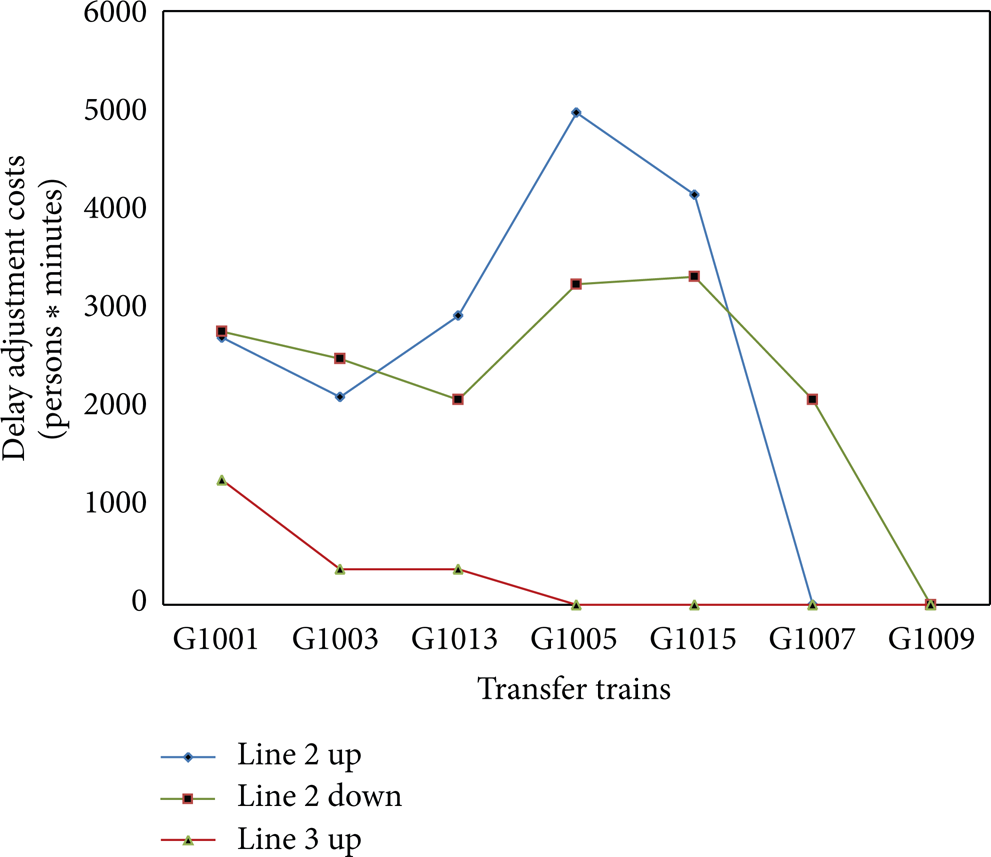
Tendency chart of delay adjustment costs of different transfer trains.

Tendency chart of delay waiting cost of different transfer trains.
Then, we research sensitivity of the ratio of transfer passengers for each transfer direction. Through changing the ratio of transfer passengers of one connecting direction and fixing the other two, we get the tendency of costs and the ratio of transfer passengers as shown in Figure 12. And the upper limits are 0.1, 0.1, and 0.05.

Tendency charts of costs and ratio of transfer passengers.
Figure 12 (a) is the tendency of costs and ratio of transfer passengers with different ratios of other kinds of passengers (choose random). And Figure 12 (b) is the tendency with the same ratios of other kinds of passengers. So the costs are increased with the increase of the ratio of transfer passengers. Besides, the ratios of all kinds of passengers have effect on the total delay adjustment costs. And the adjustment costs and adjustment scheme are also related to the transfer buffer time and train operation density.
6. Conclusion
The paper researches the delay adjustment strategies on the transfer station of the high-speed railway. It analyses the classification of different kinds of passengers during the transferring and related time factors of adjustment strategies. By making the product of delay time and the number of delay passenger as the costs, we build the delay adjustment model at the transfer station and design two adjustment strategies to support the model. Through designing the algorithm and example analysis, we prove that the adjustment costs and adjustment scheme is related to the ratios of different kinds of passengers, transfer buffer time, and train operation density of the connecting lines. We have some conclusion: (1) with the same other conditions, more transfer passengers will lead to bigger adjustment costs; (2) with the same other conditions, the bigger transfer buffer time can reduce the impact by the delayed train and adjustment costs; (3) with the same other conditions, more trains on the connecting line benefit the passenger delay adjustment.
Conflict of Interests
Li Xiaojuan, Han Baoming, and Zhang Qi declare that there is no conflict of interests regarding the publication of this paper.
Footnotes
Acknowledgment
This work was financially supported by National Key Technology R&D Program (2009BAG12A10-3).