




Abstract
In this paper boundary layer analysis is performed over a heated horizontal wavy surface. The governing boundary layer equations are transformed into parabolic partial differential equations with the help of appropriate coordinate transformation. Parabolic partial differential equations are then solved numerically with finite difference scheme, seeking details of the momentum and energy fields. Step by step computations are done for the upstream, downstream, and entire regimes. The numerical results are thoroughly discussed in terms of local skin friction and local Nusselt number coefficients for various parameters, like phase shift parameter, φ, and amplitude of the wavy surface, a. In addition, streamlines and isotherms are also drawn in order to visualize velocity and temperature distributions, respectively, within the boundary layer region.
1. Introduction
Plane surfaces transfer less heat energy as compared to irregular surfaces. Perhaps, surfaces are intentionally made nonuniform or uneven in order to acquire enhancement in the rate of heat transfer. Flow over the rough surfaces is common in industries therefore knowledge about heat transfer through irregular surfaces becomes important in this context. Solar collectors, condensers in refrigerators, cavity wall insulating systems, grain storage containers, and industrial heat radiators, for example, are a few of many applications of rough surfaces through which small as well as large scale heat transfer is encountered. Many theoretical and computational studies have been carried out to investigate the surface undulations on the convection flows. Effects of nonuniformities on convection flow and heat transfer have been investigated by several researchers. Yao [1] and Moulic and Yao [2] were the first to point out the effects of nonuniform surfaces for the natural convection boundary layer flow. Afterwards, various investigations have been done by considering vertical wavy surface in several important physical situations. For instance, combined heat and mass transfer in natural convection flow from a vertical wavy surface has been discussed in detail by Hossain and Rees [3]. They evaluated the results numerically over a wide range of Schmidt number, Sc (ranging from 7 to 1500). Later on, Jang et al. [4] and Jang and Yan [5] analyzed the heat and mass transfer effects on natural and mixed convection flows, respectively. Both studies take into consideration vertical wavy surface for their analysis. Further, Molla and Hossain [6] noted the effect of radiation on mixed convection laminar flow along a vertical wavy surface. They solved the problem numerically through (i) Keller box method and (ii) straightforward finite difference scheme and discussed the results in terms of shear stress, rate of heat transfer, streamlines, isotherms, and velocity and temperature distributions. Molla et al. [7] also studied natural convection flow along a vertical complex wavy surface with uniform heat flux. The complex surface considered by [7] was the combination of two sinusoidal functions, a fundamental wave and its first harmonic. More recently, natural convection boundary layer flow of thermally radiating fluid along a heated vertical wavy surface has been analyzed numerically by Siddiqa et al. [8] in a nonabsorbing medium using the straightforward finite difference method. In addition to above some authors focused on horizontal wavy surface under different circumstances. In particular, free convection induced by a horizontal wavy surface in a porous medium has been examined well by Rees and Pop [9]. In this paper, authors focused on those cases where the waves have an O(Ra−1/3) amplitude, and Rayleigh number, Ra, is based on the wavelength of the waves and is assumed large. Hossain and Pop [10] studied magnetohydrodynamic boundary layer flow over a continuous moving horizontal wavy surface. They showed that the flow and heat transfer characteristics are substantially altered by both the magnetic field parameter and the amplitude of the wavy surface. Later the problem posed by Rees and Pop [9] has been extended by Narayana et al. [11] for the case of double diffusive convection and cross-diffusion effects on a horizontal wavy surface in a porous medium.
In order to address the industrial requirements, most of the previous investigations about convection flows are concerned with the vertical wavy surface. To the best of our knowledge, so far natural convection flow of pure fluid along a horizontal wavy surface has not been considered yet. With this understanding here we aim to investigate natural convection flow of viscous incompressible fluid of small Prandtl number over wavy horizontal surface. Primitive variable formulation is employed to transform the boundary layer equations into parabolic partial differential equations which are then simulated through straightforward finite difference method. Results are discussed to study the influence of phase shift parameter, φ, and amplitude of the wavy surface, a, on local skin friction coefficient, local Nusselt number coefficient, streamlines, and isotherms.
2. Mathematical Formulation
Here we have considered a two-dimensional flow of a viscous incompressible fluid over a horizontal wavy surface as shown in Figure 1. Assume that the surface temperature of the flat plate T w is greater than ambient fluid temperature, T∞. All the fluid properties are considered constant except density. Our detailed numerical work will assume that the surface exhibits sinusoidal deformations. Therefore, the shape of the wavy surface profile is assumed to pursue the following patterns:

where α is the dimensional amplitude of wavy surface, l is the characteristic length scale associated with thewaves, and φ is the phase shift parameter.
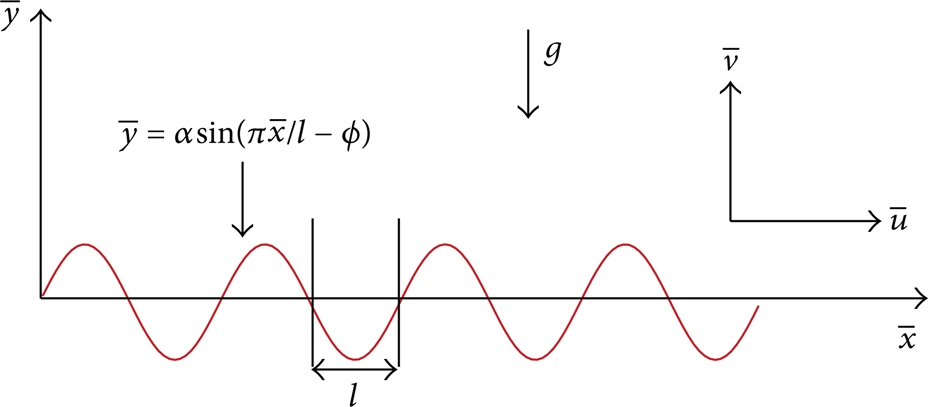
Physical model.
The equations governing the flow are as follows:

where
The boundary conditions to be satisfied are

where

We now attempt to introduce the following dimensionless group into (2)-(3):

where Pr is the Prandtl number that relates the thermal and momentum boundary layer thickness and Gr is the Grashof number that associate buoyancy and viscous force acting on the fluid. Substitute the dimensionless variables given in (5) into (2)-(3) and ignoring the terms which are of O(Gr−2/5), we get the following dimensionless equations:

The boundary conditions (3) become

where a is the dimensionless amplitude of the wavy surface. The effect of the wavy surface is incorporated into the governing equations by using the following transformation:

into the boundary layer equations (6)-(7) to get
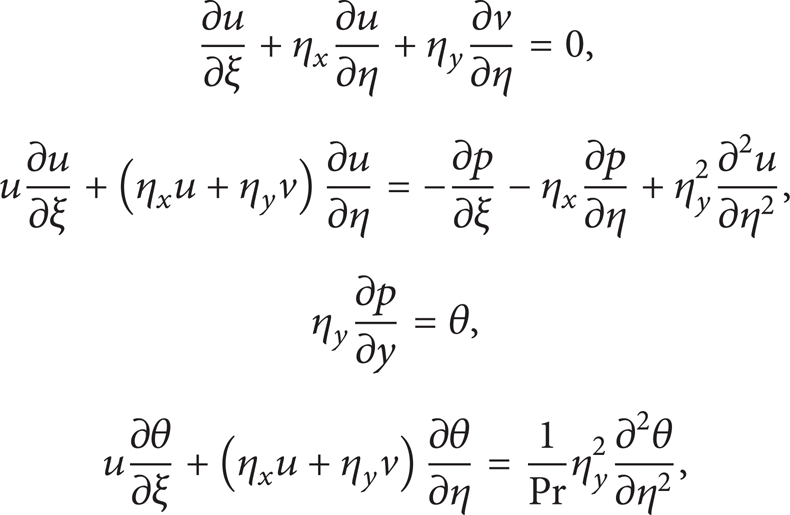
where η x = – σξ = – dσ/dξ and η y = 1.
The boundary conditions (7) become

Boundary layer equations given in (9)-(10) are further transformed into suitable system of equations which is valid for the entire regime in the axial direction, that is, from the leading edge to the downstream regime. For this, the appropriate set of transformations is

Substitute (11) into the above system of equations leads to

Boundary conditions are

where

It should be noted that near the leading edge, that is, for small X, the functions given in (14) take the following form:

However, for the case when X is large, the functions given in (14) take the following form:

When amplitude of the wavy surface, a, is 0 (i.e., a = 0), the set (12) to (13) demonstrate the model of Pera and Gebhart [12]. In this analysis natural convection flow was analyzed from a slightly inclined heated surface, therefore, inclination angle in [12] and waviness in the underlying problem should be set to zero to make compatibility between the present and the previous model. Further in [12], problem was formulated in terms of stream function formulation but in our case governing equations are presented though primitive variable formulations. Despite all of this, it is still feasible to compare these models.
The system (12)-(13) is solved numerically by employing straightforward finite difference method together with Thomas algorithm. Discretization process is initiated and central-difference quotients are used for diffusion terms whilst backward difference quotients are employed for the convection terms. Finally a system of algebraic equations is obtained which is solved by applying the Thomas technique. The computation has been started from X = 0.0 and then it marched up to X = 20.0 taking the step length ΔX = 0.005. The computations are iterated until the quantities meet the following convergence criteria at the streamwise position:

By comparing the results for different grid size in Y direction, we reached at the conclusion to choose ΔY = 0.05 and maximum value is taken to be Y = 10.0 in order to get accurate results. Very recently, this method has been used successfully by Siddiqa and Hossain [13] in order to investigate mixed convection boundary layer flow over a vertical plate with radiative heat transfer.
At this stage, it is possible to obtain the physical quantities such as local skin friction coefficient and local Nusselt number coefficient, which are significant from an engineering point of view. These relationships can be calculated from the mathematical expressions given in (18)–(20), where τ and q are, respectively, the nondimensional local shear stress and the local rate of heat transfer that may be obtained for all X from

for small X from

and for large X from

The following section contains the comparison between the solutions obtained for small, large, and all X which are done in terms of local skin friction coefficient and local Nusselt number coefficient. Moreover, in the next section, we explain the effects of several important parameters such as phase shift parameter, φ, and amplitude of the wavy surface, a, on local skin friction, and local Nusselt number coefficients. Results are discussed for two wavy pattern of the surface; namely, (1) Y = αsin (πX – φ) and (2) Y = α sin2(πX – φ).
3. Results and Discussion
In the present problem, natural convection flow along a horizontal wavy surface is considered which obeys sinusoidal patterns as Y = αsin (πX – φ) and Y = α sin2(πX – φ). The dimensionless boundary layer equations are transformed into suitable form for numerical integration. An efficient finite difference scheme is applied in connection with Thomas algorithm. Numerical results are plotted for several physical parameters in order to know the behavior of skin friction coefficient and Nusselt number coefficient. In addition, streamlines and isotherms are also drawn to analyze the flow pattern.
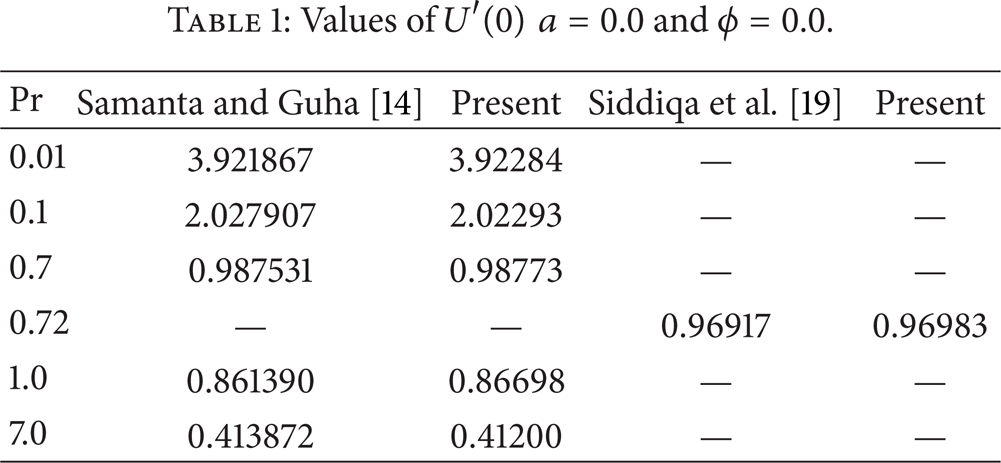
It is worthy to mention that present numerical results are also compared with Samanta and Guha [14], Mehrizi et al. [15], Deswita et al. [16], Raju et al. [17], and Lin et al. [18] for a = 0.0 and φ = 0.0 and are entered in Tables 1 and 2. These tables contain the comparison of U′(0) and θ′(0) for different Prandtl number, Pr. Comparison shows good agreement between the present and the previous results.
Values of U′(0) a = 0.0 and φ = 0.0.
Values of θ′(0) a = 0.0 and φ = 0.0.

The influence of scaled amplitude of the wavy surface, a, on local skin friction coefficient and local Nusselt number coefficient is discussed in Figure 2 for a = 0.0, 0.5, 1.0, 1.5, and 2.0, while Pr = 0.01 and φ = 90°. In this figure, small and large X results are obtained from the relations given in (19) and (20), respectively, whereas the curves for the intermediate region are obtained through (18). It is anticipated from the figure below that small, large, and all X curves matches well for precise range of locally varying parameter X. In particular, in the downstream region (where X is small) X ranges from 0 and 5 and in the upstream region (where X is large) X lies between 15 and 20. Further, a = 0.0 corresponds to purely flat horizontal plate case. For a ≠ 0, the distribution of local skin friction and Nusselt number coefficients are oscillatory and one can observe that these undulations get weaker as soon as they move away from the leading edge. Therefore, it can be concluded that near the leading edge amplitude of the wave carries more energy but gradually they lose energy as the distance from the surface increases in axial direction. In other words, the nonzero waves carry a finite amount of total energy, and after traveling some axial distance they decay because the energy is distributed among the boundary layer region.

(a) Local skin friction and (b) local heat transfer coefficients for a = 0.75 and 1.5, while Pr = 0.1 and φ = 90° for the case Y = αsin (πX – φ).
Rest of the analysis is done by taking results from the relations (18). In Figure 3 the effect of phase shift parameter, φ, is shown on the coefficients of local skin friction and local Nusselt numbers. Here phase shift parameter, φ, is set as 0°, 90°, and 180°, whereas a = 1.0 and Pr = 0.01. Physically, this angle informs that the waveform has shifted (left or right) from the reference point. It can be seen that in our case waveform has been shifted towards right. Graphs of local skin friction coefficient clearly shows that highest positive response is given by φ = 180°, while for local Nusselt number coefficient maximum response comes from φ = 90°. Therefore, it may be concluded that fluctuation factor is controlled by phase shift parameter and fluctuation increases for increasing φ.

(a) Local skin friction and (b) local heat transfer coefficients for φ = 0°, 90°, and 180°, while a = 1.0 and Pr = 0.01 for the case Y = αsin (πX – φ).
Likewise, heat transfer within the boundary layer region is visualized through streamlines and isotherms in Figure 4. This figure is plotted for three different values of a, these are a = 0.0, 1.0 and 2.5, and other parameters are fixed as φ = 0° and Pr = 0.01. Again a = 0.0 represents purely horizontal plate case, while a ≠ 0 signifies oscillatory case. It can be observed that these undulations get stronger within the boundary layer region when a increases from 0.0 to 2.5. Hence, for higher values of a, the waves carry more energy during this fluid flow; therefore, a plays significant role in the development of the boundary layer flow region.

(a) Streamlines and (b) isotherm for a = 0.0, 1.0, and 2.5, while Pr = 0.01 and φ = 0° for the case Y = αsin (πX – φ).
Finally, comparison of the results obtained from wavy patterns (1) Y = α sin (πX – φ) and (2) Y = α sin2(πX – φ) is done in terms of shear stress and heat transfer rate in Figure 5. It can be concluded that number of oscillations increases if one chooses the pattern mentioned in (2). However, maximum positive response is given by undulations given in (1).

(a) Local skin friction and (b) local heat transfer coefficients for a = 1.0, Pr = 0.01, and φ = 0°.
4. Conclusion
In this paper, natural convection flow induced by two different horizontal wavy surfaces is analyzed. Governing boundary layer equations are transformed to a set of parabolic partial differential equations which are solved numerically using finite difference scheme together with Thomas algorithm. Results are computed in terms of local Nusselt number and local skin friction coefficients. Streamlines and isotherms are also drawn for the amplitude of wavy surface parameter, a. It is observed that surface geometry (undulations) plays vital role in controlling heat transfer rate.