A wireless network scenario of bidirectional relaying with imperfect channel side information (CSI) is considered, in which two source nodes intend to exchange information with the help of one relay. The power allocation problem is investigated to minimize the total transmit power subject to constraints on two source nodes' received signal-to-noise-ratios (SNRs). The best relay that minimizes the total transmit power is selected in a multiple relay network. We also present outage analysis when the proposed power allocation is adopted, and a close-form approximation of outage probability is obtained by shrinking the integral interval. Simulation results show that the total transmit power can be substantially decreased and the outage probability is significantly decreased by the proposed power allocation scheme when two source nodes have different QoS requirement.
1. Introduction
Bidirectional or two-way relaying is a spectral efficient protocol when two terminals need to exchange information with the help of one or multiple relays [1]. The spectral efficiency can be significantly improved by accomplishing data exchange in two time slots [2]. Bidirectional relay communications have recently attracted considerable interest, and transmission schemes in bidirectional relay networks have been analyzed wildly [3]. Based on complexity criterion, the amplify-and-forward (AF) protocol is the simplest strategy because only an amplification processing at the relay is required. The transmission in amplify-and-forward bidirectional relay network takes place in two time slots. Two source nodes first transmit at the same time to one or multiple relays. The relay receives a superimposed signal, then amplifies the received signal, and forwards it back to both source nodes [4].
In bidirectional relay networks with multiple relays, the performance of wireless relay networks can further be enhanced by selecting the relay for transmission properly [5–7]. In [6], the authors presented a max–min SNR-based relay selection algorithm for bidirectional relay networks. In [7], the author presented a relay selection to minimize the system symbol error rate (SER). Consequently, it is beneficial to design an effective relay selection scheme for the coherent bidirectional transmission scheme with multiple relays and to achieve spatial diversity. Unlikely [5–7], a max–min relay selection method was presented in bidirectional cooperative networks with the imperfect channel state information in [8]. The impact of imperfect channel estimation on the outage probability is investigated. But the power allocation is not considered during outage probability analysis.
In bidirectional relay network with one relay or multiple relays, power allocation can improve the system performance significantly, by allocating the power on each node properly. Most work on power allocation for two-way relaying, for example, [9], was proposed to maximize the sum rate of the user pair. In [10], the authors consider power allocation with wireless network coding in a multiple-relay, multiple-user networks using convex optimization. In [11], power allocation strategies are proposed to maximize the sum rate and the diversity order, respectively. In [12], two power allocation algorithms were proposed to maximize the upper bound of the average sum rate and to achieve the tradeoff of outage probability between two source nodes, respectively. The power allocation algorithm proposed in [13] aims to maximize the smaller of the two source nodes' received SNRs. But the algorithm in [13] did not consider the scenario that two source nodes have different QoS requirement, for example, different transmit data rate requirement and different SER requirement. Also they assume perfect channel state information (CSI) at each node.
Outage analysis for bidirectional relay network was investigated in [14, 15]. In [14], the author proved that the bidirectional opportunistic relay network is outage-optimal among single relay selection schemes. The exact outage probability expression of two-way opportunistic relaying systems is presented in [15]. However, during the outage analysis in [14, 15], all the nodes are assumed to transmit at the same power and the power allocation is not adopted.
In this paper, we focus on the power allocation problem in bidirectional relay networks in the presence of imperfect channel state information. In particular, we investigate power allocation algorithm in order to minimize the total transmit power subject to constraints on two source nodes' received SNRs, when each node only knows the channel estimation. We obtain the closed-form solution of optimal power value allocated for each node. Then the relay with the minimum total transmit power is selected. The relay selection can be operated either by centralized manner or distributed manner. At last, the outage probability is analyzed for bidirectional relaying with power allocation algorithm proposed. The performance of the proposed scheme is verified through simulations.
2. System Model and Problem Formulation
2.1. System Model
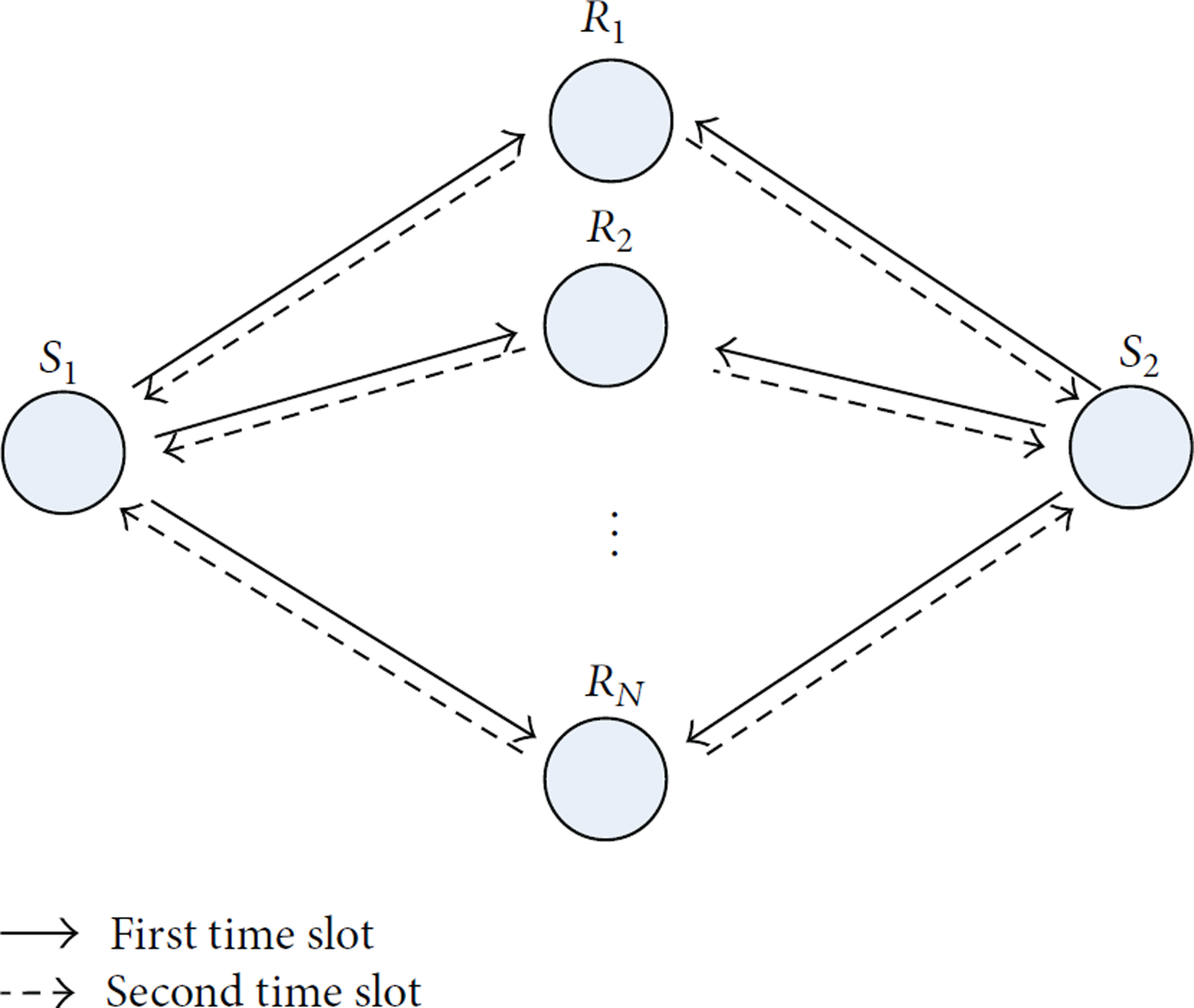
We consider a general bidirectional relay network, which consists of two source nodes, denoted by and , and N relay nodes, denoted by , as illustrated in Figure 1. All nodes are equipped with a single antenna. We assume that the two source nodes cannot communicate with each other because of the poor channel quality between them. The data exchange can be accomplished in two time slots. In the first time slot, both source nodes simultaneously send the information to all relays. Thus, each relay receives the superimposed signal. In the second time slot, an optimal single relay is selected to forward the received signals to two source nodes, and all other relays keep idle. Assuming a flat-fading scenario, denote the complex reciprocal channel coefficients from the ith relay to as , , .
Bidirectional relay networks.
Considering the imperfect CSI at every terminal, we can model the relation between the channel and its estimate by [8]
where is the correlation coefficient between the channel gain and its estimate and is a zero-mean complex Gaussian random variable with variance , Therefore, has the distribution . We assume that both source nodes know all channel coefficients estimate and relay knows its own local channel coefficients estimate.
Consider a two-step bidirectional relay AF protocol with relay selection. As a result, one of the relays, without loss of generality, is selected to serve as the means of communication between the two source nodes. Let , denote the symbol that will be transmitted by the source . We assume that is chosen from a constellation of unity power. The signal received in the relay at time t can be express as
where and are the transmit powers of source nodes and , respectively, and is the complex noise at the ith relay. In the second step, the relay multiplies its received signal by a complex weight factor and transmits the so-obtained signal. The signal transmitted by the ith relay is thus . Let denote the transmit power of the ith relay; assuming that the information symbols and noises are independent, we have
Then the weight factor is given by
The signals and received at source nodes and can be represented, respectively, as
where is the noise at the kth source node, for . All noises are assumed to be i.i.d. Gaussian with zero-mean and have the same variance . The first term on the right hand side of (5) and that of (6) are, respectively, the self-interferences of and , which can be cancelled by subtracting them from the received symbols at each node. Thus, after cancelling the self-interference of the node and , for , , the signal can be written as
The signals and can be used to decode the information symbols and at source nodes and , respectively.
We note that each source node knows its own data signal , . However, they should estimate the channel coefficients to cancel the self-interference terms. Therefore, because of the estimation error, the terms and remain as self-interference in the received signals and , respectively. It can be noticed that if each source node has full CSI, the self-interference could be fully eliminated.
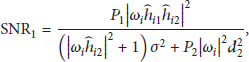
where and , representing the interference caused by the channel estimation error.
Assuming that each source node has perfect CSI, that is, , and and for the unit-variance noise signal, SNR reduces to
Considering the definition of amplifier factor , (10) can be rewritten as
which has a similar form to the result reported earlier in [12].
3. Asymmetric Bidirectional Relaying Network
Power allocation and relay selection can improve the system performance in bidirectional relaying network. The criterion in symmetric bidirectional relaying network is to maximize the minimum SNR between two source nodes. But the criterion cannot be adopted in asymmetric bidirectional relaying networks. In asymmetric bidirectional relaying network, two source nodes have different transmit rate requirement. Thus, the objective of power allocation and relay selection is to minimize the total power when each source node meets QoS requirement.
3.1. Problem Formulation
We consider the joint optimal relay selection and power allocation for the bidirectional relay network that minimizes the total outage probability with total transmit power constraint.
The main problem can thus be represented as
where denotes the total transmit power consumed by two source nodes and one relay node; when the ith relay is selected, and denote the SNR requirement of each node, respectively. can be written as
where , , and denote the power consumed by source nodes , and relay node respectively.
The variables in problem (12) include the power allocated on each source node, the amplify factor, and the relay index. To optimize the amplify factor on relay node is equivalent to optimizing the transmit power on relay node. So the objective of the problem (12) is to choose the best relay node and to determine the transmit power on two source nodes and one relay nodes. During the relay selection step, the relay is chosen considering the total transmit power consumed by the link . And the total transmit power is determined by the power allocated on each node. So in the power allocation and relay selection algorithm, we deal with power allocation part firstly.
3.2. Power Allocation and Relay Selection
A joint power allocation and relay selection algorithm is proposed in this section to solve the problem (12). The optimization problem in (12) involves continuous variables and binary variables. This is equivalent to optimizing over , , , which is the optimal power allocation problem and then optimizing over i, which is the optimal relay selection problem.
To reduce the computational complexity the power allocation and relay selection is operated separately, so that the number of variable can be reduced. During the power allocation step, the power allocation on each source node and one dedicated relay node is calculated to improve the received SNR. During the relay selection step, the best relay is selected according to the allocated power obtained in the former step.
3.2.1. Power Allocation
Firstly, we consider the power allocation problem among two source nodes and the selected relay . Considering (9), the power allocation problem is represented as
Obviously, the minimum total transmit power can be achieved when , . Otherwise, if, for example, the first constraint in (14) is satisfied with inequality at the optimal solution, then the optimal can be scale down to satisfy this constraint with equality. This, however, further reduces the total transmit power in (8), thereby contradicting the optimality. Considering (8) and (9), the transmit power of each source node can be represented as
where .
Substituting (15), (16) to (14), (14) can be rewritten as
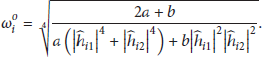
As can be seen from (17), the objective function does not depend on the phase of . Therefore, no phase adjustment is required at the relay. By solving (17), the optimal factor of relay i can be obtained. The equation (17) can be solved by Lagrange method. Differentiating the objective function in (17) and equating it to zero lead us to the following equation:
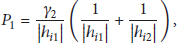
Using the optimal amplify factor, the optimal power allocation on each node can be derived according to (15) and (16). By substituting (19) in (15) and (16), the transmit power of source nodes and can be calculated. Substituting (19) into (13), we obtain the minimum total transmit power . Also the power allocation on the ith relay can be calculated by substituting (19) into (3). Consider
When the full CSI is known at each source node, the power allocated on each node has a simplified expression:
For symmetric QoS constraints where , the optimum power allocated on the relay equals the transmit power allocated on the two source nodes.
In high SNR regime, when and , (22), (23), and (24) can be rewritten as
From (21) and (22), the transmit power of one node is proportional to the SNR requirement of the other node. When the SNR requirement of one source node is larger, more power should be allocated on the other source node. The SNR requirement of each node can determine the power allocated on the selected relay and each source node.
3.2.2. Relay Selection
With the optimal power allocation solution obtained, the problem in (12) reduces to the following relay selection problem:
The “best” relay can be selected either by centralized relay selection or by distributed relay selection. Both relay selection methods are described as follows.
Centralized Relay Selection. When both source nodes know all the channels, centralized relay selection is adopted. The “best” relay can be selected by two source nodes, by calculating , for , as in (22). Then one source node broadcasts the index of the best relay to all relays over a control channel. Those relays which do not hear their own indices, will not participate in relaying. The “best” relay will use its local channel state information to calculate its own optimal transmit power .
Distributed Relay Selection. When each source node only knows its own channel coefficient, for example, only knows channel , relay selection can be operated in a distributed manner. The two SNR thresholds are known by two source nodes and all relay nodes. Relay knows its own local channel coefficients and by listening pilot signal from the two source nodes. Then it can calculate the minimum total transmit power with its local channel coefficients and SNR thresholds using (22). Then each relay starts a timer whose duration is inversely proportional to synchronously. The time timer of the “best” relay b expires first and then broadcasts its index to the rest nodes in the network. After hearing the index of the “best” relay, each source node sends its symbol with the power calculated by (26) and (27).
According to (25), the relay selection result is dependent on the channel state information between each relay and two source nodes and is irrelevant to the signal to noise ratio requirement of each node, and . Only the channel amplitude information is required during the relay selection step instead of full channel state information.
4. Outage Probability Analysis
We consider the outage probability of two-way opportunistic relay networks with our proposed power allocation. Assume that the two source nodes have different data rate thresholds, and . The outage occurs when either source node falls below its threshold rate; that is, . Considering the Shannon's capacity theory, the outage probability can be expressed as
where , , and and represent the data rate of link , and respectively.
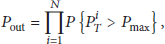
With optimal power allocation, the minimum transmit power required to achieve each transceiver's SNR threshold can be obtained by (25). When the total transmit power is lower than , the outage occurs, which is . Because the relay which cost least power is selected in the relay selection, we have
where is the minimum transmit power needed to achieve each source node's SNR threshold, is the minimum transmit power needed if relay is selected, and is total transmit power. When the relays know the exact channel side information without estimate error, the outage probability can be expressed as follows by substituting (25) into (31):
Considering the pdf of and , we can get
where .
By substituting (32) into (21), the outage probability of bidirectional relay system with different QoS requirement can be represented as
where .
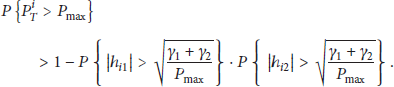
The integral part in (33) is nonintegrable and cannot be further simplified. Considering (31), we can get the approximation of outage probability by shrinking the integral interval
The channel state information and are independent, and thus the equation can be rewritten as
Considering the p.d.f. of and , we can get
Also, we can get the approximation of the outage probability
5. Simulation Results
In this section, we study the performance of power allocation scheme in bidirectional relay networks which have 6 relays, compared with the power allocation according to SNR-balancing criterion in [13]. The channels coefficients and are generated as zero-mean normal complex random variables. The noise power at the relays and at the two source nodes is assumed to be 0 dBW. We explore the total transmit power with different SNR thresholds of two source nodes.
We illustrate the transmit power required with increasing SNR threshold of source node , when the SNR threshold of source node equals 10 dB in Figure 2. The total transmit power and the power allocated on the selected relay are increasing with increasing. The power allocated on sourse is increasing linearly with increasing. We can also see that when the SNR thresholds of two sources are not equal, , the proposed power allocation scheme outperforms SNR-balancing criterion based power allocation scheme in [13].
Total transmit power versus , for dB.
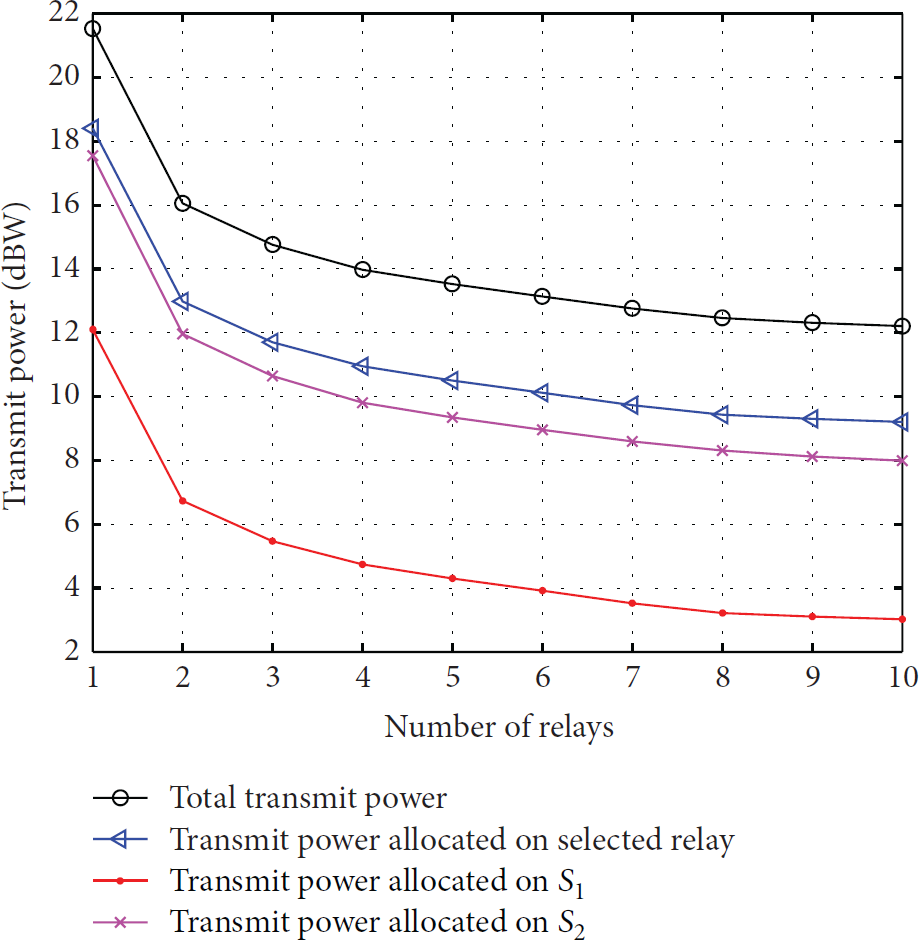
Figure 3 shows the minimum power required with dB, dB, with different number of relays in the two-way relay network. Power allocated on is much larger than that on , because the required SNR threshold of is 5 dB larger than that of . The power allocated on the selected relay is larger than that on both sources, which is the same with Figure 2. With increasing number of relays, the minimum power required is decreased. Exploiting multiple relays obtains higher diversity order and lower transmit power.
Total transmit power versus number of relays.
In Figure 4, we compare the outage probability as a function of for a two-way opportunistic relay system. We have set , dB for symmetric traffics and dB, dB for asymmetric traffics. The outage probability of two-way relay networks without power allocation is also shown. Figure 6 shows that the proposed power allocation can decrease the outage probability significantly. For symmetric traffics, the outage probability of two-way relaying with our proposed power allocation scheme equals that with the power allocation according to SNR-balancing criterion in [13]. But in asymmetric condition, the system with our proposed power allocation scheme has lower outage probability.
Outage probability versus total transmit power, for relay number .
Figure 5 shows the exact outage probability and the approximation of outage probability with different number of relays, when each node knows the exact channel state information. The approximation is lower than the exact outage probability because the integrating interval is reduced in the approximation operation. Also, we can observe that the approximation is more accurate in high SNR regime.
The exact outage probability and the approximation.
Outage probability with different channel state estimation.
In Figure 6, the outage probability is shown with different correlation coefficient of the estimated channel gain and the exact channel gain. When , each node knows the exact channel state information. When , the outage probability is increased because of the estimation error.
6. Conclusions
We developed an energy efficient power allocation scheme to minimize total transmit power of bidirectional relay networks with imperfect channel state information. We obtain a closed-form expression of power allocated on each node. Then one single relay which can minimize the total transmit power is selected to forward the amplified signal. We also obtained the expression of the outage probability after power location and an approximation expression of outage probability. Simulation result shows that the outage probability is slightly increased when there is channel estimation error.
Footnotes
Acknowledgments
This work is supported by the National Natural Science Foundation of China under Grant no. 51274202, Natural Science Foundation of Jiangsu Province under Grand no. BK20131124, the Fundamental Research Funds for the Central Universities under Grant no. 2013RC11, Qing Lan Project, and 333 Talent Project and Six Talent Tops of Jiangsu province.
References
1.
JeonY.KimY.-T.ParkM.LeeI.Opportunistic scheduling for multi-user two-way relay systems with physical network codingIEEE Transactions on Wireless Communications2012114129012942-s2.0-8486021751210.1109/TWC.2012.021412.111189
2.
KimT. T.PoorH. V.Diversity-multiplexing trade-off in adaptive two-way relayingIEEE Transactions on Information Theory2011577423542542-s2.0-7995953577110.1109/TIT.2011.2145190
3.
RankovB.WittnebenA.Spectral efficient protocols for half-duplex fading relay channelsIEEE Journal on Selected Areas in Communications20072523793892-s2.0-3384773635810.1109/JSAC.2007.070213
4.
LouieR.LiY.VuceticB.Practical physical layer network coding for two-way relay channels: performance analysis and comparisonIEEE Transactions on Wireless Communications2010927647772-s2.0-7694909493110.1109/TWC.2010.02.090314
5.
JingY.JafarkhaniH.Single and multiple relay selection schemes and their achievable diversity ordersIEEE Transactions on Wireless Communications200983141414232-s2.0-6294913861410.1109/TWC.2008.080109
6.
JingY.A relay selection scheme for two-way amplify-and-forward relay networksProceedings of the International Conference on Wireless Communications and Signal Processing (WCSP '09)November 2009Nanjing, China152-s2.0-7774932117610.1109/WCSP.2009.5371758
7.
SongL.Relay selection for two-way relaying with amplify-and-forward protocolsIEEE Transactions on Vehicular Technology2011604195419592-s2.0-7995597582510.1109/TVT.2011.2123120
8.
GuD.LeungC.Performance analysis of transmit diversity scheme with imperfect channel estimationElectronics Letters20033944024032-s2.0-003745642010.1049/el:20030243
9.
ZhangX.GongY.Adaptive power allocation in two-way amplify-and-forward relay networksProceedings of the IEEE International Conference on Communications (ICC '09)June 2009Dresden, Germany152-s2.0-7044950842210.1109/ICC.2009.5198705
10.
LiuT. C.-K.XuW.DongX.LuW.-S.Adaptive power allocation for bidirectional amplify-and-forward multiple-relay multiple-user networksProceedings of the IEEE Global Communications Conference (GLOBECOM '10)December 2010Miami, Fla, USA162-s2.0-7955161941810.1109/GLOCOM.2010.5683807
11.
HanY.TingS.Ho.C.ChinW.High rate two-way amplify-and-forward half-duplex relaying with OSTBCProceedings of the IEEE 67th Vehicular Technology Conference-Spring (VTC '08)May 2008Singapore242624302-s2.0-4774913933010.1109/VETECS.2008.536
12.
ZhangY.MaY.TafazolliR.Power allocation for bidirectional AF relaying over rayleigh fading channelsIEEE Communications Letters20101421451472-s2.0-7674909149710.1109/LCOMM.2010.02.092227
13.
TalwarS.JingY.ShahbazpanahiS.Joint relay selection and power allocation for two-way relay networksIEEE Signal Processing Letters201118291942-s2.0-7865090558310.1109/LSP.2010.2096466
14.
ZhengJ.BaiB.LiY.Outage-optimal opportunistic relaying for two-way amplify and forward relay channelElectronics Letters20104685955972-s2.0-7795116896810.1049/el.2010.2803
15.
GuoH.GeJ. H.Outage probability of two-way opportunistic amplify-and-forward relayingElectronics Letters201046139189192-s2.0-7795384228310.1049/el.2010.1315