




Abstract
We analyze the competitive price game model for spectrum sharing in cognitive radio networks with multiple primary users and secondary users and propose a user requirement based competitive price game model for the calculation of the shared spectrum size of cognitive user in Bertrand game. The communication requirement of the cognitive user is quantified into different requirement levels. With the application of spectrum requirement factor, cognitive user can adjust the demanded shared spectrum size according to self-requirement level and the shared spectrum price provided by licensed users. It can avoid the waste of spectrum resource caused by the overdistribution of spectrum to the cognitive user with low communication requirement. Simulation results show that the occupied spectrum of cognitive user can be adjusted with the variation of requirement levels, and the licensed users can achieve better profit performance with consideration of requirement of cognitive user by adjustment of the shared spectrum price proposed spectrum sharing model.
1. Introduction
Cognitive radio is viewed as an effective approach for improving the utilization of the radio spectrum [1]. The cognitive transceivers have flexible spectrum sensing ability and can adjust transmission parameters adaptively according to the ambient environment. The spare spectrum of licensed users (primary user) can be accessed by the cognitive users (secondary user) dynamically without causing harmful interference, and certain economic revenue can be achieved by the primary users [2, 3].
As the behaviors of the primary users and secondary users interact with each other, game theory, which is viewed as an effective tool for the analysis of interactive decision making, is applied in the spectrum sharing problem of cognitive radio networks [4]. The players in game model are primary and secondary users. The strategy space for each user consists of various actions related to spectrum sharing. Specifically, for secondary users, the strategy space includes which licensed channel they will use, what transmission parameters (e.g., transmission power or time duration) to apply, and the price they agree to pay for leasing certain channels from the primary users. For primary users, the strategy space may include which unused channel they will lease to secondary users and how much they will charge secondary users for using their spectrum resources [5, 6]. The competitive price model is applied to analyze the spectrum sharing problem in cognitive radio networks and obtain the Nash equilibrium price strategies that maximize the profits of primary users. As the price strategies of other primary users are usually not available simultaneously, the iterative equilibrium price calculation was further analyzed [7, 8]. The spectrum sharing problem with price strategies offered simultaneously and sequentially is also discussed in [9]. The selection of adjustment factor in the calculation of the equilibrium price is discussed in [10]. The auction mechanism is used to analyze the spectrum sharing of cognitive users to obtain the transmit power that satisfies the interference constraints [11], and the auction mechanism based on the signal to noise ratio and power is proposed; it can be applied to achieve the iterative calculation of the equilibrium price in distributed cognitive radio networks. The spectrum allocation algorithm based on dynamic multiband auction is discussed in [12], and the spectrum auction problem is converted to the 0/1 integer knapsack problem. The shared spectrum price is determined according to the supply-demand relationship. The spectrum resource allocation of cognitive radio networks based on auction mechanism is also analyzed in [13]. The cognitive users bid for the spectrum resource, the licensed users as the spectrum broker determine the spectrum sharing strategies without the deterioration of its communication quality, and the iterative calculation of the spectrum bid from secondary users in distributed cognitive radio networks is discussed. With the consideration of the collaboration among cognitive users, the mechanism of monetary compensation and motivation is used to improve utility function of the cognitive uses; thus the licensed spectrum can be shared with better fairness performance [14]. The spectrum leasing problem in cognitive radio networks is discussed in [15], which is different from the spectrum leasing model mentioned above; the primary users allow the spectrum sharing with selection of the affordable interference levels. The auction mechanism based spectrum sharing between single primary user and multiple secondary users in cognitive radio networks is discussed in [16], the shared spectrum power strategies of the secondary users are determined by Vickrey auction mechanism to guarantee the interference power levels without causing harmful influence to the communication quality. The auction agent-based spectrum sharing in cognitive radio networks is analyzed in [17]. In addition to the primary users and secondary users, specialized agent is responsible for the spectrum resources allocation. It applies for the spectrum resource from the primary users and reallocates the licensed spectrum resource to the secondary users at certain price strategies. The transmit information between the primary users and secondary users can be reduced by the spectrum sharing mechanism, and effective spectrum sharing strategies can be achieved.
As the competitive price game model is applied in the cognitive radio networks with multiple primary users and single secondary user service, and the auction mechanism spectrum sharing model is applied in the cognitive radio networks with single primary user and multiple secondary users, this paper focused on the spectrum sharing problem with multiple primary users and secondary users. Moreover, on the basis of the competitive price game model, the spectrum resource demand levels of the secondary user are taken into account; the secondary service can adjust the applied spectrum resource according to the spectrum demand of secondary users and the shared spectrum price from the primary users. It is more applicable in the practical cognitive radio networks with the consideration of the spectrum requirements of secondary users, and the spectrum efficiency can be improved.
The rest of this paper is organized as follows. Section 2 describes the system model of spectrum sharing in cognitive radio networks. In Section 3, the spectrum sharing problem based on competitive price game is analyzed. Section 4 presents the simulation results, and Section 5 draws some conclusions.
2. System Model
We consider a wireless system with multiple primary users, the total number of which is denoted by N. For simplicity, assume the communication of secondary users is served by a secondary service. In this case, primary user i wants to sell portions of its spare spectrum to secondary user at price

We apply Bertrand price model in economics to analyze the spectrum sharing problem in cognitive radio networks. The primary users provide the price strategies of shared spectrum, and the demanded spectrum size of the secondary user is determined from its utility function, which is relevant to the price strategies provided by primary users. The spectrum sharing profits of primary user depend on the economic revenue and the cost due to spectrum sharing. Here, the cost of spectrum sharing is defined as the degradation of the quality of service (QoS). The primary users constantly adjust the price strategies of shared spectrum to achieve the maxima of their own profits.
The demanded spectrum size of secondary user can be calculated through the quadratic utility function that is described as follows [5]:
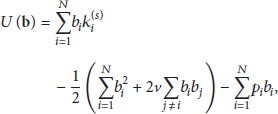

The demanded spectrum resource of the secondary service from the primary users can be determined by calculating the solution of
3. The Competitive Price Gamed Based Spectrum Sharing with User Requirement
On the basis of the spectrum sharing model in cognitive radio networks based on the competitive price game, we take the impact of cognitive users' spectrum requirement in the spectrum sharing into account and establish an improved spectrum sharing model with the combination of competitive price game and auction mechanism as shown in Figure 1. The secondary service can collect the spectrum bids of the secondary user within the secondary user group, and the demanded spectrum resource level can be determined by the spectrum bids of the secondary users. With the acknowledgement of the shared spectrum price provided by the primary user and the spectrum demand levels of the secondary users, the secondary service determines the optimal shared spectrum size by competitive price game model. After the secondary service obtains the exclusive spectrum access right of certain spectrum resource, the secondary service reallocates the obtained spectrum resource to the secondary users by auction mechanism. Thus, the spare licensed spectrum resource can be shared between multiple primary users and secondary users.
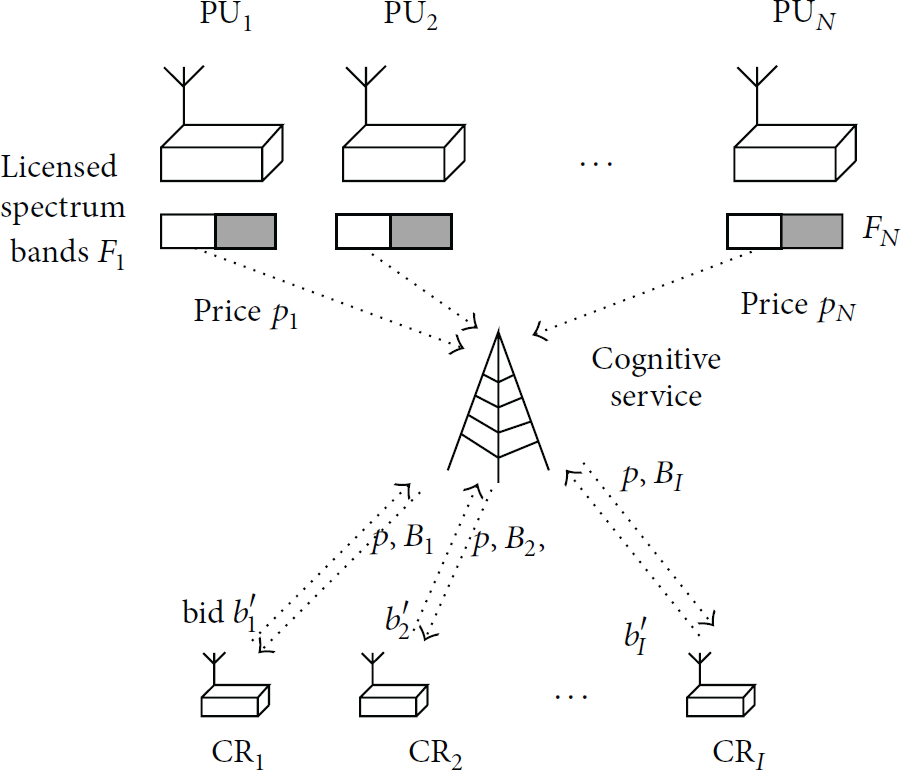
The improved spectrum sharing model.
In the spectrum sharing model based on auction mechanism, the secondary users submit the spectrum bids
At the secondary service terminal, the demanded spectrum resource of the secondary is


From (5), we can get
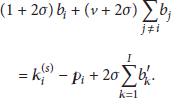
The size of shared spectrum can be rewritten as the linear equations according to (6):

The size of demanded spectrum can be obtained by


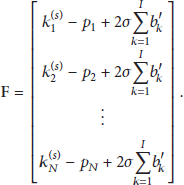
The elements in the inverse of
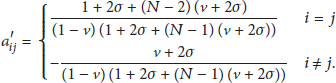
With the acknowledgement of shared spectrum price strategies

3.1. Adaption of the Shared Spectrum Price
The cost of spectrum sharing in this paper is defined by the QoS degradation of primary users. The revenue function


In Bertrand price model, the players of the game are the primary users, the strategies of the players are prices of shared spectrum, that is,
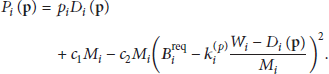
However, in practical spectrum sharing model for cognitive radio networks, the spectrum resources of the primary users are usually restricted. The spectrum demand of the secondary users will not be definitely satisfied by the primary users. Thus, it needs to consider the constraints of the shared spectrum size.


It can be achieved from (16)–(18) that
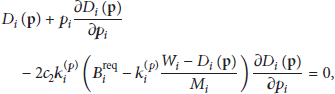

In practical cognitive radio networks, the price strategies of other primary users cannot be achieved simultaneously; the Nash equilibrium price strategy of the competitive price model cannot be achieved through the linear equations formed by (19). Thus, it is needed to further discuss the iterative method without acknowledgment of price strategies from other primary users.
Assume the price strategies of other primary users cannot be achieved simultaneously, but the price strategies of primary users during last cycle are available. The Nash equilibrium price that maximizes the system profits of the primary users can be achieved iteratively.
The linear gradient descent algorithm is one of the effective tools to calculate the maximum and minimum value of continuous target function during the optimization problems. For the primary users, the profit function is convex with the variation of shared spectrum price. At the

3.2. Reallocation of Achieved Spectrum Resource
The secondary users submit the spectrum bids
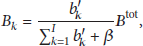
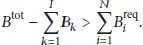
With the shared spectrum resource

The economical cost


Thus

When the cognitive user cannot get acknowledgment of the spectrum bids from other cognitive user, which is similar with the calculation of the shared spectrum price in competitive price game model discussed in Section 3.1, the spectrum bids of the secondary user can be achieved by

4. Simulation Results
We consider a cognitive radio network with two primary users and two secondary users sharing a frequency spectrum of size 20 MHz. The target BER for each secondary user is
Figure 2 shows simulation results of the shared spectrum size of the secondary service under different spectrum requirements from the secondary users, where spectrum requirement

The shared spectrum size under different requirement levels of cognitive users.
Figure 3 shows the simulation results of the system profit of the primary users by providing spectrum sharing to the secondary users. It can be concluded from Figure 3 that, with the increasing spectrum requirement of the secondary users, more shared spectrum size can be obtained by the secondary users, and the primary users can also achieve more spectrum sharing profits.
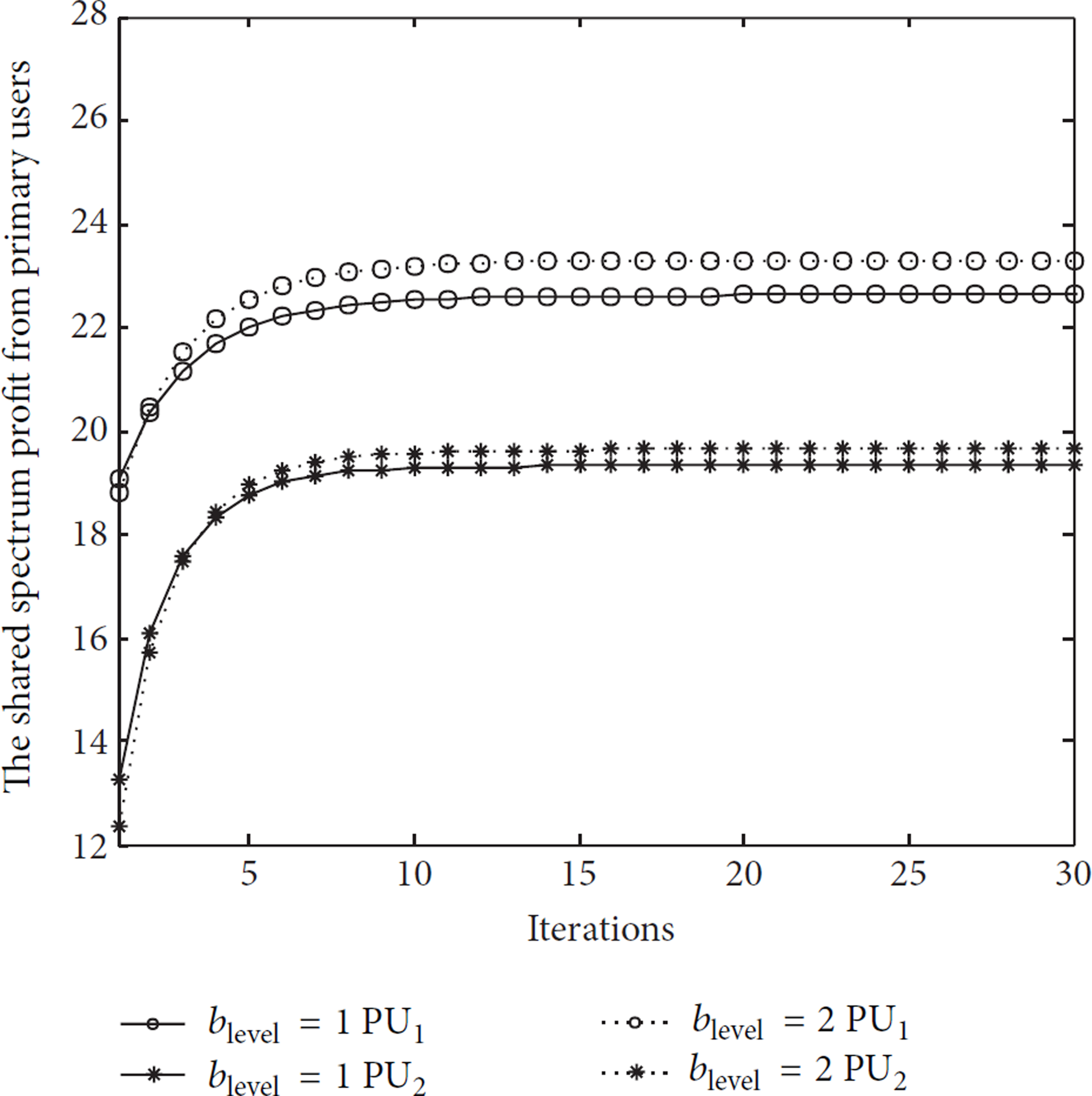
The profit of primary users by providing spectrum resource under different requirement levels of cognitive users.
Then, we compare the proposed approach with the conventional approach which combines the competitive price game and auction mechanism directly without considering different spectrum requirement levels from the secondary users. Figure 4 shows the simulation results of spectrum bids with different spectrum requirement levels from the secondary users, when applying the proposed spectrum leasing model and the conventional competitive price game model for cognitive radio networks. The factor θ is reduced to control the cost function in the improved spectrum leasing model. On the contrary, with the increase of factor θ, the spectrum requirements of the secondary users are increased. Where the signal to noise ratio of the secondary receiver 1 is 18 dB and the signal to noise ratio of the secondary receiver 1 is 22 dB. In the conventional spectrum leasing model with the combination of the competitive price game and auction mechanism,

The spectrum bid of cognitive users system revenue performance of primary users in the improved spectrum trading model.
Figure 5 shows the simulation results of the shared spectrum resource size of the secondary service by the improved spectrum leasing model and the conventional spectrum leasing model with direct combination of the competitive price game and auction mechanism. It can be concluded from Figure 5 that, in the improved spectrum leasing model, the secondary user can increase the spectrum bids to apply for more licensed spectrum resource. It is more suitable for the spectrum leasing problem in cognitive radio networks.

The achieved shared spectrum resource of the cognitive service management by the improved spectrum trading model.
5. Conclusion
In this paper, we analyze the spectrum leasing problem of the cognitive radio networks with multiple primary users and multiple secondary users, and propose an improved spectrum sharing model considering the spectrum requirement of the secondary users. This approach introduces the demanded spectrum resource of the secondary users into the utility function base on the competitive price game model and uses a spectrum requirement level to quantify the communication requirements of the secondary users. Then the secondary service can determine the size of shared spectrum according to the spectrum requirement of the secondary users and the provided spectrum sharing price, and the primary users adjust the price of shared spectrum to maximize their spectrum sharing profits. The simulation results show that the achieved spectrum resource of the secondary user can be adjusted flexibly according to its spectrum requirements and the shared spectrum price of the primary user, especially when the demand spectrum size of the secondary users cannot be satisfied by the primary users. It can also avoid the waste of spectrum resource when the spectrum requirement of the secondary user is low.
Footnotes
Conflict of Interests
The authors declare that there is no conflict of interests regarding the publication of this paper.
Acknowledgments
This paper is supported by the Young Scientists Fund of the National Natural Science Foundation of China (Grant no. 61101141), the Natural Science Foundation of Heilongjiang Province, China (Grant no. QC2012C070), and the Fundamental Research Funds for the Central Universities of Ministry of Education of China (Grant no. HEUCF1308).