




Abstract
Passive acoustic source tracking using underwater distributed sensors has been a severe problem because of the complexity of the underwater channel and the limited resources of the sensors. In this paper, we propose an acoustic source tracking algorithm using underwater distributed sensors. According to the waveguide invariant theory, a slope of the interference pattern which is seen in a spectrogram is proportional to range of the acoustic source. The proposed algorithm matches the interference patterns at the distributed sensors and calculates a distance ratio between source and sensors. A locus of the source by the principal of the circle of Apollonius is estimated. The Apollonius circle, however, still keeps the ambiguity against the correct source location. In addition hyperbola equation is introduced into localization algorithm by estimating time difference of arrival between the received signals at the distributed sensors. Finally the cross point of the circle and hyperbola can be estimated as the position of the acoustic source. The proposed algorithm is tested on sea trial data for acoustic source ranges of 400–2,000 m and frequencies from 50 to 750 Hz. The results show that the proposed algorithm successfully estimates the source location within an error bound of 7.3%.
1. Introduction
For the last couple of decades, there has been a great deal of research to improve the performance of localization and tracking of acoustic source in the shallow water. There are several localization methods, such as conventional beamforming method and MFP (matched field processing) technique based on acoustic propagation model in multipath environment [1, 2]. However, the conventional beamforming method needs large sensor array, and MFP is not always applicable to real situations because it requires very accurate environmental information in order to localize the source.
The range of the source can be estimated by the much simpler waveguide invariant theory [3]. The invariant parameter called β is useful for describing the characteristic of the acoustic waveguide [4, 5]. D'Spain and Kuperman developed an analytical model, based upon the waveguide invariant, to predict the frequency dependence of broadband interference patterns in shallow water [6]. Heaney provided a method to extract three acoustic observables, one of them being the waveguide invariant, from a spectrogram and relate these to the sediment geoacoustic properties [7]. However, the waveguide invariant method requires knowledge of certain invariant parameter which unfortunately often varies with sound speed structure of the ocean. In [8], the authors proposed the methods to extract the waveguide invariant parameter directly from spectrogram. Recently several methods are introduced using the waveguide invariant theory and showed enhanced performance. In [9], a technique was developed to estimate the range to a fixed acoustic source from the acoustic intensity as measured over a window of ranges and frequencies based on the waveguide invariance. This technique was tested on experimental data that was obtained from an acoustic receiver towed by an autonomous underwater vehicle heading directly toward the acoustic source. But it needs a moving receiver and is still dependent on the ocean environment. So it is necessary to localize the source that is independent of the waveguide invariant parameter β without the information of the ocean environment at the distributed sensors.
In this paper, we propose the acoustic source localization algorithm regardless of waveguide invariant parameter and environmental information by use of underwater distributed sensors. According to the waveguide invariant theory, a slope of the interference pattern which is seen in a spectrogram is proportional to range of the acoustic source. The proposed algorithm matches the interference patterns at the distributed sensors and calculates a distance ratio between source and sensors. A locus of the source by the principal of the circle of Apollonius is estimated. The Apollonius circle alone, however, still keeps the ambiguity against the correct source location. By estimating time differences of signal arrivals between source and receivers, the hyperbola equation is used to get the cross point of the equations. The sea trials were performed to prove the applicability of the proposed algorithm.
The rest of this paper is organized as follows. Section 2 outlines the waveguide invariant theory, and Section 3 presents the proposed algorithm. Section 4 applies the proposed algorithm to the experimental data. Finally, Section 5 gives a summary and conclusion.
2. Waveguide Invariant Theory
The interference pattern which is seen in the spectrogram collected from the moving source-radiated noise arises from the mutual interference between modes reflected by the sea surface and the bottom. This interference structure is summarized by a quantity β called waveguide invariant parameter and introduced by Chuprov [4]. These patterns are a function of the propagation characteristics of the environment and so can be used to determine the environmental properties. The slope of the interference pattern has been known as invariant parameter and describes the dispersive characteristics of the field in a waveguide. The value β is approximately 1 in the Pekeris waveguide of the real ocean, but β is the variable by mode number, frequency, source depth, and so on. A plot of acoustic intensity versus range and frequency due to an acoustic source in an ocean waveguide exhibits striations [10]. The waveguide invariant's striations which is called the interference pattern can be seen in Figure 1, which is a plot of the simulated acoustic intensity in a 100 m water depth Pekeris waveguide with a sound speed of 1500 m/s and a bottom sound speed of 1600 m/s when the depths of a source and sensor are 50 m, respectively.

(a) The Pekeris waveguide, (b) acoustic intensity spectrum in the Pekeris waveguide.
If two sensors are used to source localization in identical acoustic propagation environment, it is possible to detect the source without regard for β because the value β has identically effect on each sensor. The relationship between waveguide invariant parameter β and slope of the interference pattern for each sensor can be expressed as the following equations:


The trajectory of a moving source and coordinates with 3 sensors.

Spectrograms at (a) sensor 1, (b) sensor 2, and (c) sensor 3.
Since the value β has identically effect on each sensor, (1) can be summarized as
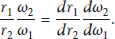
Assuming that

3. Proposed Method
In this paper, we propose the acoustic source tracking algorithm regardless of waveguide invariant parameter. First, we need to estimate the ratio of the range between source and sensors from interference patterns. We can find out this ratio from compression or expansion process of the interference patterns. Figure 4 shows the basic concept of the interference pattern fitting. One sensor is selected as the reference and the spectrum at the other sensor is scaled on the frequency axis until they are matched up with each other. When the accumulated squared error between the reference spectrum and the scaled spectrum has the minimum value, the scaling factor can be estimated as the ratio of the range. This optimizing criterion becomes


Compression or expansion process of the interference patterns.
The circle of Apollonius shown in Figure 5 is defined as the locus of points that the distance from a fixed point is a multiple of the distance from another fixed point. If the multiple is equal to 1, then the locus is a line which is perpendicular bisector of the segment of each fixed point, and if the multiple is not equal to 1, then it is a circle so called circle of Apollonius. The result from the compression or expansion process of the interference patterns is the locus of the source derived from the principal of the circle of Apollonius. It requires the other equation in order to track the correct source location. So we use the hyperbolic equation for TDOA (time difference of arrival) estimation [12] between distributed sensors. Finally, the cross point of the circle and the hyperbola can be estimated as the source location. The equations for the circle and hyperbola are as follows:


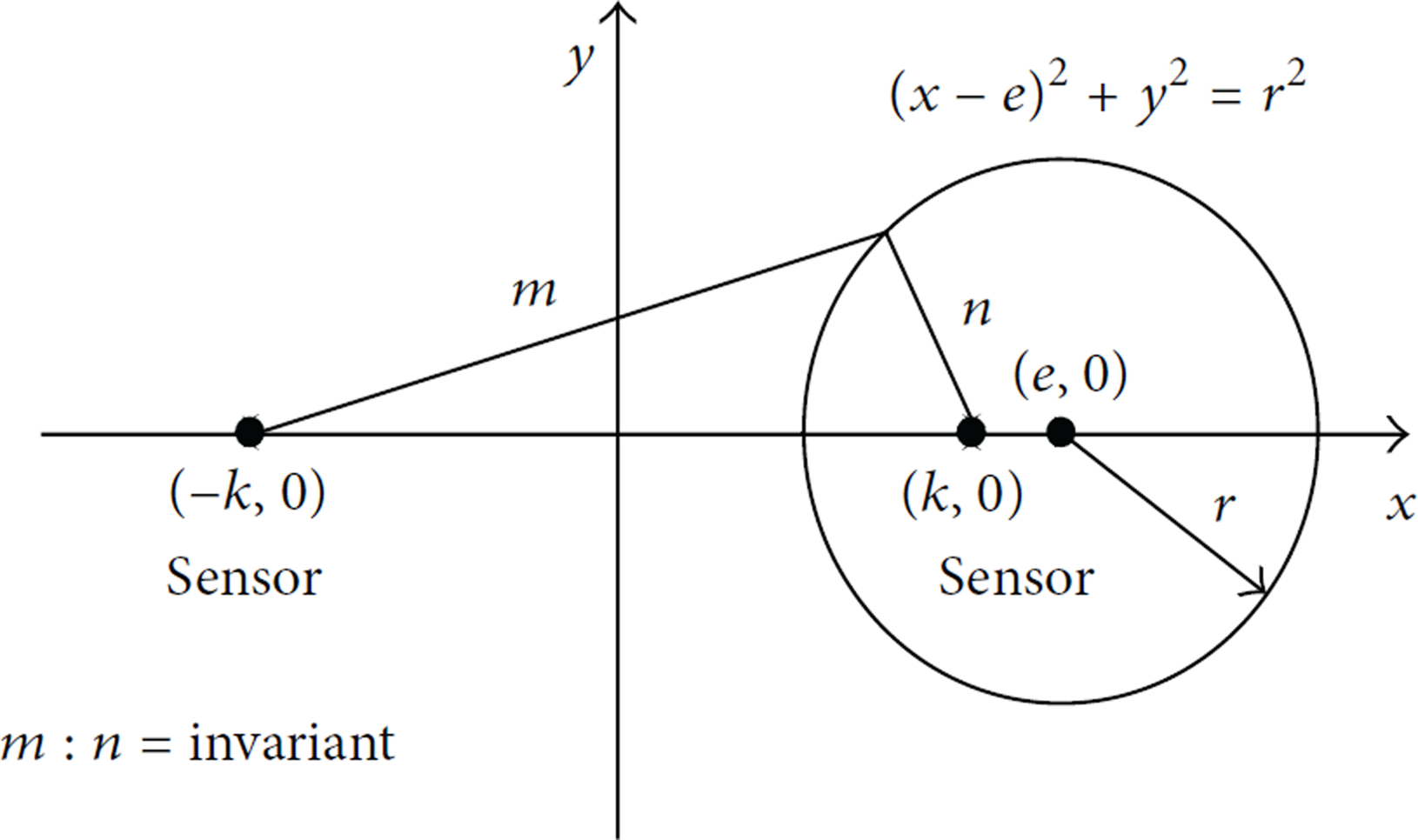
Circle of Apollonius.
4. Experimental Results
The experimental data presented in this paper was collected during MAPLE05, an experiment performed during May 2005 near Pohang city, Republic of Korea. The sound speed profiles were measured periodically by XBT (eXpendable Bathythermograph) instrument and are plotted in Figure 6. The setup for sea trial is shown in Figure 7. An acoustic source was towed at 50 m below the ocean surface at an approximately 4-knot speed rate. The source signal has 50 to 750 Hz band and the source level of 160 dB re 1 μPa at 1 m. The exact acoustic source locations were measured from GPS unit in vessel. The hydrophones were equipped at sea bottom and the spacing of the distributed sensors was 66 m.

Sound speed profiles during experiment.
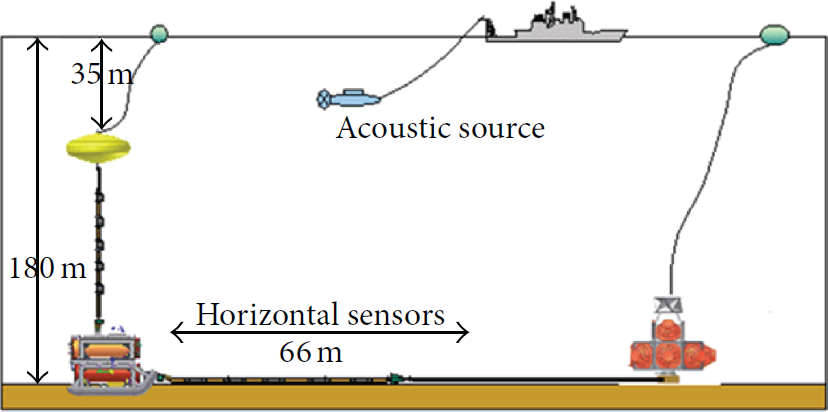
Setup for sea trial.
Figure 8 shows the spectrograms of the recorded time series at sensors. This plot of acoustic intensity due to a broadband source exhibits striations by waveguide invariance. The ratio of the range is estimated based on the compression or expansion of these striations. The estimated and exact ratios of the range are shown in Figure 9(a). Figure 9(b) is the error of this ratio. We can see that the range between source and sensors is the same at time frame 215. Figure 10 shows the trajectory of finally estimated acoustic source. The average error is 41 m and the average error rate is 7.3%.

Spectrograms of the measured signals at (a) sensor 1, (b) sensor 2.
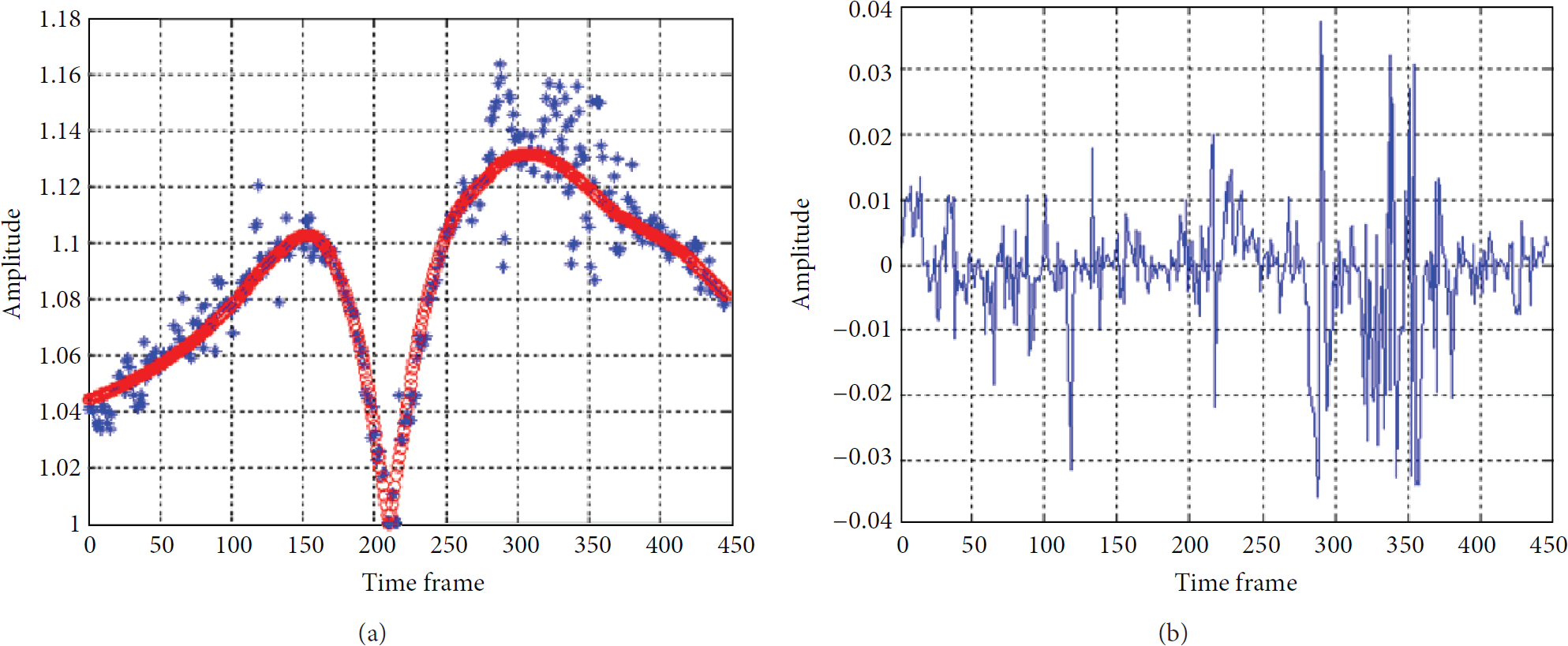
(a) The ratio of the range estimated by the proposed method; (b) the ratio error of the range.

Source trajectory (mark “+”) estimated by the proposed method and true trajectory (solid line) by GPS.
5. Conclusion
The localization method based on waveguide invariance has been introduced for estimate source position without regard for β and knowledge of the ocean environment. In this paper we proposed the method to estimate the position of the acoustic source by using two underwater distributed receivers. In the proposed method the relative range ratio was found. The equation of Apollonius circle was calculated out from the interference patterns, while the equation of hyperbola was found out from time delay value based on TDOA estimation. The experiments presented in this paper explore the waveguide invariant phenomena. The proposed passive acoustic source tracking algorithm holds good capability whose error is within 7.3% rate by sea trials. This could be used as an acoustic source tracking algorithm and it has the potential to keep the performance without the requirement of a prior knowledge of waveguide invariance.
Footnotes
Acknowledgments
This work was supported in part by Defense Acquisition Program Administration and Agency for Defense Development under the Contract UD130007DD and by Ministry of Education and National Research Foundation of Korea (NRF) through the Human Resource Training Project for Regional Innovation.