




Abstract
In order to study the relation between the food package temperature and ambient environment, the food package temperature is investigated by numerical simulation under the different conditions, such as evaporator outlet velocities, ambient temperatures, and relative humidity. In the present computation, the influence of mass transfer and radiation is considered. The computational results show that the front and top food package temperature rises to 0.1 ~ 1.2°C due to the effect of light. At the investigated range of this paper, the food package temperature decreases when the air curtain velocity increases, but the food package temperature also increases with increase of ambient temperature and humidity. At the same time, the food package temperature decreases 0.2 ~ 1.1°C when air curtain outlet velocity increased by 0.15 m/s. The food package temperature rises about 0.6°C when ambient temperature increases by 2°C. The food package temperature rises about 0.9°C when ambient humidity increases by 20%. Therefore, the study can provide the reference for the design of refrigerated display cabinet.
1. Introduction
At the end of the food cold chain, refrigerated display cabinets play a very important role in ensuring quality and freshness of perishable food, which also can beautify the supermarket environment and allow customers free access to food inside the cabinets. According to investigation, more than 70% of total cooling capacity is produced by air curtain. However, many factors can affect the performance of air curtain, such as the width of discharge air grill, discharge air temperature, velocity, and external environmental conditions. In present, many researchers have focused mainly on the performances of the air curtain including using the CFD and experimental method.
Howell [1] found that energy saving could reach 20%–30% for most display cabinets when the relative humidity was lowered from 50% to 35%. Stribling et al. [2] showed that the CFD method was an efficient tool to investigate the performance of refrigerated display cabinet. The correlations of the total heat transfer across the air curtain were developed based on the finite difference method by Ge and Tassou [3]. Cortella pointed out that CFD was an important tool to study air flow and food temperature of inner refrigerated display cabinet [4]. Navaz et al. [5] studied the flow field characteristics and performance of the air curtain of refrigerated display cabinet combined using CFD method and digital particle image velocimetry. Foster et al. [6] showed that the CFD results could be applied to design refrigerated display cabinet and improve its performance. Navaz et al. [7] investigated influencing parameters of air entrainment in an open refrigerated display cabinet by CFD and experimental method. Chen and Yuan [8] investigated several important influencing factors of refrigerated display cabinet, such as ambient temperature and relative humidity, ambient air velocity, air supply flow, air flow from perforated back panels and night cover. D'agaro et al. [9] applied 2D and 3D models to investigate the air flow and temperature distribution in vertical refrigerated display cabinet. Gray et al. [10] observed that a 70-30 distribution of flow between the air curtain and rear duct could yield a good performance. Yu et al. [11] proposed modified two-fluid turbulence model to simulate the fluid flow and heat transfer characteristics of air curtains in an open vertical display cabinet. Yu et al. [12] developed the correlation model of TEF (the entrainment factor) for air curtain based on the CFD simulation. Amin et al. [13] developed a new approach using tracer gas to study the steady-state infiltration rate of display cabinet. Chen [14] studied thermal insulation of air curtains by simulation under different structural parameters. Moureh et al. [15] found that could be the performance of refrigerated display cabinet improved by the use of mist flow whereby fine water droplets were injected into the air curtain. Cao et al. [16] used the new algorithms and model to optimize air curtains. Ge et al. [17] applied the integration of CFD and cooling coil models to investigate flow field and temperature distribution of refrigerated display cabinet taking into account the effect of ambient temperature and humidity. Gaspar et al. [18] presented the variation of heat transfer rate and TEF obtained different ambient air conditions, varying air temperature, relative humidity, velocity, and its direction relatively to the display cabinet frontal opening. Hammond et al. [19] developed a model based on the Richardson number for a recirculating curtain sealing an open fronted display cabinet without back panel flow. Amin et al. [20, 21] investigated the effects of factors on the infiltration rate of open refrigerated vertical display cabinet. Laguerre et al. [22] developed mathematical model of food temperature in refrigerated display cabinets.
From the previous literature reviews, we can see that previous researches mainly focus on the performance of air curtain. Few literatures take into account the effect of external environment conditions. So this paper is to investigate the effects of some important factors on food temperature in refrigerated display cabinet, such as the light, ambient temperature and relative humidity, and supply air velocity by fan blade.
2. Physical Model
The 2D CFD model of refrigerated display cabinet (shown in Figure 1) is established in this paper. The main structure data of the refrigerated display cabinet is described in detail as follows.
The computational domain's geometry dimensions are 3600 mm in width and 3600 mm in height. The dimensions of refrigerated display cabinet are 995 mm × 2200 mm (width × height).
The distance from back panel to the left boundary is 500 mm.
The cabinet shelf is divided into six product shelves; The length of the shelf is 460 mm. the distance between two shelves is 275 mm while the gap between the fifth and bottom shelves is 325 mm.
Three rows of food packages are placed in each shelf. According to GB/T21001.2-2007, the size of food package is 100 mm × 50 mm ((width × height), so the height of food packages is 150 mm, food package pitch is 50 mm in each shelf, and the food package pitch is 120 mm in bottom shelf. The food package number is 1 to 18.
The power of light is 30 W.

Two-dimensional diagram of refrigerated display cabinet.
3. Mathematical Model and Computational Method
3.1. Mathematical Model and Computational Method
Air flow is assumed to be a two-dimensional steady, incompressible turbulent flow problem and neglects viscous dissipation. The influence of ambient air relative humidity is considered by making use of a species transport model. The fluid is considered as a mixture of dry bulb air and water vapour. Its mathematical model is as follows:

where φ is common variable; Γ is generalized diffusion coefficient; S is generalized source term corresponding to φ; the turbulent Schmidt (Sct) number's value is 0.7. Different equations are referred in [23]. Table 1 gives the parameters of different partial differential equations. Classically recommended values are applied as the constants for the K-ε model in Table 1, which can be obtained in Table 2.
Variables, diffusion coefficients, and source terms of each governing equations.

The coefficients in K-ε model.

The heat gain of refrigerated display cabinet by thermal radiation is one of the most important cooling load components between food package and walls. The radiation equation is as follows:

whereI is directional radiation intensity; s is optical path length; a is absorption rate; σ s is scattering rate; T is local temperature; σ is Stefan-Boltzmann constant; Ω is solid angle.
In the present computation, a surface-to-surface radiation model (based on surfaces view factors calculation) is used to take into account the heat gain component. The discrete ordinates model is employed as the radiation model in the present computation. The SIMPLE algorithm is used as the solution method for the coupling of pressure-velocity. The second upwind scheme is applied to the convection term.
3.2. Boundary Conditions
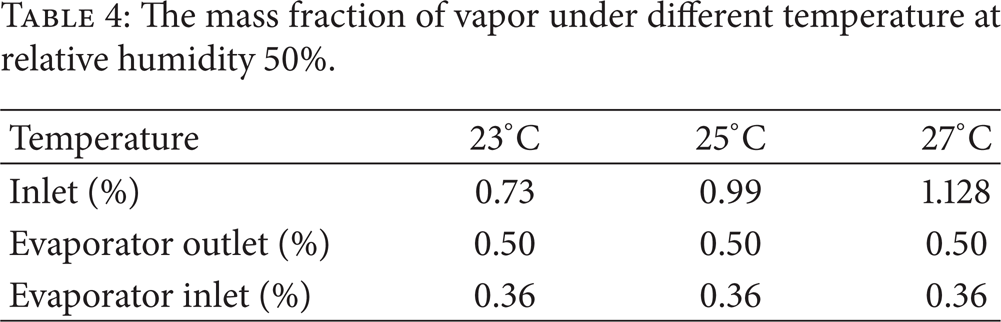
In the present computation, the left and right walls of computational domain are defined as pressure inlet and pressure outlet, respectively. The ceiling and floor are defined as adiabatic walls, and boundary conditions of the evaporator inlet and outlet are defined as velocity inlet and pressure outlet, respectively. In addition, the boundary condition of the face permeability is correlated as constant. The perforated panel is defined as a porous jump condition of which the parameters can be adjusted according to the panel perforated rate. Others are all defined as wall. Because light generates continuous heat, it is defined as a wall with heat source. Food packages are set as solid; the physical property of food packages is defined in accordance with GB/T21001.2-2007. Under different relative humidity and temperature, mass fraction of water vapour on each boundary is shown in Tables 3 and 4, respectively.
The mass fraction of vapor under different relative humidity at temperature 25°C.

The mass fraction of vapor under different temperature at relative humidity 50%.
4. Grid Independence
A careful check for the grid independence of the numerical solutions has been made to ensure the computational accuracy. The grid independence is performed by using the progressively finer grid until the most food package difference less than 0.5°C. For this purpose, three grid systems, 45059, 56667, and 62677, are tested (Figure 2). The temperature difference of three grids is less than 0.5°C. Therefore, in order to obtain the accurate results and save computer resource, the grid of 56667 is used for all the calculations. All of the grid cases are used as structured/unstructured grids. In order to resolve the temperature and the velocity gradient near the refrigerated display cabinet, a fine mesh is placed, as shown in Figure 3.

Grid independency test.

Grid systems.
5. Numerical Results and Discussions
The velocity field and temperature field are shown in Figures 4 and 5 at the given light, ambient temperature 25°C, relative humidity 50%, and inlet velocity 1.5 m/s, respectively.

Velocity field.

Temperature field.
It can be seen from Figure 4 that air curtain is formed between discharge air grill and return air grill. Because of entrainment, and width of air curtain increases gradually. Backflow can be formed between the food package and shelf because the seepage of cold air from perforated back panel is influenced by food package and air curtain. The air entrainment from ambient space occurs in the upper regions of the air curtain and spills in the lower, which therefore increases the infiltration load of refrigerated display cabinet. From Figure 5, we can see that the air curtain is very efficient to form the heat transfer barrier between the internal display cabinet and the external environment. The food package temperature in the vicinity of air curtain has relatively higher temperature than those nearer the back panel because of the air entrainment and thermal radiation. So the good performance and stabilization of air curtain are the goals of any new refrigerated display cabinet.
5.1. The Effect of Light
Food temperature is influenced by generating heat of light. By comparing the food temperature with and without light, it can be seen from Figure 6 that the rear and top food packages temperature is affected obviously by light. Under the 30 W, the temperature of food packages 6, 7, 14, 15, 17, 18 with light presents about 0.1–1.0°C higher than those without light; food temperature of 16 is higher than 1.2°C. Therefore, the effect of light must be considered in the computation.

Food package temperature without light or with light.
5.2. The Effect of Air Velocity
Figure 7 shows food temperature with the change of air velocities of evaporator outlet. From the figures, it can be seen that the food temperature dwindles with the rising of air velocity. When air velocity increases, it will enhance heat transfer of food package and can decrease the seepage of heat by air curtain from the external environment. In the meantime, it brings some problems, such as the blade power increase and more cold air spill on return air grill. Therefore, to determine the optimum air velocity, food package temperature and power consumption must be taken into account.

Food temperature under different outlet velocity of air curtain.
5.3. Effect of Ambient Temperature and Relative Humidity
The indoor environment greatly influences the performance of air curtains when refrigerated display cabinet is operating. The present investigations are to evaluate the effects of ambient temperature and relative humidity. Figure 8 shows the food temperature distribution under different ambient temperature at relative humidity 50% and different ambient relative humidity at ambient temperature 25°C. Results show that the food temperature increases with increasing ambient temperature and ambient relative humidity. When the indoor temperature is increased by 2°C, the food temperature increases by about 0.3°C; in the meantime, indoor relative humidity is increased by 20% and the temperature of the food temperature increases by about 0.9°C. The air entering the evaporator includes part of indoor air entrainment by the air curtain. Therefore, when the indoor relative humidity is constant, the temperature of the evaporator outlet cold air rises with increasing the temperature of indoor air, and convective heat transfer between food and cold air of cabinet decreases with increasing the temperature of indoor air, so the food temperature and thermal radiation also rise. As for increasing relative humidity at a certain temperature, food temperature also rises (see Figure 9).

Comparisons of food temperature under different ambient temperature and relative humidity.

Food temperature contours under different ambient relative humidity.
6. Conclusions
In this paper, the food temperature which is affected by light, air velocity of air curtain outlet, and indoor temperature and relative humidity in the refrigerated display cabinet is investigated by numerical simulation. The main conclusions are as follows.
The light has a great impact on food temperature in the refrigerated display cabinet. The right-side food temperature of the refrigerated display cabinet with light is 0.1–1.2°C higher than that without light.
The food temperature decreases with increasing the air velocity of air curtain outlet.
Results show that the food temperature increases with increasing ambient temperature and relative humidity. When the indoor temperature is increased by 2°C, the food temperature increases by about 0.3°C; in the meantime, indoor relative humidity is increased by 20%, and the food temperature rises by about 0.9°C.
Footnotes
Acknowledgments
This work is supported by the National Natural Science Foundation of China (21076200, 21006099) and Foundation of Henan Educational Committee (2011A470013).