




Abstract
This paper proposes 2K–2H type planetary gear reducer and analyzes its meshing efficiency. First, according to the concept of train value equation, the kinematic design of 2K–2H type planetary gear reducers is carried out. Three 2K–2H type planetary gear reducers are designed to illustrate the design algorithm. Then, based on the latent power theorem, the meshing efficiency equation of 2K–2H type planetary gear reducer is derived. According to the meshing efficiency equation, the meshing efficiencies of 2K–2H type planetary gear reducers are analyzed. The 2K–2H type planetary gear reducer has the following characteristics. (1) There is a power circulation in 2K–2H type planetary gear reducer. (2) Larger reduction ratio makes less meshing efficiency. (3) For the same reduction ratio, larger value
1. Introduction
Planetary gear trains can be designed to have high reduction ratios and can be used as the gear reducers for power machinery. However, the planetary gear train with high reduction ratio is a coupled planetary gear train with compound gear system.
Planetary gear trains were the subject of intensive research directed at kinematic analysis [1–9], kinematic design [10–14], efficiency analysis [15–24], and patents [25–30]. Few studies focused on the efficiency analysis of 2K–2H type planetary gear trains. The 2K–2H type planetary gear train has a problem of “power circulation” that makes the meshing efficiency not good. The purpose of this paper is to design 2K–2H type planetary gear reducer with better meshing efficiency.
By referring to the studies of kinematic analysis and design of planetary gear trains, this paper proposes 2K–2H type planetary gear trains. Three 2K–2H type planetary gear trains are proposed for the design of gear reducers with high reduction ratios (such as 50, 100, and 99). Based on the latent power theorem, the equation of meshing efficiency of 2K–2H type planetary gear reducer is derived. According to the efficiency equation, the 2K–2H type planetary gear reducers with better meshing efficiencies can be synthesized. Some 2K–2H type planetary gear reducers are designed and their meshing efficiencies are analyzed to illustrate the results. Based on the conclusions of this paper, 2K–2H type planetary gear reducer with better meshing efficiency can be synthesized.
2. 2K–2H Type Planetary Gear Train
Since the reduction ratio of noncoupled planetary gear trains is less than 10 (R r < 10), 2K–2H type planetary gear train is proposed to have high reduction ratio. 2K–2H planetary gear train is a planetary gear train with two sun gears (including ring gears) and two carriers (planet arms). Figures 1(a)–1(f) show the six design concepts of 2K–2H type planetary gear trains.

Six design concepts of 2K–2H type planetary gear trains.
According to Figure 1(c), in 2012, Hsieh and Chen [29] proposed a 2K–2H-type planetary gear reducer (as shown in Figure 2(a)) to have high reduction ratio and got the Taiwan patent right (M428280). According to Figure 2(a), in 2013, Hsieh and Tang [14] designed 2K–2H type planetary gear trains with reduction ratios 29, 34, and 726, respectively (shown in Figures 2(b)–2(d)).

2K–2H type planetary gear reducer (Taiwan patent number M428280) [29].
3. Kinematic Design
3.1. Train Value Equation
For a planetary gear train, let us denote the first sun gear as i, the last sun gear as j, and the carrier (arm) as k, respectively. The train circuit contains sun gear i and sun gear j, and carrier k can be denoted as (i, j; k). The relationship among ω i , ω j , and ω k can be expressed as

The 2K–2H type planetary gear reducer shown in Figure 2 has two sun gears and two carriers; it is a planetary gear train with two train circuits. The 2K–2H type planetary gear reducer is coupled with two train circuits. According to the research of Hsieh et al. [11], the coupling relationship (Figure 2(a)) can be expressed as in Figure 3.

The coupling relationship of 2K–2H type planetary gear train.
Let (2, 4; 5) and (2, 4; 7) be the 1st and 2nd train circuits of the planetary gear train, respectively, and ξ42 (ξ4′2′) the train value of ring gear 4 (4′) to sun gear 2 (2′). According to (1), the two train value equations can be rewritten as
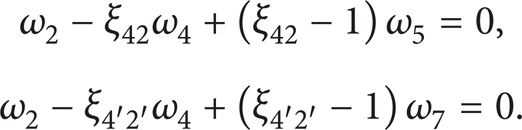
Based on (2), by eliminating the variable ω4, we get

Sun gear 2 is adjacent to input shaft (ω2 = ωin); ring gear 4 is free link, carrier 5 is fixed (ω5 = 0); carrier 7 is adjacent to the output shaft (ω7 = ωout). For the 2K–2H type planetary gear reducer, the reduction ratio (R r ) can be written as

If Z2 = 12, Z3 = 38, Z4 = 88, Z4′ = 87, and Z7 = 37, then ξ42 = – 7.333, and ξ4′2′ = – 7.25. According to (4), the 2K–2H type planetary gear reducer shown in Figure 2 (d) has ξ42 = – 7.333 and ξ4′2′ = – 7.2; its reduction ratio is R r = 726.
3.2. Examples
If Z2 = 26, Z2′′ = 28, Z3 = 21, Z4 = 72, and Z6 = 22, then ξ42 = – 2.7692, and ξ4′2′ = – 2.5714. According to (4), the 2K–2H type planetary gear reducer shown in Figure 4 (a) has ξ42 = – 2.7692 and ξ4′2′ = – 2.5714; its reduction ratio is R r = 50.
If Z2 = 27, Z2′′ = 28, Z3 = 22, Z4 = 72, and Z6 = 22, then ξ42 = – 2.6667 and ξ4′2′ = – 2.5714. According to (4), the 2K–2H type planetary gear reducer shown in Figure 4 (b) has ξ42 = – 2.6667 and ξ4′2′ = – 2.5714; its reduction ratio is R r = 100.
If Z2 = 18, Z3 = 24, Z4 = 66, Z4′ = 63, and Z6 = 21, then ξ42 = – 3.6667 and ξ4′2′ = – 3.5. According to (4), the 2K–2H type planetary gear reducer shown in Figure 4 (c) has ξ42 = – 3.6667 and ξ4′2′ = – 3.5; its reduction ratio is R r = 99.

2K–2H type planetary simple gear reducer.
4. Meshing Efficiency Analysis
4.1. Latent Power Theorem
For a planetary gear train with sun gear i, ring gear j, and carrier k, let T i , T j , and T k be the torques of members i, j, and k, respectively. Since they rotate around the same axis, according to the torque balance, we have:

Furthermore, the latent powers of sun gear i and ring gear j relative to carrier k (P i k and P j k ) are defined as


Let η ij k (η ji k ) be the meshing efficiency of planetary gear train if the latent power is transmitted from sun gear i (ring gear j), to ring gear j (sun gear i) when carrier k is relatively fixed. Based on the concept of latent power, the relationship among P i k and P j k can be expressed as


Substituting (6)-(7) into (8a)-(8b), we get


4.2. Equation of Meshing Efficiency
According to the kinematic analysis, if ξ4′2′ = ξβ < ξ42 = ξα < 0, then the reduction ratio is R r > 0. We get ω2 > ω7 > 0 > ω4.
4.2.1. 2nd Train Circuit
For the 2nd train circuit of 2K–2H type planetary gear reducer shown in Figure 3, i2 = 2′, j2 = 4′, k2 = 7, and ξ4′2′ = ξβ < 0, the relationship of angular velocity among ωi2, ωj2, and ωk2 can be expressed as

Since carrier k2 is output and ωk2 > 0, we get Tk2 < 0. According to (5), (9a), and (9b), since ξ4′2′ = ξβ < 0, we get Ti2 > 0 and Tj2 > 0. Then, based on (7) and (10), the latent powers of ring gear j2 relative to carrier k2(Pj2k2) can be expressed as

According to (8a), we have

According to the definition of train value and (9a), we have

For the 2nd train circuit, sun gear i2, ring gear j2, and carrier k2 rotate around the same axis; (5) can be rewritten as

Then, based on (13) and (14), we have
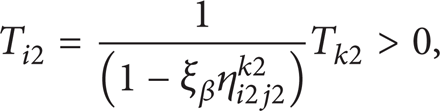

According to (10) and Ti2 > 0, Tj2 > 0, we get

Based on (17), the power flow of 2nd train circuit can be drawn as Figure 5 (b).

The power flow of 2K–2H type planetary gear reducer.
4.2.2. 1st Train Circuit
Since ring gear j1 and ring gear j2 are coupled together to be the free link, we have



For the 1st train circuit of 2K–2H type planetary gear train shown in Figure 3, i1 = 2, j1 = 4, k1 = 5, and ξ42 = ξα < 0, the relationship of angular velocity among ωi1, ωj1, and ωk1 can be expressed as

According to (20) and (21), the latent powers of ring gear j1 relative to carrier k1(Pj1k1) can be expressed as

According to the definition of train value and (9b), we have
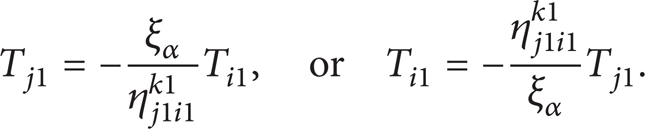
Based on (16), (20), and (23), we get
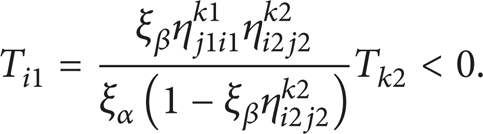
According to (15) and (24), the input torque Tin = Ti1 + Ti2 can be expressed as

Based on (25), the meshing efficiency of the 2K–2H type planetary gear reducer can be obtained as

For the gear manufacturing, if the gears are manufactured by shaving, the meshing efficiency of external (internal) gear pair is 0.98 (0.99). And if the gears are manufactured by grinding, the meshing efficiency of external (internal) gear pair is 0.99 (0.995). The relative meshing efficiencies η ij k and η ji k can be regarded equal to 0.98 × 0.99 = 0.9702 (0.99 × 0.995 = 0.985). Then, based on (4) and (26), the 3D drawing among ξ42 (ξα), R r , and η m can be expressed as in Figure 6. For specified reduction ratio (e.g., R r = 50 and 100), the meshing efficiency between ξ42 (ξα) and η m can be expressed as in Figure 7.

The 3D drawing of meshing efficiency of 2K–2H type planetary gear reducer.

The meshing efficiency of 2K–2H type planetary gear reducer.
Example 1 (Figure 4 (a), R r = 50). Figure 4 (a) shows a 2K–2H type planetary gear reducer with ξ42 = ξα = – 2.7692 and ξ4′2′ = ξβ = – 2.5714; according to (4), its reduction ratio is R r = 50.
If η246 = η2′4′6 = 0.9702, based on Figure 7 (a), its meshing efficiency is η m = 55.50%.
If η246 = η2′4′6 = 0.9850, based on Figure 7 (a), its meshing efficiency is η m = 71.32%.
Example 2 (Figure 4 (b), R r = 100). Figure 4 (b) shows a 2K–2H type planetary gear reducer with ξ42 = ξα = – 2.6667 and ξ4′2′ = ξβ = – 2.5714; according to (4), its reduction ratio is R r = 100.
If η246 = η2′4′6 = 0.9702, based on Figure 7 (b), its meshing efficiency is η m = 37.84%.
If η246 = η2′4′6 = 0.9850, based on Figure 7 (b), its meshing efficiency is η m = 54.82%.
Example 3 (Figure 4 (c), R r = 99). Figure 4 (c) shows a 2K–2H type planetary gear reducer with ξ42 = ξα = – 3.6667 and ξ4′2′ = ξβ = – 3.5; according to (4), its reduction ratio is R r = 99.
If η246 = η2′4′6 = 0.9702, based on (4) and (26), its meshing efficiency is η m = 43.74%.
If η246 = η2′4′6 = 0.9850, based on (4) and (26), its meshing efficiency is η m = 60.80%.
The meshing efficiency of 2K–2H type planetary gear reducer with R r = 100 (Figure 4 (b)) is less than 2K–2H type planetary gear reducer with R r = 99 (Figure 4 (c)). Hence, when we design the 2K–2H type planetary gear reducer, we must choose the larger |ξ42|(|ξα|) as possible. Based on the above reasoning, we conclude the following.
There is a power circulation in 2K–2H planetary gear reducer.
Basically, larger reduction ratio makes less meshing efficiency.
For the same reduction ratio, larger value |ξ42|(|ξα|) will get better meshing efficiency.
The efficiency of gears manufactured by grinding is only improved by 1.5% (from 97.02% to 98.5%). However, the meshing efficiency of 2K–2H type planetary gear reducer is improved by 28%–44.8%. For 2K–2H type planetary gear reducer, the quality of gears is an important factor.
If the gears are manufactured by grinding, the meshing efficiency of external (internal) gear pair can be regarded as 0.99 (0.995) the meshing efficiency of 2K–2H type planetary gear reducer is good.
5. Summary
This paper proposes a design methodology for the 2K–2H planetary simple gear reducer. First, according to the concept of train value equation, the kinematic design of 2K–2H type planetary simple gear reducers is carried out. Three 2K–2H type planetary simple gear reducers with high reduction ratios (50, 100, and 99) are designed to illustrate the design algorithm. Then, based on the latent power theorem, the meshing efficiency equation of 2K–2H type planetary gear reducer is derived. According to the meshing efficiency equation, the meshing efficiency of 2K–2H type planetary simple gear reducer is analyzed. The 2K–2H type planetary gear reducer has the following characteristics.
There is a power circulation in 2K–2H type planetary gear reducer.
Basically, larger reduction ratio makes less meshing efficiency.
For the same reduction ratio, larger value |ξ42|(|ξα|) will get better meshing efficiency.
If the gears are manufactured by grinding, the meshing efficiency of external (internal) gear pair can be regarded as 0.99 (0.995) and the efficiency of gear pairs is only improved by 1.5% (from 97.02% to 98.5%). However, the meshing efficiency of 2K–2H type planetary gear reducer is improved by 28%–44.8%.
For 2K–2H type planetary gear reducer, the quality of gears is an important factor.
Based on the above results, 2K–2H type planetary gear reducer with better meshing efficiency can be synthesized.
Footnotes
Acknowledgment
The authors are grateful to the National Science Council of the Republic of China for the support of this research under NSC 100 2221-E-150-013 and NSC 102-2218-E-150-001.