




Abstract
In Machine-to-Machine (M2M) communications, authentication of a device is of upmost importance for applications of Internet of Things. As traditional authentication schemes always assume the presence of a person, most authentication technologies cannot be applied in machine-centric M2M context. In this paper, we make the first attempt to formally model the authentication in M2M. We first model four attacking adversaries that can formulate all possible attacks in M2M, which are channel eavesdropping attack, credential compromise attack, function compromise attack, and ghost compromise attack. Next, we propose four models to tackle those corresponding adversaries, namely, credential-based model, machine-metrics-based model, reference-based model, and witness-based model. We also illustrate several concrete attacking methods and authentication approaches. We proof the authentication security for all proposed models and compare them for clarity. Our models present soundness and completeness in terms of authentication security, which can guide the design and analysis of concrete authentication protocols. Particularly, we construct a uniform authentication framework for M2M context and point out all possible authentication mechanisms in M2M.
1. Introduction
Machine-to-Machine (M2M) communication is a typical communication fashion in the Internet of Things (IoT). It has been envisioned as one of the most promising Internet-accessing approaches in the IoT for long-distance remote devices. M2M networking interface enables wide area communications for mobile or static devices, so that it is quit convenient and easy to deploy remote devices rapidly. M2M thus becomes a typical communication method for most IoT applications such as remote environmental sensing, long-distance controlling, moving object locating, and tracing. Besides, M2M communication further incorporates various novel applications such as smart grid [1], tele-medicine [2], and smart vehicles [3].
As remote devices are always located faraway in unattended or malicious environments, it is very likely that the devices may be hacked by attackers. For example, the software system in devices may be injected or infected by certain malicious codes, which may modify or fabricate forthcoming outgoing data. Moreover, the devices may perform arbitrary (Byzantine) misbehavior after being compromised. Thus, the data sent by remote sensing devices must be authenticated. Otherwise, remote receivers in the other end will receive a lot of garbage information and consequently respond falsely.
We note that the authentication in M2M context is quite different from traditional authentication. Roughly speaking, traditional authentication usually assume the entity being authenticated is a person, or human is involved in authentication procedures. Simply speaking, the authentication methods usually rely on three aspects: “what you know, what you have, and who you are.” As the entity authentication in M2M is not a person, the traditional methods such as “what you know and who you are” may not be applied. For example, password-based authentication (by manually inputting password) cannot be applied in M2M context. The biometric-based authentication such as fingerprint recognition cannot be applied in M2M context neither.
Furthermore, traditional authentication methods for wireless sensor networks (WSNs) may not be able to smoothly migrate to M2M situations. That is, the authentication methods in WSNs usually rely on certain secrete credentials in cryptographic building blocks, for example, secrete keys for symmetric key encryptions, or private keys for digital signatures. Those secrete credentials are stored in devices or chips attached to devices (e.g., smart cards). However, such an authentication method still cannot defend against all aforementioned attacks. For example, when devices are compromised, those credentials will be revealed by attackers, by hacking the devices or injecting malicious codes. It again shows the distinction between M2M authentication and person-based authentication where entities (i.e., persons) usually are assumed uncompromising.
Therefore, the entity authentication in M2M context must be reconsidered and reinspected. We also need to explore the tailored authentication methods in M2M context, to guarantee a stronger authentication (that will be formally defined later), in case the devices are compromised and credentials are exposed. Besides, the formal models for authentication are appealing, as the formal models can guarantee the security strength and clarify the core part out from various application details. Unfortunately, such problem has not been explored thoroughly until now, to the best of our knowledge.
Currently, although several related works start to concentrate on M2M security problems [4–8], the strong authentication methods in M2M have not been thoroughly explored yet [9–13]. In this paper, we make the first attempt to figure out the abstract models for M2M context. We adapt a formal and rigorous method used in modern or theoretic cryptography, to strictly state, present, and analyze the security of authentication. More specifically, we firstly formulate attack models regarding to device compromising in M2M context by using interactive Turing machine. We next categorize the classifications in M2M authentication and their security specification. Finally, we propose several abstract authentication models to address different attacking patterns and proof their security. All our presentations strictly follow the formal expressions for better clarity and rigorous generality.
The contributions of the paper are listed as follows: (1) we strictly formulate the possible attacks and adversaries in M2M, which facilities to clearly locate the security fragile point. For example, we point out credential compromising attack, function compromising attack, and ghost compromising attack; (2) we formulate the general and abstract authentication models with provable security in M2M context, which figures out the fundamental characteristics of all possible authentication methods in M2M to guide the further design and security analysis in practices; (3) we point out several concrete attacking methods and propose corresponding authentication approaches to illustrate our models.
The rest of the paper is organized as follows. In Section 2, we discuss the basic assumption and models used throughout the paper. Section 3 provides the detailed description of our proposed models and analysis. Section 4 gives an overview on relevant prior work. Finally, Section 5 concludes the paper.
2. Problem Formulation
2.1. Network Model
In most M2M communications, there exists two major entities: devices, denoted as
Functional module, denoted as Credential module, denoted as
In this paper, we focus on above typical fashion in M2M communications—from devices to central servers. It is without loss of generality, because communications between devices and devices far away in M2M are usually relayed by a central server. As the devices are equipped with wide area communication capabilities, multihop M2M relay within remote devices rarely happen. The relay is usually unnecessary, as the devices can upload reports directly to central servers.
Even though multihop relay between devices happens, it is usually local area wireless communication such as wireless personal area network (WPAN), for example, Zigbee, or wireless local area network. That is, the reasonable architecture has two tiers: the communication between devices and gateways is WPAN, but the communication between gateways and a central server is M2M. In this case, the authentication of devices in the former tier has been explored in WSN communities and previous solutions can be migrated; the authentication of gateways in the latter tier is our focus. That is, in this scenario, we look on gateways as devices in our discussion.
In addition, no matter in which kind of authentication scenarios, we always assume the peer who authenticates (i.e., verifier) is trusted or secure. It is a baseline for the further meaningful discussion. We thus focus on the peer being authenticated (i.e., prover), which is a device in M2M scenarios. That is, how to authenticate a device in M2M.
2.2. Attack Model
It is required to consider the situation that devices may be compromised, as the devices may be always located in unattended environments. From the viewpoint of security strength, such assumption for the existence of stronger adversary will result in stronger security guarantee, which is mandatory for certain critical applications, such as gas emission monitoring and back-bone smart grid. According to the modeling of networks and devices, we classify the attack models into four folders as follows.
Channel eavesdropping attack, denoted as Credential Compromising Attack, denoted as Function compromising attack, denoted as Ghost compromising attack, denoted as
Note that, the
2.3. Security Definition
Roughly speaking, the secure authentication in this paper is defined as the interactive proof between two probabilistic polynomial interactive Turing machine (ITM) [14].
The ITM being authenticated is called Prover (denoted as 𝒫); the ITM authenticating Prover is called Verifier (denoted as 𝒱). The 𝒫 and 𝒱 both have one outgoing communication tape, one incoming communication tape, one input computing tape, one output computing tape, and one inner working tape. They also have other auxiliary tapes for interaction and security: one identity tape, one security parameter tape, one random tape, and one-bit activation tape. In this paper, the outgoing communication tape of 𝒫 is the same with the incoming communication tape of 𝒱. For simplicity, this tape is called interaction tape, denoted as
The adversary (denoted as In In In In
As we have already stated, 𝒱 needs to be secure (or honest) in authentication semantics.
Environmental ITM (denoted as 𝒵) exists. 𝒵 can read and write input tapes of 𝒫 and 𝒱. The protocol result is the output of 𝒵.
The one interaction between 𝒫 and 𝒱 can be modeled as follows.
𝒫 writes outgoing communication tape 𝒱 reads incoming communication tape
The sequence can be interchangeable. The times of interaction may be more than once.
Next, we state the definition of authentication and its security as follows:
Definition 1 (Authentication).
From the transcripts on tape
Definition 2.
Security of Authentication of Protocol Π in the presence of adversary 𝒜. From
Define attack experiment run protocol Π in the presence of adversary 𝒜, where 𝒫 and 𝒱 are both ITM with security parameter n; 𝒱 witnesses 𝒜 tampered transcripts on tape if and only if 𝒱 output 1, the experiment output 1.
Definition 3.
Authentication protocol Π is secure, if for any ITM adversary 𝒜, it exists a negligible function

Indeed, authentication can be further divided into two types: entity authentication and message authentication. Entity authentication is the concentration in this paper. Message authentication is however usually required also in communication context and can be attained with entity authentication together. We thus later do not explicitly split those two.
Definition 4 (Entity Authentication (Message Source Authentication)).
From
Definition 5 (Message Authentication (Message Integrity Authentication)).
From
We can similarly define the attack experiment and corresponding security for entity authentication and message authentication.
3. Proposed Authentication Models
In this section, we propose a family of models to solve the authentication problem in M2M context.
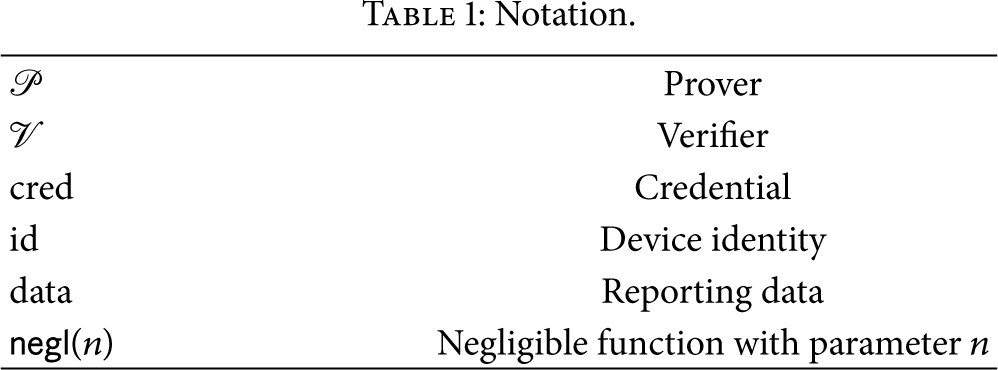
We list all major notations used in the remainder of the paper in Table 1.
Notation.
3.1. Defending Channel Eavesdropping Attack: Credential-Based Model (CBM)
To defend 
(1) One-wayness. From 
(2) Second-Preimage Resistance. Without 
Certainly,
Credential-based model can be further divided into two folders: one credential-based model and multicredential-based model. As it is named, multicredential-based model use multiple credentials in each
For only guaranteeing the entity authentication,
Analysis
Definition 6 (Soundness).
The designed protocol can guarantee the required security. That is, the designed protocol is the sufficient condition of the required security.
Definition 7 (Completeness).
The required security needs the designed protocol to guarantee. That is, the designed protocol is the necessary condition of the required security.
Proposition 8.
Credential-based model 
Proof.
It can be proofed by similar methods in Universally Composable security [14]; hereby only sketch is given. The security of the proposed model is guaranteed by the security of
In other words, if environmental machine can distinguish the reality model and the ideal model, a new adversary can be created to subvert a certain security assumption by revoking the environmental machine as a subfunction. In the ideal function,
Proposition 9.
Credential-based model has completeness for defending Channel Eavesdropping Attack.
Proof.
The proof has two folders: the credential is required; the credential is presented properly. On the one hand, as devices need to distinguish themselves with others, they need to show their secretly possessed knowledge—credential—to proof their identity. Thus, there must exist a credential in the tuples in
Besides, multicredential-based model is securer than one credential-based model. That is, the exposure of one credential by eavesdropping adversary
Definition 10 (Forward Authentication Security).
That is, if current credential is exposed by eavesdropping adversary
Proposition 11.
In
Proof.
By using one-way function f,
Proposition 12.
Credential-based model 
Proof (Straightforward).
The authentication security of credential-based model relies on the secrecy of credentials. The presence of
3.2. Defending Credential Compromising Attack: Machine-Metrics Based Model (MBM)
If the attack model is strengthened to
For simple illustration of
Definition 13 (Credential Relocation Attack).
It is an attack that the credentials are relocated to anther device. Although the received
To tackle the 
If we look
Machine-metrics based model can be further divided into two folders: one Machine-Metrics based model and multiple Machine-Metrics based model. As it is named, multiple Machine-Metrics based model use multiple
For only guaranteeing the entity authentication,
Analysis
Proposition 14.
Machine-Metrics based model
Proof.
As the function module is secure, adversary cannot compute
Proposition 15.
Machine-Metrics based Model has completeness for defending Credential Compromising Attack.
Proof.
The proof can be reduced to the proof of Proposition 9. Concretely, the proof has two folders: a new credential is required; the new credential is presented properly. On the one hand, as devices need to distinguish themselves with others, they need to show their secretly possessed knowledge—credential—to proof their identity. As the credential module can be compromised, the credential must come from the functional module. Thus, there must exist a credential in the tuples in
Similarly, multiple Machine-Metrics based model is securer than one Machine-Metrics based model. The discussion is similar to the one in the previous section. In summary, Machine-Metrics based model can be looked as an analog of biometric-based authentication for human.
Proposition 16.
Machine-Metrics based model 
Proof (Straightforward).
The authentication security of Machine-Metrics based model relies on the secure computation of
We give three special illustrations on Machine-Metrics based model for defending
Definition 17 (Computation-Based Authentication).
Each time 𝒱 sends a one-time random computational puzzle, 𝒫 counts the computation duration time in microsecond or Central Process Unit (CPU) cycles as the result of
Example 18.
𝒱 sends a computational puzzle
Definition 19 (Location-Based Authentication).
𝒱 sends an one-time random location puzzle. 𝒫 returns computed location values. 𝒱 verifies the location characteristic of 𝒫. That is,
Example 20.
𝒱 sends an one-time random location puzzle: the distance from 𝒫 to a randomly chosen point. 𝒫 computes the distance value according to its location values such as global positions and latitudes, as the location characteristic, in other words, the returning result of
Similarly, we can further define authentication methods by requesting other physical characteristics such as memory size, hardware fingerprints. Note that such kind of requesting must be fresh and generated at real time.
3.3. Defending Function Compromising Attack: Reference-Based Model (RBM)
If the attack model is strengthened to
To illustrate
Definition 21 (Characteristic Replication Attack).
The set
Definition 22 (Data Pollution Attack).
Data is polluted by attackers, although the credential is valid to make the data being authenticated. That is,
To tackle the
The reference-based model is described as follows:

We give two special illustration on reference-based model in the following.
Definition 23 (History-Based Authentication).
The authenticator 𝒱 verifies the history behaviors (e.g., data) to authenticate the trustworthiness of current behavior of 𝒫, for example, the trustworthiness of
Example 24.
Suppose the history set is S, which consists of n values. That is, 
Definition 25 (Neighbor-Based Authentication).
The authenticator 𝒱 verifies the other 𝒫's behaviors (e.g., neighbors' reporting data) to authenticate the trustworthiness of current behavior of 𝒫, for example, the trustworthiness of
Example 26.
Similar to above example, suppose the neighbor set is S, which consists of n values. That is, 
In the neighbor-based authentication, the reference set S may not be always trustworthy. That is, the values in S may come from other 𝒫s that are untrustworthy. To deal with this issue, we propose extra two methods in the following.
Definition 27 (Trustworthy Stunt Authentication).
The S is from other trustworthy 𝒫s that are predeployed. That is, the authenticator 𝒱 verifies the trusted stunt's report (e.g., data) to authenticate the trustworthiness of current behavior of 𝒫, for example, the trustworthiness of
Definition 28 (Threshold Stunt Authentication).
Suppose there exists at least α nodes in S that are trustworthy (i.e., not compromised) in neighbor-based authentication. Simply speaking, the verification function can be designed as follows: select the median
Analysis
Proposition 29.
Reference-based model 
Proof.
The message source authentication is guaranteed by Proposition 8. The message integrity authentication is roughly guaranteed by history-based authentication and neighbor-based authentication in reference-based model. It proofs the soundness of reference-based model.
Proposition 30.
Reference-based Model has completeness for defending Function Compromising Attack.
Proof.
As functional module can be compromised by
Proposition 31.
Reference-based model 
Proof (Straightforward).
As the credential module can be compromised in
3.4. Defending Ghost Compromising Attack: Witness-Based Model (WBM)
If the adversary has the most powerful strength, namely, the
Proposition 32.
Proof (Straightforward).
As the credential module and functional module can both be compromised, any security enhancement will be also compromised. Thus,
To tackle the
Suppose environmental characteristics consist of n components. That is, 
We give an illustration for the witness-based authentication in the following.
Definition 33 (Contamination-Based Authentication).
The authentication is provided by witness from other trustworthy peers in different channels.
Example 34.
The authenticator 𝒱 verifies whether 𝒫 is touched or moved via the observation of protection lock or surveillance video camera. For example,
Analysis
Proposition 35.
Witness-based model 
Proof (Sketch).
As the proof of authentication relies on the witness from others who are not compromised, the authentication security can be guaranteed. It proofs the soundness of witness-based model.
Proposition 36.
Witness-based Model has completeness for defending Ghost Compromising Attack.
Proof (Sketch).
As the 𝒫 can be totally compromised, the security enhancement for authentication must come from other trustworthy entities.
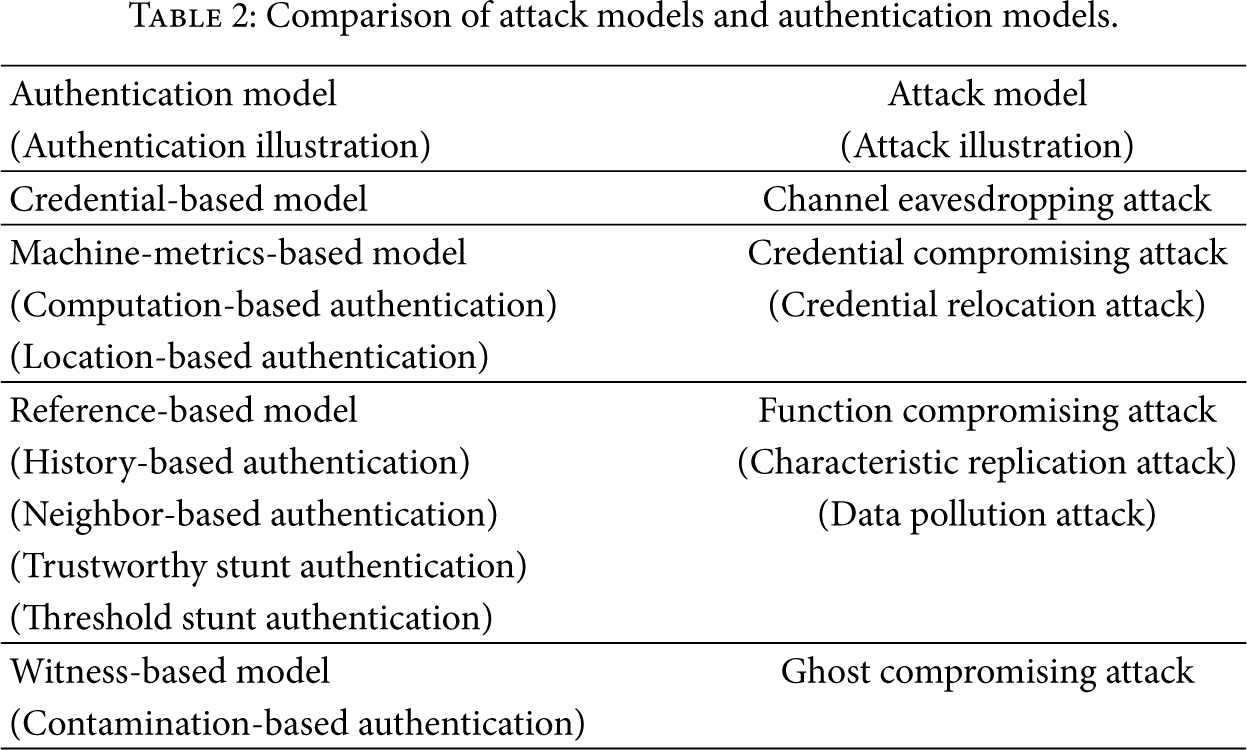
Comparison. The security comparison of proposed models is compared and summarized in Tables 2 and 3.
Comparison of attack models and authentication models.
Security comparison of models.

4. Related Work
Security of M2M communications starts to attract more and more attentions [4, 5, 7, 8], but solutions for authentication in M2M context have not been thoroughly explored. Especially, the formal authentication models for M2M have been rarely discussed. In this paper, we made the first attempt in this regard. Zhang et al. [12] provided a practical group-based authentication for Machine Type Communication (MTC) scenario. Each device shares a secret key with home environment, and a group secret key with other devices in the same group. Their discussion focused on roaming cellular networks and human may be involved. He [10] proposed to use machine's fingerprint and encryption technique to conduct remote register authentication of software to prevent unauthorized use. It focused on software copyright safeguard. Lu et al. [5] first pointed out the reliability and security requirements in M2M communications. Many other works addressed security problems in smart grid scenarios, which may be related to M2M communications. For example, Fadlullah et al. [15] studied the detection of malicious activities in smart grid communication and proposed an early warning system. Bartoli et al. [16] studied secure aggregation in smart grid M2M networks. They included the security design in the physical layer and MAC layer. Saied et al. [8] proposed a key establishment solution for heterogeneous M2M communications. Other works explored the security in a broader domain—IoT, which is relevant to M2M. For example, Alam et al. [17] studied the interoperability in security attributes between different administrative domains in IoT. They proposed a layered architecture of IoT framework. As the M2M is still undergoing development, several works studied M2M standards [6, 18–20]. For example, Bartoli et al. [6] reviewed the current undergoing standards for M2M communications.
5. Conclusions
In this paper, we made the first attempt to propose a family of formal models to authenticate devices in M2M context. We first modeled four attacking adversaries that can include all possible attacks in M2M. Next, we proposed four models to tackle corresponding adversaries. We also illustrated several concrete attacking methods and authentication approaches. We proofed the authentication security for all proposed models and compared them for clarity. Our models presented soundness and completeness with respect to necessary and sufficient conditions for authentication security, which can guide the design and analysis of concrete authentication protocols. Especially, we constructed a uniform authentication framework for possible various authentication approaches. Our model also pointed out all possible authentication mechanisms or sufficient solutions for authentications in M2M.
Footnotes
Acknowledgments
This research was financially supported by National Natural Science Foundation of China (no. 61170217), the Open Research Fund from Shandong provincial Key Laboratory of Computer Network (no. SDKLCN-2011-01), and Fundamental Research Funds for the Central Universities, China University of Geosciences (Wuhan) (nos. 110109 and 090109).