




Abstract
Numerical investigation of free convection heat transfer in a differentially heated trapezoidal cavity filled with non-Newtonian Power-law fluid has been performed in this study. The left inclined surface is uniformly heated whereas the right inclined surface is maintained as uniformly cooled. The top and bottom surfaces are kept adiabatic with initially quiescent fluid inside the enclosure. Finite-volume-based commercial software FLUENT 14.5 is used to solve the governing equations. Dependency of various flow parameters of fluid flow and heat transfer is analyzed including Rayleigh number (Ra) ranging from 105 to 107, Prandtl number (Pr) from 100 to 10,000, and power-law index (n) from 0.6 to 1.4. Outcomes have been reported in terms of isotherms, streamlines, and local Nusselt number for various Ra, Pr, n, and inclined angles. Grid sensitivity analysis is performed and numerically obtained results have been compared with those results available in the literature and were in good agreement.
1. Introduction
Rectangular enclosures with differentially heated vertical sidewalls are of great importance to many fields of studies in heat transfer phenomena such as natural convection. It is one of the most widely investigated configurations because of its prime importance as a benchmark geometry to study convection effects and compare numerical techniques. Additionally, the geometry has many applications in different industrial techniques and equipments such as solar collectors, food preservation, compact heat exchangers, and electronic cooling systems among other practical applications. As a consequence of these applications, a thorough literature exists in this field of study especially in the case of Newtonian fluids [1–4].
Natural convection laminar flow of non-Newtonian Power-law fluids performs an important role in various engineering applications which are related to pseudoplastic fluids. It should be noted that the pseudoplastic fluid is characterized by apparent viscosity or that consistency decreases instantaneously with an increase in shear rate. The study of fluid flow and heat transfer related to Power-law non-Newtonian fluids has attracted many researchers in the past half-century. An excellent research on pseudoplastic fluid was conducted by Boger [5]. At first, boundary-layer flows for such non-Newtonian fluids were investigated by Acrivos [6]. Since then, a large number of literatures are created due to their wide relevance to pseudoplastic fluids like chemicals, foods, polymers, molten plastics, and petroleum production and various natural phenomena.
It is important to be noted that most of fluids employed in chemical and petrochemical processes or many other industries seems to show non-Newtonian behavior. The natural convection of a non-Newtonian fluid over enclosures such as a cylindrical enclosure or a heated plate has received more attention [7–14]. Several methodologies including analytical [7], numerical [8], and experimental [9] approaches have been employed in most of these studies, and the results indicated that the free convection features are considerably affected by the rheological properties of the fluid. However, the crucial issue of the buoyant convective process in various other geometries/enclosures of a non-Newtonian fluid has remained largely unexplored.
Kim et al. [15] studied unsteady buoyant convection of a non-Newtonian Power-law fluid within a square enclosure. The authors used the finite volume technique realizing that the rheological properties have a considerable effect on the transient process. Additionally, the numerical solutions had an extensive qualitative agreement with the descriptions obtained from the scale analysis. Following their study, steady-state analysis is performed in this study for a trapezoidal configuration of Non-Newtonian fluid. We have performed parametric studies by varying angle of the inclined surfaces, Rayleigh number, Prandtl number, and Power-law index.
2. Mathematical Formulation
Consider a two-dimensional trapezoidal enclosure of length (base) and height H, which is filled with an incompressible Power-law non-Newtonian fluid. Figure 1 displays the enclosure with top and bottom insulated walls. The left inclined wall is heated and the right inclined wall is cooled with constant temperature. With invocation of Boussinesq's approximation, governing equations take the form as below:


where (u, v) represent velocity components in the horizontal x and vertical y directions; T represents the temperature; p represents the pressure; g represents the gravitational acceleration; and ρ, β, and α represent the density, thermal expansion coefficient, and thermal diffusivity of the fluid at reference temperature T0. The related boundary conditions are




Dimensionless forms of (1)–(4) can be obtained in the following fashion:

The crucial part of the formulation is to assign a suitable fundamental equation, which relates definite components of stress tensor to the relevant kinematics variables. For this purpose, a purely viscous Power-law non-Newtonian fluid is assumed, which follows the Ostwald-De Waele Power-law [7–9]:

In the above, two material parameters are involved, that is, K, the consistency factor and n, the Power-law index, and D ij represents the rate of deformation tensor. Apparently, n = 1 corresponds to those fluids of Newtonian behavior with the coefficient of viscosity K, whereas n > 1 indicates the dilatant (or shear thickening) behavior and n < 1 shows pseudoplastic (or shear thinning) behavior of a non-Newtonian fluid. The pseudoplastic fluids have generally a high viscosity, and thermal variation of viscosity has also a direct effect on the thermal and flow fields. In the present setup, the dependency of K on temperature is not assumed; a small temperature difference, ΔT, is assumed.

Schematic of the cavity and the coordinate systems.
D ij is simplified to the following equation for the two-dimensional Cartesian coordinates:

From (7) and (8), we get (9) for apparent viscosity [11]:

Obviously, for n = 1, K represents the conventional viscosity. However, for nonunit n, non-Newtonian behavior, complex dependence of viscosity on fluid's property, and velocity components gradients are diagnosed. Based on the physical rationalizations and trial-and-error efforts, a grouping, which consists of the consistency coefficient K, the Power-law index n, the fluid density ρ0, and the cavity height H, emerges to be appropriate [9]:

It is important to be noted that application of ν′, which is in dimension of m2s−1, is analogous to that of kinematics viscosity of Newtonian fluids. Using (10), Prandtl number and Rayleigh number are defined, respectively, as below [12]:

It is of great interest for many researchers to investigate local Nu of hot wall in many thermal systems. Similarly, local Nu is studied for left hot inclined wall which is defined as follows:
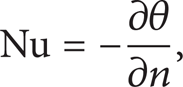
where ndenotes the normal direction on left-side plane.
3. Numerical Procedure
Finite-volume-based code is used to discretize and solve the coupled set of equations (1)–(4) employing commercial software Ansys FLUENT 14.5. In this framework, QUICK scheme was used for convective terms and SIMPLE algorithm was employed for the coupling of the pressure and velocity. Convergence criteria were set to 10−5 for all relative residuals.
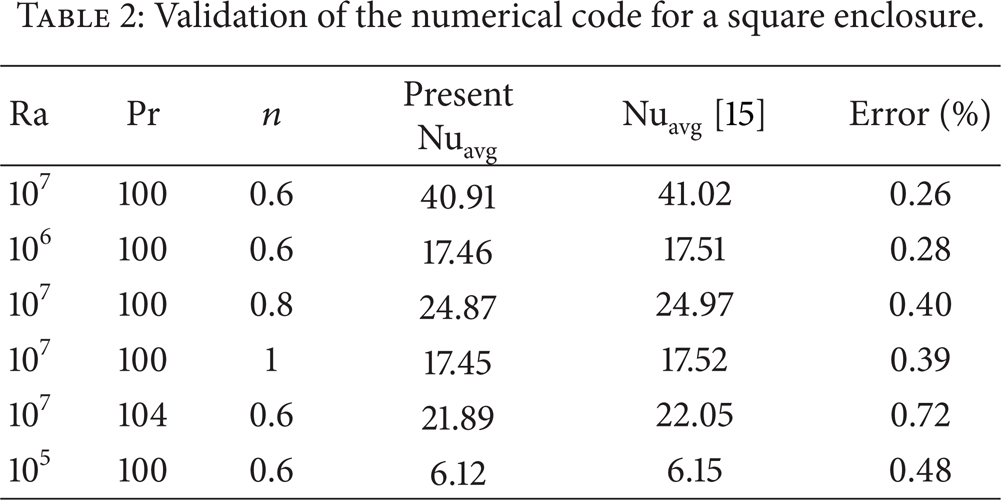
A grid of 81 × 81 has been required for obtaining acceptable results, as shown in Table 1; a refinement to 101 × 101 leads to a maximum difference of 2.04% and 0.35% in terms of maximum stream function (ψ Max ) and average (Nuavg) for Pr = 100 of a square enclosure. As an additional check of the results' accuracy, the present solution has been validated against the Benchmark solutions obtained, in the case of the classical Newtonian fluids and non-Newtonian fluids in a square enclosure. Nusselt numbers of some certain cases are compared in Table 2.
Preliminary tests on the grid size effect (Ra = 105, Pr = 100, andφ = 0).

Validation of the numerical code for a square enclosure.
4. Results and Discussion
In this section, the results correspond to the influence of important parameters, namely, inclination angle (0 ≤ φ ≤ 60), Power-law index (0.6 ≤ n ≤ 1.4), Rayleigh number (104 ≤ Ra ≤ 106), and Prandtl number (100 ≤ Pr ≤ 10,000), on heat transfer and fluid flow. The results are presented in the form of local Nusselt number, isotherm, and stream function for the above parameters. Figure 2 illustrates isotherms and streamlines of various angles for trapezoidal enclosure of Ra = 105, Pr = 100, and n = 1. As expected due to presence of hot and cold walls, fluid rises up from bottom horizontal edge, adjacent to the hot inclined wall and flows up along it reaching the top horizontal edge. Then, the fluid flows down beside the oblique cold wall forming a roll with clockwise rotation inside the cavity. By the increase of angle, horizontal isotherms occupy much area of the enclosure. Also the formed roll is elongated toward the side walls by the increment of trapezoidal angle. Figure 3 indicates local Nu of hot wall for three angles of Pr = 100, Ra = 105, and n = 1. For square enclosure (φ = 0), local Nu has a maximum value of nearly 14 at the top end of hot inclined side wall. By tilting the angle to 30°, maximum Nu is reduced to almost 8 and its position is near top end again. By further increase in angle value (φ = 60), Nu value is reduced more and many positions may be regarded to have maximum Nu of nearly 2. It is concluded that by the increment of trapezoidal angle, average Nu is reduced and this may be attributed to the increase of mean distance between two differentially heated inclined side walls.

Isotherms (left) and streamlines (right) for different inclination when Ra = 105, Pr = 100, and n = 1.

Local Nu for 3 different angles of Pr = 100, n = 1, and Ra = 105.
Figure 4 displays isotherms and streamlines of distinct Power-law index n, from 0.6 to 1.4 for Pr = 100, Ra = 105, and φ = 30. When shear thinning behavior is converted to the shear thickening behavior by the increment of Power-law index, maximum stream function is reduced from nearly 0.3 kg/s to 9.3 × 10⁻⁶ kg/s. This reveals that for n > 1, fluid gradually rises up to the top edge and we would expect lower Nu for n > 1 with respect to those n < 1. Isotherm lines show that the intrusion of fluid at top and bottom edges is thickened by the increment of Power-law index. This fact shows that much part of fluid inside the enclosure is expressed for the case of higher n. Local Nu is displayed in Figure 5 for different n of Pr = 100, Ra = 106, and φ = 30. Shear thinning fluid has a larger value of maximum Nu than that of shear thickening fluid. This maximum value is located near top edge of sloped hot wall for all n.

: Isotherms (left) and streamlines (right) for different n when Ra = 106, Pr = 100, and φ = 30°.

Local Nu for different n when Pr = 100, φ = 30, and Ra = 106.
Figure 6 represents isotherms and stream functions of different Ra for Pr = 100, n = 1, and φ = 30. Stream lines reveal that for Ra = 104 a clockwise roll is formed within the enclosure and with the increase of Ra; this roll is extruded and elongated toward the side walls generating two small rolls. Also maximum stream function is increased from 0.0022 kg/s for Ra = 104 to 0.01 kg/s for Ra = 106. It is clear that larger value of Ra results in higher Nu due to the higher rate of heat transfer from hot wall to the cold wall and Figure 7 reveals this fact for Pr = 100, n = 1, and φ = 30. The Pr effect on flow behavior is also investigated. Note that the values of Pr are much larger than unity for non-Newtonian fluids and it has been shown that an increase of this parameter makes the contribution of convective terms in (4) negligible [15], but to have better insight into the fluid flow, we present numerical results of distinct Pr. Figure 8 displays isotherms and streamlines of fluid for different Pr of Ra = 105, n = 1, and φ = 30. There exists negligible difference of isotherms and stream functions. Stream function for Pr = 100 is reduced from 0.0052 kg/s to 5.2 × 10⁻⁵ kg/s for Pr = 10,000. Note that Nu never changes as the Power-law index is unity for different Pr [15].

Isotherms (left) and streamlines (right) for different Ra when n = 1, Pr = 100, and φ = 30.

Local Nu for different Ra when Pr = 100, φ = 30, and n = 1.

Isotherms (left) and streamlines (right) for different Pr when n = 1, Ra = 105, and φ = 30.
5. Conclusions
A numerical study has been performed on steady natural convection of non-Newtonian fluids within a trapezoidal cavity with differentially heated walls. The main objective of the present work was to observe the influence of parameters, namely, Power-law index, trapezoidal angle, and Pr and Ra in terms of isotherms, streamlines, and local Nusselt number. Main outcomes of the study are as follows.
By the increase of trapezoidal angle, the formed roll within the enclosure is elongated and extruded toward the side walls. Additionally maximum Nu on left hot wall is reduced by the increase of trapezoidal angle.
Shear thinning behavior of the working fluid has higher Nu value than that of shear thickening. This may be attributed to the lower maximum stream function of higher Pr.
Increment of Ra enhances local Nu and makes the generated roll at the core of enclosure extruded to the side walls.
Pr variation has not significant effect on Nu as most non-Newtonian fluids contain higher values of Pr. Also maximum stream function is reduced by the increase of Pr.