




Abstract
Many existing routing protocols in Mobile Ad hoc Networks (MANETs) focus on finding paths in dynamic networks without considering security. In this paper, we propose a trust model which evaluates neighbours' direct trust by factors of encounter time, mobility, and successful cooperation frequency. The revised D-S evidence theory is used to combine multiple recommended pieces of evidence and obtain the recommended trust value. Then based on the novel trust mechanism, we propose a trusted routing protocol named TDS-AODV protocol by extending the AODV protocol. In this protocol, a node makes a routing decision according to the trust values of its neighbour nodes. Finally, two routes are built: the main route with highest route trust value in the candidate routes and a backup route. Simulation results reveal that TDS-AODV can eliminate malicious nodes effectively when building the route; furthermore, it also achieves better performance than TAODV and AODV in terms of throughput, packet delivery ratio, and average end to end delay.
1. Introduction
The past decade has witnessed tremendous research efforts devoted to Mobile Ad hoc Networks (MANETs). MANETs are temporary autonomous systems with the special characteristics of dynamic network topology, limited computational abilities, and continuously changing scale. Due to its flexibility, a MANET is attractive for applications, such as disaster relief, military service, and robot networks [1]. However, this flexibility also causes security problems. Routing security is one of the challenging issues in current research.
Traditional MANET routing protocols, such as destination-sequenced distance vector routing (DSDV) [2], dynamic source routing (DSR) [3], and ad hoc on-demand distance vector routing (AODV) [4], assume that all nodes in the network work in a benevolent manner and no predefined trust exists between communication partners. However, the fact is that malicious behavior among nodes exists; for example, selfish nodes deny relaying the packets of other nodes, and malicious nodes perform impersonation, fabrication, or modification attacks against the network traffic [5]. Hence, it is necessary to incorporate security mechanisms into MANET routing protocols to mitigate the impairment from malicious nodes. However, the security mechanism basing on the traditional cryptosystem is used to resist external attacks, but it cannot effectively solve the internal attacks by malicious nodes [6]. Therefore, the trust mechanism which is considered to be an effective measure to solve those questions has recently been studied.
In our trust mechanism, the successful cooperation frequency factor is considered in direct trust evaluation to guarantee the security of network. It is calculated according to its accumulated observations using the Bayesian inference which adopts Beta distribution. Unlike most trust mechanisms [7–12] that focus on trust evaluation without considering performance of the network, we take other two factors (factors of encounter time and mobility) into account. A good network performance can help save nodes' limited resources and prolong the network lifetime, which is very important in MANET. The network topology in MANET is dynamic; hence, the next hop of a node may not be its next hop the next moment. To create a relatively stable network topology as much as possible, we propose two factors, nodes' average encounter time and mobility, when calculating nodes' direct trust value. The two factors make the trust mechanism more suitable for resource-restricted MANET. D-S evidence theory, which was first introduced by statistician of Dempster [13] and extended by Shafer [14], is used to calculate direct trust value, integrate indirect evidence, and obtain the overall trust value. We choose D-S evidence here because it does well in dealing with the uncertainty of trust value.
Based on the novel trust mechanism, we put forward a trusted routing protocol, by extending the AODV protocol in MANETs, TDS-AODV for short. In this protocol, a node evaluates its neighbours' trust value according to the trust model and selects reliable nodes as its next-hop nodes. A source can establish multiple reliable paths to a destination in one route discovery process. We consider the number of hops as well as the trust value of paths to the destination. A destination will respond with three shortest paths as candidates and the path trust will be calculated during the process of Route Reply (
The rest of this paper is organized as follows. Section 2 summarizes the related work on trust evaluation and trust-based routing protocols. Section 3 presents the novel trust evaluation mechanism. Section 4 describes TDS-AODV in detail. Section 5 provides the simulation studies. Finally, we conclude this paper in Section 6.
2. Related Works
Researchers are becoming more and more interested in integrating trust into a MANET and have proposed numerous works. In this section, we first focus our attention on trust evaluation models in MANETs and then discuss the trust based routing protocols in MANETs.
2.1. Trust Evaluation
Peng et al. [7] assessed the subjective trust of nodes through the Bayesian method, but they were not able to detect dishonest recommendations. Zouridaki et al. [8] chose to determine the node trustworthiness with respect to reliable packet forwarding by combining first-hand trust and second-hand trust information. However, the trust calculation in unsupervised ad hoc environment involved complex aspects such as availability and mobility. besides packet forwarding. Omar et al. [9] sought to establish a fully distributed trust model based on trust graphs and threshold cryptography.
At present, most of the trust evaluation literatures ignore the uncertainty of trust value. To deal with this problem, some researchers [10–12] resort to D-S evidence theory. D-S evidence theory has the capacity of expressing directly for “uncertain,” which makes it suitable to calculate the trust value in MANETs. Xie et al. [10] proposed a trust model for MANETs based on D-S evidence theory. The model can be a good solution for the combination of pieces of evidence, but it failed in addressing the issues concerning conflicting recommendation pieces of evidence. In this paper, we adopt the revised D-S combination rule which includes a consistent intensity to calculate nodes' trust value.
2.2. Trust-Based Routing Protocols
Wang and Wu [15] introduced the trust metric which depended on network traffic statistics to evaluate the trust and then loaded the trust model on the previously proposed distance-based location-aided routing (
When transmitting a packet to a given destination, a node may have two routes: one is short but incredible while the other is long but credible. One of our main aims is to design a rational strategy which involves both hop counts and trust values in making decisions. The detailed implementation of our scheme is a secure extension of the AODV. Because of its ability to cope with network dynamic changes and repair broken links in routes, AODV is one of the promising protocols for deployment in a MANET.
3. Trust Model Based on D-S Evidence Theory
Trust model essentially performs trust derivation, computation, and application [20]. Trust applications including trust-based route discovery and route selection will be discussed in the next section.
3.1. D-S Evidence Theory
D-S evidence theory is based on the identification frame Ω set comprised by basic propositions which are both exclusive and exhaustive.

The difference between Belief and Plausibility is referred to as Belief Interval. It is represented by the range of maximum uncertainty. The relationship of Belief and Plausibility is shown in Figure 1.

Belief (Bel) and Plausibility (Pl).
3.2. Trust Factors
The definition of “Trust” in this paper refers to the confidence that node i has on node j about the ability to forward packets successfully. Nodes tend to select the neighbour that has higher trust value as the intermediate node. In general, the trust between nodes only has some connection with malicious behaviors; however, we should consider more factors that depend on the interactions between neighbour nodes in a MANET due to its flexibility.
3.2.1. Factor of Average Encounter Time
The concept of average encounter time does well in quantifying node's encounter history record. Encounter means that two nodes enter each other's wireless transmission range. The larger the



Average encounter time.
3.2.2. Factor of Mobility
The topology of MANET is dynamic due to the node movement; hence, in order to establish a more stable routing, it is necessary to take the node mobility into account when a node selects its cooperative nodes. The factor

3.2.3. Factor of Successful Cooperation Frequency
Node i has a detection mechanism to obtain its interaction results

Once node j behaves badly,
3.3. Direct Trust
Subject node i monitors the behaviors of object node j in one cycle and acquires the current trust value
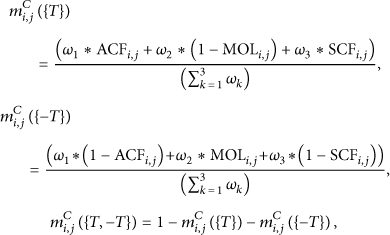
Furthermore, the direct trust value is recalculated in accordance with history records. Assuming the direct trust value of latest cycle is


3.4. Recommendation Trust Evaluation
3.4.1. Trust Transitivity
Suppose the recommended trust value of node i on node j can be obtained through s different paths, and the number of recommendation paths s depends on nodes' distribution and communication radius. In order to avoid trust recycle recursion and decrease network communication payload, the recommendation values are confined to direct trust value of the common neighbours owned by both node i and node j. As shown in Figure 3, node i can get the trust recommendation of node j from

Recommendation relationship between subject node i and object node j.
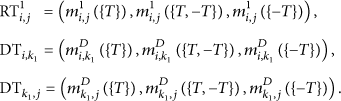
Let us set
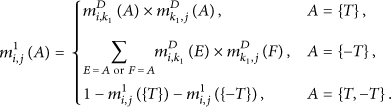
Using the symbol ⊗ to denote this operation, we get

To vividly show the process of trust transitivity, we resort to Figure 4. It is obvious to see that as long as one of

The process of trust transitivity.
Extending the above transitivity to multihop, we can get recommended trust through complex recommendation paths with many middle nodes

3.4.2. Dynamic Aggregation of Recommended Trust
On the basis of trust transitivity, node i obtains recommended trust values on node j through s recommendation paths, namely,

Then, node i would aggregate these pieces of evidence to get a consensus on node j. Due to the existence of malicious nodes that may offer false recommendation, we introduce the revised D-S combination rule which adopts a consistent intensity to adjust weights of recommended trust values. The integration process is described in detail as follows.
Firstly, we compute the corresponding average weight denoted as

The difference between two pieces of recommended trust evidence increases with the reduction of consistent intensity. The lower the consistent intensity is, the more probably false trust recommendation may occur.
Furthermore, the matrix of consistent intensity composed of all the recommended trust values is defined as follows:

Through summation in row and normalization, the totally consistent intensity of recommended trust

Then, the basic reliability function m of every recommended trust evidence is amended by


Extending to s independent pieces of evidence which belongs to the same identification frame Ω, we can get

At last, the consistent recommended trust
3.5. Overall Trust Value Synthesis
Through the observation and recommendation from neighbour nodes, subject node i computes
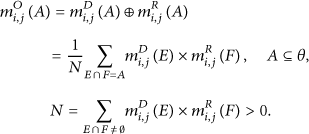
Algorithm 1 shows the process that subject node i judges whether node j is “Trust”, “Distrust” or “Uncertain”. The threshold values η and ξ are determined by specific application environment; here, we define
(1) (2) node i regard node j as “Uncertain”; (3) (4) node i regard node j as “Trust”; (5) (6) node i regard node j as “Distrust”; (7) (8) node i regard node j as “Uncertain”; (9)
4. Trust-Based Routing Protocol
In this section, we extend the AODV protocol to which can establish trusted route with minimum hops and maximum path trust based on trust mechanism denoted by TDS-AODV. The differences between AODV and TDS-AODV are listed as follows.
We append the model of trust computation and fields including Every node maintains a local black list. We append We set backup route to avoid initiating the route discovery frequently.
4.1. Route Discovery
During the process of route discovery, when node i chooses another node j to forward a packet, node i may suffer some attacks from node j, such as black hole attack. Thus, it is important to choose a reliable next hop node. The process of judging whether node j can be the next hop of node i is as follows.
Step 1.
Node i checks whether it has the trust value of node j (
Step 2.
Node i computes
Step 3.
After receiving the
Step 4.
Step 5.
Whether node j is reliable can be estimated using Algorithm 1. If node j is trusted, node i will update
Once a node is in a black list, it will neither receive packets from its neighbour nor have its packets forwarded. That is, a malicious node in a black list is excluded by its neighbours. When a node exists in the black lists of all its neighbours, it will be excluded from the local network.
Sending packets by the trusted route will decrease the probability of malicious attacks and improve the survivability of MANETs. We evaluate the trustworthiness of a route by the trust value of nodes along the route, denoted by

As shown in Figure 5, the trust value of path

Path trust computation of a single path.

Path trust computation of a multiple path.
In our trusted routing mechanism, the route discovery includes three processes: (i) Route Request (
4.1.1.
Delivery
An
When the source node S needs to send data to the destination node D, it first checks whether there is a feasible path found between S and D. If so, S sends the data to D; otherwise, S will broadcast a
When any reliable intermediate node K whose authentication process was discussed before receives a
Step 1.
It checks whether one copy of the same
Step 2.
If node J is not the source, node K creates a reverse route to S using the previous hop (node J) of the
Step 3.
K checks whether there is a valid route to the destination. If so and the
Step 4.
K increases
The pseudocode of the
(1) (2) (3) S sends data to D; (4) (5) broadcasts the (6) (7) (8) checks whether one copy of the same been received; (9) (10) discards (11) (12) creates a reverse route to S using the previous hop of the checks whether there is a valid route to the destination; (13) greater than that in the (14) unicasts a Route Replay ( via J through the reverse route; (15) (16) increases propagates the (17) (18) (19) calls the process of route reply; (20)
4.1.2.
Delivery
An
Step 1.
If it is the first time for D to receive a
Step 2.
If
Step 3.
If there are less than three routes in the cache of D, then add the new route in its cache and go to Step 6, otherwise go to Step 4.
Step 4.
D compares the hop count of the new route with that of the route which owns the maximum hop count in its cache (denoted as route X). If the former is more than or equal to the latter, D discards the new
Step 5.
D uses the new route to substitute route X and then turns to Step 6.
Step 6.
D sets
After receiving a
(1) (2) sets (3) (4) sets a timer window increases the destination sequence number by records the route of sends the intermediate node; (5) (6) discards the follow-up (7) (8) adds the new route in the cache; sends the intermediate node; (9) or equal to that of route X (10) discards the new (11) (12) uses the new route to substitute route X; sends the intermediate node; (13) (14) (15) updates forwards the (16) (17) updates calls route selection;
4.1.3. Route Selection
When S receives the
(1) when source node receives the (2) (3) updates the (4) (5) discards the follow-up selects the route with the largest as its main route; picks the route with second largest backup routes; (6)
4.2. Route Maintenance
After each successful route discovery takes place, S can deliver its data to D through a route. However, the route may break at any time instant due to the mobility of nodes or attacks. In order to maintain a stable and secure network connection, route maintenance is necessary to ensure the system survivability. AODV protocol designed two types of route maintenance mode one is a local repair mechanism and the other is that S reestablishes the route. Detailed process is discussed as follows.
Once the route is found, each node along the route periodically sends
In TDS-AODV, besides link failure, if
5. Simulation Studies
To evaluate the performance of TDS-AODV, we use the simulation tool MATLAB. In our simulation, fifty nodes at first are randomly placed in a specific field (100 m × 100 m) and move to another random position with a speed chosen between 0 to 30 m/s. The malicious nodes randomly drop data packets based on their trust value. The simulation parameters are listed in Table 1.
Simulation parameters.

5.1. Performance Metrics
To measure the performance of our proposed TDS-AODV, we identify three metrics: (i) throughput: the number of packets transmitted per unit time from the source node to the destination node; (ii) packet delivery ratio: the ratio of the number of packets received to the total number of packets; and (iii) average end to end delay: the average delay between the sending of the packets by the source node and its receipt at the destination node.
The network topology of TDS-AODV was compared with that of TAODV [22] and AODV in this paper. We also carried out three simulations in terms of the maximum node speed and the proportion of malicious nodes to compare the above three performances of two protocol.
5.2. Simulation Results and Analysis
Figures 7 and 8 are the network topology of TDS-AODV and AODV with 20% malicious nodes. It is obvious to see that our method can avoid malicious nodes becoming the next hop effectively while in AODV malicious nodes can be selected as the next hop. The reason is that TDS-AODV takes nodes' trust value into account.

Network topology of TDS-AODV.
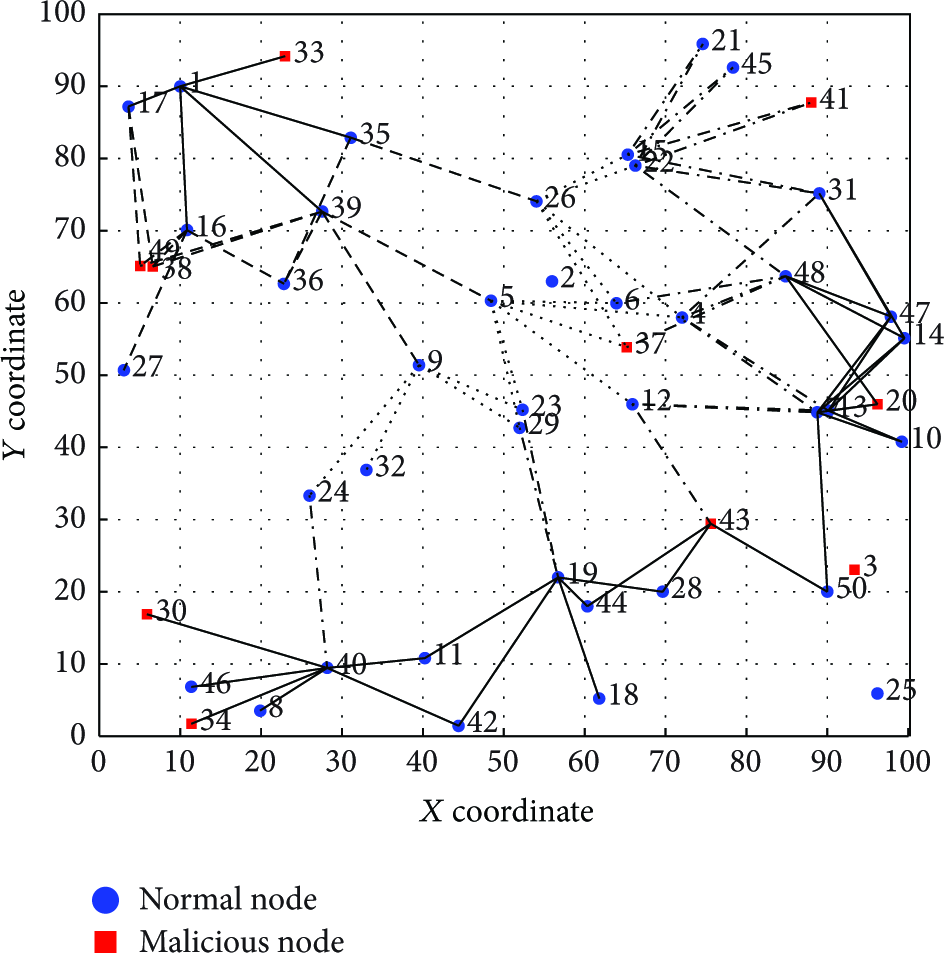
Network topology of AODV.
Figure 9 shows the average routing hop of TDS-AODV and AODV with different numbers of malicious nodes. when the number of malicious nodes accounts for a certain proportion of the number of total nodes, the average route hop of TDS-AODV is a little higher than that of AODV, because nodes would rather choose a relative longer path than choose malicious nodes as the next hop nodes in TDS-AODV. Although the path of TDS-AODV may be a little longer, the performance of TDS-AODV is still better than that of AODV as it eliminates malicious nodes out of the routing paths, which will be proven by the following simulation experiments.

Everage route hop of TDS-AODV and AODV with different numbers of malicious nodes.
Figures 10 and 11 depict the throughput of TDS-AODV, TAODV, and AODV. The routing throughput of TDS-AODV is averagely 29.60% lower than that of AODV and 21.27% lower than that of TAODV in Figure 10. This is because that our method can detect malicious nodes effectively and thus prevent the channel congestion. The throughput changes little at different maximum speed which indicates our method has excellent dynamic. As shown in Figure 11, the throughput rises slowly with the increase in the number of malicious nodes. Besides, TDS-AODV rises more slowly than TAODV and AODV as it prevents the malicious nodes from becoming the next hop and affects less by malicious nodes.
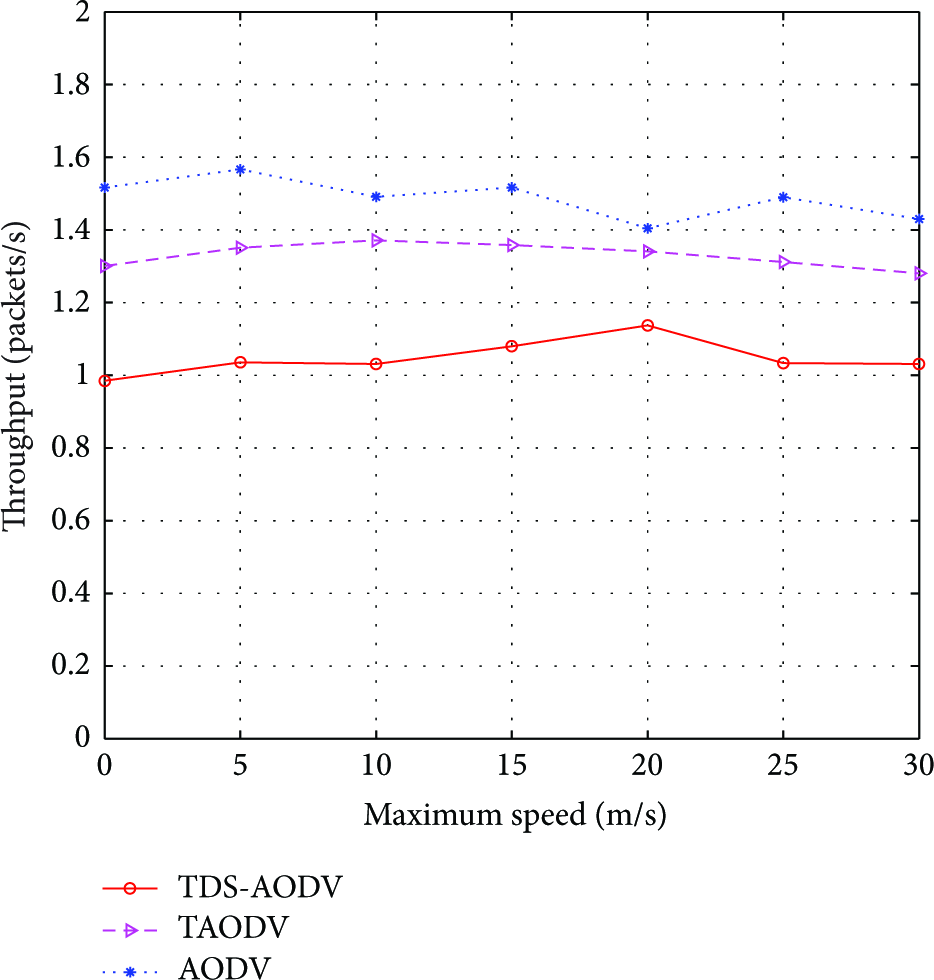
Performance of network throughput at different maximum speed.

Performance of network throughput with different number of malicious nodes.
The packet delivery ratio of TDS-AODV, TAODV, and AODV is shown in Figures 12 and 13. It can be observed that TDS-AODV outperforms TAODV and AODV in the packet delivery ratio because of the fact that in TDS-AODV intermediate nodes make routing selection considering hop count and trust value. It shows the packet delivery ratio of TDS-AODV is averagely 46.24% higher than that of AODV and 17.18% higher than that of TAODV in Figure 12. Figure 13 indicates that TDS-AODV has better fault tolerance as its packet delivery ratio declines slowly with the increase in the number of malicious nodes.

Performance of packet delivery ratio at different maximum speed.

Performance of packet delivery ratio with different number of malicious nodes.
We give the average end to end delay comparisons of TDS-AODV, TAODV, and AODV in Figures 14 and 15. As shown in Figure 14, the average end-to-end delay of three schemes rises very slowly with the increase in the maximum speed. However, the average delay of AODV is 18.73% higher than that of TDS-AODV and the average delay of TAODV is 7.74% higher than that of TDS-AODV in Figure 14 due to the lack of consideration of dynamic topology. Figure 15 depicts the performance of average delay with different number of malicious nodes. The average end to end delay of TDS-AODV declines faster than AODV. Because when intermediate nodes choose the next hop they will not consider the malicious nodes and thus save the time.

Performance of average delay at different maximum speed.
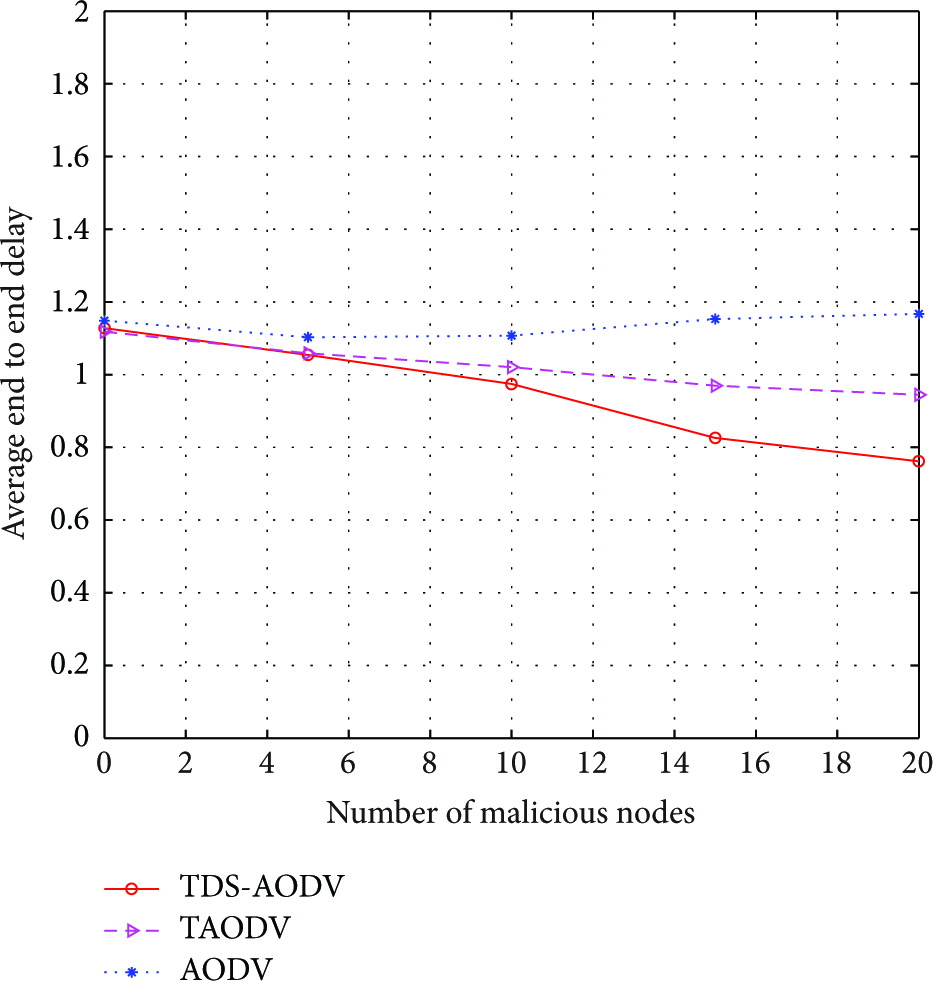
Performance of average delay with different number of malicious nodes.
6. Conclusions
In this paper, we propose a novel trust mechanism after investigating on trust models of ad hoc networks and routing in current researches. In this trust mechanism, direct trust value on each neighbour node is calculated by using trust factors of average encounter time, mobility, and successful cooperation frequency, which are defined according to node behaviors. Meanwhile, the revised D-S evidence theory is used to combine multiple recommended pieces of evidence and obtain the recommended trust value. Then, a trusted routing protocol based on the novel trust mechanism, by extending the AODV protocol is presented. In this protocol, a source establishes a main path and a backup path which are evaluated by two aspects: hop counts and trust values. At last, we validate the correctness and effectiveness of TDS-AODV by comparing its performance with TAODV and AODV on Matlab platform. Simulation results show that TDS-AODV is able to eliminate malicious nodes effectively when building the route and achieves an improvement in throughput, packet delivery ratio, and average end-to-end delay.
In our future work, we will conduct extensively simulation and rigorous analysis to quantify and evaluate the tradeoff between the security and the nodes' energy consumption. In addition, a comprehensive performance evaluation will be conducted to compare TDS-AODV with other routing protocols (e.g., DSR).
Footnotes
Acknowledgments
The authors are grateful to the anonymous reviewers for their insightful comments. This work is supported by the National Natural Science Foundation of China under Grants no. 61201317 and no. 61001138.