




Abstract
Damage detection of pipelines is of great significance in terms of safety in the oil and gas industry. Currently, lead zirconate titanates (PZTs) are the most popular piezoceramic materials and show great potential in the applications of structural health monitoring. In this paper, the authors present a feasibility study on the crack detection and severity monitoring of pipelines using PZT transducers. Due to their electromechanical properties, the piezoceramic transducers can be either as an actuator or a sensor to generate or detect the stress wave. The active sensing approach was applied to monitor the crack severity of pipelines. The crack in the stress wave propagation path can be regarded as a stress relief, which reduces the received energy by the sensors. In the test, eight different operating conditions were tested in which one artificial crack was created ranging from 0 mm to 10.5 mm. A wavelet packet-based crack severity index was also built to quantitatively identify the pipeline damage condition at various crack depths.
1. Introduction
Pipelines consistently experience complications in service, with some examples being stress corrosion and excessive external forces, which cause the pipelines to form cracks. These cracks, if not detected in a timely fashion, may lead to catastrophic events with severe economic losses and environmental pollution. The study on damage detection of pipelines is of great significance to ensure their safe operation and receives increasing attention in the literature. Methods for pipeline damage detection include the fiber optic sensor based method [1–3], the acoustic emission method [4–6], the ultrasonic method [7–10], the eddy current method [11–13], and piezoelectric impedance method [14–17].
In recent years, the piezoceramic transducer based active-sensing approach has been developed and demonstrated its promises in real-time damage detection and health monitoring of civil infrastructures [18–28]. Due to its advantages of both actuation and sensing capacities, wide bandwidth, fast response, and low cost, piezoceramic based transducers are used in the active sensing approach to structural damage detection. In the active sensing approach, one piezoceramic transducer is used as an actuator to generate the desired wave to propagate through the host structure, and other distributed piezoceramic transducers are used as sensors to detect the wave response. Cracks or damages inside the structure act as a stress relief in the wave propagation path. The amplitude of wave and the transmission energy will decrease due to the existence of cracks or damages. The decrease of the transmission energy can be correlated with the degree of the structural damage. In general, the active sensing approach has the advantages of real time and distributed monitoring.
In this paper, the authors explore the feasibility of applying the active sensing approach to crack detection and crack severity monitoring of pipelines using piezoceramic transducers. The lead zirconate titanate (PZT) type of piezoceramic material is adopted in this paper due to its strong piezoelectric effect. In this research, an experimental setup involving a pipe segment with an artificial crack is fabricated. On the pipe segment, one PZT is used as the actuator in order to generate the swept sine wave signal. Meanwhile, three PZTs are set up at different locations on the pipe as sensors to receive the excitation signal from the actuator. Since all structures have their own unique initial and boundary conditions (including different sensor locations), the severity of structural damage will be assessed by the changes in the damage indexes as monitored by the sensors. With this approach, the severity of the pipeline crack can be monitored by tracing and analyzing the amplitude of the response signal. In addition, the wavelet packet-based crack severity index is implemented to quantify the severity of the crack detected via the active sensing approach.
2. Wavelet Packet-Based Crack Severity Index
When piezoelectric materials are subjected either to a stress or strain, they will generate an electric charge. Similarly, the opposite is also true—when subject to electric charges, piezoelectric materials are able to produce a stress or strain. Due to this special piezoelectric property, PZT transducers can be used interchangeably either as actuators or as sensors. This research takes advantage of these properties in the active sensing approach. One PZT is set up as an actuator to generate a guided electrical signal, while additional distributed PZTs are set up elsewhere to receive this signal. Since the stress wave propagation is highly dependent on the wave path's medium, the characteristics of the received signal can be used as an indicator for the structural health monitoring.
In this research, the basic experimental approach is related to the above principles. The crack in the stress wave propagation path functions as a stress relief. Furthermore, the loss of energy received by the sensors is correlated with the severity of the crack. These phenomena are then quantified with wavelet packet analysis, which is used as a signal-processing tool for analysis. The wavelet transform technique is widely used in engineering structural analysis. For example, the wavelet energy method was used to search the critical incidence of earthquake excitation in multidimensional seismic response of offshore platforms [29]. Wavelet denoising has been used for bridge health monitoring using GPS and the characterization of multipath signals and techniques for their removal by improved particle filtering [30, 31]. In this paper, indicators of damage to the pipeline will be extracted from data using wavelet analysis techniques. Because of the complexity of the tested structure, the frequency response can be observed by a guided swept sine wave input and the energy obtained by wavelet packet analysis from the response is compared to the baseline, thereby increasing the accuracy when judging whether structure damage has occurred. The basic principles of this analysis technique are as follows.
In the proposed health monitoring algorithm, the sensor signal V is decomposed by an n-level wavelet packet decomposition into




3. Experimental Setup and Testing Procedures
3.1. Pipeline Specimen and PZT Locations
One section of a pipeline sample was used in this experiment. The pipeline was constructed from Q235 steel. The dimensions and material properties of the pipeline are shown in Table 1. The outer and inner diameters of the pipeline are 101 mm and 80 mm, respectively.
Pipeline dimensions and Q235 steel properties.

Four PZT patches were fixed on the pipeline surface using Epoxy (LOCTITE EPOXY). The locations of PZT patches are shown in Figure 1. It should be noted that PZT-1, PZT-2, and PZT-3 are equidistant from each other along the length of the pipe. Also seen in Figure 1, the location of PZT-4 is rotated 90 degrees counterclockwise from PZT-3. A third point to note is that an artificial crack was cut approximately halfway between PZT-1 and PZT-2. Figure 2 shows the actual specimen with the aforementioned PZT locations and the artificial crack.

Locations of PZT sensors.
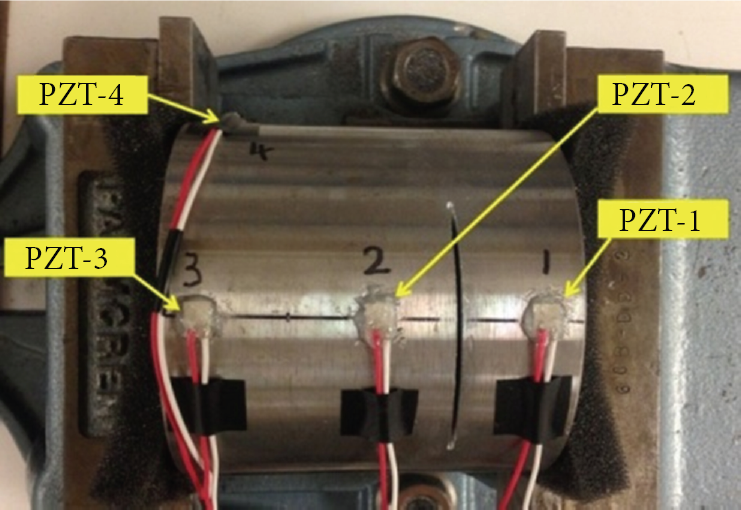
Pipeline specimen with PZT patches.
As mentioned previously, the PZTs display special electromechanical properties, such as density and capacitance. Some of these properties are presented in Table 2. Many factors will influence the detection of pipeline damage, such as piezoelectric ceramic sensor types and properties, the thickness of the bonding layer, the quality of bonding, the material, and size of pipeline. On the other hand, since the proposed method compares the damage indexes of the structure during healthy and damaged states, the above factors will not affect the damage identification results.
Main properties of PZT patches.

During the test, eight operating conditions correlating to different crack depths (0 mm–10.5 mm) were investigated. Table 3 depicts each operating condition with its corresponding crack depth. It should be noted that the crack depth increased by 1.5 mm for each operating condition starting from condition 1 and the crack width was always 1.2 mm.
Test operating conditions (OCs).

3.2. Experimental Setup
In the presented test system, the PZT actuator (PZT-1) is connected with a function generator (Agilent 33120A). The PZT sensors (PZT-2, PZT-3, and PZT 4) are connected with a data acquisition system (NI USB-6363). The sampling rate of the data acquisition system for each channel is 1 Ms/S. The entire experimental setup is shown in Figure 3.
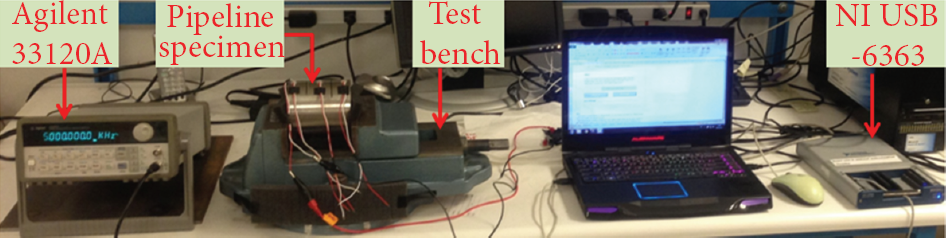
Experimental setup.
3.3. Testing Procedures
During the test, PZT-1 was used as an actuator and PZT-2, PZT-3, and PZT-4 were used as sensors. A swept sine wave signal from 60 kHz to 200 kHz was generated by PZT-1, as shown in Figure 4. The amplitude of the excitation signal is 10 V and the period is 2 s. During each operating condition, PZT-1 produced the guided swept sine wave to all the other sensors and the response signal were recorded by the sensors. Since the pipeline crack was regarded as a stress relief which affected the performance of the stress wave propagation between the actuator and sensors, the sensor signals accurately reflected the pipeline crack severity for each operating condition.

One section of the swept sine wave signal.
4. Experimental Results and Analysis
The received signals of PZT-2, PZT-3, and PZT-4 in each operating condition are shown below in Figures 5, 6, and 7. Each signal was subjected to several resonance frequencies within the range of 60 kHz to 200 kHz. Each plot reflects the sensor signal response from one period of the swept sine wave signal, which is equal to 2 seconds in the time domain. From the plots, several resonance peaks can be observed, especially towards the end of the period (i.e., after 1.8 seconds). Through the analysis of these peaks, the same general trend can be identified for each of the PZTs. This trend shows that the amplitudes of the resonance peaks decrease with an increase of the crack depth. This trend indicates that less energy is collected by the sensors with increasing crack depth. Ultimately when the crack is of a depth near 10.5 mm, the entire signal response is extremely weak, which indicates that the crack almost fully blocks the stress wave propagation from the actuator to sensors.

Sensor 2 signal response for each operating condition.

Sensor 3 signal response for each operating condition.

Sensor 4 signal response for each operating condition.
The signals received by sensors are different for the same stress wave propagating through different crack depths. It is from these differences that the method can determine the location and severity of cracks in the structure. As the method only compares two states (healthy versus damaged), differences in materials, size, and so forth across samples/structures will not affect the performance or requirements of the method. In addition, the vibration response of the structure in a very wide frequency range is calculated by the energy method, and it is more sensitive to minor damage identification.
In order to quantitatively analyze the crack severity on the pipe, the wavelet packet-based crack severity index is developed, as shown in Figure 8. The height of the bars indicates the damage degree collected by the each corresponding sensor. Based on the principle of the crack severity index, 0 is the health status of the structure corresponding to a crack depth of 0 mm (operating condition no. 1). It can be seen that the heights of the bars increase for each incremental operating condition that corresponds to an increase of the crack depth. For Sensor 2, the most distinguishable changes in crack severity index are observed due to the increases in bar height up to the value of 0.4 for operating condition no. 8. This can be attributed to Sensor 2's close proximity to the artificial crack location on the pipe (as seen in Figure 2). The same trend is also observed for Sensors 3 and 4, which confirms that the crack functions as a stress relief in the wave propagation path.

Pipeline crack severity index.
5. Conclusion
In this paper, the active sensing based crack severity detection of pipelines was verified. Since the crack functions as a stress relief in the wave propagation path, the signal response of the sensors reports a decreasing trend with the increasing depth of the crack. From the wavelet packet-based crack severity index, the crack severity for each operating condition was quantitatively identified by the values indicated by the heights of the index bars. As the cracks developed, the damage index for all sensors increased. In addition, the energy loss phenomenon directly correlated to the locations of the sensors with respect to the crack and the sensitivity of the sensors. It was then identified that the sensor the closest to the crack was subjected to a largest energy loss. Since the damage index value of the sensors is highly dependent upon sensor locations, the proposed crack severity index presents great potential to locate cracks with distributed sensors. Compared to the engineering applications for pipelines, the principles and methods of damage detection are identical. To better understand the performance of the active sensing based crack detection system shown in this paper, location detection for multiple cracks on longer pipelines will be studied in future work.
Footnotes
Acknowledgments
This research reported in this paper was partially supported by The National Natural Science Foundation of China (no. 51378077), the Petro China Innovation Foundation (2011D-5006-0605), and the Scientific Research Project Foundation of Hubei Provincial Department of Education (D20131205).