




Abstract
For the purpose of balancing node energy consumption in Wireless Sensor Networks and in the premise of considering network coverage, a kind of node broadcasting scheme at fixed intervals under variational acceleration straight-line movement model is proposed in this paper. Simulation results illustrate that the approach proposed in this paper has a superior performance on balance of energy consumption compared to IEA method and uniform broadcasting as well as random broadcasting methods. And the energy saving effect is close to that of the theoretical deployment model of data fusion and nondata fusion.
1. Introduction
Energy balance is a key metric impacting the performance of Wireless Sensor Networks (WSNs) [1, 2]. One of the most efficient methods to achieve energy balance is to optimize the deployment and configuration of WSNs [3–9]. However, it is well known that designing a Wireless Sensor Network is a difficult task, especially the sensor node deployment which has an impact on the coverage, the network connectivity, and the network lifetime as well as the cost of the WSNs [10].
For practical applications, deterministic deployments can be time-consuming and error-prone, since they have the utmost challenge of guaranteeing connectivity and proper area coverage upon deployment. The deployment problem has been the topic of much research work. However, the majority of the work focuses on theoretical lab-appropriate approaches for carefully positioning nodes to meet research requirements [11–13].
On the other hand, currently, random broadcasting and uniform clustering methods are adopted in most multihop WSNs [14]. By communicating among nodes and sleep scheduling, it could save more energy to extend network lifetime. However, it is difficult to achieve an energy balance [15–17]. In the multihop communication network of WSNs, the closer to the base station, the energy of the node will be consumed faster. If a large number of nodes nearby the base station are dead, there will be an isolated subnet with the base station, and then the data will not be able to reach the base station anymore. This is also known as hot spot problem of the multihop network [18]. Therefore, how to design a flexible deployment and broadcasting model for nodes is a chief problem in WSNs [3].
2. Related Works
There is considerable literature addressing various aspects of energy balancing deployment. Fan et al. [19] propose a type of deployment strategy with relay nodes to ensure energy balance. By computing the most proper transmission distance, several relay nodes are set between source nodes and the base station to achieve balance between the energy consumption of sensor nodes and relaying nodes. However, this strategy takes a considerable cost in time and cannot be applied in large-scale networks; Fei [20] proposes a grid based network deployment algorithm. In this algorithm, each grid defines an inner node, which has the least distance from the grid center as its cluster. Besides, it utilizes the gateway to gather the information in a cluster then deliver it to the nearest cluster head. This deployment strategy owns the advantages for the convenience of information management and data fusion. But it should be noted that energy unbalance is also a key problem in this network. In addition, Liu [21] proposes a new method of deployment using ant colony iteration in grid models which reaches the goal of coverage with minimum nodes.
Besides optimizing deployment schemes, heterogeneous initial energy allocation and modulation modes are proposed by some literatures as well to achieve energy balance. Ren et al. [22] provide a method called IEA. In this method, initial energy of each node is allocated according to its distance from the base station. Then, the initial energy difference between neighboring nodes is simplified as a constant value. However, the error in IEA cannot be neglected, and in real networks it is usually impossible to prior allocate initial energy. Soltan et al. [23] propose another method to achieve energy balance. In a circular network, they choose noncoherent BFSK with low complexity and high SNR for the nodes near the base station, and coherent BPSK with high complexity and relative low SNR for the nodes far from the base station. But, like IEA, this method cannot achieve self-adaptation in a varied network. In addition, heterogeneous modulation causes low transmission efficiency.
By computing network lifetime after deployment, Hou et al. [24] adjust the location of relay nodes to maximize the network lifetime. But this method takes a heavy cost for the process of iteration and cannot adapt itself with varied networks. Ren et al. [25] propose a distance-based energy efficient placement in circular networks. Though coverage has been taken into consideration in this deployment, it fails to analyze the energy consumption on the condition of data fusion. In addition, [26–28] provide a similar method in which circular networks are to be divided into several rings with different radii. By utilizing this method to figure out the minimum value of the objective function, it is easy to get the optimum radius for each ring. However, it also ignores the network coverage problem.
Based on the above researches and taking real physical environment into account, this paper proposes a new broadcasting method, in which the thrower is undergoing a straight-line motion with varied acceleration and broadcasts at a fixed rate. Section 3 of this paper provides a detailed realization process, and the simulation of this method is shown in Section 4. The conclusion is provided in Section 5.
3. Method Description
3.1. Energy Balance Oriented Theoretical Deployment Model of WSNs
The major properties of WSNs are random broadcasting and multihop transmission [3–6]. As a result, it is wise to firstly analyze the energy balance of a linear multihop network model. As Figure 1 shows, a network has N nodes:


Linear multihop network model.
Based on this equation, the relation of different hop distances in this linear structure should meet

It is obvious to find that
This linear model is similar to the models in literature [26–28] and can be generalized into circular networks, as Figure 2 shows. The network region is made up of a solid circle with radius L and the base station is located on the center of the circle. So, several multihop transmission models of the linear structures compose an energy balancing circular network model. The hop distance of every node in the linear structure should meet


Energy balance oriented deployment model in circular networks without data fusion.
From Figure 2, it should be noted that nodes in the network will form several concentric circles with different radii, and the difference between radiuses is not uniform (as the dotted lines in Figure 2 show). It is also easy to find that given the network size, the angle of two neighboring linear structures (as angle θ in Figure 2) determines the number of nodes required to be deployed as well as the network coverage.
3.2. Deployment Model Based on Variable Acceleration Straight-Line Movement
Though energy balance can be achieved in both the linear deployment model and the concentric circular deployment model, it is difficult to locate nodes accurately. As a result, based on (3) which describes the relation between neighboring hop distances, a new deployment strategy is proposed here to simulate and substitute for the energy balance oriented theoretical deployment model. In this strategy, the thrower is undergoing a straight-line motion with an acceleration which is varying at a constant rate and deploying nodes during a fixed time interval. As Figure 3 demonstrates, an object P undergoes a decelerated straight-line motion with a decreasing acceleration. Its motion starts with the initial speed


Deployment model based on variable acceleration straight-line movement.
Let P deploy a node at its instantaneous position with a fixed time T interval. According to the rule of straight-line motion with variable acceleration, the distance between two neighboring nodes will be smaller, which is similar to the energy balance oriented deployment scheme demonstrated in Section 3.1. Figure 3 points out the deployment positions

By mathematical induction

Then we get

Equation (3) shows that we should ensure

so

Equation (8) illustrates, similar to (3), with the increase of k,
However, in most practical cases, broadcasting by air is used as a major deployment way. As a result, it needs to take some improvement, as shown in Figure 4. Similar to Figure 3,

Broadcasting by air based dispersal model.
From Figure 4, it can be inferred that the relation between


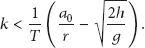
From (13), if the thrower undergoes a straight-line motion with a variable acceleration and is broadcasting nodes with a fixed time interval T, the real linear structures formed by landed nodes in network region are similar to the structure under the energy balance oriented linear network deployment. In addition, on the condition of air broadcasting, the difference between neighboring hop distances is much smaller than that in other deployments.
From what has been discussed above, we assume that the thrower undergoes a decelerated motion with a decreasing acceleration first and then an accelerated motion with an increasing acceleration along a diameter of the network region. Thus, the deployment of nodes in the linear structure along that diameter can be accomplished.
The initial velocity is

Result of single air broadcasting with straight-line motion.
From Figure 2, in order to ensure energy balancing, the location of deployed nodes will form several concentric circles and the difference of radii of neighboring circulars obeys (3). Similarly, after several air broadcastings, the deployed nodes will form several concentric circles, whose radius are different and their difference is not uniform. The difference between radiuses of neighboring circles meets (13).
3.3. Coverage Guaranteed Air Broadcasting Deployment Scheme
By the model of air broadcasting under variable acceleration straight-line movement, a linear network can be well deployed. Then, how many times should a thrower move and broadcast to guarantee to cover the whole network region? The key is up to the angle θ shown in Figure 2. From the discussion above, θ determines the number of nodes which are needed to be deployed. In this sense, θ relates with not only the whole energy consumption, but also the network coverage rate.
In [25], in a concentric circle deployed network, the author finds that the whole circular region could be ensured covered if and only if the circumference composed of the outermost nodes satisfies the requirement of network coverage rate. Assume node sensing radius is R. Let


Coverage rate guaranteed air broadcasting deployment scheme.
To the whole network, the number of times of straight-line broadcastings is

3.4. Energy Balancing Deployment Scheme with Data Fusion
In a previous energy balance oriented deployment strategy and fixed interval air broadcasting with a variable acceleration motion, it is assumed that the schemes ignore the data fusion. However, in real WSNs, as the sensing regions overlap and the redundancy cannot be neglected, it is necessary to do data fusion in relaying nodes.
Here, we analyze the deployment method for linear structures as Figure 7 shows. Given that the data fusion ratio is η and the bit number of data one-time gathered by a node is m, then it is easy to figure out that the bit numbers of transmitted data are


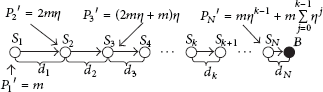
Energy balance oriented deployment with data fusion.
As η is a number less than one,
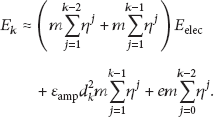
In the same way, we get

then we can infer

for
4. Simulation Results
4.1. Simulation Environment
To testify the properties of the deployment of broadcasting nodes with a variable acceleration movement, the simulation is operated under Omnet++3.2 and Matlab7.0. The values of the deployment under test are deployment effect, network residual energy, and its standard deviation. Then we compare the result of the test with that of IEA method and the uniform and random broadcasting methods. Set the network as a circle with 900 meters radius and the major parameters are shown in Table 1.
The major parameters of simulation.

4.2. Simulation Result
Figures 8 and 9 show the simulation results of broadcasting with variable acceleration straight-line movement and energy balancing deployment without data fusion. From the simulation, the effects of the two deployments are nearly the same, and the density of nodes increases as the distance from the base station decreases. In the method proposed in this paper, the hop distance between two nodes far away from the base station is a little less than the hop distance in energy balancing deployment model, while the density of nodes near the base station is a little less than that in energy balancing deployment model.
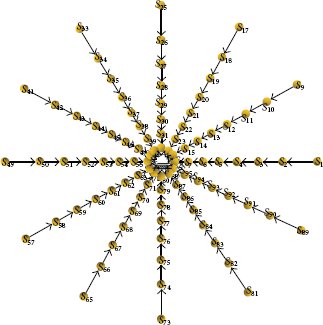
Effect of broadcasting with variable acceleration straight-line movement.

Effect of energy balancing deployment.
Figures 10 and 11 show the average residual energy of nodes and their standard deviation. As the broadcasting result of our method is similar to the result of energy balancing linear deployment model, the residual energy will reach its maximum and its standard derivation will reach its minimum, which means it has the best energy balance. In a nascent condition of the network, IEA method can achieve a good energy balance as well, and it is nearly the same with the air broadcasting with variable acceleration movement. However, its initial energy setting is just based on the distance from that node to the base station, and the difference of initial energy of neighboring nodes is constant, so after the network operates for a long time, the energy balance will be broken and the result of IEA is close to uniform broadcasting. It is also easy to find that the residual energy of a node is least and the property of energy balancing is worst under random broadcasting deployment.
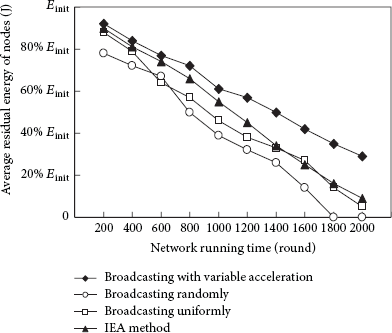
Average node residual energy in different deployments.

Standard derivation of residual energy in different deployments.
It should be noted that after the network operates for 1800 turns, the standard derivations of node residual energy in uniform and random broadcasting undergo a significant decrease. It is because there appear a lot of dead nodes, and the number of living nodes reduces rapidly. Therefore, the difference of each node's residual energy is not significant.
Figures 12 and 13 demonstrate a comparison between our method and the two energy balancing ensured theoretical deployment models. It can be concluded that whether or not to execute data fusion, our method shows no difference in residual energy and its standard derivation. So, it is proved that the deployment of air broadcasting with variable acceleration movement is able to, in some sense, achieve an energy balance. In addition, the deployment on the condition of data fusion should pay attention to the energy balance for data transmission and fusion; its property of energy balancing is a little worse compared with the condition of not adopting data fusion operation, and their property difference will be enhanced as the network operates.

Average node residual energy in air broadcasting with variable acceleration movement and energy balancing deployment.
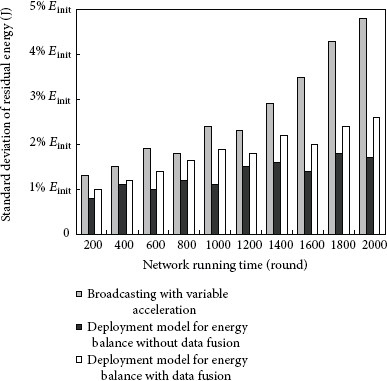
Standard derivation of residual energy in air broadcasting with variable acceleration movement and energy balancing deployment.
To testify the effects of the variation of parameters in the simulation, we set T to 10 s, 12 s, and 14 s, respectively, and then observe and compare the effect of the deployment and energy consumption. The comparison is shown in Figures 14 and 15.

Effects of deployments with different interval.
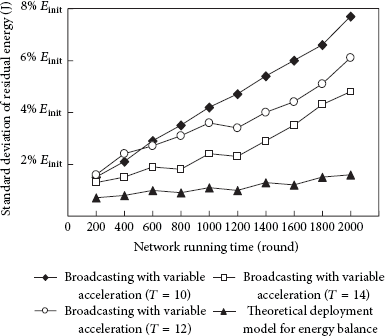
Standard derivation of node residual energy of deployments with different interval.
From the figures, we note that a too large or short interval T will make the effect of deployment depart from the promised prospect, causing an unbalance of energy consumption. If T is set to a feasible value, after an air broadcasting with a variable acceleration movement, the hop distance between neighboring nodes in the network will correspond with the energy balancing deployment model, showing a good energy balance.
Figures 16 and 17 show the energy balancing analysis on the condition of different data fusion ratio. If the ratio of data fusion is low (

Effects of different deployment with different data fusion ratio.

Standard derivation of node residual energy with different data fusion ratio.
5. Conclusion
This paper utilizes a variable acceleration movement model to propose a broadcasting scheme to simulate the energy balance oriented deployment model. Based on the consideration of coverage rate, a practical implementation process is provided. The analysis of its simulation result proves this new deployment approaches the theoretical deployment and achieves a good energy balance.
Footnotes
Acknowledgments
The subject is sponsored by the National Natural Science Foundation of China (61202355), Research Fund for the Doctoral Program of Higher Education of China (20123223120006), China Postdoctoral Science Foundation (2013M531394), Natural Science Foundation of Jiangsu Province (BK2012436), Jiangsu Provincial Research Scheme of Natural Science for Higher Education Institutions (11KJB520014), Postdoctoral Foundation of Jiangsu Province(1202034C), the Scientific Research Fund Project for Translation Talents of Nanjing University of Posts and Telecommunications (NY211018) and a Project funded by Priority Academic Program Development of Jiangsu Higher Education Institutions (Information and Communication, YX002001).