




Abstract
A trapezoidal cavity absorber for a linear Fresnel reflector concentrator is analyzed and optimized via CFD simulation. The heat loss coefficient is introduced; the influences of ambient temperature, absorber temperature, cavity depth, inclination of side walls, insulation thickness, glass window, and emissivity of selective absorption coating have been studied. The results show that radiation dominates the cavity heat loss, and heat loss through the glass window is higher than through the insulation layer; among these factors, impact of emissivity of selective absorption coating and insulation layer is greater than that of the other factors. The simulation results via CFD prove that cavity with a 100 mm depth shows the best thermal performance among the parameters that have been taken into account.
1. Introduction
Concentrating solar collecting technology is necessary for the advanced solar thermal utilization which can obtain high temperature heat source. The solar concentrating collectors mainly consist of parabolic through collector (PTC), parabolic dish reflector (PDR), heliostat field collector (HFC), and linear Fresnel reflector (LFR) [1]. The most popular in commercial use is PTC which owes more than 10 years of successful operation to SEGS [2] located in southern California of America. But the costs (costs?) of manufacture, operation, and maintenance of PTCs are higher, which leads to a hot research on LFR. Compared to PTC, the main advantages of LFR [3, 4] are as follows:
fixed absorber tube with no need for flexible high pressure joints;
much cheaper planar or slight curvature reflecting mirrors and simple tracking systems;
efficient use of land since the primary reflecting mirrors can be placed one next to the other;
primary mirrors are mounted near ground so the cost of structural support is low, and the wind loads are small.
The LFR can be regarded as a decomposed PTC which consists of dozens of rows of primary reflecting mirrors and a stationary absorber (see Figure 1). Sun rays are reflected into the stationary receiver by the mirrors. Häberle et al. [5] had investigated the optical and thermal performance of Solarmundo LFR; the Solarmundo Fresnel collector has about 70% thermal performance of a parabolic trough (UVAC) per aperture area and is about 10% below the electricity costs of the whole system. The first person who brought LFR concept is Giorgio Francia [6] in the 1960s. In 1979, FMC company designed a 100 MWe LFR power plant for the Department of Energy, but the plan deadlocked over the funds. The research upsurge of LFR began in the 1990s. Israel company Paz built an LFR system with a Compound Parabolic Collector (CPC) as the secondary reflector [7]. The Belgium company Solarmundo built a similar LFR system [8] but huge; the primary reflecting mirror area is 2500 m2, single mirror with a 0.5 m width. Germany carried out the “VDemo Fresnel” project [9]. The first demonstration LFR power plant Puerto Errado1 had been built in Spain 2009.

Schematic diagram of an LFR system.
One technical problem is shading and blocking between adjacent mirrors; a simple solution is to increase the height of receiver tower and to increase the gap between adjacent mirrors, which may increase the initial cost. Mills and Morrison [10] of University of Sydney brought up the concept of compact linear Fresnel reflector (CLFR), which has less site area. The optical efficiency is 74% at top. Solar Heat and Power Pty had built a 40 MWe CLFR solar heating system for preheating boiler feed water in Hunter Valley.
Receiving device is the key equipment of an LFR system [11]. Considering the requirement of the working fluid outlet temperature and concentration ratio, there are two main types of the receiving devices [12–14]. For the high temperature section (350°C~400°C), a metal glass vacuum tube and a CPC secondary reflector are used, which may be more expensive; for a lower temperature section (200°C~325°C), a trapezoid cavity receiver is used, which contains a tube bundle on upper surface of the cavity.
In this paper, we will analyze the thermal performance of a trapezoidal cavity for a small linear Fresnel receiver via CFD simulation and discuss the influence of cavity geometry, insulation thickness, emissivity of selective absorption coating, ambient temperature, and absorber temperature. The goal of this paper is to achieve a maximum thermal efficiency of the cavity, which can be regarded as the transfer coefficient between the outer surface of the cavity and the ambient air at steady state, and provide an optimization design of the cavity receiver for LFR.
2. Heat Transfer Model
2.1. Mathematical Model
The absorber is enclosed in order to minimize convection losses with ambient air. The bottom surface of the cavity is a glass window that allows the sun rays from the mirror array to enter the cavity to be absorbed by the absorber plate; there is a tube bundle upon the plate. Dey [15] studied four different arrangements of absorber plate and tube bundle, which is out of the scope of this work. The sides and top of the cavity are insulated on the outside to minimize conduction and convection losses to the environment. The absorber heats up due to the incident concentrated solar radiation and emits long wavelength radiation into the cavity. The emitted radiation is absorbed by the cavity sides and window; in the end, heat loss has been caused through insulation and window (see Figure 2).

Cross-section of the absorber models of heat transfer.
In a Cartesian coordinate system, the continuity equation is as follows:

The momentum conservation equation is
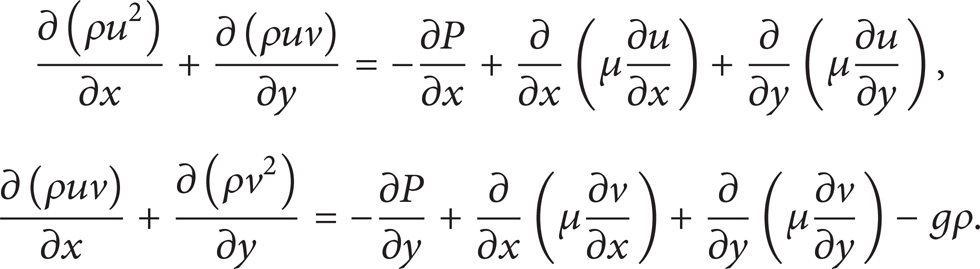
The energy equation is

where h is the enthalpy and q v is the volumetric heat source.
The buoyancy-driven flow regime of natural convection should be decided by the Rayleigh number, which can be viewed as the ratio of buoyancy and viscosity forces times the ratio of momentum and thermal diffusivities,

where Pr is the Prandtl number, g isgravity, l ischaracteristic length, a isdynamic viscosity, ν iskinematic viscosity, and β is thermal expansion coefficient.
Ra less than 108 indicates a buoyancy-induced laminar flow [16], with transition to turbulence occurring over the range of 108 < Ra < 1010.
2.2. Solution Method
To simplify the heat transfer model, several assumptions are used:
steady state;
2D heat transfer model;
the absorber plate temperatures are fixed and resulting heat losses are calculated.
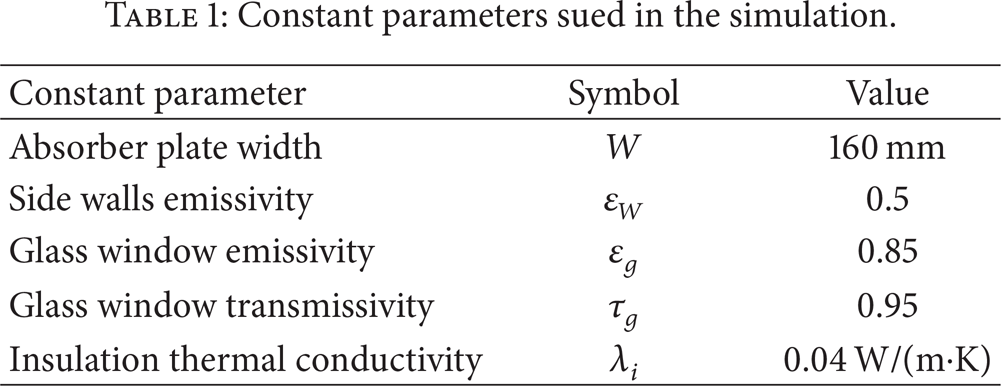
Notation for the cavity dimensions is shown in Figure 3. Fixed parameters in the modeling are shown in Table 1, and variable parameters are shown in Table 2.
Constant parameters sued in the simulation.
Variable parameters sued in the simulation.


Schematic of cavity geometry.
The heat transfer model is solved by the commercial CFD software Fluent 6.3, taking into account all heat transfer mechanisms: radiation, convection, and conduction. A 0.5 m × 0.5 m outer space is created for computing convection and radiation between the cavity and the environment. Heat transfer is fierce inside and around the cavity, so the grid is detailed there. Triangle mesh is used in the entire region, which is shown in Figure 4.

Mesh of the entire region.
The absorber plate is modeled as isothermal surface. Surfaces of side walls, insulation, and glass window are modeled as combined convection/radiation boundary. The simulation model is laminar according to Ra number.
In this model, the glass window is semitransparent, so the discrete ordinates (DO) radiation model is chosen. All discretization is carried out using first order upwind. Air properties are modeled as piecewise linear. Minimum convergence criteria are set at 10−3 for continuity and velocity and 10−6 for DO and energy. First, 500-step iterations are carried out under default underrelaxation factors and then turn them down, proceeding 10000-step iterations, monitoring the temperature of outer surface of glass window, making sure there is no fluctuation.
3. Results and Discussion
3.1. Heat Loss Coefficient
When heat absorption and heat release reach a balance of the cavity receiver, as usualstating under steady state, the capacities that are absorbed and lost are equal:

where m is the mass flow rate, T i is the working fluid inlet temperature, and T o is the working fluid outlet temperature.
Heat loss coefficient U L is a key indicator of the thermal performance of the cavity receiver. As the U L increases, the total heat lost increases. U L is defined as
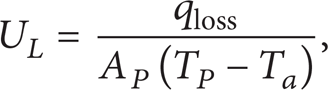
where A P is the area of absorber plate, namely, area of the side coated with absorbing coatings, T P is the temperature of absorber plate, and T a is the temperature of ambient air.
According to the literature [17], U L can be predicted by the following empirical formula:

3.2. Heat Loss Simulated Result
The heat loss coefficient based on absorber plate aperture was calculated as a function of the difference between average tube temperature and ambient air temperature; see Figure 5. Figures 6 and 7 show the velocity magnitude inside the cavity, temperature of the absorber plate is 400°C, and width is 160 mm. These two figures confirmed the convection heat transfer of inside walls through the air flow. Velocity near the side walls is the strongest among the inside area, the flow is enhanced when the cavity depth grows, and the biggest velocity occurs when cavity depth is 150 mm, which is 0.0821 m/s.

Nonlinear curve fit of U L (h = 100 mm, d = 20 mm).

Contours of velocity magnitude inside the cavity for h = 50 mm.

Contours of velocity magnitude inside the cavity for h = 150 mm.
Heat losses through glass window are higher than through insulation layer, which can be observed in Figure 8. With the rise of the temperature of absorber plate, the difference is getting more and more obvious. When the temperature of the absorber is 100°C, heat losses through glass window are 1.48 times of that through insulation, when the temperature of the absorber reaches 400°C, that is, 1.84. The radiation losses dominate the thermal losses inside the cavity as presented in Figure 9, and the radiation losses through the glass window occupy the most of the total heat losses.

Schematic of heat loss versus T P (h = 100 mm, W = 160 mm, and d = 20 mm).

Schematic of heat loss versus T P (h = 100 mm, W = 160 mm, and d = 20 mm).
Figure 10 shows the heat loss coefficient U L versus the absorber temperature. U L increases with the increase of the absorber temperature. When the temperature of the absorber plate is 100°C, U L is 9.35 W/(m2·K); as to 400°C of the absorber plate, U L is 17.21 W/(m2·K), and 84.1% is decreased.

Schematic of U L versus T P (W = 160 mm, d = 20 mm).
We can also notice the influence of cavity depth h to the heat loss coefficient U L from Figure 10. When the ambient temperature, insulation thickness, and the inclination of side walls are constant, U L varied with cavity depth are small, but U L with the 100 mm cavity depth are the smallest in general.
Hold other parameters' constant, such as width of absorber plate and cavity depth, and change the inclination of side walls; the influence is shown in Figure 11. U L shows a downtrend with the increase of inclination of side walls; compared with U L with the 30° inclination, 9% declination occurs with the 60° inclination of side walls; this is because areas of glass window and lateral wall surfaces are increased.

Schematic of U L versus θ (W = 160 mm, d = 20 mm, and h = 50 mm).
The insulation layer is an effective arrangement to minimize the heat losses through the cavity outer surface. We choose four insulation thicknesses for validating the influence of insulation: 0 mm, 10 mm, 20 mm, and 30 mm. The result is shown in Figure 12; as expected, the heat transfer coefficient decreases with the increase of insulation thickness. Heat losses coefficient with 10 mm insulation thickness is 58% lower than that of without insulation. But to continue increasing the thickness of insulation, the heat preservation effect improving is not obvious. Heat losses of the cavity with 30 mm insulation thickness only reduce by 2.2%, compared with 10 mm insulation thickness.

Schematic of U L versus d (W = 160 mm, h = 50 mm, and θ = 45°).
The main effect of glass window is to minimize the convection heat transfer between cavity inside and ambient air; the influence of glass window on total heat loss coefficient is shown in Figure 13. The effect of glass window is obvious; when cavity depth is 50 mm, 100 mm, and 150 mm, U L of cavity with glass window has declined by 4.4%, 9.6%, and 10.8%, respectively. The concentrated solar beam causes an incidence angle on the outer surface of glass window that is greater than 0°, which means optical losses will be produced, so we should choose the glass window with high transmissivity and low reflectivity.

Schematic of U L versus h (W = 160 mm, d = 20 mm).
The turning point ofsolar thermal utilizations is the popularization and use of selective absorption coating, which has a high absorptivity (>0.9) and low emissivity (<0.1). Since the first presentation by the experts of Israel and America in 1954, much research has been done so far [9]. The selective absorption coating can work under 550°C, which solves the bottleneck of concentrated solar energy utilization. The influence of selective absorption coating to U L is shown in Figure 14; U L increases nearly linearly with the increase of selective absorption coating emissivity of absorber. When the coating emissivity ε P is 0.05, U L is 11.85 W/(m2·K), which is 47% lower than U L with the 0.5 coating emissivity.

Schematic of U L versus ε P (d = 20 mm, W = 160 mm, h = 50 mm, and θ = 45°).
The declination of ambient temperature will lead to the increase of heat loss (see the qloss curve in Figure 15); this makes sense, but U L declines with the increase of ambient temperature. As mentioned in Section 2 of this paper, U L can be regarded as the heat transfer coefficient between the outer surface of the cavity and the ambient air; according to the Newton cooling law, the smaller the temperature difference, the larger the heat transfer coefficient. The influence of ambient temperature on U L is small; when T a increase from 270 K to 310 K, U L just increases by 6.7%.

qloss and U L versus T a (d = 20 mm, W = 160 mm, h = 50 mm, and θ = 45°).
4. Conclusions
In this paper, a CFD performance prediction and optimum of the cavity receiver for linear Fresnel reflector concentrator have been made, considering the cavity configuration and other influence factors, and the effect on U L is complex; main conclusions are as follows.
The most important factors which influence the heat loss coefficient are insulation and emissivity of selective absorption coating, which can reduce 58% and 47% of the heat loss coefficient, respectively; glass window plays the second position, which can reduce 10.8% of the heat loss coefficient at most when cavity depth is 150 mm. The influence of ambient temperature is small.
The heat loss coefficient shows a downtrend with the increase of inclination of side walls; the influence of cavity depth is negligible, which is consistent with the conclusion of Facão and Oliveira [18]. Among all the cavity models that are simulated in this work, the trapezoidal cavity with 100 mm cavity depth and 20 mm insulation thickness plays the best thermal performance.
Conflict of Interests
The authors declared that they have no conflict of interests related to this work.
Footnotes
Acknowledgments
This work was supported by the National Natural Science Foundation of China (Grant no. 51106091) and the Shandong University Innovation Foundations (Foundation no. 2012ZD018).