




Abstract
In recent years, many emerging information technologies have been applied to learning environments in an attempt to overcome drawbacks associated with traditional teaching environments. Some of these technologies have been shown to improve learning outcomes and learning motivation. Advances in wireless communications have raised research interest in the development of ubiquitous learning (u-learning) environments and their impact on learner attitudes and behavior. This study reports the use of augmented reality (AR) technology to create virtual objects for use in mobile devices to create a context-aware, AR-enabled guided tour application for outdoor learning. The goal is to provide learners with a friendly, interactive interface and rich, engaging media to stimulate intrinsic motivation and learning performance. The main advantages of the proposed system include the following: (1) it helps stimulate learning intention through pursuing outdoor learning objectives, (2) AR technology provides learners with contextual information related to the outdoor learning environment, and (3) it enhances learner retention of teaching contents easily with the situated learning strategy.
1. Introduction
Rapid advances in information technology have created venues for organized learning beyond the traditional classroom, especially through the use of mobile devices to create opportunities for context-aware ubiquitous learning [1, 2]. In traditional classroom learning environments, instruction is conducted through lectures and activities provided by the teacher along with course books and audio-visual materials. Learners listen to their teachers' instruction while receiving visual cues through PowerPoint presentations, handouts, or whiteboard content before participating in learning activities or group discussions. However, traditional classroom learning is normally quite structured and is limited to preexisting teaching materials or preplanned learning activities.
M-learning has recently emerged as a trend in instruction, offering learners with networked mobile devices unprecedented convenience and allowing them to learn anywhere, anytime [3–5]. In contrast to traditional classroom instruction, m-learning allows learners to use Internet resources, multimedia technologies, and virtual team skills in online discussions, exams, video conferencing, and other activities. Ubiquitous learning overcomes time and place limitations to allow engagement in reality-based learning applications through which they experience, explore, and develop problem solving skills, thus improving learner motivation [6].
Hwang et al. claimed that the formation of individual knowledge is structured by practice and past experience [7]. Hence, the traditional classroom environment cannot help improve learners' concentration nor can the teacher immediately determine whether knowledge acquisition has occurred [8]. Through ubiquitous learning, learners can form their own concepts and knowledge and take responsibility for their own behavior through learning methods based on constructionism [9, 10]. In a traditional classroom teaching environment, teachers unilaterally provide supplementary material through text and/or images, leading to learner disengagement. U-learning methods can replace classroom learning in a way that allows learners to obtain situated knowledge in the real-world environment [11].
This research integrates radio frequency identification (RFID) and augmented reality (AR) technologies on mobile devices. The learner uses the device while exploring a geopark, looking up supplementary information and acquiring knowledge through situational purpose-driven learning. In this way, learners can take the initiative to explore learning, actively constructing new knowledge [12]. This research adapts innovative information technologies to create learning activities, enabling learners to explore geology in depth and stimulate learner motivations to study and understand geological concepts and knowledge.
2. Literature Review
2.1. RFID Technology
Reduced costs and improved performance of RFID hardware hold promise for the development of new smart living applications [13]. RFID allows for automatic identification of objects and the wireless transmission of various kinds of data from an RFID tag attached to the target object to RFID readers [14].
Hwang et al. integrated the use of concept maps and ubiquitous learning applications using mobile devices and RFID technology to help learners assess their knowledge acquisition following learning actives [15]. Their approach allows learners to learn anytime, anywhere, using their handheld mobile devices to engage in learning on demand. Hwang et al. created a u-learning environment in the Southern Taiwan Science Park, using RFID systems to teach astronomical concepts [7].
2.2. Ubiquitous Learning RFID/Wireless
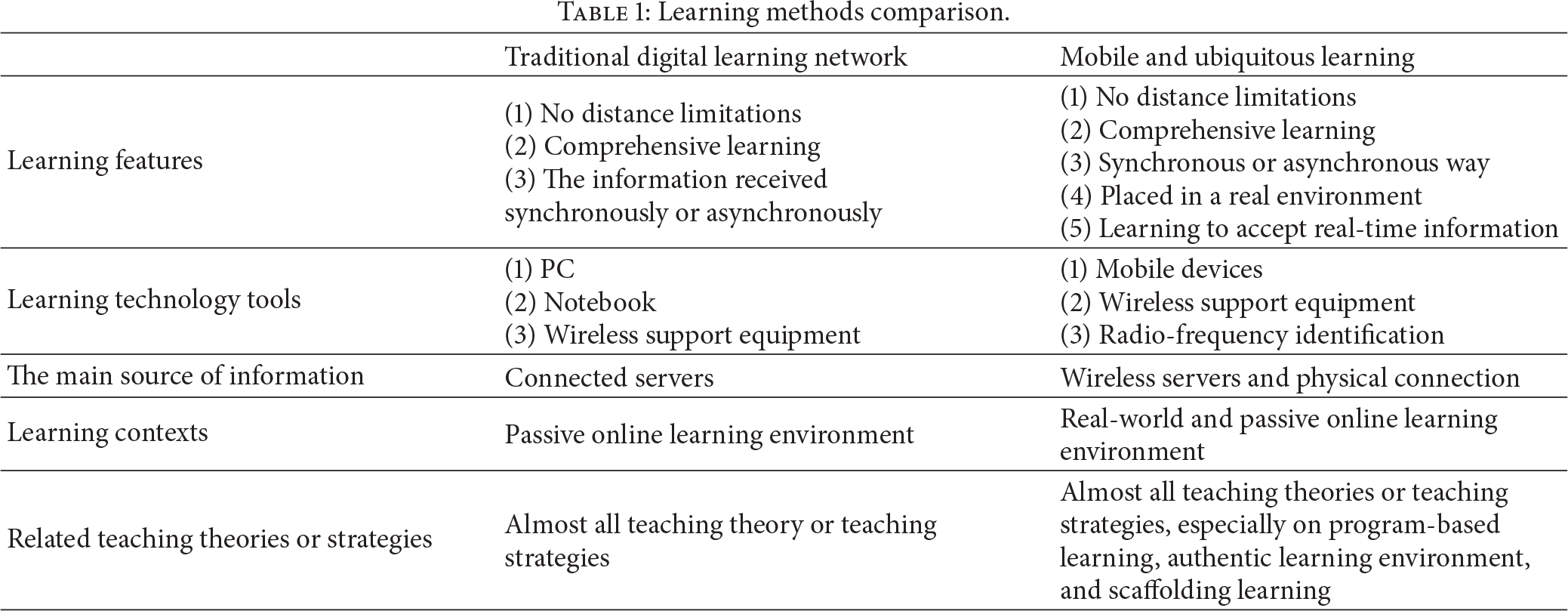
Ubiquitous learning is broadly defined as “anytime, anywhere learning” [7]. Over the past 10 years, advances in wireless networks, sensor technology, and mobile devices have contributed to the development of this innovative teaching model [16]. Innovations in technology now allow students to learn in real world environments with the digital devices providing personalized instruction [17]. Such a learning mode has several advantages as follows [11] and listed in Table 1.
Easy access to new knowledge and sharing information: using mobile devices, students access the desired information or knowledge anytime and anyplace [15]. Unlimited learning venues: with their mobile devices, students can learn at any location or on the go, both indoors and outdoors [18]. Real-world, situated learning: mobile learning allows learners to access information in highly contextualized situations, drawing on resources which enrich their understanding of their immediate surroundings and context. Knowledge is presented in authentic contexts, thus enhancing learner autonomy, and the use of the proposed system in group activities can promote peer interaction [19]. Students can record their learning process in real-life situations: the outdoor learning course allows students to engage supplementary course material in the context of their authentic surroundings and provides a complete record of the learning process, providing a basis for recommendations from instructors or expert systems [20].
Learning methods comparison.
2.3. Augmented Reality Integrated into Learning
Augmented reality uses a calculated field position and camera angle to impose a layer of virtual objects over the “real-world” background [21]. Users can not only immerse themselves in the combined virtual and real-world scenes but also interact with the virtual objects and access relevant and useful information [22].
Until recently, augmented reality applications were limited to “hot-spots” providing limited supplementary information at specific points on guided tours. However, the technology has advanced significantly in recent years to the point where it can now be used to effectively increase learning motivation and engagement without the need for purpose-built hardware. AR systems can be designed to provide students with personalized scaffolding and support and help them construct personal knowledge as they observe and experience real-world contexts [23, 24].
Augmented reality technology is developing rapidly. Both the Android and iPhone operating systems support AR in navigation features, providing users with location-specific information. Images have a stronger impact on memory than text, thus layering supplementary images and information over the real world environment in the AR environment can promote knowledge retention [25].
Liarokapis et al. proposed an interactive Multimedia Augmented Reality Interface for E-learning (MARIE) system and developed a user-friendly interface to explore the potential for AR in instruction by superimposing virtual multimedia content (VMC) information in an AR tabletop environment [26]. Matcha and Awang Rambli investigated the potential of AR spaces to supply communication cues and promote collaboration in learning environments. Their empirical results indicated that AR techniques have significant potential to serve as a shared medium in collaborative learning [27].
3. Methodology
3.1. Research Process
This research integrates a context-aware ubiquitous learning environment and AR techniques, using content based on the Yehliu Geological National Park. The application design and testing process were conducted in three stages detailed as follows and also showed in Figure 1.
First stage: catalog the required learning material regarding the Yehliu Geological State Park, and create appropriate teaching materials for integration into the AR application. This stage contains two steps as follows.
Field surveys: interviews with park's staff and surveys of legacy systems, to gather material for use in the construction of the content for the context-aware ubiquitous learning system. Literature review: review studies of relevant technologies and learning theories to determine the technical feasibility of the proposed approach, combining ubiquitous learning, augmented reality, and RFID along with research on the design principles for acquired learning systems. Second stage: develop the ubiquitous learning system and integrate the developed content for testing.
System implementation: the D'Fusion software platform is used for Android-based development, creating presentations based on plan views and 3D graphs perspective views. Instructional design: layer the teaching materials in the AR environment to increase richness and engagement. The AR content is layered on top of real images of the geological formations, thus improving learner recall. Student knowledge acquisition and learning outcomes are measured experimentally through questionnaires, and interviews are used to solicit user feedback. System testing and debugging: check to ensure the system works reliably, and use learner feedback to determine how to improve system performance and usability. Third stage: assess learner response to the system.
Experimental design assessment: observe learners in the process of using the proposed u-learning system to achieve predetermined tasks in Yehliu Geological Park. System effectiveness and learning outcomes are assessed using a questionnaire after the usage session. Conclusion and recommendations: questionnaire responses are analyzed to assess user perceptions of and reactions to the proposed system and to obtain ideas for potential improvements to the system and content.
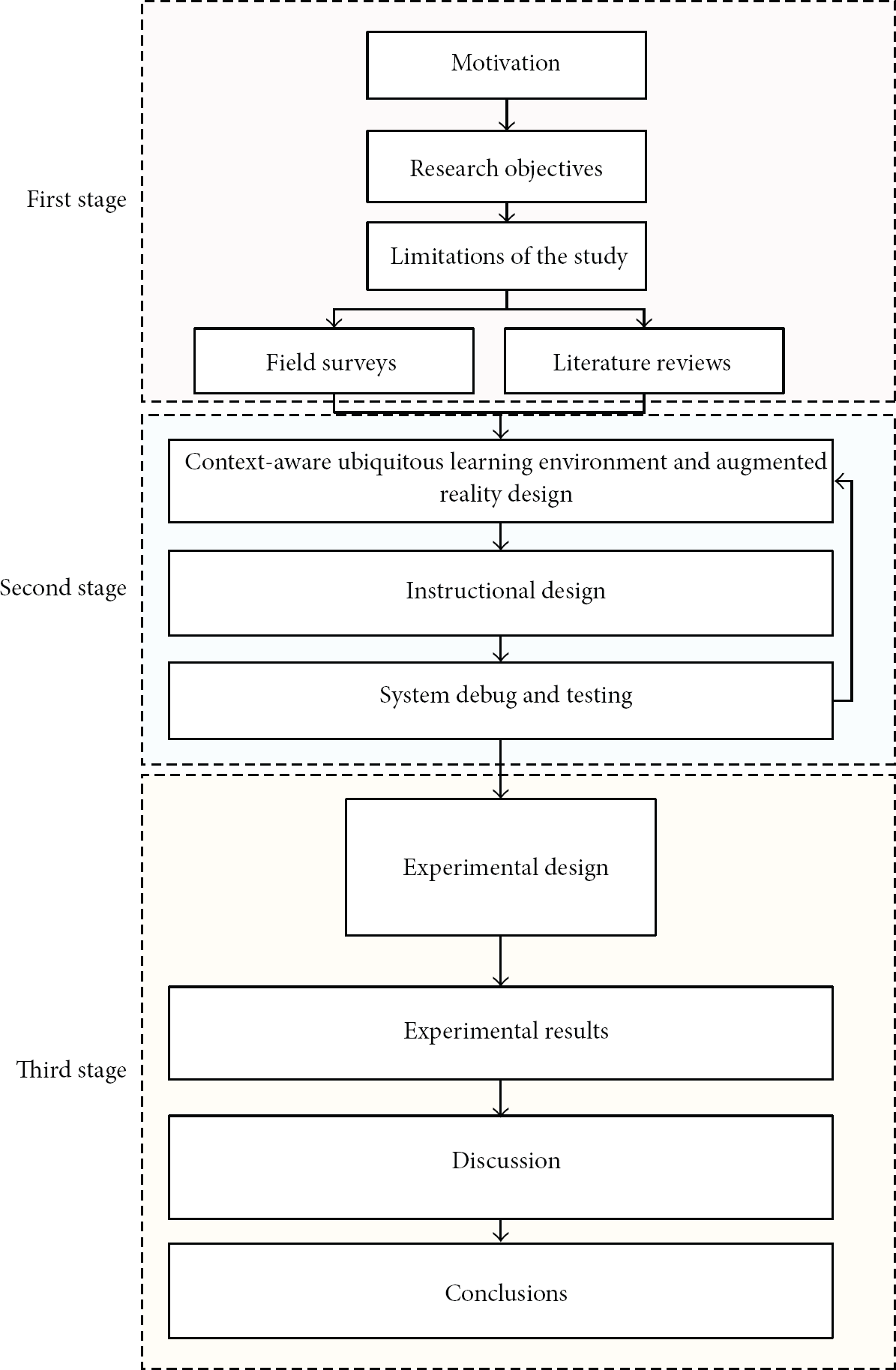
Research flowchart.
3.2. Experimental Design Environment
The proposed u-learning system incorporates radio frequency identification (RFID) and augmented reality (AR) technologies on mobile devices, allowing the learner to immediately access supplementary information on geological objects observed in the geopark. This section describes the hardware and software requirements of the proposed system.
Hardware requirements include a mobile device providing Internet access and an RFID-enabled environment. RFID tags and readers are used to identify individual students/users and to record learner progress and scores. An HTC Sensation XL mobile phone and an ASUS Eee Pad Transformer Prime TF201 Tablet PC were used as the mobile devices in system development and testing. The RFID-enabled environment was built using active RFID readers and tags, wherein the tag draws on an internal power supply to detect signals transmitted by the RFID reader and to reply back to the reader [28, 29].
Software requirements include platform-specific software development kits and an augmented reality development environment. Eclipse was used as development for Android 4.0.1 because it offered many relevant development tools and good compatibility [30]. AR development was done using D'Fusion on an Android platform, with the ubiquitous learning system developed from plan views and 3D graphs. D'Fusion offers better performance by using additional graphs in place of real-time computing effects for light/shadow and material textures.
4. Experimental Design and Results
4.1. System Architecture and Module Description
Situational awareness was used to allow users to follow learning activities along a predetermined route, using the augmented reality features to engage in image memory-based learning to increase comprehension and retention. Figure 2 shows the system architecture, and each module and function is described in detail below.

Ubiquitous learning system architecture diagram.
4.1.1. Teachers
Teachers can use a classroom version of the AR system to introduce system usage and content in the classroom. In traditional classrooms, learners can only learn about nature through text and pictures, making it difficult for them to truly understand the essence of the natural sciences. However, using the proposed system, the teacher in the classroom can lead students through the supplemental teaching material at various difficulty levels.
The system offers two modules through which teachers can customize the content and activities. The first is the teaching plan management module, which allows teachers to select an appropriate level of difficulty for the learning objectives. The other module is the content management module, allowing teachers to easily swap different activities in or out of the course. In the module, all teaching materials are classified according to level of difficulty, allowing teachers to, for example, adjust the difficulty of the reading program to continuously challenge learners. Learners can also use ancillary and supplemental teaching materials in the AR environment, using geographical location information to elevate their learning efficiency.
4.1.2. Learners
The system logs all learner activity, automatically adjusts the scope of learning objectives, selects an appropriate learning difficulty level, and updates parameters according to learner search results. While navigating the learning path, learners can engage with one topic after another. In the traditional classroom, learners often have difficulty keeping pace with a teacher's presentation because of a lack of understanding. Using the proposed u-learning system, students can repeatedly engage with the instructional material at his or her own pace, thus developing a sound understanding of the topic.
4.2. Augmented Reality Interface and Operations
The AR interface allows users to follow a series of learning activities and targets along a predetermined context-aware route. When observing a particular object, the learner clicks the Augmented Reality button to access supplementary information about the object. The action of actively seeking out supplementary knowledge promotes knowledge acquisition and retention. In addition, learners can access contextualized geographic information by clicking the Geographic Information button. Figure 3 illustrates the AR interface. Area “A” provides the name of the learning objectives, while “B” provides an image. Area “C” provides an augmented reality view of the learning objectives, while area “D” provides relevant geological information.

AR interface.
5. Conclusions
Augmented reality and RFID technologies were integrated to create contextually-aware instructional system for use in outdoor environments. Content specific to the Yehliu Geological Park in northern Taiwan was adapted to the platform, allowing students to engage in self-paced learning activities and exploration along a predetermined trail in the park. The system was designed to increase learner engagement and autonomy, while improving knowledge acquisition and retention.
The system helps learners easily develop an understanding of local geological and cultural conditions. The immediacy of the environment increases learner engagement, with the potential of sparking learner motivation for further exploration and learning.
This research has some limitations and they need to be addressed in future work. Some learners indicated that software and hardware limitations resulted in unacceptably long latency to load relevant content. Since the platform was developed to improve learner engagement and learning outcomes, latency and other ease of use issues must be improved.
Footnotes
Acknowledgment
The authors would like to thank the National Science Council of the Republic of China, Taiwan, for financially supporting this research under NSC 102-2221-E-025-003, NSC102-2622-E-025-001-CC3, and NSC-101-2622-E-025-002-CC3.