




Abstract
The fiber Bragg grating (FBG) technology has been rapidly applied in the sensing technology field. In this paper, an FBG pressure sensor is designed and implemented to detect the leakage of prestressed concrete cylinder pipe (PCCP). The pressure sensor is mainly based on a Bourdon tube with two FBGs bonded on its outside and inside surfaces, respectively. The measurement principle and simulation analysis results are described. The wavelength shift difference of the two FBGs is utilized as a pressure sensing signal, the sensitivity is enhanced, and the temperature cross-sensitivity is compensated. Experimental results indicate that the measurement sensitivity is 1.414 pm/kPa in a range from 0 to 1 MPa, and the correlative coefficient reaches 99.949%. This kind of pressure sensor is effective to quasi-distributed measure and online monitor pressure of gas or liquid in industry and manufacture fields.
1. Introduction
In recent years, fiber Bragg grating (FBG) sensors have been widely used in an increasingly large number of sensing applications due to their especially attractive characteristics such as intrinsical safety, immunity to electromagnetic fields, remote sensing, and large multiplexing capabilities, as discussed by Mihailov [1]. Pressure is one of the most important physical parameters in a process industry. Unfortunately, the traditional pressure sensors, mostly based on electrical train gauge, vibration wire, mechanics, and so forth, as discussed elsewhere [2, 3], are unable to adapt to the harsh environments with serious electromagnetic interference (EMI), dangerous chemicals, or explosion matters and are impossible to realize pressure's multipoint measurement and online monitoring at a long distance. Therefore, the FBG-based pressure sensors have become an important researching direction as studied elsewhere [4–7].
The intrinsic pressure sensitivity of a bare FBG is only 3.04 pm/MPa, which is too low for the practical pressure measurement as presented by Xu et al. [8]. There are many methods proposed to enhance the pressure measurement sensitivity indirectly, such as embedding FBG in polymer, soldering metal-coated FBGs on a free elastic cylinder, and attaching the FBG fiber to a diaphragm as studied elsewhere [9–13]. However, many of these approaches have relatively complex structures which are not easy to be fabricated. The prestressed concrete cylinder pipe (PCCP) has been widely applied in the world for water conveyance in many areas like municipal, industrial, and plant piping systems [14]. The security monitoring and reliability management of large diameter PCCP still meet a lot of challenges for the owners and the public in some significant projects such as the Great Man Made River (GMMR) in Libya and the South-to-North Water Diversion (SNWD) in China [15].
In this paper, an FBG pressure sensor using a Bourdon tube as spring element is designed and applied to detect the leakage of prestressed concrete cylinder pipe (PCCP). The measurement principle and simulation analysis results of this pressure sensor are introduced. Experimental results indicate that the measurement sensitivity is 1.414 pm/kPa in a range from 0 to 1 MPa, and the correlative coefficient reaches 99.949%. With respect to the features of the designed pressure sensor, it is expected to be widely used for pressure's quasi-distributed measure or online monitoring in industry and manufacture fields.
2. The FBG Pressure Sensor
2.1. Measurement Principle
Fiber Bragg grating is written by exposing a single mode fiber to a periodic pattern of ultraviolet light, and the sensing of FBGs is based on the principle of Bragg reflection. The wavelength variation caused by the axial strain change Δε and the temperature change ΔT could be given by [16, 17]

where λ is the initial wavelength of FBG, p e , α f , and ξ are, respectively, the effective photoelastic coefficient, the thermal expansion coefficient, and the thermal-optic coefficient of fused silica fiber. According to (1), the influence of temperature fluctuation should be eliminated in order to obtain pure strain variation.
Since the intrinsic pressure sensitivity of FBG is not very high, thus the FBG pressure sensing has been generally realized indirectly by sensing the strain instead. In order to amplify the pressure measurement, a Bourdon tube is used as a spring element for its simplicity, reliability, and adaptability. Therefore, the structure of the designed FBG pressure sensor is depicted in Figure 1.

The structure of the FBG pressure sensor.
As shown in Figure 1, two FBGs (FBG-1, FBG-2) are, respectively, bonded on the outside and inside surfaces of a C-type Bourdon tube along the circumferential direction with an epoxy adhesive. The Bourdon tube has a flat oval cross section. It is assumed that the provided end effects are neglected, and the strain on longitudinal line of the Bourdon tube's surfaces is the same along the circumferential. The maximum strain value occurs on the center longitudinal line and could be calculated by the following [18, 19]:

where K = Rh/a2, P is the applied pressure, E is the Young's modulus, μ is the Poisson's ratio of material, a and b are the semimajor axis and semiminor axis of the flat oval cross section, h is the wall thickness, R is the radius of curvature of the Bourdon tube, and Φ is a position function in the relation between a/b and h/b. Equation (2) could be expressed as
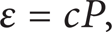
where c is a constant for any given Bourdon tube. FBG-1 glued on the outside surface of the Bourdon tube senses a negative strain, and FBG-2 bonded on the inside surface of the Bourdon tube detects a positive strain, as shown in Figure 1. Assuming that the strain transmission ratio is 1, according to (1) and (3) the relation of wavelength shifts of the two FBGs and the applied pressure can be expressed as follows


As the FBG-1's initial wavelength λFBG-1 is close to the FBG-2's initial wavelength λFBG-2, and the initial wavelengths (λFBG-1, λFBG-2) are much larger than the wavelength shifts (ΔλFBG-1, ΔλFBG-2), so λ0 could be used to replace λFBG-1 and λFBG-2. The difference of the two wavelength shifts is obtained by subtracting (4) from (5):

Thus, (6) can be adapted as

where k = 2cλ0(1 – p e ) is a constant and is able to represent the pressure sensitivity of the FBG pressure sensor. Equation (7) shows that the two FBGs' wavelength shift difference is a linear function of the applied pressure and independent of temperature variation. Using the wavelength shift difference of the two FBGs as pressure sensing signal, the pressure sensitivity is improved, and the temperature cross-sensitivity is effectively avoided.
2.2. Simulation Analysis
To verify the feasibility of the proposed method and structure, finite element analysis (FEA) with ANSYS has been carried out. In the simulation analysis, the strain distribution on the surfaces of the Bourdon tube has been calculated. The material of the Bourdon tube is copper alloy, and the parameters of the Bourdon tube in the following calculation and simulation are Young's modulus E = 1.1 × 10¹¹ Pa, Poisson's ratio μ = 0.31, radius of curvature R = 33 mm, wall thickness h = 0.55 mm, semimajor axis a = 6 mm, and semiminor axis b = 2.5 mm.
The center strain values on the Bourdon tube's surface where the two FBGs are bonded versus pressure variation are shown in Figure 2. It is obvious that there is a linear relation between the strain values and the applied pressure, which matches the theoretical calculation analysis aforementioned. The linear relation between the strain (ε1, ε2) and the applied pressure P can be, respectively, expressed as

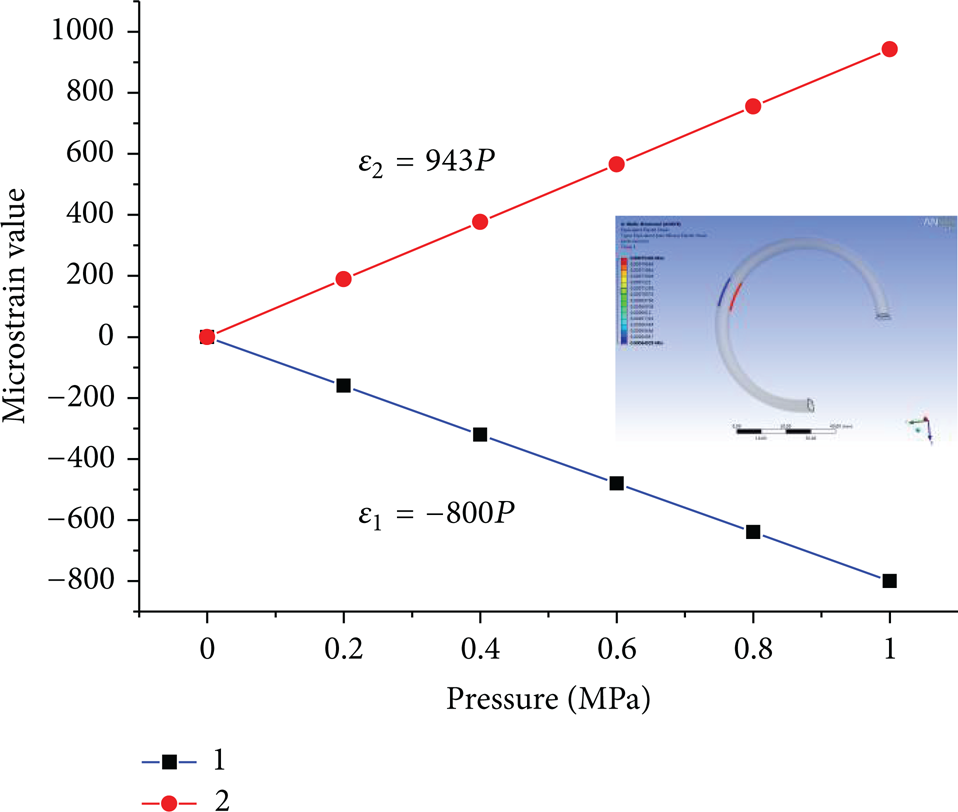
The center strain values on the outside surface versus pressure variation.
For an FBG of central wavelength of 1550 nm, typical strain sensitivity is approximately 1.2 pm/microstrain. According to (6) and (8), the difference of the two FBGs' wavelength shifts could be obtained as follows:

Equation (9) shows that the pressure sensitivity simulation calculated is 2091.6 pm/MPa or 2.0916 pm/kPa. In addition, the modal analysis results with ANSYS explain that the inherent frequency of the Bourdon tube is 180.7 Hz, so the presented pressure sensor is unsuited for the measurement of dynamic pressure with high frequency.
3. Experiment and Results
The experimental devices are shown in Figure 3, involving the FBG pressure sensor, a piston gauge, an FBG interrogator, and a personal computer. The FBG pressure sensor is placed on a piston gauge which is used to control the pressure applied to the pressure sensor. An FBG interrogator based on CCD array with minimum resolution of 0.1 pm is used to monitor the Bragg wavelength shifts of the two FBGs under different values of the pressure. During the experiment, the pressure applied to the sensor by the piston gauge is changed from 0 to 1 MPa with a step of 0.1 MPa, and the temperature around is fixed at the room temperature.

A photo of the experiment instruments.
Figure 4 depicts the wavelength shifts versus pressure variation for the two FBGs. The wavelength of FBG-2 presents a red shift, indicating that FBG-2 is stretched and senses the positive strain while the wavelength of FBG-1 has a blue shift which verifies that FBG-1 is compressed and senses the negative strain. Both variation patterns are linear.

Wavelength shifts of the two FBGs versus pressure variation.
Figure 5 shows the variation of the wavelength shift difference for the two FBGs versus the applied pressure. The fitting results are also presented in Figure 5, and the pressure sensitivity is 1.414 pm/kPa with a fitting linear correlation coefficient of 99.949%. The measured sensitivity is in agreement with the simulation calculation value, and the difference is mainly caused by the simulation calculation error and the strain transmission ratio.
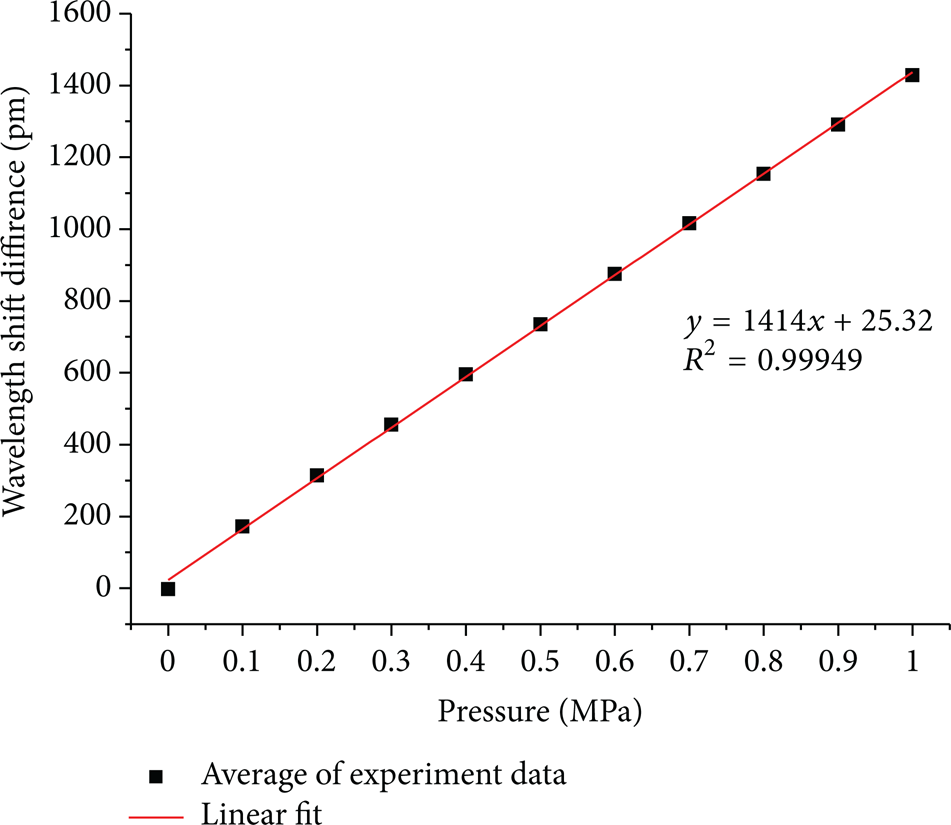
Variation of the wavelength shift difference for the two FBGs versus pressure.
4. Application in Detecting Pipe Leakage
In the following experiments, the presented FBG pressure sensor is utilized to detect the leakage of PCCP pipeline. The experimental devices and procedure are shown in Figure 6, mainly consisting of two concrete piers, a steel cylinder pipe, two PCCPs (PCCP-1 and PCCP-2), an FBG pressure sensor, an FBG interrogator, and a personal computer. The inside and outside diameters of the PCCP are 2 m and 2.6 m, respectively, and the length of each PCCP is 5 m. Figure 7 is a real photo of the partial experimental field.

Experimental setup.

A real photo of partial experiment field.
As shown in Figure 7, the FBG pressure sensor is installed at the pipe joint between PCCP-1 and PCCP-2, where the leakage events usually take place in the PCCP pipeline. The FBG pressure sensor is fixed in the test hole by a screw thread to measure the pressure variation in the cavity, which is between the rubber seal A and rubber seal B, as depicted in Figure 8. If the rubber seal A becomes invalid, the pressured water in the PCCP would flow into the ring cavity, and the pressure in the ring cavity would rise. If the rubber seal B also becomes invalid, the water would go through rubber seal A and rubber seal B and leak to the outside of the PCCP from the joint.

Installation of the FBG pressure sensor.
After the pipeline was filled with water, the pressure of the water would be elevated to approximately 0.6 MPa by a motor pump as shown in Figure 7. Figure 9 shows the pressure variation in the ring cavity recorded by the FBG pressure sensor. It could be found that the pressure in the ring cavity firstly gradually rises to 0.6 MPa and then has a downward trend. It is mainly because the water in the pipeline was leaking to the outside through the rubber seals as shown in Figure 8. Therefore the pressure of the water in ring cavity could not be stabilized at 0.6 MPa. This experiment demonstrates that the presented FBG pressure sensor could be effectively used to detect the leakage of PCCP pipeline by monitoring pressure aviation in the ring cavity.
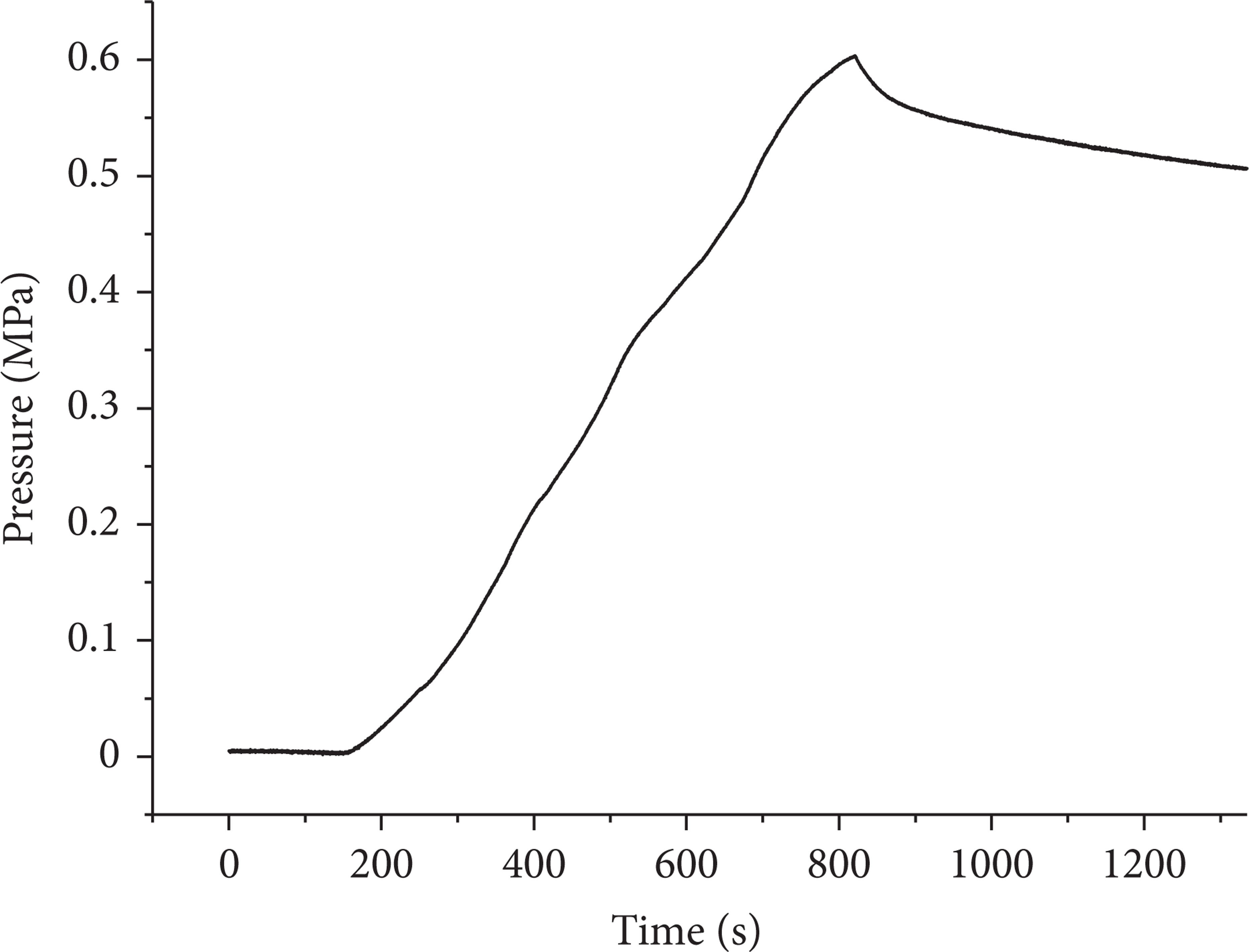
Pressure variation in the ring cavity.
5. Conclusions
An FBG pressure sensor adopting a Bourdon tube with two FBGs as pressure component has been presented and utilized in practice. The temperature cross-sensitivity is effectively avoided by using the wavelength shift difference of the two FBGs as the pressure sensitive parameter. Moreover, the experimental results demonstrate that the FBG pressure sensor possesses a good linearity and repeatability with the measurement sensitivity of 1.414 pm/kPa, which is 465 times higher than a bare FBG. The presented sensor has been utilized to detect the leakage of PCCP pipeline. The measurement range and sensitivity of the pressure sensor could be adjusted by simply optimizing the size and material of the Bourdon tube, and multiple sensors could be multiplexed in one single optical fiber. This kind of FBG pressure sensor is supposed to have many potential applications for pressure's quasi-distributed measurement and online monitoring in industry and manufacture fields.
Footnotes
Acknowledgment
This work was supported by the National Science and Technology Major Project of China under Grant no. 2012ZX04001-012-05.