




Abstract
Bolted structures are commonly used in civil infrastructure. It is important to perform bolt inspection regularly to ensure the safety of structures. Traditional bolt inspection methods are time-consuming; moreover, bulky instruments are needed in these methods. In this paper, a piezoceramic based active sensing approach is developed to perform the health monitoring of bolted structures. Surface-bonded piezoceramic patches are used as health monitoring transducers. Wavelet packet analysis is used to analyze the sensor data to extract the features that indicate bolt looseness. Based on wavelet packet analysis results, a damage index is developed to quantitatively evaluate the damage status. To verify the effectiveness of the proposed method, a bolted connection experiment with piezoceramic transducers was performed. In the experiment, the looseness of the bolt is adjusted by a torque wrench. Experimental results show that the proposed approach is effective to detect and evaluate bolt looseness.
1. Introduction
Bolts are commonly used in civil infrastructure where the inspection of bolts is extremely labor intensive. To reduce inspection labor and enhance safety, real-time health monitoring technologies have been recently researched for bolt inspection, such as an impedance based method [1–4], a vibration or ultrasonic based method [5, 6], and an electric conductivity based method [7]. Due to the advantages of low cost, quick response, and solid-state actuation, piezoceramic materials have been used as transducers for health monitoring purposes. In addition, an active sensing approach has been used in the health monitoring of various civil infrastructures [8–13]. Recently, a proof-of-concept study of monitoring bolt connection status using a piezoelectric based active sensing method was conducted [14]. The proof-of-concept study only involves a pair of bolt-and-nut that connect two small metal plates. No meaningful structure was involved in the proof-of-concept study. In this paper, using piezoceramic materials, an active sensing based approach is further developed and applied to perform health monitoring of a bolted connection in light pole structure. During the experiment, different torque values were applied to tighten a bolt connection on the structure to simulate the damage of different degrees of looseness. The proposed health monitoring approach was performed to evaluate the health status of the bolt connection on a real structure. A damage index was developed to quantitatively evaluate the severity of the bolt looseness. Experimental results verified the effectiveness of the proposed approach.
2. Monitoring Principle and Algorithm
For various degrees of looseness of a bolt, the stiffness around the screwed area and the boundary conditions of the bolt are different. The changes in the stiffness and boundary conditions result in the alternation in the wave propagation. Thus, the bolt inspection can be performed by analyzing the wave responses across the bolted connection. In the proposed research, the active sensing approach is used; that is, a piezoceramic transducer bonded on the surface of a bolt is used as an actuator to generate the stress wave, while another piezoceramic transducer bonded on the other side of the screwed area is used as the sensor to detect the responses. By analyzing the response signals, the health status of the bolt is evaluated. Wavelet packet analysis is used as the signal processing tool due to the fact that it enables the inspection of relatively narrow frequency bands over a relatively short time window. In wavelet analysis, a signal is split into an approximation (low frequency information) and a detail (high frequency information). The approximation is then itself split into a second-level approximation and its detail, and then the process is repeated. In wavelet packet analysis, not only the approximations are decomposed into the next level's approximations and details but also the details are decomposed into the next level's approximations and details. This process is repeated as shown in the decomposition tree in Figure 1. In Figure 1, the letter “A” stands for “Approximation” and the letter “D” stands for “Detail.”
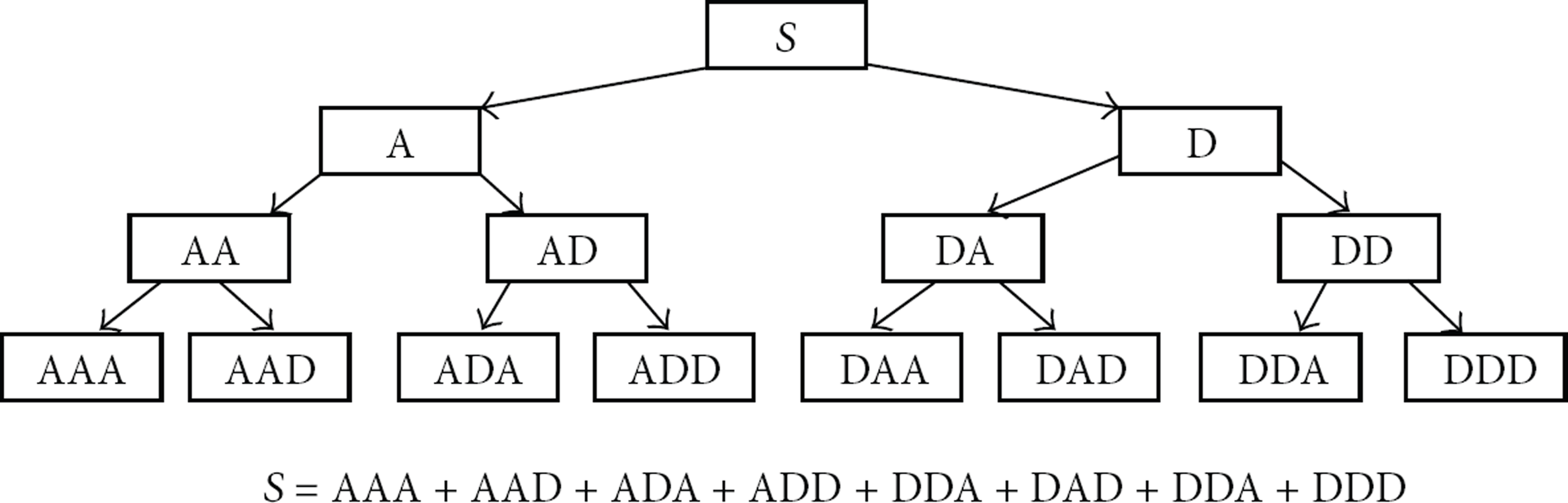
Decomposition of wavelet packet analysis.
In the proposed health monitoring algorithm, the sensor signal S is decomposed by an n-level wavelet packet decomposition into


The damage index for the decomposed signal at the jth frequency band is defined as

3. Experimental Setup and Testing Program
In this health monitoring test, a bolt connection that joins two plates in a pole structure was used as a testing object, as shown in Figure 2(a). Different values of torque were applied to gradually tighten the bolt and piezoceramics were used as health monitoring transducers. The proposed active sensing approach was implemented to evaluate the health status of the bolt during the tightening process. At present, the most widely used piezoceramic material is the lead zirconate titanate (PZT) due to its strong piezoelectric effect and wide availability. In this experiment, one PZT patch is attached on the bolt as an actuator as shown in Figure 2(b), and another PZT patch is attached on the other side of the plate as a sensor, as shown in Figure 3. The dSPACE 1104 is used as the data acquisition system. During the experiment, the bolt looseness was controlled by a torque wrench. In the experiment, the torque was gradually increased from 2.5 foot-pounds to a maximum allowable value of 17.5 foot-pounds. The proposed active sensing based health monitoring approach was implemented to evaluate the bolt looseness.
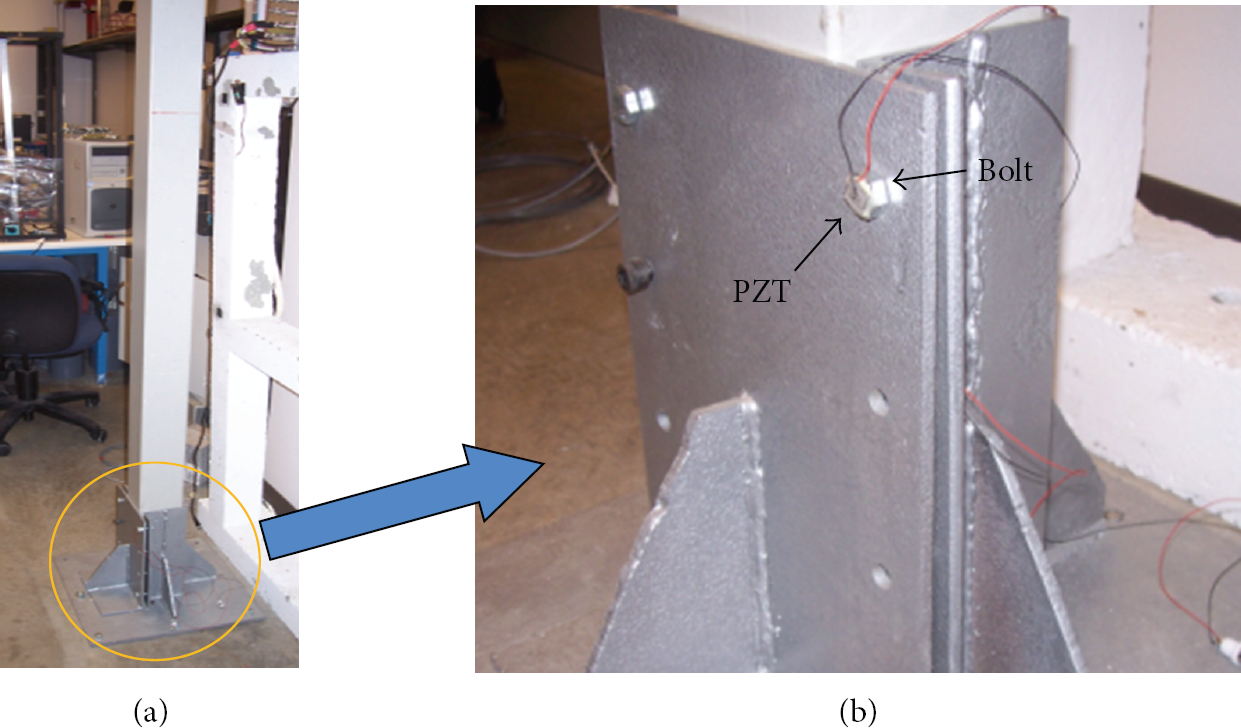
Piezoceramic transducer (actuator) bonded on the bolt cap.

Piezoceramic transducer (sensor) bonded on the other side.
4. Experimental Results
During the health monitoring test, a sweep sine wave was used as the excitation source for the PZT patch bonded on the surface of the bolt. The PZT patch bonded on the surface of the plate on the other side of the connection was used as a sensor. The sweep sine wave starts at 100 Hz and ends at 12 KHz with a period of 10 seconds. Wavelet packet analysis is used as the signal processing tool to extract the damage features. Daubechies wavelet (db10) is used as the mother wavelet. The decomposition level for the wavelet packet analysis is 3 and the sensor signals are decomposed into 8 subsets in different frequency bands. The proposed damage index is used to evaluate the damage status on the bolt.
From the time response comparison, shown in Figure 4, it is observed that there are some differences around 8–10 seconds for different torque cases; however, the differences are not very obvious. The wavelet packet analysis will be used here to further analyze the data. To extract more detailed damage information, the time responses were decomposed into 8 subsets by wavelet packet analysis. Figure 5 shows the decomposed signals in 8 frequency bands, respectively. It is noted from Figure 5 that the time responses in the frequency bands DAA (5th), DDA (6th), and DDD (8th) have very low energy levels as compared to the rest the frequency bands and will not be used for further consideration. For the frequency bands that have much higher energy levels, that is, the 1st, 2nd, 3rd, 4th, and 7th frequency bands (AAA, AAD, ADA, ADD, and DDA), a comparison of the decomposed signals reveals that there is an obvious difference between each case. During the process of tightening the bolt with increasing torque, the stiffness and boundary conditions changed significantly, which resulted in the change of wave propagation at different frequency ranges. To visually show the damage development, damage indices of different frequency bands are shown in Figure 6. The damage index figure quantitatively reveals the damage severities under different degrees of bolt looseness. From the experimental results shown in Figure 6, it is clear that the damage becomes more severe with less torque applied on the bolt, which means that the proposed wavelet packet based damage index can be used to represent the severity of bolt looseness.

Time response comparison for sweep sine wave responses.
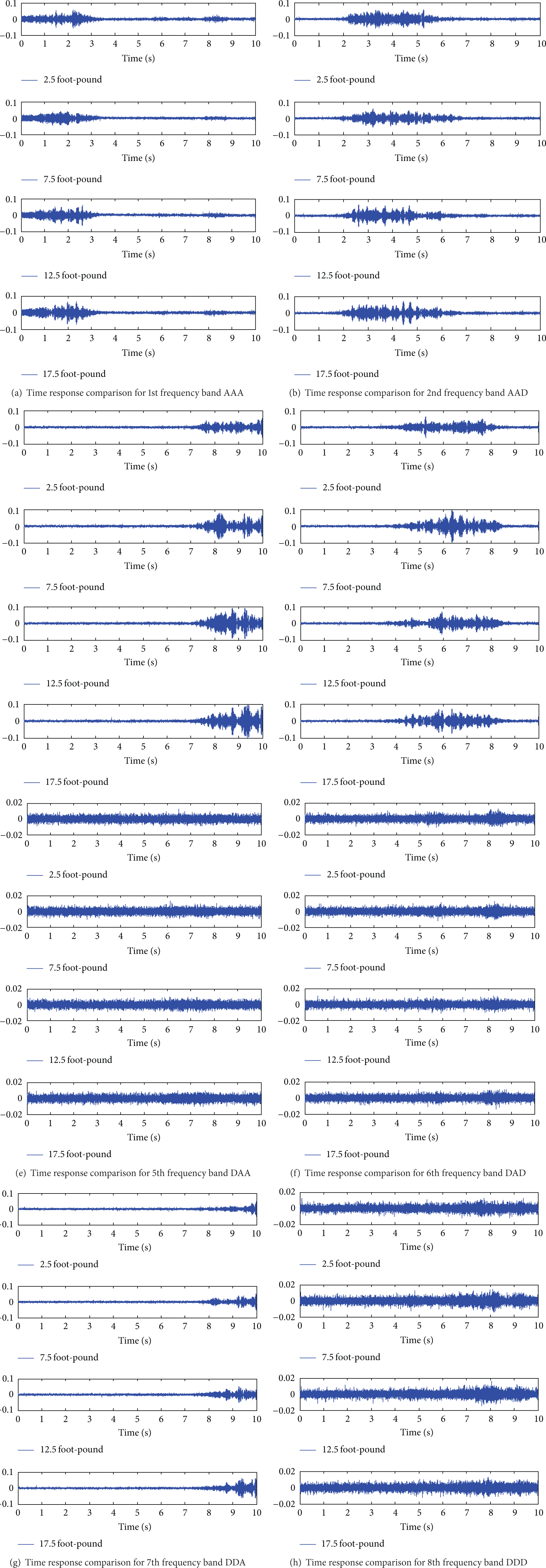
Time response comparison for different frequency bands.
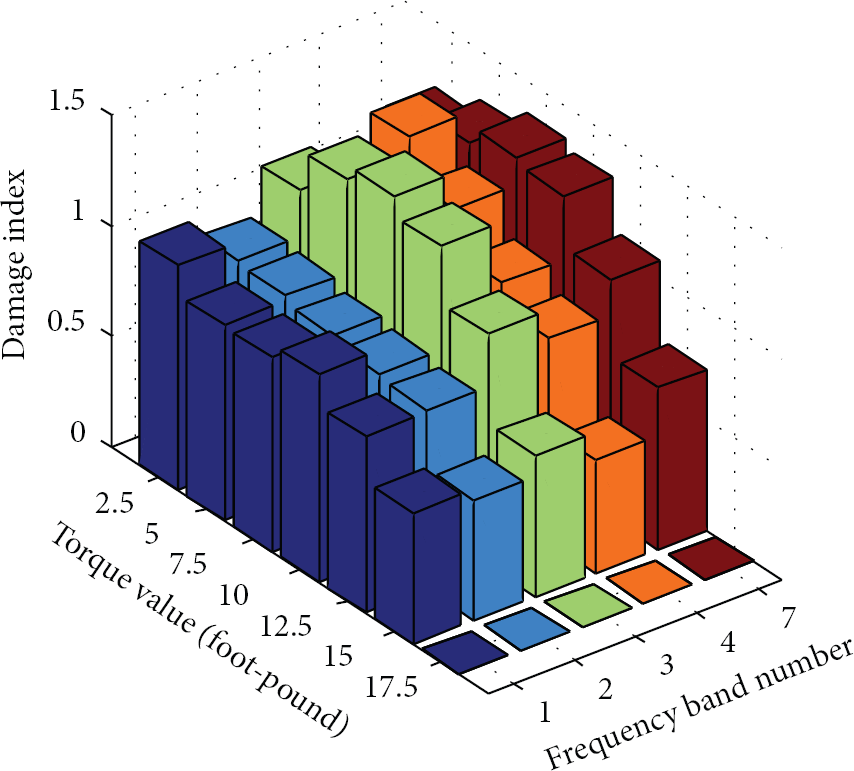
Damage indices of interested frequency bands.
5. Conclusion
In this paper, using piezoceramic patch transducers, an innovative active sensing approach was developed to perform bolt inspection in a structure. To simulate different damage severities, the looseness of a bolt was adjusted by a torque wrench with various torque values. In order to quantitatively evaluate the damage, a wavelet packet based damage index was developed. Experimental results show that damage indices captured damage features and the damage index values matched the damage development. The proposed approach has the ability to detect the loosening bolt at its incipient stage and has the potential to perform real-time inspection of bolted structures. Please note that a “calibration” process that uses different levels of applied torque is needed to establish the damage index of the bolt connection prior to field deployment. Since multiple bolt-nut pairs are often employed in a single connect, our future work will involve optimization algorithms [15, 16] to determine optimal sensor numbers and locations. In addition, the time reversal method will be explored in our future work to increase the sensitivity of the proposed method.
Footnotes
Acknowledgment
This research was partially supported by Grant nos. 51278387, 51278084, and 51121005 (Science Fund for Creative Research Groups) from the National Science Foundation of China (NSFC).