




Abstract
The energy hole problem exerts great impact on the energy efficiency and lifetime of wireless sensor networks (WSNs) based on many-to-one communication model. Unequal cluster emerged in recent years is a good way to alleviate the energy hole problem by dispersing cluster heads' burden. However, it fails to address this problem fundamentally due to its inherent characteristics. The single non-uniform nodes distribution strategy can alleviate the energy hole problem well by setting more nodes in networks to achieve energy balance, yet it may result in low energy efficiency and high cost of the networks. In this paper, by analyzing and minimizing intra- and inter-cluster energy consumption, we construct a suboptimal unequal cluster for WSNs. We propose a non-uniform sensor distribution strategy based on the previous unequal cluster in accordance with the energy balance principle. Simulation results show that our proposed non-uniform sensor nodes distribution strategy can not only achieve good energy efficiency as the unequal cluster method, but also ensure the network energy consumption balance and resolve the energy hole problem completely as the non-uniform sensor distribution approach. Furthermore, our algorithm needs fewer sensors to be settled than single non-uniform node distribution.
1. Introduction
Advances in MEMS-based sensor technology and wireless communications in recent years have contributed to the development of low-cost, low-power, multifunctional sensor nodes that are small in size with short communication distance and weak computational ability. These small sensor nodes are capable of sensing the environment, storing and processing the collected sensor data, and interacting and collaborating with each other within the network [1]. Due to the characteristics of strict energy constraint and nonrechargeable energy provision, the energy resource of sensor networks should be wisely managed to extend the lifetime of sensors. Since energy consumption is of vital importance for wireless sensor networks, much attention has been paid to low-power hardware design, collaborative signal processing techniques, and energy-efficient algorithms at various WSNs [2, 3].
The main goal of WSNs is to collect useful information as much as possible in the monitoring area, which implies that energy efficiency and lifetime of networks are very important. In order to achieve high energy efficiency and increase network lifetime, sensors are often hierarchically organized into clusters. Within a cluster, each node has its own cluster head (CH) and transmits data to its CH over relatively short distance, which in turn forwards the data (or it is further aggregated) to the sink via a single-hop or a multihop path through other CHs. Previous researches have shown that multi-hop communication between a data source and a data sink is usually more energy efficient than direct transmission due to the characteristics of wireless channel. This method can ensure high energy efficiency. However, the energy hole problem arises when the multi-hop forwarding model is used in intercluster communication. As the cluster heads close to the data sink are burdened with heavy relay traffic, they will die much faster than the other cluster heads, reducing sensing coverage and causing network partitioning [2, 4–7]. Although the strategy of rotating the cluster head role ensures that sensors consume energy in a more consistent manner, the energy hole problem described previously still cannot be eliminated. Experimental results in [4] show that when the network lifetime is over, up to 90% of the total initial energy of the nodes is left unused in uniform sensor distribution WSNs. The unbalanced distribution of communication loads caused by this problem has become a key factor that affects the lifetime of the networks.
In order to solve this problem, many strategies have been proposed. Some proposed clustering algorithms to alleviate this problem by wisely arranging the cluster size. The result is that clusters closer to the base station are expected to have smaller cluster size. By this way, the CHs will consume less energy during the intracluster data processing and preserve more energy for the inter-cluster relay traffic to prevent their premature death. This kind of unequal cluster strategy can alleviate the energy hole problem and achieve better energy efficiency than equal cluster structure in WSNs. But the energy hole problem described previously still cannot be eliminated completely due to its inherent characteristics of many-to-one communication. In nonhierarchical flat structure WSNs, Lian et al. [4] explicitly proposed a nonuniform node distribution strategy to solve the energy hole problem and enhance the data capacity. In [5], the authors also argue that energy depletion balance may be achieved by using the non-uniform node distribution method. Wu et al. [8] proposed a non-uniform node distribution method to address the energy hole problem. These single nonuniform node distribution strategies can solve the energy hole problem but need more nodes to be deployed for sharing the task of data relay without any data aggregation, thus resulting in lower energy efficiency and high cost.
In this paper, by combining the advantages of both unequal cluster and non-uniform node distribution approach, we develop a non-uniform sensor distribution strategy based on unequal cluster to eliminate the energy hole problem. We adopt the corona model of WSNs and divide energy consumption in each cluster into two parts including intra- and intercluster energy consumption. By analyzing the energy consumption relationship between intra-cluster data processing and inter-cluster data forwarding, we derive the expression of the per node energy consuming rate (ECR) based on the distance from clusters to the sink. Through ECR model, we find that if the cluster size (the same as corona width) is reasonably arranged, ECR will be minimized, which means minimal average energy consumption of nodes and longer network lifetime. With the minimal ECR in each corona, we deduce the non-uniform sensor distribution method.
In our strategy, nodes with different density are placed in different coronas according to the previous non-uniform sensor distribution results. If we let
The remainder of the paper is organized as follows. Section 2 covers related researches in this area; Section 3 introduces the system assumptions used throughout this paper; Section 4 establishes and analyzes the ECR model of sensor node with intra- and inter-cluster communication and introduces the calculation algorithm for non-uniform sensor distribution strategy; Section 5 elaborates on our simulation efforts and the analysis of the results obtained; Section 6 offers concluding remarks and points out research directions in the future.
2. Literature Review
In recent years, a large number of papers have been published on how to extend the network lifetime and solve energy hole problem for WSNs. Up till now, many algorithms about hierarchical cluster and nodes distribution have been proposed for addressing them. In the following part, we will give a brief review to the most important researches and findings related to our approach.
Li and Mohapatra [10] initiated the energy hole problem study in a large many-to-one sensor network. They described the energy hole in a corona model and defined the per node traffic load and the per node energy consuming rate (ECR), both of which are used in our paper. Based on the observation for ECR in each corona, they proved that nodes in inner coronas consume energy much faster and have shorter lifetime. They developed a mathematical model to analyze the energy hole problem and proved that hierarchical deployment and data compression have a positive effect in a uniformly distributed sensor network. Olariu and Stojmenović [11] are the first researchers to study the issue of whether energy hole can be avoided from a theoretical perspective. Assuming a wireless sensor network with uniform node distribution and uniform data reporting functions, they proposed an energy model to analyze the relationship between the network lifetime and the width of each corona in concentric corona model. By further assuming that the transmission range of sensor is adjustable, they demonstrated that when all the coronas have the same width, the energy consumed by routing can be minimized. Moreover, they points out conditions for avoiding the unbalanced energy depletion problem.
The major purpose for eliminating the energy hole problem is to enhance the network energy efficiency and prolong the lifetime. In flat WSNs, many authors [9, 12, 13] adopted the strategy of adjusting the transmission power of nodes to avoid the energy hole problem. By assigning different transmission radii according to the distance from sensors to sink, energy hole problem can be alleviated. Considering the energy consumption distribution for single-hop and multihop communication to the sink, Perillo et al. [14] proposed an alternate mode between multihop and singlehop to achieve energy consumption balance. They calculated the optimization of network lifetime in a linear programming problem. But the authors only consider that nodes use up their energy simultaneously without thinking of using energy efficiently to collect useful data. For hierarchical network algorithms based on cluster architecture, Heinzelman et al. [6] proposed the LEACH algorithm. Due to the communication with the base station by single hop, lots of energy is consumed in the long-distance communication. Many other cluster-based hierarchy algorithms are improved from LEACH [15–20]. Benefiting from data aggregation for redundant sensing data and the decrease of communication distance among nodes, hierarchical network algorithms can achieve better energy efficiency and energy consumption balance than flat algorithms. The energy hole problem is alleviated to some extent but is far from being solved.
To avoid the energy hole problem in multi-hop communication WSNs, unequal cluster concept which is different from the general equal hierarchical cluster algorithms has been adopted to extend the network lifetime in these years [21–24]. Soro and Heinzelman [21] investigated firstly an unequal clustering size model (UCS) to balance the energy consumption of cluster heads in multi-hop heterogeneous WSNs. Through both theoretical and experimental analyses, they proved that unequal cluster could be useful, especially for heavy traffic applications. EEUC [24, 25] has been proved as an efficient algorithm to address energy hole problem. In EEUC, clusters closer to the base station are smaller in size than those farther away from sink; thus, cluster heads closer to the base station can save some energy for forwarding inter-cluster data. This algorithm works well in balancing the energy consumption among cluster heads and slowing down their premature death. However, due to the inherent characteristics of a many-to-one communication, energy hole problem cannot be eliminated completely.
Another strategy to avoid the energy hole is the node density control, which can balance the energy consumption effectively. Lian et al. [4] proposed the non-uniform node distribution strategy in wireless sensor networks. The energy hole is caused by massive energy consumption near the sink. The energy hole problem can be solved completely by deploying more nodes near the sink to relay the distant data. Wu et al. [26] proposed a non-uniform node distribution strategy to achieve the subbalanced energy depletion. The authors point out that if the number of nodes in every corona increases in geometric progression with a predetermined ratio, the network can achieve balanced energy depletion. Olariu and Stojmenović [11] discussed the non-uniform node distribution strategy in wireless sensor networks. Assuming an energy consumption model in which only energy consumption for data transmission is considered, they proved that balanced energy depletion can be achieved when the node density of each corona is arranged proportionally. In their scheme, nodes near the sink have to send data at a lower rate. Compared with the hierarchical cluster algorithms, single node density control strategy can guarantee simultaneous energy depletion of all sensors but will result in lower energy efficiency and high cost because of the massive redundant data transmission and redundant node distribution.
3. Preliminaries
Before elaborating on our algorithm, we will introduce the characteristics of the network model used in our study. We consider a WSN consisting of sensors and sink and make the following assumptions.
3.1. Assumptions on Node and Energy of the Network
We consider a sensor network with N nodes in a circular area within a radius of R to continuously monitor the sensing area. We denote ith sensor by Each sensor has the maximum transmission range denoted by Nodes can estimate the approximate distance to another node based on the received signal strength. Nodes can use power control to adjust the transmission power according to the distance to the receiver. The links between nodes are symmetric, and time division multiple access (TDMA) scheduled data transmission from normal nodes to its cluster head. The network runs a periodic data gathering application. The sensor generates traffic at an average rate of λ bits/second and sends it to its CH, which in turn delivers it to the sink using multi-hop communication.

Sensor network area consisting of coronas.
A typical sensor node includes three basic units: sensing unit, processing unit, and transceivers. For our energy model of multi-hop forwarding scheme, we assume a free space propagation channel model [23]. We ignore the power consumption of node for sensing because it is constant at any time and cannot be reduced with whatever means. Thus, the energy model of a sensor involves the power for data aggregating, data receiving, and data transmission according to this radio hardware energy dissipation in both the free space (

Here, the electronics energy
3.2. The Sensor Network Model Based on Corona
We adopt the corona model in this paper. The area around sink is divided into coronas of a dynamic width as illustrated in Figure 1. We assume that the sink has a steady energy supply and a powerful radio that can cover the whole monitoring area. K concentric circles of radius
In many other unequal cluster algorithms like EEUC, the cluster's size far from the sink is always bigger than the cluster's size near the sink, so it is assumed that a sensor in

We have the following assumptions about the clustering approach in each corona: sensors whose distance to the sink is in
4. Nonuniform Sensors Distribution Strategy
As mentioned previously, when WSNs are sensing and collecting data, the redundant distribution sensor nodes are in the sleep mode. They turn off most of their components and only run a timer circuitry to listen to the channel. Hence, energy consumption of sensors in the sleep mode can be ignored. The active nodes are distributed uniformly with the minimal node density
4.1. ECR Model Based on Intra- and Intercluster Energy Consumption
In this section, we will analyze the energy consumption in cluster and deduce the mathematical model among the ECR, the cluster size, and the distance from node to sink. We formulate the suboptimal cluster size calculation approach in each corona based on the ECR. Instead of considering the energy consumption balance in every corona directly [3], we optimize the ECR in each corona. Let

Let


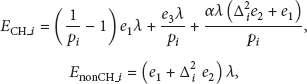

As the sensing data relay from the outside coronas is done hop by hop, the total traffic load carried by the CHs in the corona


Accordingly, the number of active nodes in corona

In [27], the author has proved that approximate
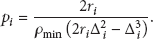
For simplicity, we set λ = 1 bit/second which will not affect the results of our analysis. Substituting (11) into (10), we can simplify

In order to further study the relationship of ECR between intra- and inter-cluster communications, we will split


4.2. The ECR Model Analysis
It can be seen from (10) that the data aggregation coefficient α and the cluster head probability
Next, we will analyze the relationship among
Figures 2, 3, 4, and 5 demonstrate the changes for ECR, average energy consumption rate for intra-cluster data processing and inter-cluster communication versus cluster size

Node energy consumption rate versus cluster radius

Node energy consumption rate versus cluster radius

Node energy consumption rate versus cluster radius
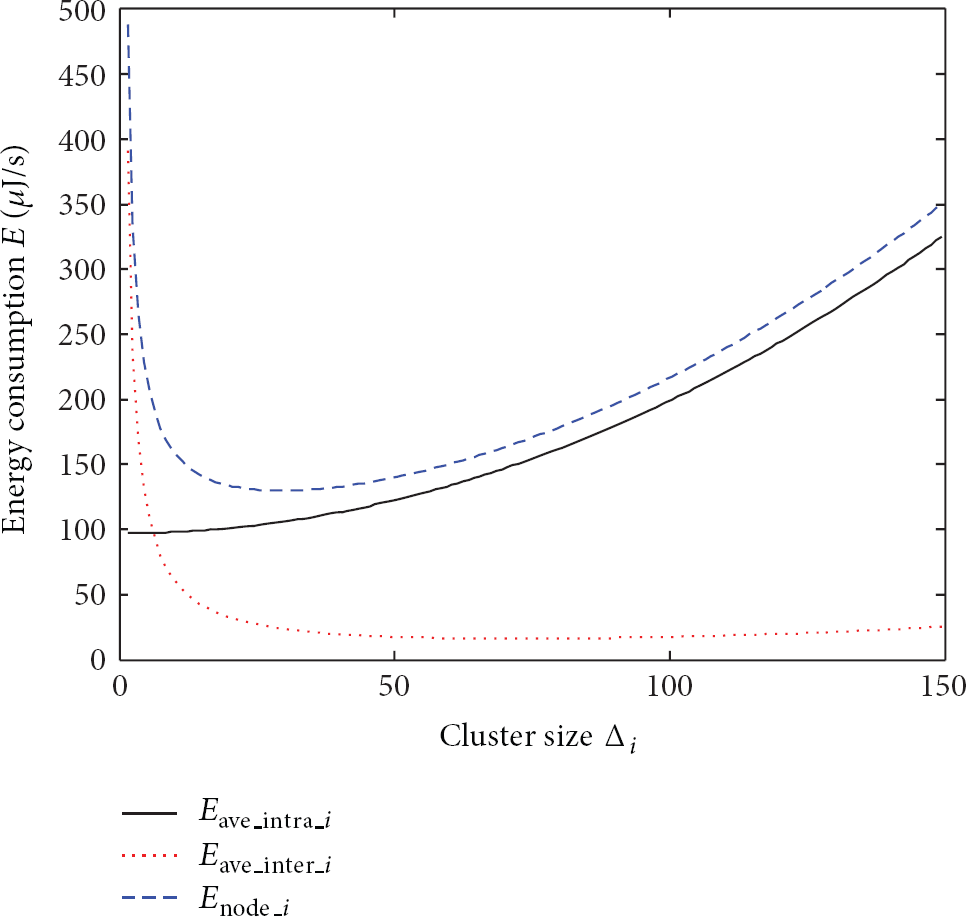
Node energy consumption rate versus cluster radius
As shown in Figures 4 and 5, when the upper bound of corona
Figure 6 illustrates the change of

Node energy consumption rate versus the distance form sink
4.3. The Computation for Sub-optimal Unequal Cluster and Minimal ECR
From the previous analysis, we can calculate a group of optimal
We notice that the cluster size is equal to the corona width in corona

In (15),

Node energy consumption rate in corona
After


In (18)



It is obvious that

The values of
From (13), in the outermost corona
4.4. The Nonuniform Nodes Distribution Strategy
After we have obtained

To put it simple, we assume that each sensor has the power of
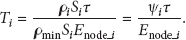
Ideally, if there is no residual energy for all nodes when network loses its function, the network lifetime and the energy efficiency are maximized. That is,

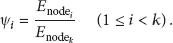

As the minimal values of
4.5. The Data Transmission Mechanism
In order to get higher data transmission efficiency, we design an energy-balancing layered data transmission mechanism based on the previous non-uniform sensor distribution algorithm. Firstly, the sink constructs the unequal coronas, and sensor node can be deployed according to the results derived in the previous section. Sensor nodes select CHs and join the adjacent CH based on its distance to sink. Upon completion of the suboptimal unequal clusters, CHs are able to deliver their data to the sink. Each CH firstly aggregates the data received from its cluster members and then transfers them to the sink node via a multi-hop path through other intermediate CHs. The organization of intra-cluster data transmission is similar to LEACH, so we will not elaborate it again in this section. The pseudocode of the inter-cluster data relay algorithm is presented in Algorithm 1. In order to achieve balanced energy depletion among the CHs, they firstly exchange their energy and position information CHMessage to maintain a real-time table CoronaList about the neighbor cluster head. By this algorithm, CH can select one relay CH with maximum energy resource. At the same time, it has to exchange the residual energy message with all candidate relay CHs in lines 4–12 of Algorithm 1. After selecting the relay CH with the maximum residual energy, the CH can forward its own data and the data coming from its upper corona. The process of selecting relay CH and forwarding data will be repeated until the data arrive at sink node in lines 13–17 of Algorithm 1. If there is more than one candidate with the same maximum residual energy, choose one of them randomly. When SystemMessage is received, for instance, instructions for completing data transfer or reelecting cluster head, and another interrupt instruction is trigged by sink node, the network will terminate the data transmission process.
(1) CalculateCHMessage(ID, Layer_ID, ResEnergy) (2) Exchange(CHMessage) in adjacent corona (3) Rec_Message(CHMessage) from Neighbor_CH (4) (5) add node Neighbor_CH to CH.Up_CoronaList (6) Return (CHMessage(ID, Layer_ID, ResEnergy)) to Neighbor_CH (7) (8) (9) add node Neighbor_CH to CH.Down_CoronaList (10) Request (CHMessage(ID, Layer_ID, ResEnergy)) from Neighbor_CH (11) Update (CH.Down_CoronaList) (12) (13) (14) { (15) {CH.Down = MaxResEnergy(CH.Down_CoronaList) (16) Transfer_Data(CH.Down, Neighbor_CH.Data)} (17) (18) (19) }
On the other hand, as indicated in Algorithm 1, since the non-uniform sensor distribution strategy based on unequal cluster can be calculated by the sink node, the complexity of network cluster protocol is determined by the clustering algorithm and inter-cluster data transmission mechanism. The non-uniform sensor distribution strategy based on unequal cluster does not increase the complexity of network.
5. Simulation Results
In this section, both the numerical results and the performance results of our strategy will be presented via simulation by MATLAB. At the beginning, we will calculate the optimal corona width and build the unequal hierarchical cluster network based on network parameters. Then we calculate the node distribution density in each corona. As the node distribution algorithm is based on unequal cluster, the performance of unequal clustering will directly influence the energy efficiency of network. Therefore, we firstly examine the performance of our unequal cluster algorithm, by comparing with two typical cluster protocols EEUC and LEACH. Then, we verify the effectiveness of our algorithm in eliminating the energy hole problem. At the same time, we prove that our distribution strategy has better energy efficiency and network lifetime with less sense nodes compared with the single node distribution strategy [26].
In order to conduct the experiments, proper parameters for both the sensor nodes and the network should be defined. We assign
Parameters and characteristics of the network.

5.1. Calculation for Nonuniform Sensor Distribution Based on Unequal Cluster
According to our non-uniform sensor distribution strategy, the circle sensing area is partitioned into unequal clusters firstly based on the parameters in Table 1. The size of the innermost corona will be determined firstly, followed by size of outermost corona until the conditions of terminating iteration is triggered. Then, the corresponding non-uniform distribution sensors density with minimal ECR in each corona can be achieved as indicated in Table 2.
Optimal nonuniform sensor distribution density and unequal clusters.

As mentioned in the previous section, the energy hole problem may arise in multi-hop wireless sensor networks if the cluster heads close to the data sink are burdened with heavy relay traffic. Different from the general opinions on unequal cluster, for instance, EEUC which argues that clusters closer to sink should be smaller in size, we find that cluster will not always be downsized as the distance from clusters to sink decreases so long as ECR in each corona obtains the minimal value. Downsizing the cluster will result in cluster increase in inner corona. Though it can alleviate relay traffic burden on the CH nodes, ECR in the whole cluster will increase dramatically, which will exacerbate the energy hole problem because of the decrease of cluster members. This result serves as an important guideline for the design of unequal cluster. In the following simulation test, we will prove that our unequal cluster can achieve better performance than EEUC.
5.2. Performance of Nonuniform Sensor Distribution Strategy Based on Unequal Cluster
Since the sensor distribution strategy is based on unequal clusters, the performance of the unequal cluster based on our optimal algorithm will exert great impact on network. We will firstly review the characteristics of the unequal cluster by comparing with cluster algorithms such as LEACH and EEUC. Simulation results show that our unequal cluster can achieve better energy consumption balance between cluster heads and minimal ECR in the whole network. Secondly, we will look into our non-uniform sensor distribution strategy in terms of the residual energy of nodes, the number of nodes that need to be distributed, and the network lifetime.
5.2.1. The Performance of Unequal Cluster
In our scenarios, we use the same parameters for EEUC mechanism [24] with the node density being
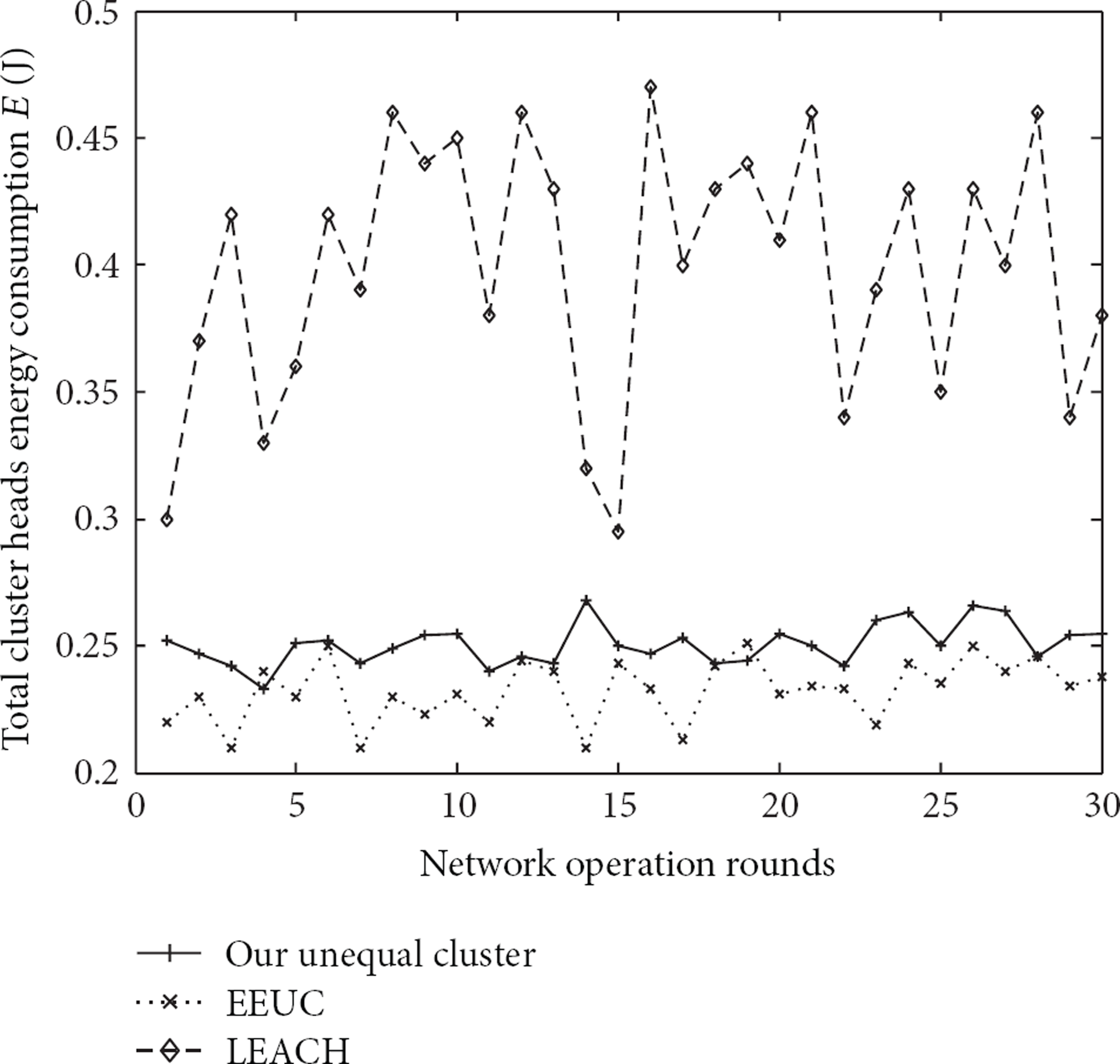
Total energy consumption of cluster heads.
Generally speaking, in accordance with the basic principle to avoid energy hole problem using unequal cluster algorithm, more nodes need to participate in traffic data relay, in inner corona in particular. However, to ensure longer network lifetime, we should not only consider the energy balance among the cluster head nodes but also consider the energy balance among all cluster members. ECR is an important parameter to measure energy consumption of all cluster members. In EEUC, the balance of energy consumption for cluster heads is the only factor that is taken into consideration, with ECR which has direct bearings on network lifetime being ignored. Figure 9 shows the change of ECR based on the distance from nodes to sink for three algorithms. It can be seen that our algorithm is better than EEUC in terms of nodes' average energy consumption rate. For LEACH, the average energy consumption of network nodes will increase sharply when nodes are away from sink because of the long distance in single-hop communications.

The energy consumption per node.
5.2.2. Energy Efficiency and Lifetime
In this part, we will analyze the energy efficiency and lifetime of our strategy. Firstly, we will study the residual energy of each node when the network lifetime ends. Then, we compare the sensor density of our strategy with that of other non-uniform sensor distribution methods. Finally, we verify that our non-uniform sensor distribution strategy based on unequal cluster can obtain longer network lifetime and better energy efficiency.
Firstly, we examine residual energy of nodes when the network lifetime ends. We define the network lifetime as the time period until WSNs cannot guarantee the effective coverage and data sensing and collection for the monitoring area. And sensor death in the network means the sensor loses the ability to sense data or send data to its cluster head. Figure 10 shows the cumulate residual energy of nodes in each corona when the network lifetime ends. The fitting fragments of line indicating the total energy of the nodes belong to the five coronas C 1–C 5 from right to left. It can be seen that when the network lifetime ends, there is nearly no residual energy in the network since only few sensors have residual energy. Through further analysis, we can find that the little residual energy is the result of energy consumption unbalance in the cluster topology maintenance and node sleep-listening mechanism in different coronas. For data relay, unbalanced energy consumption is prevented, or the energy consumption balance of the entire network is achieved indirectly, and the energy hole problem is solved completely. On the other hand, it also proves that the nonoptimal ECR in the outermost corona in our strategy exerts no adverse impact on the elimination of energy hole problem.

The nodes' residual energy when WSNs lose function.
Secondly, we compare the deployed sensors' density of our strategy with that of other non-uniform sensor distribution methods. In [26], we propose a non-uniform node distribution strategy to achieve the balance of energy depletion. We also point out that if the density of nodes in coronas increases in geometric progression with common ratio, energy depletion balance in the network can be achieved and the energy hole problem could be solved.
In this distribution strategy, sensor nodes are not organized into cluster hierarchy structure, and the monitoring area is divided into coronas with the same width. Each node in the network has several candidate relay nodes in the next inner corona. All experiments are done with the same minimized node density
In Figure 11, we can see that node distribution density is much lower in our non-uniform sensor distribution strategy. Figure 12 shows the specific number of distribution nodes in each corona for the two non-uniform sensor distribution strategies. It is obvious that few sensors are needed to effectively monitor the sensing area and eliminate the energy hole problem if our strategy is adopted. This is mainly due to the inherent advantages of the unequal cluster, including data aggregating, efficient data routing mechanism, and lower radio communication conflicts. Data aggregating can significantly reduce the frequency of data forwarding, and cluster hierarchy can be used to select efficient routing path more easily.

Node distribution redundancy rate coefficient.

The number of distributed nodes in each corona.
Finally, we verify the network lifetime and energy efficiency for our non-uniform sensor distribution strategy based on the unequal cluster. In order to estimate the lifetime of the WSNs, the metrics of First Node Dies (FND), Percent of the Nodes Alive (PNA), and Last Node Dies (LND) are always used [11]. FND is useful in sparsely deployed WSNs. However, PNA is more suitable to measure the network lifetime in densely deployed WSNs. LND does not have much practical value. FND and LND are not suitable for our node distribution strategy. When WSNs lose its ability to collect and transmit data, the network is regarded as dead.
Figure 13 shows the number of sensor nodes that are still alive during simulation test, and Figure 14 illustrates the rounds of data transmission for the four strategies during their lifetime. For EEUC, as more cluster heads participate in the traffic relay in inner corona, it can balance the energy consumption between cluster heads. Moreover, it can achieve better energy efficiency and longer lifetime than LEACH with the FND metric. But the energy hole problem which is inevitable in uniform sensor distribution WSNs, even in cluster hierarchy structure, will cause much residual energy when the network lifetime ends. For single non-uniform node distribution strategy, energy consumption balance of sensors can be ensured, and all the sensor nodes will die nearly at the same time. Therefore, the energy hole problem has been resolved completely. But consider the nodes that need to be settled, we will find that this strategy may result in very low energy efficiency and high cost for WSNs.

The network lifetime.

The rounds of data transmission.
In our non-uniform sensor distribution strategy based on unequal cluster, we adjust the node distribution density according to the minimal value of ECR in each corona while taking into account the energy consumption of cluster heads and cluster members. From Figures 13 and 14, we can see that the FND occurs early in our strategy, but the network still works well in network coverage and data collection through sleep-listening mechanism of redundant nodes. When the number of survival nodes in the network approaches 400, all the remaining nodes will use up their residual energy almost at the same time, and then the network lifetime ends. In this way, the energy consumption balance for the entire network is achieved, and the energy hole problem is eliminated completely. From the simulation results, it can be seen that our strategy can ensure longer network lifetime and better energy efficiency compared with the other three strategies.
6. Conclusion
In this paper, we have proposed a nonuniform sensor distribution strategy based on unequal cluster for WSNs. The major objective of our algorithm is to resolve the energy hole problem and improve the performance of WSNs based on multi-hop communication.
By focusing on intra- and intercluster energy consumption and using the ECR model, we calculate the minimal value of ECR according to the distance to the base station and deduce the non-uniform node distribution strategy. Our non-uniform sensor distribution mechanism works well in eliminating the energy hole problem by balancing average energy consumption speed of cluster nodes. Through sleep-listening mechanism of redundant nodes and suboptimal unequal cluster protocol, our non-uniform sensor distribution strategy can ensure better energy efficiency and longer network lifetime. Moreover, we have proved that our strategy ensures better performance than LEACH, EEUC, and other single non-uniform sensor distribution algorithms, as evidenced by the simulation results.
We also find that minor unbalance in energy consumption will be caused by cluster topology maintenance and node sleep-listening mechanism in different coronas if our strategy is adopted. In this paper, we only use a simple sleep-listening schedule approach. How to get the efficient cluster topology maintenance approach and node sleep-listening mechanism for our algorithm are the major issues we need to solve in the future.