




Abstract
Smart work services can help to reduce work time and help to remove irrational processes in the process of product management, by providing proper information promptly. To make the smart work environment, the system has to be in a data-driven manner so that the data can keep its consistency. Preexisting data acquisition method in inspection job is almost based on documents or handover from other engineers. However, sometimes it produces inconsistent data which is different from updated information and it leads to potential risk factors. To prevent and reduce inconstant information between users and updated information, this paper suggests radio-frequency identification device (RFID) and cloud technology.
1. Background
The proportion of the cost incurred by operation phases is known to be a maximum of 80%, in which the overall cost of the entire lifecycle includes the total cost of the product from its manufacturing to its disposal. Therefore, many industries have been researching effective methods of product management using convergence technologies such as PEID (product embedded identification) [1, 2], PLCS (product life cycle support) [3], PLM (product lifecycle management) [4], and e-PLM (extended product lifecycle management) [5]. To reduce these costs, products must be maintained in a sufficient operational state so that they can be repaired as soon as possible in the event that they fail. However, the maintenance cost increases when higher-priced product such as airplanes, submarines, and offshore plants fail. This is especially true for costly marine products, especially FPSO (floating production storage and offloading) products which consist of more than one million parts. This makes it more difficult to maintain these types of products. Thus, the information of these millions of parts must be managed systematically and must be able to be provided to engineers rapidly to help with their maintenance actions. Large ship management companies have their own enterprise management systems to control and supervise their fleets, offering a link between ships and a shore office (Figure 1). Moreover, each ship has its own specific management system connected to the ship management company. However, these are high level management systems, which simply integrate information pertaining to operation or maintenance actions. Engineers still must make an effort to find design information from management system information or manuals. During the processes, many redundant actions can occur, requiring additional effort or leading to erroneous results when engineers make incorrect choices. Moreover, it produces inconsistent information because of the engineer's mistake. Swift and accurate operation and maintenance based on precise information can help to improve product safety and can help to reduce the operational cost incurred by delayed actions. Hence, information consistency to maintain validated information during maintenance is an important requirement. This paper suggests mobile technology based on cloud and RFID (radio-frequency identification) system to acquire correct information and retain the consistency of information. We focused on the inspection process and developed and validated an inspection prototype. In the remainder of this paper, Section 2 presents an overview of the different researches in this area. In Section 3, a brief introduction of technologies that retain the consistency of information is given along with a definition of RFID and cloud services. Section 4 presents a detailed explanation of the RFID-based cloud inspection system. The experimental results of our prototype are discussed in Section 5.

(a) Current ship to maintenance work field interaction. Note the manual handover of the information alignment step while receiving/updating the Ship management system. (b) The proposed system interaction approach. By synchronizing the information between the maintenance work field and the ship's management system, engineers are able to be provided with updated information continually.
2. Related Work
PROMISE [6]. The aim of the PROMISE project is to develop a new generation of PLM system that uses a smart embedded information technology system to allow the seamless flow and transformation of data and information. The system is also able to allow all participants in a product's lifecycle to manage and control product information at any moment of its lifecycle and at any place in the world. PROMISE technologies consist of a product embedded information device (PEID), decision support system (DSS), product data knowledge management (PDKM), and promise middleware.
PEID can collect products information where in products inside and it transfers to management server. All of the product's data are controlled under middleware system without making any inconsistent data (Figure 2).

The figure shows a demonstration of end of life vehicles. A vehicle is installed in PEIDs, which become important machinery, and all information which comes from the vehicle is sent to PDKM/DSS through the PROMISE middleware.
Cloud PLM (Product Lifecycle Management): FriedParts [7]. PLM software allows companies to manage the entire lifecycle of the products efficiently and cost effectively, from ideation, design, and manufacture to service and disposal [8]. Therefore, a PLM system must have all of the information pertaining to product's parts, and this information must be collected from many other systems, such as computer-aided design (CAD), computer-aided manufacturing (CAM), computer-aided engineering (CAE), product data management (PDM), and purchasing and accounting systems (ERP). During such a process, a substantial amount of redundant data can arise, which leads to information inconsistency between the design intent and the actual fabrication. This work introduces an approach to bridge the tool-chain divide web-based architecture, known as FriedPart. FriedParts is a technology demonstration of the idea that CAD and PLM should share a single parts database to eliminate synchronization effort and errors. It should exploit online information sources and should simplify and automate date-entry tasks (Figure 3).

FriedPart's system architecture. The core infrastructure divided into four cloud-hosted components which work together to run the website and manage its data.
This work includes a simulation of the proposed method to prevent information inconsistency using a web-based cloud service, but here we focus on a lower level of data management related to inspections and attempt to apply RFID technology to acquire validated information and maintain the coherence of information during transfers.
3. Consistent Technology
This paper suggests three technologies which we refer to as consistency technology. These are RFID to detect data precisely and to derive the correct information, a cloud service to maintain the consistency of the information, and ZigBee-based ubiquitous sensor network to connect with server.
3.1. Cloud
Cloud service refers to the datacenter hardware and software that provides various services over the Internet. Cloud computing refers to both applications delivered as services, the hardware and the system software in the datacenters. The advantage of the cloud service is that service providers enjoy greatly simplified software installation and maintenance and centralized control over versioning; an end user can access the service “anytime, anywhere,” share data collaborate more easily, and keep their data stored safely in the infrastructure [9].
From a field engineer's viewpoint, a list of parts information used in the design is always needed for maintenance actions (Figure 4). Moreover, they have to know this information before they start the work. Therefore, this paper suggests the use of a mobile device which is able to provide design information. However, the resources of the mobile device, for example, its storage capabilities, computing performance, or application environment, are limited compared to those of a laptop computer. All of the information or the management system cannot be contained in a mobile device; therefore, only essential data can be contained in the mobile device. Additionally, the updated information can be confirmed before the work is started by the field engineers, as the mobile devices are operated in an independent environment that is separated from the management system. In this paper, the cloud service is applied to synchronize the module for the importing of the essential information required for inspection; for example, checklists, guidance material, manuals, or a list of parts used in the design, and for the importing and exporting of the last updated information before and after the inspection.

Users and providers of cloud computing. The cloud infrastructure consists of hardware for data warehousing and providers for transferring and providing software as a service.
3.2. RFID (Radio-Frequency Identification)
RFID uses radio-frequency waves and electromagnetic induction to transfer data between a reader and an item that is to be detected, identified, or tracked. An RFID system comprises RFID tags (transponders) that are electrically programmed with unique information and an RF module (reader) with a decoder (transceiver) [10]. The technology is considered to be one of the pivotal enablers of the “Internet of Things.” It has been labeled as the next generation of bar coding; however, it can provide much more, such as recognizing items in real time to derive important information related to the design or a list of parts used in the design (e.g., the bill of materials—BOM) [11]. RFID increases the levels of productivity and convenience in processes and has thus become an integral part of life. This technology is used in many applications and industries, such as theft prevention, toll collection, traffic management, access control, automated parking, the dispensing of goods, the tracking of library books, intermodal container shipment, and in the tracking of assets in supply chain management (Figure 5) [12, 13].

The RFID reader used in the case study. It supports Bluetooth interface to connect with a mobile device.
This paper seeks to explore how RFID technology can be used to retain information consistency in a cloud service. Section 4 deals with the design of the RF-detecting service.
3.3. ZigBee-Based USN
The ubiquitous sensor network is a wireless-communication infrastructure which is able to form a mesh topology, connecting a device with other devices. In ship structure, USN has a meaning of obtain ship design information wirelessly in anywhere and anytime through the connection of USN. In a ship structures however, there are many types of structural steels that are hindering data communication [14], which is the rising problem about building a wireless communication network. To configure the USN appropriately for the ship's structure, we are using ZigBee technology and Ethernet line, because ZigBee technology has a few advantages in cost and power consumption and also that it can be organized as a mesh topology. Mesh topology means that many devices are connected with each other like a mesh and that makes possible a stable connection, in which even though transfer line is blocked by obstacles.
However transferring speed is too low to send a big size of the ship model data, so we combined Ethernet lines to our USN system that play a role in transferring the ship design information. ZigBee just functions as monitoring pipes and communicates with simple text data from fields to server. Figure 6 shows the configuration of ZigBee-based USN with Ethernet (power line communication: PLC) and wireless protocols (IEEE 802.15.4 and IEEE 802.11x).

ZigBee-based USN configuration.
4. RF Inspection Based on Cloud
Information derived from erroneous data seriously affects the overall maintenance system in ship management operations. Therefore, precise information is always important for proper product management, and all of the information must be updated continuously. This paper suggests an RFID-based clouding inspection service which is capable of acquiring highly accurate information and which provides updated information to engineers for effective maintenance.
4.1. System Architecture
The RFID-based cloud inspection mobile system has three main components: a mobile device running the Android OS, RFID, and a cloud server. Significantly, both of the mobile device and the RFID components are located on the client side, while the cloud is on the server side. All inspection information acquired by inspectors with the mobile inspection system is recorded in an SQLite database system. After an inspection, this information is transferred to the main maintenance system through the cloud server system to automatically synchronize the information of the client and the server system. RFID is used for communication with the mobile device under the Bluetooth protocol.
To generate and manage the relationships between the RFID tags and inspection items, a shared database exists in the mobile device. Therefore, the RFID-based cloud inspection mobile system is able to compare a tag's number within data tables which contain the relationships with the parts list. The RFID-based cloud inspection mobile service mainly consists of detection and synchronization services, apart from the electric (Figure 7). Each module is briefly described below.

Overview of the RFID-based cloud inspection mobile system framework.
4.2. RF-Detection Service
The RFID-based cloud inspection mobile system adopts DOTR-900 with a UHF RFID reader with a Bluetooth interface (Figure 6). DOTR-900 supports various operations, including the Android OS. All of the data files in the mobile module are synchronized with the maintenance server through the cloud system. In addition, this system is operated under wireless communication infrastructure known as a USN (ubiquitous sensor network), which was investigated in an earlier study by the authors [15]. The RFID tags refer to one of the parts lists used in the product design process, creating a link to that information. These relationships have to be managed by the mobile system to compare the tag numbers and thus to create a database set. This database must be synchronized with the main maintenance system.
4.3. Synchronization Service
Cloud to Device Messaging Framework (C2DM) services are used to synchronize information between engineers and the data server, which is provided by Goggle. Message sender has to be issued authoring identification from C2DM server and has to register the user's device [16]. C2DM can send/receive message to/from other users' devices to notify changed information. This system is based on Java SE JDK v6.0, Apache Maven 2.2.1, the Android OS. In a case study, we utilized Galaxy Tab 10.1 running Android OS 4.0, and the cloud/data server system is operated under Windows Server 2008. The client system does not always under run on a wireless network. Hence, the client system must be able to be operated independently and be able to connect to the cloud server system flexibly when it operates under a wireless network environment (Figure 8).
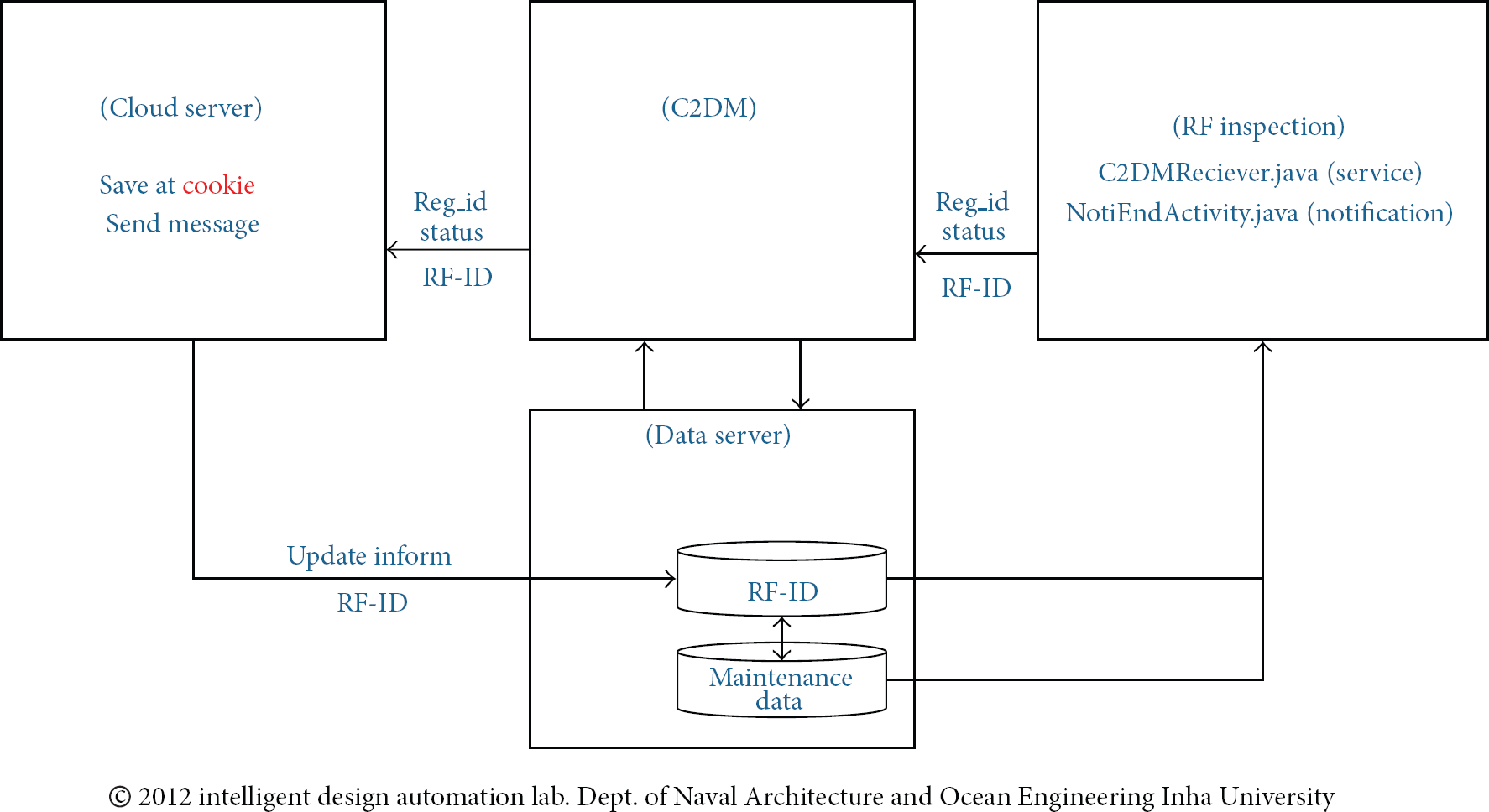
Synchronization service by using C2DM. C2DM is based on sending a device message and it informs to the device when its status has changed or requests are called.
5. Case Study
This study was applied to a PSC (Port State Control) inspection system in a case study. This study utilizes an Android-OS-based mobile device in an RFID-based cloud inspection mobile service system. The existing approach to find information and to inspect the parts of a ship adopts a manually printed paper-based checklist sheet. Most of the inspection tasks in a maintenance job are paper-based tasks, including the following:
copying and finding the checklist; seeking items on the checklist sheet; understanding how to inspect the items; memorizing the results; collecting evidence data; making a report in an office based on the inspection results and collecting data;
However, the inspection processes are often labor-intensive tasks, as above. Thus, they can cause inspectors to make mistakes and thus require rework to be done. Moreover, the process of seeking the checklist and finding the information for the inspection requires more time. Therefore, the inspectors utilize the RFID-based cloud inspection mobile system to enhance the inspection and maintenance management in the case study. 900 MHz passive RFID tags were used in the case study (Figures 9 and 10). Five tags were utilized for inspecting the following items: a survival craft, a fire detector, a life jacket, survey reports, and a GMDSS operator.

The card-type RFID tag used in case study. 900 MHz tag can be attached to tags on steel structures and can be detected from a distance of about 1 meter. The system can detect five hundred tags at once.

Display of the detected RFID tag information on a Smart Pad. The inspection information will be displayed once the inspectors select an item from the item list.
During the preparation phase, all of the RFID tags are attached on the wall of the inspection room. Each tag is scanned and checked before the maintenance work. Before the inspection work, the inspectors can confirm that their checklists are updated and then check the inspection list using the checklist sheet from the Smart Pad (Figures 11 and 12). The system refers to the related inspection information and the inspectors can complete their preparation work without a printed checklist or an inspection manual. During the inspection/maintenance process, the inspectors scan the RFID tag first and confirm the items for the inspection, after which they check for further detailed information such as previously examined results or examples under the USN (ubiquitous sensor network) circumstance. If the inspectors want to take pictures and prepare the results of their inspection in a report, they can take a picture and leave a note simultaneously with the mobile system without the need to go back to the office and recall the memorized data. After the items are inspected, the inspectors input the result of the inspection into the mobile device directly, and the cloud service then performs a synchronizing updated of the inspection data automatically to the main management system, which is located in a control room.

Display of the updated checklist sheet on the Smart Pad. Inspectors can record the result of the inspected items and confirm the examples of the existing inspection results.
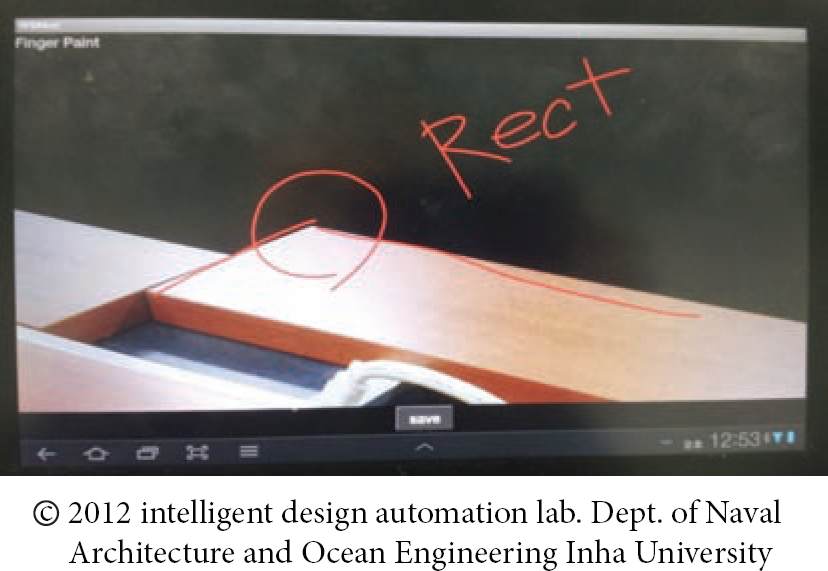
A display showing an image taken as an inspection evidence. With a mobile device, inspectors are able to take pictures and create memo simultaneously.
5.1. Evaluation
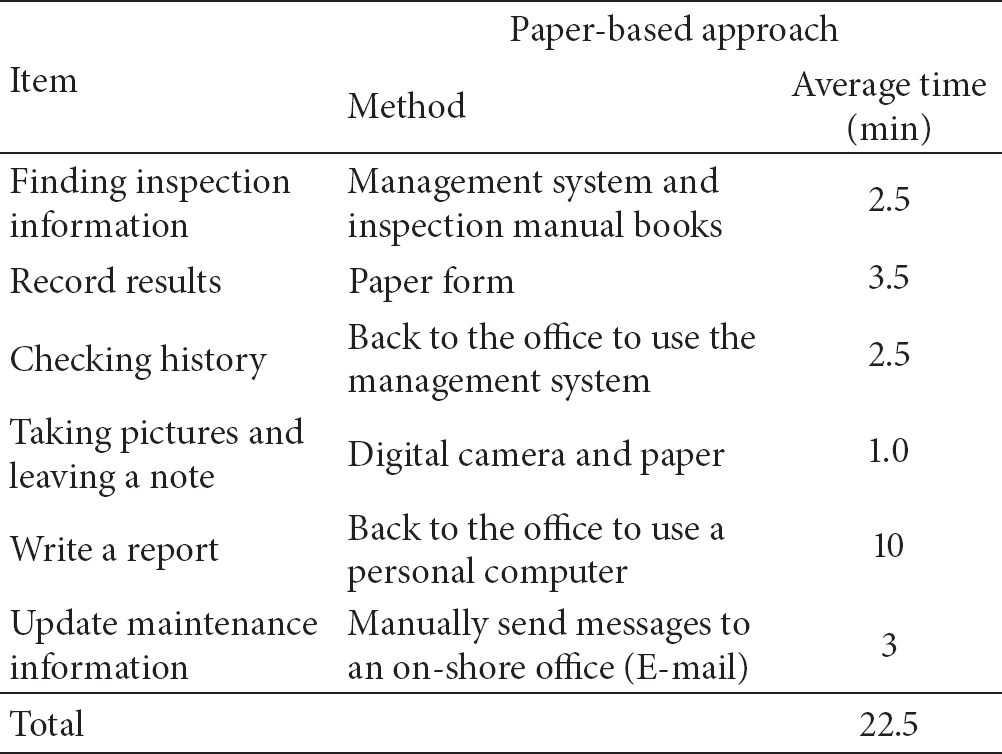
Overall, the field test results indicate that the RFID and cloud service were effective for the inspection and maintenance process as part of the overall ship management system. The evaluators in the case study consisted of three maintenance managers who belonged to the ship management company and three students who were majoring in naval architecture and ocean engineering. To evaluate the system functions and the level of satisfaction with the system performance, we distributed questionnaires and the users of the system were asked to grade the conditions of system testing, system functions, and system capabilities separately, as compared to the paper-based maintenance method, on a five-point Likert scale. Tables 1 and 2 show a comparison of the approximate time required for a typical inspection task using the printed paper-based inspection approach and the proposed mobile inspection system. 90% of the replies to the user satisfaction survey indicated that the RFID-based cloud inspection mobile system is quite adaptable to the current inspection/maintenance system and is attractive to users. This result implies that the proposed RFID-based cloud inspection mobile system is well designed and can enhance the current time-consuming inspection/maintenance process, leading to a 30% improvement in efficiency. The 90% result showing inspector satisfaction in the survey indicates that the system automatically generated reports and was able to query the historical data in the main data server and to provide precise and highly trustworthy information through the RFID tags and the mobile system.
System evaluation results: paper-based approach.
System evaluation results: proposed approach.

6. Conclusion
In this study, we suggested mobile inspection system for effective maintenance with RFID applied to cloud technology to retain the consistency of information. The contribution of this work is significant in that it elucidates the applicability of the proposed method to existing inspection/maintenance systems, offers a systematic solution, and provides a working technology demonstration of the approach. Maintenance actions must be done based on precise information and must be able to present the information rapidly from a maintenance repository. RFID technology can be used to detect accurate data and can derive the correct information. To maintain the consistency of the information between the inspection and management systems, all inspection data are synchronized via a cloud system. The RFID and cloud environment are useful for product maintenance this technology is consistent and reliable. We predict that these technologies will improve the efficiency and accuracy of maintenance operations.
Footnotes
Acknowledgments
This work was supported by the Industrial Strategic Technology Development Program (10041790) funded by the Ministry of Knowledge Economy (MKE, Korea), the National Research Foundation of Korea (NRF) grant funded by the Korean government (MEST) (NRF-2011-0010243) and INHA research grant.