




Abstract
Gossip algorithm has been widely regarded as a simple and efficient method to improve quality of service (QoS) in large-scale network which requires rapid information dissemination. In this paper, information dissemination based on algebraic gossip in a random geometric graph (RGG) is considered. The n nodes only have knowledge about their own contents. In every time slot, each node communicates with a neighbor partner chosen randomly. The goal is to disseminate all of the messages rapidly among the nodes. We show that the gain of the convergence time is
1. Introduction
With the increased demand for network resources and the expansion of the variety of information resources, information dissemination based on gossip becomes an effective way to improve quality of service (QoS) in large-scale network environment. Gossip algorithm is a simple and efficient algorithm which has good extensibility and robustness to adapt to the large-scale network environment well; it also reduces the redundancy of the retransmission to disseminate information in a wide range of distributed applications. Recently, gossip algorithms have been proposed for many distributed applications, including peer-to-peer (P2P) network, broadcast and multicast [1, 2], adhoc network routing [3], and distributed computation and parameter estimation [4, 5].
Network coding [6] is first proposed by Ahlswede et al. in 2000 to change the traditional store-and-forward routing. Network coding brought many potential advantages like improving network throughput, balancing network load and high bandwidth utilization, and increasing the network robustness and adaptability for multicast network. Chen and Tseng [7] proposed a distributed algorithm with random linear network coding [8], which is developed to effectively detect, locate, and isolate the Byzantine attackers in a wireless ad-hoc network.
In 2006, Boyd et al. boldly proposed a randomized gossip algorithm [9]. They showed that the convergence time in the random geometric graph (RGG) was
However, realistic networks are so complex that traditional topology graphs cannot match them except with the RGG. We analyze the performance of multimessage algebraic gossip in the RGG. We utilize the concept of conductance [15] to analyze the convergence time bounds. The conductance of a graph is a measure of the connectivity of the graph, which determines how fast a random walk on a graph converges to a uniform distribution. Our results show that the gain of the convergence time is
The rest of this paper is structured as follows. In Section 2, we describe the model, the algorithm, and the protocols with a few preliminaries. We state our main theoretical results and also provide essential proofs of them in Section 3. In Section 4, simulation results and detailed analysis are given. Section 5 concludes this paper.
2. Preliminaries and Models
In this network model, there are n nodes, and each node has only one message. We assume that the set of messages is
2.1. RGG Model
The RGG model Place n vertices on the region which are in random uniformly and independently distribution. Connect two vertices
We use adjacency matrix
2.2. Synchronous Time Model
A time model determines the time of multimessage dissemination. We use the synchronous time model as in [11]. In the gossip algorithms, round is the time unit during which nodes exchange their messages with each other. Assume one round is divided into n consecutive time slots. In each time slot, each node selects one of its neighbor nodes randomly and independently and shares information with it.
2.3. Gossip Algorithm
In time slot t, any node i can select neighbor nodes uniformly, randomly and independently with the probability

Here
There are three kinds of gossip algorithms—Push, Pull, and Exchange, which are defined as follows, respectively.
Push: in this model, a message is transmitted from a transmitting node (the caller) to a receiving node (the called). Thus, the communication process is initiated by the transmitting node. Pull: in this model, a message is transmitted from a transmitting node (the called) to a receiving node (the caller). Thus, the communication process is initiated by the receiving node. Exchange: here, a message is transmitted from a transmitting node (the caller) to a receiving node (the called), and at the same time, the other message is transmitted from a transmitting node (the called) to a receiving node (the caller).
2.4. Gossip Protocol
Here we use the random linear network coding technology as the gossip protocol. Random linear network coding encodes each message before sending it. We take each message as a vector from the finite field
When coding coefficient vector of any node i increases to n, it indicates that node i can recover all the messages and also means that wireless communication process has achieved convergence.
In the rest of this paper, we integrate the exchange algorithm with random linear network coding to analyze the convergence time of multimessage dissemination.
2.5. Communication Criteria
First, consider the local convergence time
Second, consider the global convergence time [18]
3. Main Results
Based on the above model, we analyze the benefit of network coding in multimessage dissemination in the RGG.
Before transmission, each sender and receiver encodes the necessary messages stored in the buffer. At each time slot, each sender i randomly selects the encoded message to send to one of its neighbors j and receives the encoded message from node j at the same time.
Firstly, we use the following definitions similar to [17].
Definition 1.
The “ If nonzero submatrices of
If the matrices satisfy condition (i) but do not satisfy condition (ii), then the set of them can be defined as the “
If neither of the conditions (i) or (ii) are satisfied, then the matrices belong to the set defined as the “
Let a node
Lemma 2.
Consider

Proof of Lemma 2.
According to the definition of the RGG and (1), we can easily derive
Suppose the probability of

Therefore, with the help of expectation of
Theorem 3.
For the RGG, the conductance of the static algebraic gossip algorithm with multimessage dissemination is
Proof.
According to the definition of conductance, we can have k-conductance for any

Here
According to the cut size between

From [20], we can obtain the wireless transmission radius in the RGG of two dimensions as

Therefore, the conductance is

Theorem 4.
For any

Proof.
Assume that in the initial time slot
According to the definition of

Let

Now consider the general time slot

By taking expectations on both sides of the above inequality and using (11), we have

For the convenience of our analysis, we use
At the same time, we can conclude that

We unfold the above inequality to get the result as

According to (14) and Theorem 5 in [11], (12) can be derived as follows

By Markov's inequality, (15) implies that

Therefore we can conclude that the convergence time of the static algebraic gossip network model is expressed as

According to (6) and (7), we can conclude that the convergence time of the mobile algebraic gossip model is

Because the conductance is the same as in (6), we conclude that the convergence time of the static gossip algorithm is as follows.
Corollary 5.
For any

The results are summarized in Tables 1 and 2 for clarity. From these tables, we observe that network coding directly affects the convergence time. Next, we will check and verify these results by simulation.
Comparison of algorithms in the RGG.

Gossip in different graph models.

4. Simulation
In this section, simulation results are presented to support our theoretical analysis. In our RGG simulation, it is assumed that the maximal communication range for each node is set to
The simulation parameters are set as follows:
simulation software: MATLAB R2010b, simulation area: unit square, number of nodes: 100–200 with step 10, maximum number of rounds for each case: 2000, runs for each case: 100, time unit: round number.
Here, the meanings of the abbreviations are set as follows:
SAG: static algebraic gossip, SG: static gossip, GCT: global convergence time, and its time unit is a round number, LCT: local convergence time, and its time unit is a round number, W.H.P: with high probability.
To analyze the performance of the static algebraic gossip algorithm, we built, simulator to investigate the relation between convergence time and other typical parameters. The simulation results are as follows.
Firstly, we analyze the relation between the global convergence time and W.H.P

The relation between GCT and W.H.P
Thus, we can choose an appropriate value of
Secondly, we analyze the relation between the global convergence time, the local convergence time, and the number of nodes in Figures 2 and 3.

The relation between GCT and the number of nodes.
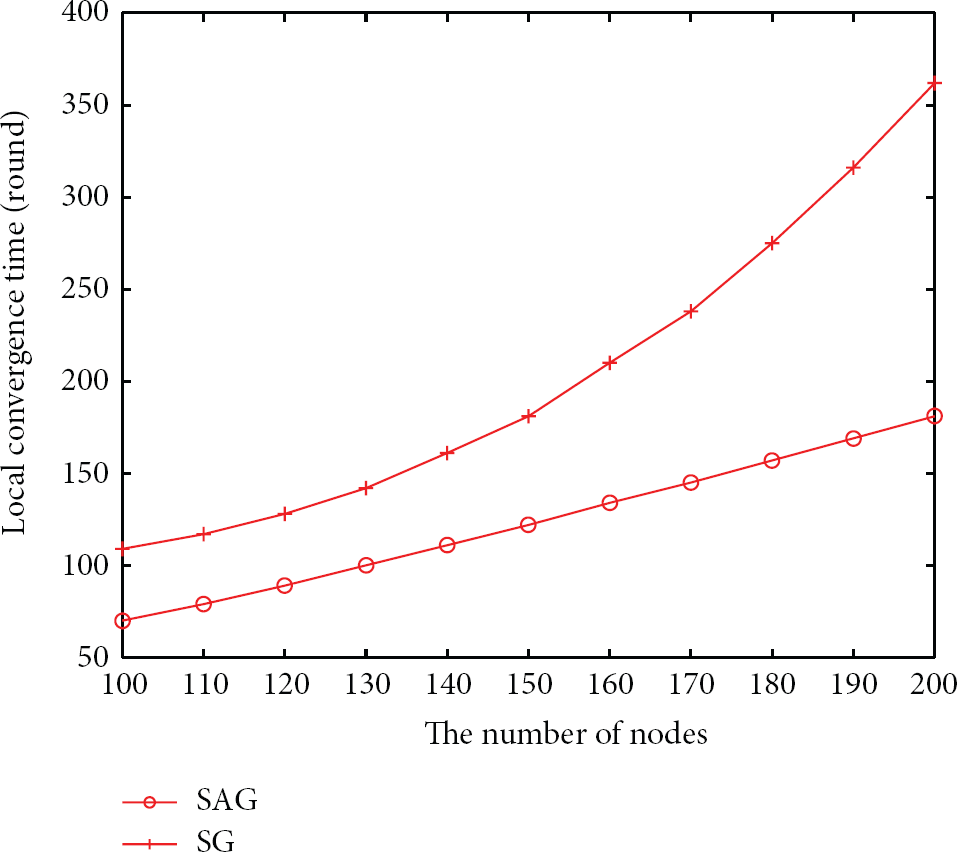
The relation between LCT and the number of nodes.
As shown in Figures 2 and 3, both the global convergence time and local convergence time go up with the increasing number of nodes. As the number of nodes increases, the global convergence time and local convergence time of static algebraic gossip algorithm are less than those of static gossip algorithm. This phenomenon results from the network coding, which effectively and obviously reduces the GCT and LCT when the number of nodes becomes larger. It can be observed from Figure 2 and Figure 3 that network coding has a relatively larger benefit on the local convergence time than the global convergence time.
Finally, we can conclude some relations from the figures. In the beginning periods of communication, network coding significantly lowers the retransmission probability. It can explain why the gap is relatively larger in the initial phase in Figure 1 and why network coding has a relatively larger impact on the local convergence time than the global convergence time in Figures 2 and 3. However, in the subsequent periods of communication, new messages are increasingly difficult to transmit, so network coding has less help to improve the performance. The constant gap in the later phase shown in Figure 1 and the differences between the global convergence time and local convergence time in Figures 2 and 3, respectively, can illustrate network coding has less help to improve the performance.
5. Conclusion and Future Work
In this paper, we studied the performance of multimessage dissemination based on the algebraic gossip algorithm in the RGG. We considered the network with n nodes which only have knowledge about their own contents. In every time slot, each node communicates with a randomly chosen neighbor partner by the exchange algorithm. Our goal is to disseminate all of the messages rapidly among the nodes. We utilized the concept of conductance to analyze the convergence time bounds. The results showed that the bounds are significantly improved from
However, there are still a number of open questions that require further research and improvement. One is to find a quantitative description of the local convergence time in a specific network environment and compare it to the global convergence time. There are still no related literatures about local convergence time quantitatively expressed so far. Compared to global convergence time, local convergence time is more susceptible to external factors. The bound of the local convergence time is not easy as
Footnotes
Acknowledgments
This work was supported by the Foundation for Innovative Research Groups of the National Natural Science Foundation of China (Grant no. 61221061) and by the National Natural Science Foundation of China (Grants nos. 61271194, 60972007, 61250001, and 61231013).