




Abstract
We study the scenario in which a large number of machine-type communication devices (MTCDs) communicate with each other by utilizing the help of the base station (BS) through some MTCD gateways. We consider an overlay mode of an orthogonal frequency division multiple access (OFDMA) based cellular system using orthogonal beamforming to provide broadband wireless access for the MTCD gateways. In order to avoid the interference with mobile users, the beamforming vectors to the MTCD gateways have to be orthogonal to the channel vectors of mobile users, which become a beamforming constraint for the MTCD gateways. However, with limited feedback of channel state information (CSI) at a BS, the orthogonal beamforming constraints may not be achieved. In such a practical case, conventional feedback schemes are feasible but not efficient due to the orthogonality constraints. In this paper, we propose a novel multiple beam selection (MBS) approach with limited feedback for MTCD gateways by taking into account the previous orthogonality constraints. Simulation results show that the performance improvement of the proposed approach over the conventional ones is generally about 10% when a BS is equipped with an array of 6 elements.
1. Introduction
Machine-to-machine (M2M) communication networks have been proposed to connect machines without the intervention from human beings. In recent years, the research of combing M2M networks and mobile cellular networks draws much attention [1, 2]. In an M2M network, there are lots of machine-type communication devices (MTCDs). These MTCDs access a cellular network by some MTCD gateways [3], which are assumed as secondary users in the cellular network. There are hundreds of MTCDs connecting to one MTCD gateway. In the combined M2M cellular networks, the MTCD gateway may need to communicate with the BS at a high data rate.
As the mobile users in a cellular system have a higher priority than the MTCD gateways, the beamforming vectors for the mobile users are designed to maximize the beamforming gains. In the overlay mode, since the signals transmitted to the MTCD gateways should not interfere with the mobile users [4], the beamforming vectors have to be orthogonal to the channel vectors to the mobile users, which become a constraint in finding the beamforming vectors for the MTCD gateways. The throughput performance can be improved when the orthogonal beamforming is combined with multiuser scheduling over multiple subcarriers, where the users with good channel conditions are selected for each transmission. Channel state information (CSI) is required in both beamforming and multiuser scheduling. However, unfortunately, in a practical system, the CSI available at the BS is imperfect due to specific system configurations. Therefore, it is worthwhile to design orthogonal beamforming using imperfect CSI for this kind of hybrid network.
1.1. Related Work
There are mainly two ways for the BS to get information from each user, that is, channel reciprocity and feedback channel. In a time division duplexing (TDD) system, it is possible to use the channel reciprocity at the BS, which refers to estimating the downlink channel from the uplink signal. However, the channel reciprocity requires calibration of the radio devices of both the receiver and the transmitter, for example, A/D converters, mixers, filters, and antennas. This requires extra special hardware as well as special protocols to facilitate the channel measurement and calibration [5, 6]. Therefore, most of the research papers assume that a feedback channel exists from each user to the BS for carrying feedback information as those in [7–9].
It is generally assumed that the feedback channel from each user to the BS is not perfect. In [10–12], the delayed feedback channel is considered. The effects of outdated CSI at the BS are analyzed by means of Markov model of the channel temporal correlation in [11, 12]. The effects of the noisy feedback channel are considered in [13–15], where the feedback channel is assumed as a discrete symmetric channel. Plenty of the pieces of literature focus on the feedback channel with finite rate (see, e.g., [16] and the references therein), which is referred to as limited feedback channel.
From the limited feedback channel, each user is allowed to send a small number of information bits back to the BS. Most of the conventional feedback schemes focus on the quantization of the channel direction information (CDI) [9] using some vector quantization algorithms [17]. In [8], a codebook of orthogonal beamforming matrices is used for the quantization. Each user quantizes the channel directions according to a beamforming codebook with a priori knowledge by both the BS and the users. Possible ways of reducing the number of feedback bits have been proposed in [18, 19], where only the mean or covariance of CSI is sent back to the BS.
As for the overlay mode based on the orthogonal beamforming that we consider in this paper, the conventional feedback strategies are no longer suitable; using conventional feedback schemes, the BS acquires an approximation of each users' channel directions the resulting beamforming vectors designed according to this approximation will not be best aligned with the MTCD gateways' channel direction. Besides, due to the orthogonality constraint, the conventional feedback strategies become inefficient. That is, the codebook used and designed in [8] is uniformly distributed in the whole space, while the actual beamforming vector lies in a subspace due to the orthogonality constraint. Thus, the vectors in the codebook that lie out of the subspace provide redundant information and result in excessive feedback. Therefore, a new feedback strategy is needed in the overlay mode for MTCD gateways.
In this study, we propose a new multiple beam selection (MBS) strategy with limited feedback of CSI. A (downlink) broadcasting channel is used to inform MTCD gateways with all the available beams. Each user chooses the best one out of the available beams and sends the index of the chosen beam back to the BS. As the beams are dynamically generated at the BS according to the interference pattern of the users, the orthogonality is guaranteed and the CSI can be fed back through the feedback channel to the BS more efficiently.
This paper addresses joint beamforming, scheduling, and feedback for broadband wireless access to provide high throughput for MTCD gateways. The design of beamforming vectors and limited feedback from each user are closely connected due to the orthogonal constraint for MTCD gateways. In conventional feedback schemes, the beamforming vectors are calculated after receiving the feedback information from each user. However, in the proposed MBS scheme, the beamforming vectors are calculated in advance, awaiting for each user's choice. A similar thought has been applied to opportunistic space division multiple access (OSDMA) in [20, 21].
1.2. Organization and Notations
The remainder of this paper is organized as follows. The system model is given in Section 2. In Section 3, a detailed study on the limited feedback for MTCD gateways is presented and the MBS strategy is proposed. The performance analysis is given in Section 4 followed by a comprehensive evaluation of the proposed MBS strategy using Monte Carlo simulation in Section 5. We conclude the paper with some remarks in Section 6.
The superscripts T and H stand for the transpose and Hermitian transpose, respectively. Upper and lower boldfaced letters are used for matrices and column vectors, respectively. Denote by
2. System Model
As in [22], in this paper, we consider downlink beamforming for MTCD gateways. Suppose that a BS in a cellular network is equipped with an antenna array of L elements. For downlink channels, there are M orthogonal subcarriers. The BS can support two different groups of users. One group has ordinary mobile users, which is called Group I. The other group consists of MTCD gateways, which is called Group II. The users in Group II want to have high data rate services. It is assumed that the users in Group I have higher priority than those in Group II. In the overlay mode, the downlink transmissions to the users in Group II should not affect the users in Group I.
It is assumed that there are K users in Group I, and Q users out of K are chosen for data transmissions in each subcarrier. These are called active users in Group I. The number of users in Group II is denoted by U. Only one of these users is selected for transmission through each subcarrier. In general, Q is small (usually
The transmitted signal vectors from the antenna array to users in Groups I and II through subcarrier m, denoted by

where
We denote by

where
If a user in Group II also receives a signal through subcarrier m whose index is denoted by

where
Note that the characteristics of the channel vectors to users in Groups I and II are different. In general,
Throughout the paper, we focus on the data transmissions of the MTCD gateways. Generally we assume that the
3. Beamforming with Limited Feedback
In this section, the beamforming algorithms for MTCD gateways are proposed. First, the algorithms with perfect CSI of the Group II users are briefly described in Section 3.1. The motivations for the new feedback scheme are given in Section 3.2. In Section 3.3, the beamforming algorithms with limited feedback CSI of the MTCD gateways are proposed.
3.1. Orthogonal Beamforming with Perfect CSI
As users in Group I have a higher priority than those in Group II, the signals to users in Group II should not interfere with the signals to users in Group I. For broadband access, it is required that the data rate to users in Group II from the BS is sufficiently high, while the number of users in Group II would not be large. In order to deal with these issues, we consider orthogonal beamforming. Using orthogonal beamforming, space division multiple access (SDMA) [23] can be implemented for downlink transmission to users in Groups I and II. The main difference of the orthogonal beamforming approach in this paper from that for the conventional SDMA is that the overlay mode based beamforming approach should take into account the priority between users in Groups I and II and maximize the data rate to users in Group II.
Note that a user scheduling problem exists in Group I as
In [24], the semiorthogonal user selection (SUS) algorithm is used for scheduling Q active users out of K users through each subcarrier. The SUS algorithm results in a group of users with channel vectors
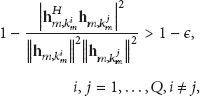
where ϵ is a small positive constant. Note that ϵ is a parameter related to the number of users K similar to α in [24], which is used to find semiorthogonal users. The SUS algorithm chooses the users with semiorthogonal channel directions. Thus, hereafter, we assume that the chosen users in Group I have orthogonal channel directions; that is,

This becomes true when the number of users K is sufficiently large [24]. We denote by

At a user in Group II, the SINR is given by

Since


The optimal beamforming vector is given by

where

Here
3.2. Motivations for the New Feedback Scheme
With perfect CSI, the optimal beamforming vectors for users in Group II are designed subject to the orthogonal constraints (9). The resulting beamforming vector (11) lies in the null space formed by the column vectors of
In the conventional feedback scheme in [8], each

where
In conventional feedback schemes, a codebook-based quantizer with a codebook comprised of multiple sets of orthonormal vectors in

where

For the quantization of the channel direction, the member of ℱ that has the smallest distortion is chosen as the feedback channel direction; that is,

For the quantization of the SINR, G bits are used to quantize this scalar value. For analysis convenience, the SINR is always assumed to be known perfectly by the BS. This assumption will be justified in Section 5 where the simulation results show that the throughput loss due to limited SINR feedback is marginal compared with the case in which perfect SINR feedback is available.
In the orthogonal beamforming for users in Group II, the optimal beamforming vectors are designed subject to orthogonal constraints which is illustrated in Figure 1. If

An example of orthogonal beamforming for MTCD gateways.
With limited feedback, if we can quantize
In conventional feedback schemes, the codebook is predesigned and known at both the BS and each user. The vectors in ℱ that lie out of null space of
3.3. Orthogonal Beamforming with Limited Feedback
We propose a new MBS strategy where a group of beamforming vectors for the MTCD gateways is generated by the BS and broadcasted through the downlink channel.
Suppose that the Q active users in Group I have been chosen and the beamforming matrix is denoted by

where
For the scheduling of a MTCD gateway, the BS should transmit N pilot signals to let them choose the best beam among N beams,

where the SINR is given by

The SINR expressions in (17) and (18) are replaced by The BS broadcasts After receiving all the N pilot signals, each user in Group II estimates the local SINR, namely, The users choose the best beam among all the pilot beams according to (17) and sends the index of the best beam At each user, the SINRs of the best beam through each subcarrier are quantized using G bits as follows:



In order to minimize the impact of the interference from the signals to users in Group I or maximize the throughput for users in Group II, the subcarrier allocation for Group II users can be carried out as follows:
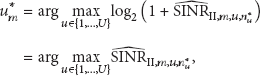
and the corresponding beamforming vectors are selected as the final beam

That is, for each subcarrier, the user in Group II who maximizes the achievable rate, namely,

Thus, the estimated throughput for user u is given by

4. Asymptotic Throughput Performance
In this section, we analyze the performance of the proposed MBS scheme asymptotically when
In this section the asymptotic throughput performance is first derived with perfect CSI feedback. In order to obtain a useful expression that characterizes the system performance with limited feedback, a lower bound on the asymptotic throughput performance is then derived.
Assumption 1.
The elements of
Hereafter, we consider performance analysis for users in Group II under the CSCG Assumption 1. For convenience, define the SNR at user

Furthermore, define

Then, we have

In (28),
Note that the SINR for a user in Group II is upper-bounded as

Assumption 2.
The distribution of
That is, we have

or

where
Now, we present numerical results to verify Assumption 2. In Figure 2, the number of users in Group I is set to

Distribution of
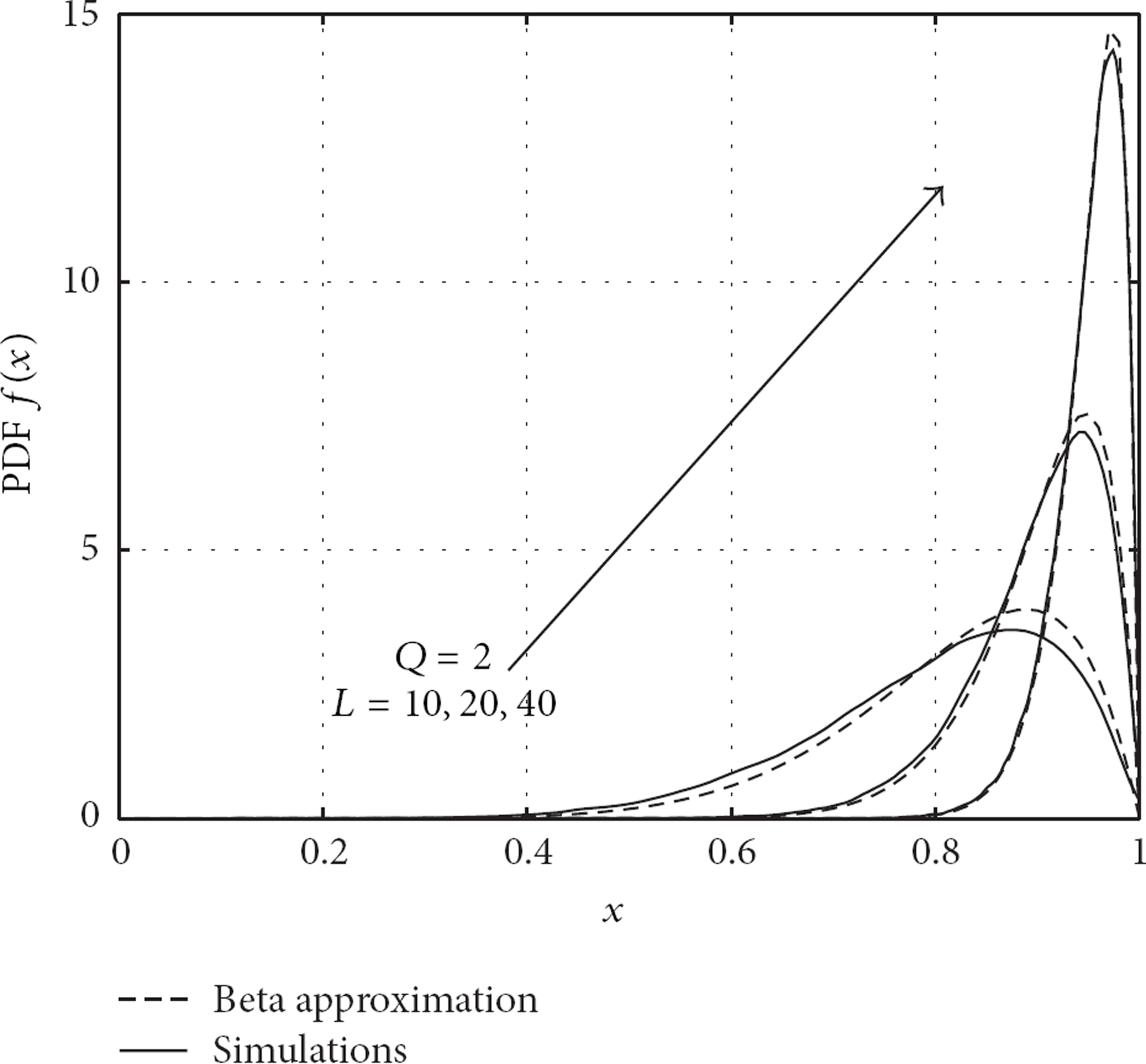
Distribution of
The probability density function (PDF) of

and the cumulative distribution function (CDF) by

where
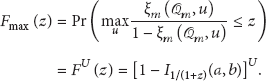
The outage probability of the maximum SINR is defined as

where Γ is the target threshold SINR.
Using the upper bound in (29), a lower bound on the outage probability of the SINR can be found. Since

we have

where
The average achievable rate per subcarrier for Group II is

and the average throughput per user becomes

We consider a lower-bound on the average achievable rate using the outage probability in (37). For a given target threshold SINR Γ, we have

A tight lower-bound on

Note that the asymptotic throughput performance is first characterized by (39) using (28). This result is then lower-bounded in (41). We will use (41) as an indication of the system performance with limited feedback.
5. Simulation Results
In this section we present various numerical results to further investigate the performance of the proposed MBS scheme. The simulation settings are described as follows: the channel elements are independent and identically distributed (i.i.d.) CSCG random variables, that is,
5.1. Effect of Increasing Feedback Bits
Simulation results for different number of active users in Group I are presented to show the effect of increasing feedback bits. As conceived, the throughput per MTCD gateway increases as the increase of the number of beams generated by the BS, unlike the results in [8] where increasing channel shape feedback does not necessarily lead to better performance.
In Figure 4, the number of transmitter antennas is set to

Throughput per MTCD gateway versus
In Figures 5 and 6, the number of active users in Group I are 2 and 4, respectively. As expected, theoretical result (41) can be used as a good indication of the system performance with limited feedback.

Throughput per MTCD gateway versus

Throughput per MTCD gateway versus
5.2. Comparison with Conventional Feedback Schemes
From the analysis in Section 3, the proposed MBS scheme achieves better performance than the conventional feedback schemes. In this subsection, numerical results are given to verify our analysis.
In Figure 7, the performances of the proposed feedback scheme and the conventional one are compared with an increasing number of users in Group II. The number of beams generated by the BS in our proposed scheme and the number of the vectors in the codebook of the conventional feedback scheme are the same and set to
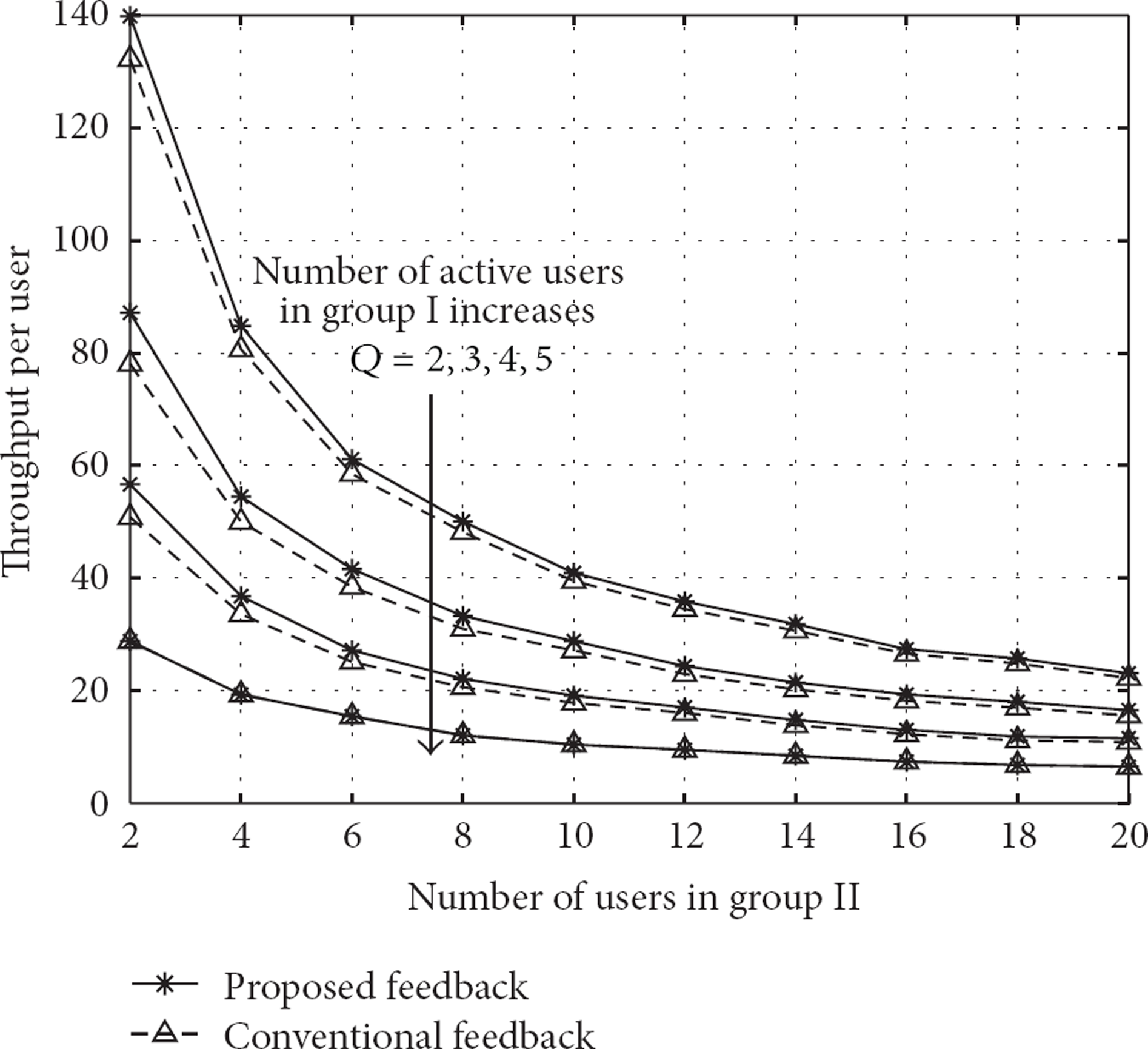
Throughput per MTCD gateway versus
5.3. Effect of SINR Quantization
The analyses and simulations above are based on the assumption that the BS has perfect knowledge of each user's SINR. The effect of quantization of SINR on the performance is shown using numerical simulations in this subsection.
Figure 8 compares the cases of perfect and quantized SINR feedback with G-bit quantization,
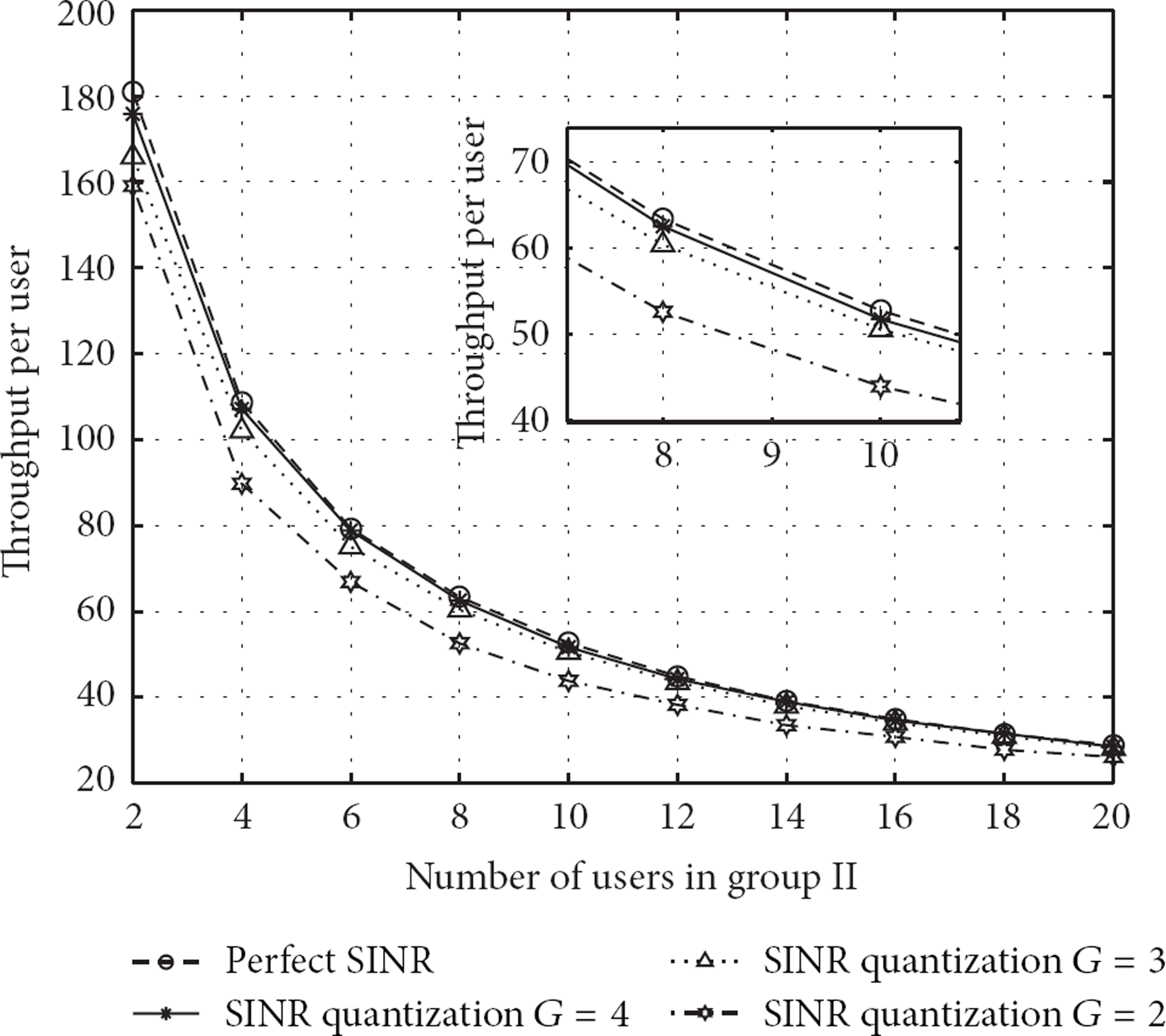
Throughput per MTCD gateway versus
From Figure 8, the throughput loss due to limited feedback of SINR is shown to be considerably low, even by employing few number of feedback bits. The same observation is made in the conventional feedback of per user unitary and rate control (PU2RC). In [8], 3 bits for SINR feedback is found to be sufficient to make the capacity loss due to negligible SINR quantization.
6. Conclusions
In this paper, we propose a scheme to combine cellular networks and M2M networks. The devices in an M2M network access a cellular network through some gateways, which are assumed as secondary users in the cellular network. With limited feedback of CSI at the BS, the new MBS method is proposed for the MTCD gateways with an overlaid transmission mode. The asymptotic performance of the proposed MBS method is characterized. Using a lower bound on the throughput with perfect CSI, we obtain a useful expression that shows the system performance with limited feedback. Simulation results show that, when the BS is equipped with 6 antenna elements, the throughput was improved by about
Footnotes
Appendices
Acknowledgments
The authors would like to thank the anonymous reviewers for their valuable comments that have helped in improving the overall quality of the paper. This work has been supported by the Specialized Research Fund for the Doctoral Program of the Ministry of Education of China (Grand no. 20120001120125) and the National Natural Science Foundation of China (Grants no. 61250001, no. 61231011, and no. 61231013).