




Abstract
This paper addresses the energy efficiency of cooperative communication in WSN. We first establish the energy model of single-hop WSN. It is found that the cooperative communication is more suitable for harsh transmission environment with long-haul distance. The energy consumption per bit is numerically minimized by finding the optimal broadcasting BER and the number of cooperative nodes. Then, we expand the conclusion to the multihop scenario where “energy hole” dominates the longevity of WSN. To mitigate the energy consumption in the hotspots, as well as to keep the promised reliability, we adjust the transmission BER of the clusters according to the hops between the sink and cluster. On one hand, the statistical reliability is met. On the other hand, the energy consumed is converted from the nearer cluster (from the sink) to the farther ones. The network lifetime is thus optimized.
1. Introduction
WSN (Wireless Sensor Network), an energy-constrained network, has nodes mainly powered by batteries which are hard to replace even if possible. Numerous applications of WSN, such as environment monitoring, always need the network to operate for years without exchange of power suppliers. The prolongation of network lifetime is hence a critical design consideration and the data transmission must be energy efficient. More specially, the sensors near the sink are likely to die earlier since they are burdened with higher data load. Their deaths lead to the dysfunction of the network with the residual energy in the outside nodes. This is the well-known “energy-hole” phenomenon, the core of many researches in the literature [1].
MIMO (multiple-input and multiple-output) explores the spatial diversity of the wireless channel which can dramatically increase the channel capacity as well as the reliability of transmission. Once the transmission distance reaches a certain threshold [2], the energy conversation performance of MIMO systems can remarkably exceed the SISO (single-input-single-output) systems under the same Signal-to-Noise Ratio (SNR). The MIMO energy-efficiency transmission scheme is particularly useful for WSN due to the limited energy supplied. However, the direct application of multiple antennas technique on WSN is impractical for the insufficient physical size of sensor nodes. Fortunately, several individual sensors can cooperate for the data transmission in order to set up a Cooperative MIMO or MISO scheme, which are also known as Cooperative Communication (CC) [3].
CC scheme explores the energy efficiency of multiantennas technique which plays a significant role in the long-range transmission, where the transmission energy consumption dominates in the overall cost rather than that of the circuit [4]. Nonetheless, the decline of transmission energy consumption does not directly lead to the prolongation of network lifetime owing to the existence of “energy hole” [5]. The residual energy in the farther nodes may be up to 50% when the network dies [6]. Thus, the energy consumption balance is also the critical topic in the design of transmission scheme. In this paper, we first propose singleHop Algorithm for the minimization of energy consumption in single-hop scenario (see Algorithm 1). Furthermore, we generalize the conclusion to the multihop scenario and present the MultiHop Algorithm to mitigate the “energy hole” by adjusting the bit error rate (BER) at each cluster (see Algorithm 2).
transmission distance d and maximum BER and the minimum energy consumption (1) (2) (3) Compute the broadcasting radius (5) Calculate the total energy consumption (6) (7) (8) (9) (10) (11) Output
statistical reliability (1) Calculate the BER sequence according to Formula (31), record as (2) Compute the optimal then calculate the average energy consumption of the nodes in each cluster by (28); (3) (4) Find the maximum (5) Find the max decreased can be met as well as keep the energy consumption of cluster b slightly less than (6) (7) (8) Output
Summarily, the main contributions of this paper are twofold.
Compared to the single-input and single-output (referred to SISO henceforth) transmission, it is revealed in [2, 7] that CC can save energy when the transmission distance exceeds the certain bound. In addition to this, we find that cooperative communication is more suitable for the long-haul transmission with higher requirement of BER in the harsh communication environment (larger path-loss parameter and power density of noise). Then, we propose the SingleHop Algorithm to choose the number of the cooperative nodes and the value of broadcasting BER to optimize the total transmission energy cost. In a multihop network, the sensors closer to the sink are more likely to be exhausted earlier due to the heavier data load. Based on the analysis of the single-hop scenario, we propose the MultiHop algorithm to prolong the lifetime of cluster-based network subject to the requirement of statistical reliability. Our strategy adjusts the transmission BER higher at the clusters farther away from the sink than the inner ones. This enables the near-sink cluster to lose the requirements of reliability. On one hand, the overall requirement can be met. On the other hand, the energy consumption of the near-sink clusters is shifted to the farther clusters.
The rest of this paper is organized as follows. The related work is given in Section 2. Section 3 presents the analysis of the single-hop network with CC scheme and SingleHop Algorithm. The numerical and experimental results are shown in Section 4. We further evaluate the energy consumption performance in a multihop clustered network, and Multihop algorithm is presented to mitigate the “energy hole” by adjusting the transmission BER in Section 5. Section 7 concludes the paper.
2. Related Work
A certain amount of research has recently been done to investigate various cooperative communication schemes. The author of [8] analyzed the performance of cooperative ARQ (automatic re-request) in both simple and hybrid schemes. It is pointed out that the cooperative ARQ protocols perform better than the traditional counterparts, even when the relay-destination channel is not as good as the source-destination channel, due to the spatial diversity explored by the cooperative protocols. Ikki and Ahmed investigated the capability of incremental-relaying mechanism for both decode-and-forward and amplify-and-forward relay schemes in [9]. Meanwhile, the closed-form expressions of BER and outage probability are proposed in their work. By the means of Alamouti space-time coding, Zhang et al. proposed a cooperative diversity system in [10], wherein the two users transmit data for each other, and the destination responds to the feedback at the middle of two Alamouti codes. To apply the distributed space-time codes in practice, the code distribution need to assign code matrix columns to individual cooperating nodes. Nonetheless, the basic setup in [8] and [10] includes only one intermediate relay node. As indicated in our work, more than 2 relay nodes may be demanded to optimize the transmission energy consumption.
From the perspective of energy consumption minimization, Cui et al. studied the characteristics of cooperative communication in WSN [2]. It is addressed that virtual multiple antennas are suitable for long distance transmission due to the extra circuit energy depletion. Based on this, Jayaweera studied the impact of the training overhead required in MIMO-based system and refined the conclusions obtained in [2]. However, the authors only consider the performance of cooperative transmission in comparison to the SISO systems. We generalize the object to the whole procedure of cooperative communication in cluster network (intracluster and intercluster) in our work. In [11], Li et al. analyze the energy consumption per unit transmit distance to achieve energy-efficient transmission. And the optimal transmission distance is obtained by turning the problem into a convex optimization problem. Nonetheless, the broadcasting BER is neglected in his work.
The selection of the “best relay” is applicable in case the source knows the CSI (channel statement information). In [12], the relay node selection and the transmission energy allocation are both studied based on the channel estimation at the source. This is implemented by the exchange of RTS/CTS messages. However, CSIR (channel statement information at the receiver), the analysis background of our paper, is more common for wireless link. Otherwise, the mature water-filling method can directly bring the optimal energy allocation scheme [13].
In [7], Zhang et al. analyzed the transmission distance in combination with the number of cooperative nodes. Then, the conclusion is extended to multihop scenario, as in our work. Hence, the optimal data transmission distance in each hop is obtained. Nevertheless, the authors merely consider the data gathering of the source node in [7]. Actually, the sensors in the network are all responsible for data collection, this is the fundamental reason for “energy hole” [14]. The global data gathering is analyzed for the rectangular scenario by Huang et al. in [15], wherein the network longevity is optimized by adjusting the cluster size. However, the authors omitted the analysis of parameters that significantly impact the network performance, especially the number of cooperative nodes and the reliability requirement. In [16], a clustered cooperative MIMO scheme based on LEACH is proposed by Yuan et al. wherein the authors concretely studied the operation process of the cluster construction. Unfortunately, the analysis of the influences of reliability and the number of cooperative nodes in cooperative communication are also ignored. In [17], Ota et al. proposed the actors' mobility control scheme in wireless sensor and actor networks (WSAN). By reinforcement learning in Markov decision processes, the energy efficient data collection scheme is addressed.
3. Single-Hop System Description and Analysis
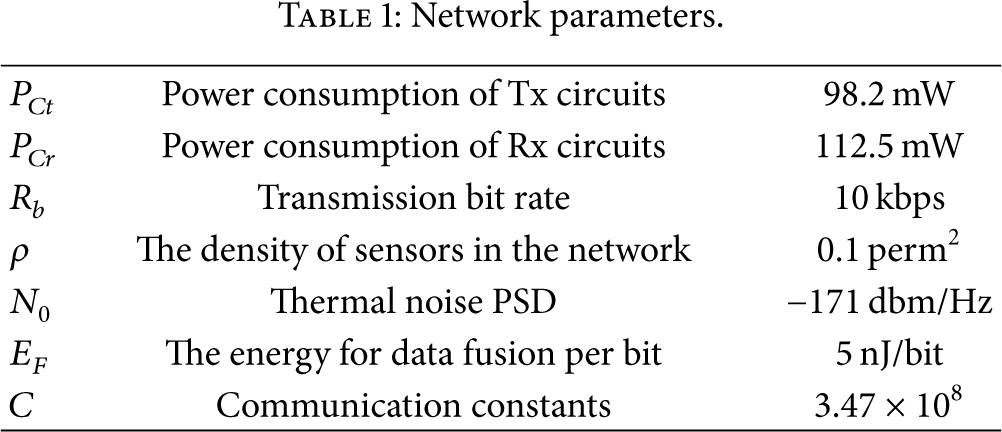
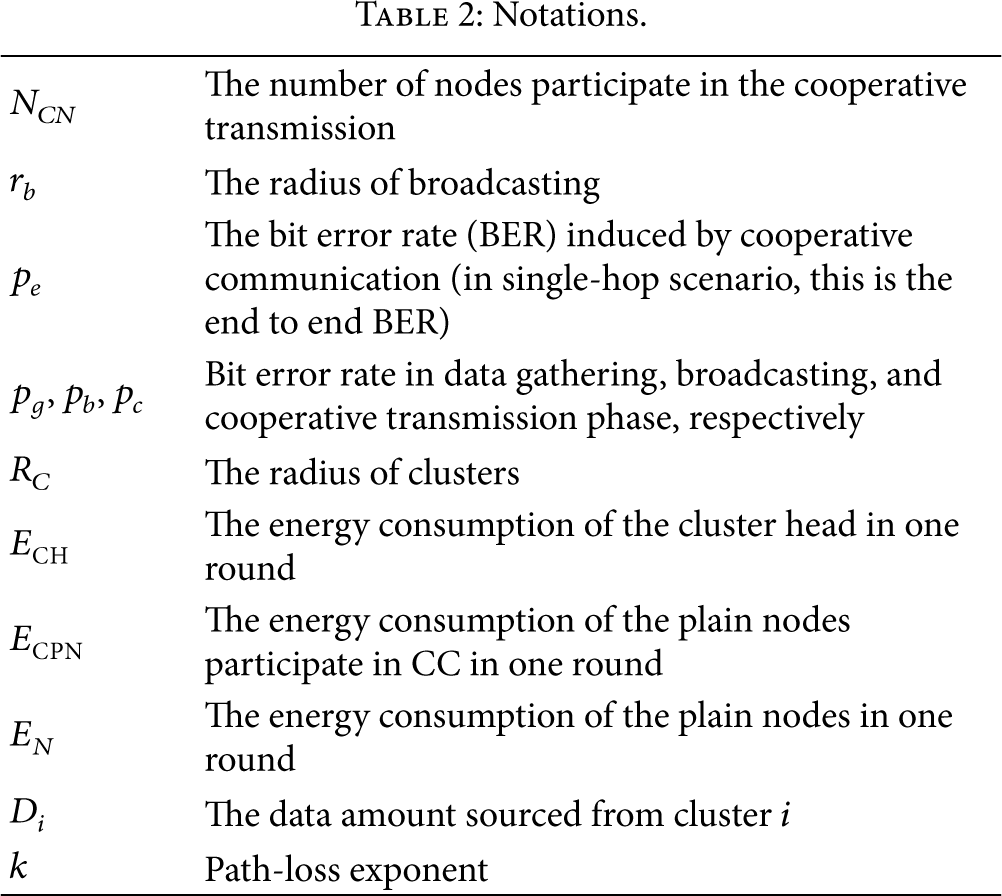
Table 1 presents the network parameters and the value of them. And for the convenience of readers to understand this paper, Table 2 summarizes the notations used in this paper.
Network parameters.
Notations.
3.1. System Model
We first introduce CC in a single-hop scenario, as seen in Figure 1. The relay node (particularly the cluster heads) broadcasts the data to its neighbors. The candidate nodes covered by the broadcasting would participate in the following CC phase, wherein the relay node and the cooperative nodes transmit the data simultaneously encoded by STBC [18] (space-time block coding) to the next relay node (or sink). This procedure of CC can also be seen in [19].

Impact of transmission range on total energy consumption.
The energy consumption of the circuit blocks, except the power amplifier, for the transmission and reception of data packet, is summarized to constants represented by 
According to [15], the energy consumption of one participated node in the cooperative transmission phase can be expressed as follows:

Since α in (1) solely depends on the modulation scheme and the associated constellation size, and we use BPSK to modulate the signal with the same constellation size throughout this paper, for brevity, C is expanded to be

We assume the fading of channel satisfies Rayleigh distribution. According to [15], the relationship between the BER and the received energy at the receiver can be derived to be


Summarily, the total energy consumption of each node for a fixed data rate can be derived as in [15]:


3.2. The Energy Consumption of CC
The broadcasting radius of the relay node is 







The corresponding energy consumption for SISO scheme with BER 

3.3. Cooperative Communication Energy Consumption Optimization
As shown in Section 4, the number of cooperative nodes
It is worth noting that the circuit energy consumption increases linearly with the number of cooperative nodes, as shown in (12). In case
4. Numerical and Simulation Results of Single-Hop CC
The related network parameters are given in Table 1 if not specified. We use network simulator ns2 version 2.35 to conduct the simulations. For each data point in the figures, we run simulation on 20 randomly created networks and take the average.
Consistent with the results of [2, 7, 20], CC outperforms the SISO system when the transmission distance is beyond a certain threshold with low E2E BER (

Transmission energy consumption per bit with low BER.
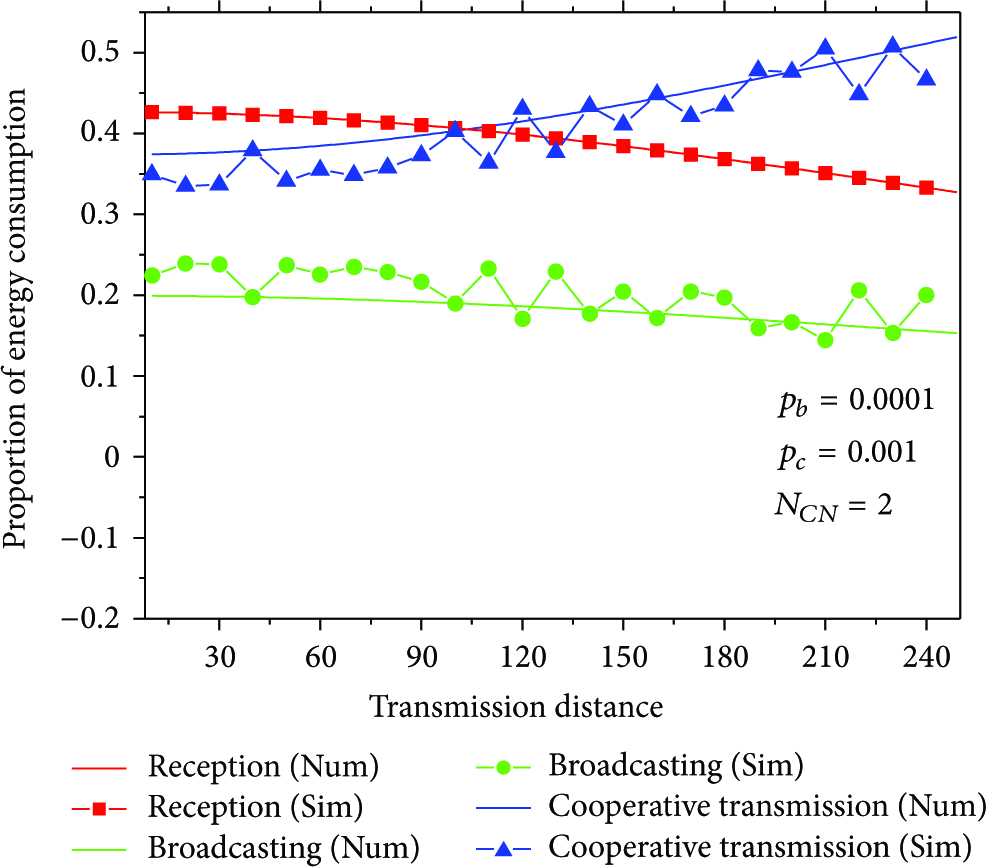
The proportional percentage of energy consumption.
Figure 4 depicts the reason of the energy efficiency, where we plot the ratio of T-BER and the required E2E BER (

The ratio between end-to-end (E2E) BER and the T-BER.

The comparison between CC and SISO scheme with high BER.

The energy consumption under multipath fading.
We evaluate the performance of CC compared to SISO with path loss exponent
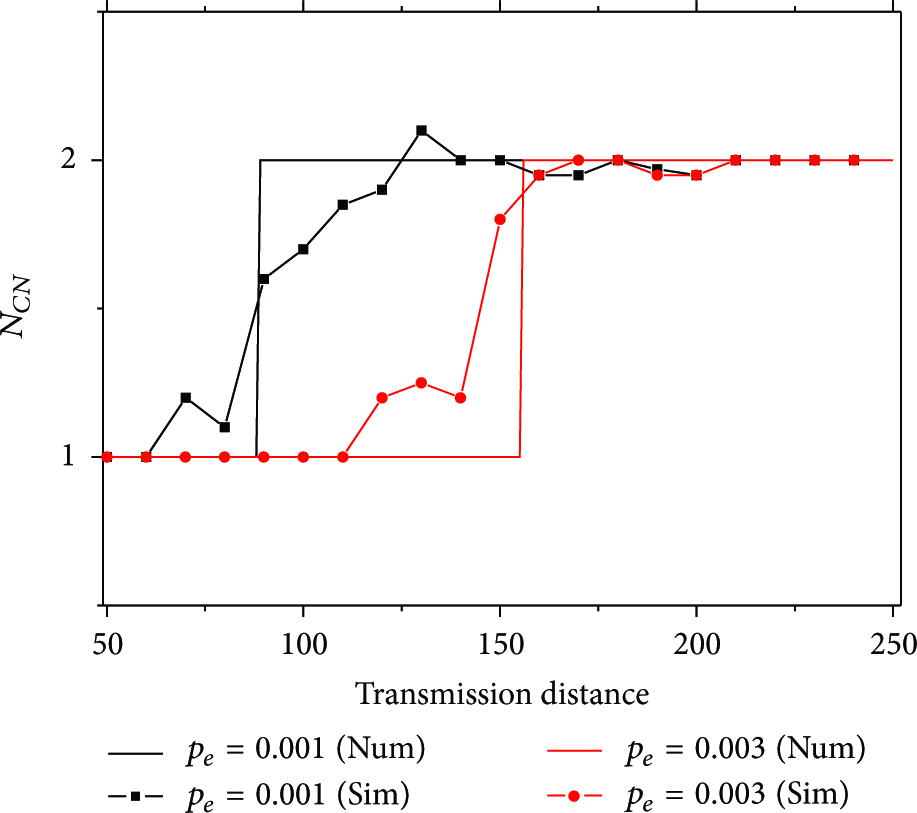
The performance of SingleHop algorithm is verified in Figures 7, 8, and 9. Take

The optimal energy consumption by using SingleHop algorithm.
The optimal number of cooperative nodes.
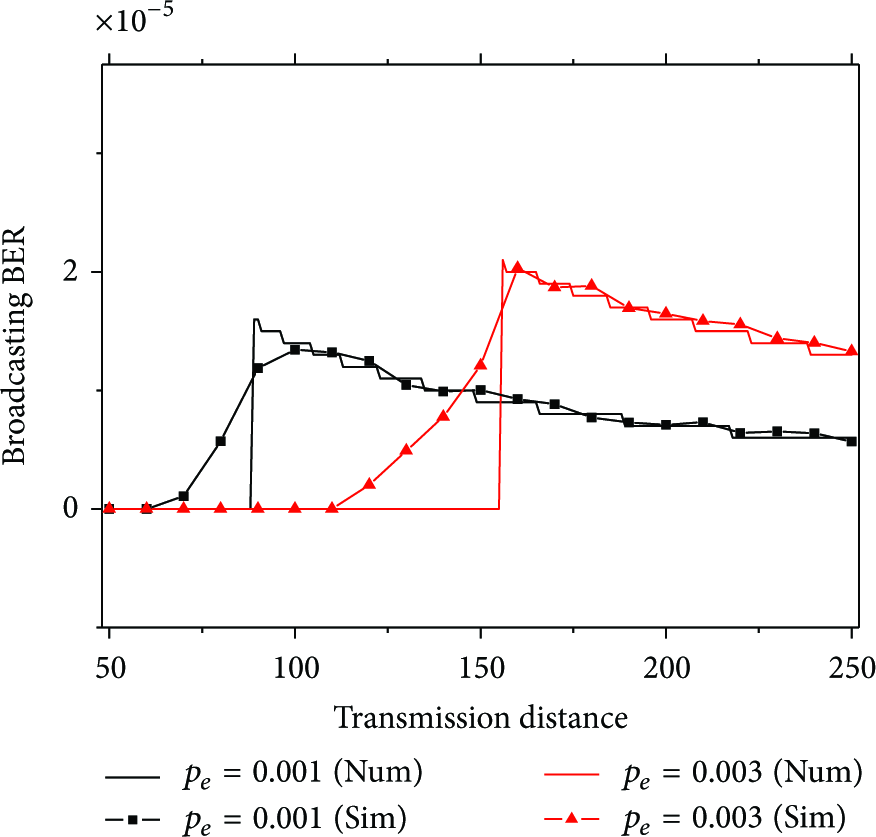
The optimal broadcasting BER obtained by SingleHop algorithm.
5. Maximization of Network Lifetime with Guaranteed E2E Reliability
In this section, we extended the conclusion of Section 3 to multihop scenario. As shown in Figure 10, nodes are densely dispersed in several circles which are far away from each other, and the clusters are linearly positioned [19]. The distance between the circles is much larger than the radius of those.

Multihop model.
The radius of the ith clusters and the density of nodes are denoted by
5.1. Analysis of Energy Consumption and Bit Error Rate at Each Cluster
During the intracluster process, the plain nodes in cluster j transmit l bits data to the cluster head with BER
The BER in each step greatly influenced the energy consumption performance as we see in Section 3. Moreover, the overall BER consists of two parts, the BER at data gathering phase and the BER induced by the intercluster data transmission, respectively.
Here, we first investigate the relationship between BER in different phases and the required reliability. The overall reliability constraint is denoted by
Theorem 1.
To meet the overall required statistical reliability 
Proof.
At the jth cluster, (19) must hold

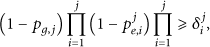
The nodes separately play 3 different characters in intercluster transmission, which are CH, cooperative nodes, and plain nodes, respectively. Based on the conclusion of Section 3, SingleHop algorithm is applied to determine the optimal value of 
Theorem 2.


Proof.
By CH rotation, any node in the cluster is able to be CH and the average distance between two randomly located nodes is 


The energy consumed by each plain node participated in CC is

The energy cost of the cooperative nodes (except CH) on the reception of the data broadcasted by CH is
In our paper, we assume that the CH and the cooperative nodes are selected based on the residual energy of the nodes. Therefore, it is considered that the energy consumption among the nodes are perfectly balanced, thus all nodes have approximate lifetime. Theorem 3 derives the average energy consumption of each clusters.
Theorem 3.
The average energy consumption per node in the ith cluster for an entire data gathering round is presented in the following:

Proof.
Nodes undertake the role of CH by cluster head rotation. Averagely, every node acts as CH for one time, as plain nodes for
Assume that the reliability 
The network longevity optimization goal can be expressed as


Recall that
We map the average energy consumption of each cluster in Figure 11. Obviously, cluster

Average energy consumption of each cluster in one round.

The broadcasting BER of data sourced from each cluster.
6. Nodes Adopt the Different BER according to the Clusters They Belong to
Evidently, the cluster nearest to the sink dies much earlier than the clusters farther away which leads to “energy hole,” since the nodes in cluster 1 are burdened with larger amount of data. We notice that the reduction of power consumption at the energy hole leads to the prolongation of network lifetime. To mitigate this “energy hole” as well as maintain the statistical reliability, a strategy is proposed to convert the energy consumption at the energy hole to the farther part of the network by adjusting the transmission BER in each cluster. Based on the analysis in Theorem 3, the sum of BER along the routing path stays stable and the accuracy of the data can still reach the requirement of reliability. By means of this method, the energy consumption of the nearer clusters is reduced although the cost of the external clusters increased. As long as the maximum energy consumption declined, the network lifetime is optimized.
Through the calculation of MultiHop algorithm, Figure 13 plots the transmit BER of

BER of transmission for cluster

Energy consumption for one data gathering round.
7. Conclusion
In this paper, we jointly investigate the SISO and CC transmission schemes in both single-hop and multihop scenarios. The optimal number of cooperative nodes and the broadcasting BER are obtained for the energy efficiency. It is shown that cooperative communication is more suitable for the long-distance transmission in harsher environment. The conclusion of single-hop network is then expanded to multihop-clustered network where we study the energy cost of different nodes (cluster head, cooperative nodes, and plain nodes) in the cluster. Finally, we prolong the network lifetime by adjusting the transmit BER along the delivery path. An interesting extension is to precisely study the cooperative nodes selection scheme, since the probability is slightly different between nodes to be covered by broadcasting (the node at the core of the circle cluster is easier to be under the convergence).
Footnotes
Appendix
Acknowledgments
This research is supported by the National Natural Science Foundation of China (61073186). Thanks are dur to the help of Xue Chen for her mathematical verification and Qiang Liu for his coding support.