




Abstract
A novel low power medium access protocol energy efficient MAC (EE-MAC) for wireless sensor network is proposed in this paper. EE-MAC targets for improving energy efficiency, delay performance and packet delivery ratio by considering various load conditions of the network. This protocol is based on the hybrid of TDMA and FDMA approaches. The novel idea behind EE-MAC is that it uses the priority concept with hybrid MAC scheduling in order to achieve its objectives. The performance of EE-MAC is obtained through simulations for various packet sizes, traffic loads, and different scenarios which show significant improvements in packet delivery ratio, energy efficiency, and delay compared to existing protocols.
1. Introduction
Wireless sensor network (WSN) is an application driven design determined by the requirements of network behaviour. Wireless sensor networks have been proposed for emergency applications, such as building fire monitoring and response. The network must be traffic and topology adaptive for this type of application. The algorithm used for communication should be delay tolerant during normal periodic monitoring and energy efficient.
Conventional WSN applications like [1–3] have concentrated on inactive low-duty cycle sensing and monitoring, in-network data aggregation, and asynchronous operation designed to extend the lifetime of sensor nodes. Conversely, the applications like real-time streaming for voice and video require comparatively high bandwidth utilization, throughput, and bounded end-to-end delay of few milliseconds. Thus, the design of effective WSN medium access control (MAC) protocols has become a more challenging task and results in a very different design trade-off than other wireless networks. Existing WSN hardware devices such as MICAZ [4], Telos [5], and CMU Firefly [6] play a major role in designing WSN-MAC layer protocol. These hardware devices use CC2420 radio [7] in order to access the multiple channels.
Designing MAC protocols for a given limited radio bandwidth (19.2 Kbps in MICA2 and 250 Kbps in MICAZ and Telos) and to increase the network throughput is a crucial task. Almost all of the proposed protocols for WSN MAC layer such as [8–14] use only one single physical frequency. Due to limited bandwidth of the sensor node hardware and the small MAC layer packet size, multifrequency MAC protocols of general wireless networks are not suitable for wireless sensor networks. For the operation of MAC protocol in multiple frequencies, single low-power transceiver of WSN node is not capable due its inability of simultaneous packet transmission and reception. The multichannel MAC protocols based on CSMA such as [15–18] have the capability to work in multiple frequencies but are not suitable for wireless sensor networks because of their limited bandwidth and small data packet size. Moreover, protocols based on IEEE 802.11 [19] like [20–24] and the protocols that use RTS/CTS control packets such as [25–28] will not work effectively in wireless sensor networks due to small MAC layer data packet size and overhead introduced by RTS/CTS packets.
An energy efficient hybrid MAC (EE-MAC) protocol for wireless sensor networks is proposed in this paper. This protocol is highly emphasized due to its qualities like high packet delivery ratio, bounded end-to-end delay across multiple hops, collision-free operation, and increased lifetime. Moreover, this protocol, takes advantage of multiple frequencies provided in recent WSN hardware platforms and it gives high packet delivery ratio and good energy efficiency. The paper is organized as follows: several key WSN MAC protocols are briefly discussed in Section 2 and the details of our proposed protocol are presented in Section 3. The performance of EE-MAC is evaluated using simulation and discussed in Section 4; Section 5 concludes with a summary of our findings.
2. Related Work
In this section, discussion of the MAC layer protocols that are used in wireless sensor networks is done. S-MAC and T-MAC are hybrids of CSMA and TDMA approaches that use local sleep-wake schedules to coordinate packet exchanges and reduce idle listening. The use of RTS/CTS control packets in these protocols introduces the possible failures during synchronization of the schemes. Moreover, these protocols are affected by the overhead of RTS and CTS packets. In addition to this, as the network size increases, either the number of schedules is to be increased or synchronization has to be repeated. In B-MAC, TinyOs [29] Low Power Listening (LPL) is achieved by waking up each node periodically after a sample interval and checking the status of channel for active condition for a short duration of time (2.5 ms). In order to achieve this, the node has to stay awake. In this scheme, the preamble should be long and to be sensed by the receiver in order to wake up the nodes. In addition, the transmitter is active for a long time to check the channel that leads to scalability problems in dense networks.
In LMAC and TRAMA the light-weight channel reservation scheme is proposed by considering the global time synchronization problem. In this method the collision-free operation is ensured. All the conventional TDMA schemes are used to provide excellent energy efficiency by minimizing idle listening, overhearing, and collision. They are not providing optimal solutions for wireless sensor networks due to the complications in providing WSN time synchronization and in difficulties to address scalability challenges. In RT-Link, the time slots are assigned centrally at the base station similar to TRAMA and this protocol supports contention slots using Slotted ALOHA rather than CSMA. It provides excellent network throughput and reduced delay performance without considering the benefits of multiple frequencies.
In MMSN [30] the multifrequency MAC protocol for sensor networks is discussed. Among the four schemes of frequency assignment problem, exclusive frequency assignment guarantees that nodes within two hops are assigned different frequencies, but it works only when the number of available frequencies is at least one higher than the number of such nodes. Moreover, the communication overhead in this scheme is comparatively high due to multiple broadcasts. In the second scheme, implicit consensus provides smaller overhead, but it assumes that physical frequencies are plentiful which is not true in current real-world WSN applications. In the remaining two schemes, even selection and eavesdropping will not guarantee the assignment of different frequencies to two-hop neighbors and, therefore, do not avoid potential conflicts. MMSN requires time synchronization to access the media; it will not take advantage of the synchronization service to resolve the conflicts and/or improve its scheme.
In HyMAC [31] the hybrid of TDMA and FDMA medium access protocol is proposed. HyMAC combines the strengths of TDMA and FDMA while alleviating their weaknesses. It provides high throughput and small end-to-end delay suitable for applications such as real-time voice streaming and its functionality is independent of underlying synchronization protocol. In this method, all the nodes are considered with equal priority which may lead to increased delay during heavy traffic.
EE-MAC is an improved hybrid MAC protocol designed for wireless sensor networks. It not only combines the strengths of TDMA and FDMA techniques and also introduces an adaptive priority scheme for channel access.
3. EE-MAC Protocol Design
The performance of EE-MAC is independent of underlying synchronization protocol and is well in WSN platforms in which-out-of-band hardware synchronization is used. The software based synchronization protocols such as RBS, TPSN, and FTSP are not used here because of degraded network performance due to their high link error rate, even when the received signal strength is above threshold. The packet format used in HyMAC is used for EE-MAC also and it is shown in Figure 1.
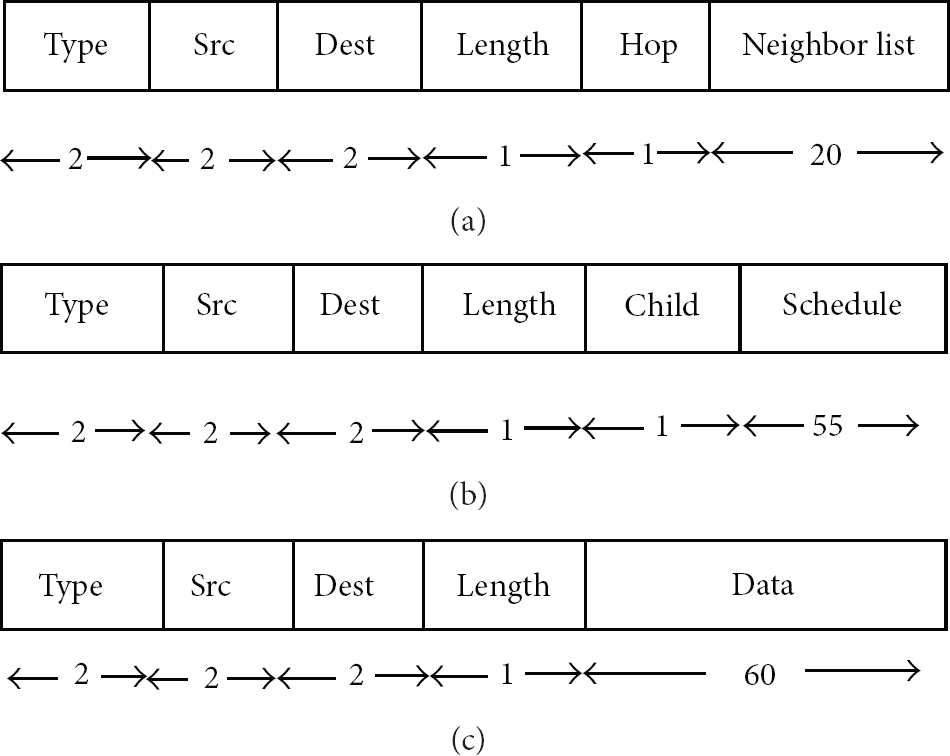
(a) HyMAC HELLO packet, (b) HyMAC SCHEDULE packet, and (c) HyMAC DATA packet.
EE-MAC operates in two phases: a setup phase and a transmission phase. During the setup phase the following operations take place.
Neighbor discovery. TDMA slot assignment. FDMA slot assignment. Local framing. Global synchronization.
These operations run only during the setup phase and if there is any change in the topology. Neighbor discovery operation is run in order to find out one-hop and two-hop neighbors in the network. This information is very useful for slot assignment. The time slot is allocated for each node such that there is no duplication of time slot within two-hop distance. For TDMA slot assignment DNIB [32] algorithm is used and for FDMA slot assignment, HyMAC algorithm is used. After the slot assignment phase, periodically the slots are reused by nodes in a predetermined period called local frame. If the local frame is computed, then global synchronization is done.
During the transmission phase, the period is divided into a number of frames. Each frame is divided into fixed time slots. Slot duration is the maximum time required to transmit a maximum sized packet. Each slot is divided into scheduled subslots and contention subslots. Each cycle starts with scheduled slots followed by contention slots. The base station will take the responsibility of assigning time and frequency to each node by using a specific algorithm. All scheduled nodes will use LPL during contention slot and send HELLO message to the base station. The unscheduled nodes also use the same procedure to send the HELLO message. If a node hears a HELLO message from any one node in its one-hop distance, it adds that node to its neighbor list. The updated neighbor list included in the next HELLO message is sent by that node. Based on the HELLO messages received from all nodes, the base station creates the schedule and sends to all nodes as SCHEDULE message. Using the assigned slot and frequency, all nodes will send their DATA message to their uplink nodes thus maximizing the throughput and minimizing the network delay.
Access to channel by different nodes is handled by priority scheme. According to the role of nodes, priority is assigned. By adjusting the initial contention window size, priority is given to all nodes. If the owner has any data to transmit, then the slot is given to it, otherwise the nonowners can contend for that and get the access. The probability of the nonowners to get access of channel depends on the priority level assigned to it. Higher priority is assigned to the forwarding nodes along with short back-off period in order to reduce energy consumption [33]. Consequently the probability of collision is reduced since contention occurs among the nodes in the same priority group and the number of nodes in one group is less than that of the total number of nodes. Here priorities are assigned to the nodes dynamically in order to accommodate the dynamic topological changes of the network.
3.1. Hybrid MAC Protocol Design
This hybrid MAC design will provide higher throughput, low end-to-end delay, and lower energy consumption. Based on the neighbor list sent by the nodes, the base station will construct the network connectivity graph. The operation of scheduling algorithm is described below. First the algorithm performs the breadth first search (BFS) by considering the base station as root and each node is assigned a time and frequency. Separate TDMA slots are assigned to each node for transmitting and receiving data in order to avoid the collision [34]. Two types of collisions are possible in this case and referred to as primary and secondary conflicts. When a node performs more than one function at a time, then the primary conflict will occur. For example, if a node is performing transmission and reception simultaneously, then it leads to primary conflict. When one node interferes with the transmission of another node, a secondary conflict occurs. Based on these 2 definitions, two nodes are said to have conflict if and only if they are transmitted simultaneously. Conflict will occur more in link scheduling and demands attention in broadcast scheduling. The slot assignment problem is assigning slot to all nodes in such a way that no two nodes within two-hop distance should have same time slot.
FDMA slots are assigned to all the nodes randomly. Then the possibility of interference in one-hop and two-hop neighbors is checked. If two nodes x and y are having interference, then the algorithm checks whether they are siblings or not. If they are siblings, then different time slots are allotted for them, otherwise different frequency slots are assigned. Once the algorithm completes this BFS for all nodes, the time slots allotted to them will be inverted using (1):

Time slot inversion is done such that parent will have the higher slot number than the child. Figure 2 shows sample scheduling of the hybrid MAC algorithm.
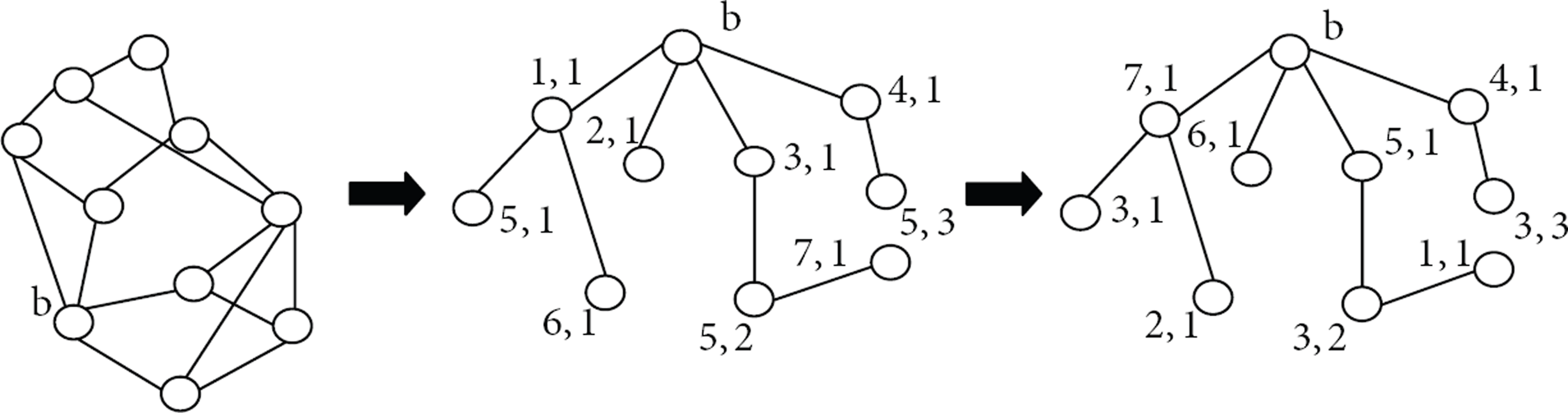
Hybrid MAC scheduling algorithm.
3.2. Priority Scheme
The priority scheme used in this algorithm is inspired from IEEE 802.11e and I-MAC. Like IEEE 802.11e, the necessary data transmitting node listens to the medium and if it is found idle for the time interval more than AIFS, then it contends to access the medium. Randomly back-off timer value is selected between 0 and contention window (CW). The CW value is assigned to a minimum at first transmission and is gradually increased to maximum value in the successive transmissions. The maximum value of CW is given by

If the channel is free after the expiration of back-off timer, then the node will start transmitting the data. Based on the AIFS and CW values the priority level is assigned. If the AIFS and CW values are smaller, then the node is assigned to higher priority level. Different values of AIFS, CW, and the corresponding priority levels are given in Table 1.
Different Priority levels.
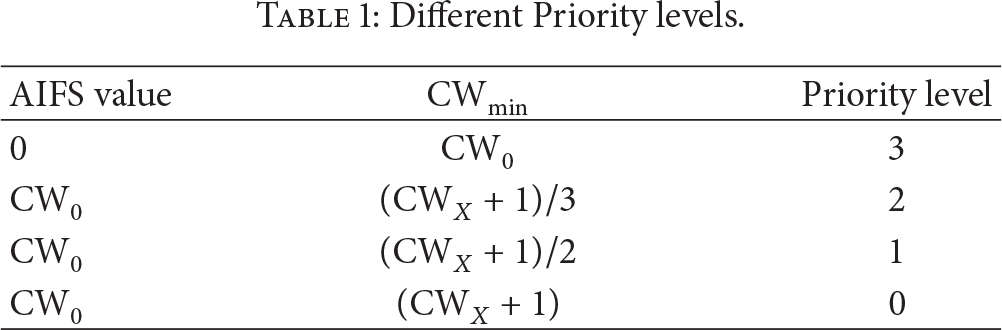
Priority level 3 (higher priority) is given to the owner node of the slot and the remaining priority levels are given to the nonowner nodes of the slot. According to the requirements and constraints faced by the nodes, the priority is assigned to them and is shown in Figure 3. Due to the changes in the network, the responsibility of the node may vary (i.e., the cluster head can share its responsibility to its member). Therefore, the priority scheme must be able to dynamically adapt to the network changes. An optimal solution is to make nodes auto attribute their own priority level. This priority can be fixed based on some statistics collected by these nodes during their lifetime which includes forwarding load, the distance to the base station, and the remaining battery charge.

Priority based channel access in EE-MAC.
4. Performance Evaluation
The overall performance of EE-MAC is evaluated in terms of energy, delay, and packet delivery ratio. Comparative simulations of EE-MAC and HyMAC are run on NS-2. The scenario is created for tree topology and by varying different parameters the simulation is carried out and the results are compared numerically as well as graphically. Parameters used in the simulation are given in Table 2. The simulation is carried out by varying number of packets, number of nodes and by changing the packet size. All these are described in the three different cases.
Simulation parameters.

Case 1.
The number of nodes in the network and packet size is kept constant in this case and by varying the number of packets generated simulation is carried out and the results are given in Table 3. The energy consumed, delay, and packet delivery ratio are calculated and are numerically compared in Table 3. In this case, number of nodes are set to 60 and packet size is kept as 1000 bytes.
Results of Case 1.

Case 2.
Number of nodes and number of packets are kept constant. By varying the packet size simulation is carried out and then the results are compared. The average delay taken by each node to deliver the data packet, energy consumed, and the packet delivery ratio is calculated and numerically compared in Table 4. Here, numbers of nodes are set to 60 and the number of packets sent is set aside as 700.
Results of Case 2.

Case 3.
Number of packets sent by the node and packet size are kept constant in this case. By varying the number of nodes in the topology, simulation is carried out and then the results are compared and given in Table 5. In this case packet size is kept as 1000 bytes and the number of packets sent by the node is fixed to 700. From the results obtained, it is evident that the performance of the EE-MAC is better than HyMAC in terms of energy consumption, the average delay for a node to deliver the packet, and packet delivery ratio.
Results of Case 3.

4.1. Energy
Figures 4, 5, and 6 show the comparison of energy consumption by HyMAC and EE-MAC for all the three cases. This energy includes the energy consumed to transmit data, to receive the acknowledgement, to retransmit the packet in case of a collision, and to sense the channel and for idle listening. Energy spent is calculated by using


Energy consumption for different numbers of nodes.

Energy consumption with different numbers of packets.
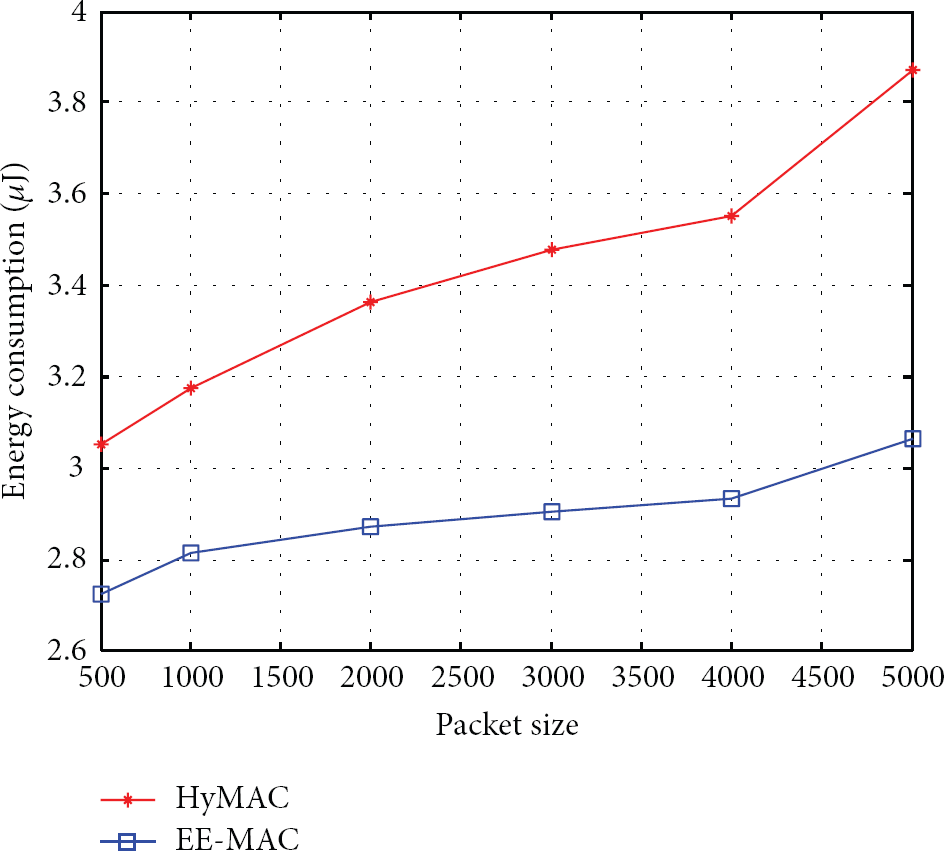
Energy consumption with different packet sizes.
The calculated energy values for all three cases are compared in the graph shown in Figures 4, 5, and 6. It can be observed from the figures that energy consumed by EE-MAC is lesser than that consumed by HyMAC in all scenarios. When the number of nodes increases, the energy consumption increases in both algorithms due to heavy traffic, whereas in EE-MAC it is less.
When the numbers of packets sent by the nodes is increased, the energy spent to deliver the packets also increased for both protocols, but it is reasonably less in EE-MAC. Energy consumption is increased for the increase in packet size, but it is comparatively less in EE-MAC.
4.2. Average Delay
Average delay taken by the node to deliver the data packet is calculated for both EE-MAC and HyMAC protocols in all 3 cases. The results are plotted in the graph and are shown in Figures 7, 8, and 9. From the figures we observe that EE-MAC performs better than HyMAC in all conditions. When the packet size is less, both protocols are having less delay. As the packet size is increased from 500 to 5000, delay is increased more for HyMAC, whereas it is comparatively less for EE-MAC.

Average delay of a node for various packet sizes.

Average delay of a node for various numbers of nodes.

Average delay of node with different numbers of packets transmitted.
When the number of senders increase, the delay also increases for HyMAC because of heavy traffic. EE-MAC overcomes this problem with the help of prioritization mechanism. When the number of transmitted packets increase the delay increases for both protocols, but it is reasonably less for EE-MAC.
4.3. Packet Delivery Ratio
Finally the packet delivery ratio is calculated for both EE-MAC and HyMAC protocols by using the following equation

In all three cases the packet delivery ratio is better for EE-MAC because of prioritization mechanism. Even for an increase in number of packets, number of senders, and packet size, EE-MAC performs better.
When numbers of packets transmitted are increased, the packet delivery ratio is decreased for both protocols due to congestion, whereas it is better for EE-MAC. These results are shown in Figures 10, 11, and 12. From the figures it is clear that EE-MAC performs better than existing MAC protocols.

Packet delivery ratio for different packet sizes.
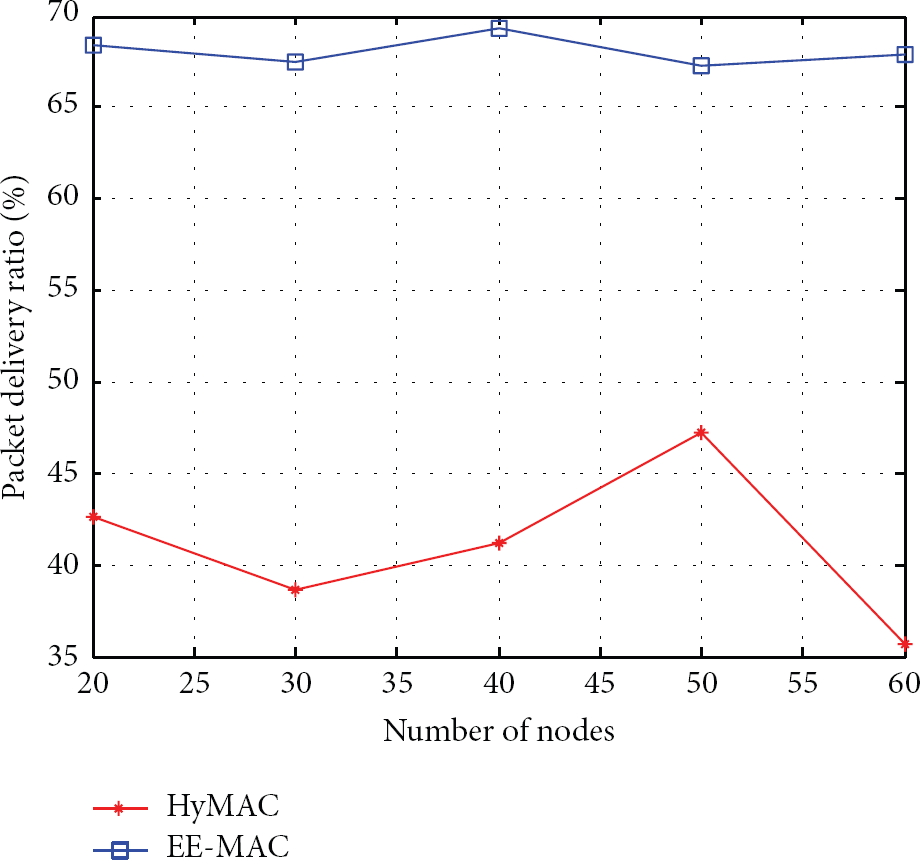
Packet delivery ratio with varying numbers of nodes.

Comparison of packet delivery ratio for different numbers of packets transmitted.
5. Conclusion
In this paper, EE-MAC, a hybrid medium access protocol with priority technique, for wireless sensor network is introduced. EE-MAC allows all nodes to access the media in an efficient and quick manner. This is achieved through an adaptive prioritization mechanism embedded with the hybrid of TDMA and FDMA techniques. In addition to this, life time of node is extended because prioritization mechanism not only reduces the back-off period but also reduces the collision between the nodes. Therefore by combining the TDMA and FDMA techniques and introducing prioritization to access the channel, EE-MAC becomes more energy efficient, more robust to topological changes, and very good in channel allocation. According to the topology changes, EE-MAC adapts itself, improves the delay performance, packet delivery ratio, and reduces energy consumption. The overall performance of the EE-MAC is evaluated through simulation using NS2 and the given results show significant improvement compared to HYMAC, mainly in energy efficiency, packet delivery ratio, and delay. EE-MAC can be implemented in a test bed to validate the simulation results as a future research work.