




Abstract
Mobile ad hoc networks mostly operate over open, adverse, or even hostile environments and are, therefore, vulnerable to a large body of threats. Conventional ways of securing network relying on, for example, firewall and encryption, should henceforth be coupled with advanced intrusion detection. To meet this requirement, we first identify the attacks that threaten ad hoc networks, focusing on the Optimized Link State Routing Protocol. We then introduce IDAR, a signature-based Intrusion Detector dedicated to ad hoc routing protocols. Contrary to existing systems that monitor the packets going through the host, our system analyses the logs so as to identify patterns of misuse. This detector scopes with the resource-constraints of ad hoc devices by providing distributed detection; in particular, depending on the level of suspicion and gravity, in-depth cooperative diagnostic may be launched. Simulation-based evaluation shows limited resource consumption (e.g., memory and bandwidth) and high detection rate along with reduced false positives.
1. Introduction
Securing mobile [Ad hoc] networks (MANETs for short) is particularly challenging because these networks often operate in adverse or even hostile environments [1, 2]. In addition, they are characterized by the open radio-based medium of communication [3], the dynamic topology [4, 5], the lack of centralized administration/security enforcement points (e.g., switches and routers) [6], the low degree of physical security of the mobile nodes, and the limited resources (e.g., energy, bandwidth) [7]. Hence, MANET is much more vulnerable to attacks than the traditional infrastructure-based network [8]. Conventional prevention techniques, for example, firewall, encryption [9], and authentication [10], cannot totally eliminate the attacks. Indeed, they address the outsiders but they are less helpful for protecting against the insiders; if a legitimate node becomes compromised, then all the secrets associated with this latter would be open to attackers. Moreover, new attacks emerge and find usually a way to penetrate the aforementioned techniques. Therefore, there is a need for a reactive mechanism, such as Intrusion Detection Systems (IDSs for short) [11], which constitutes a second line of defense.
As a first step upon this goal, we survey the attacks that have been reported in the literature. More specifically, we focus on the attacks targeting the Optimized Link State Routing (OLSR for short) [12]; its central role, namely, determining multi hop paths among devices, designates the ad hoc routing protocol as one of the favorite targets for the attackers [13]. Our attempt is not restricted to describing a bunch of attacks. Instead, we categorize and detail each attack relying on a representation/formalism that captures the complexity and temporal dependencies between each of the constituting subtasks. While describing attack, we attempt to circumvent the general form of this attack so as to keep to a minimum the detection that fails due to a varying attack. Based on these modeled attacks, we further implement one attack, challenge and derive appropriate intrusion detection.
Recent works show that attack may be identified by detecting a deviation to the correct behavior (anomaly detection); this correct behavior is either hand-specified relying on a protocol description (typically a Request For Comment (RFC for short)) as in, for example, [14] or automatically built/analyzed using machine learning or data mining techniques, for example, [15]. The difficulty involved in automatically modeling the behavior of such dynamic network leads to a large number of false positives that may be reduced by coupling automatic and specification-based anomaly detection [16]. Moreover, the used techniques are mostly characterized by their intensive calculation and, henceforth, the extensive consumption of resources [2]. An alternative consists in describing the way an intruder penetrates the system (by establishing intrusion signature) so as to detect any behavior that is close to this previously defined signature. Little attention has been centered on signature-enabled detection (also called misuse detection) in MANET [17], although it guarantees a high rate of detection along with a limited number of false alarms [18].
We propose IDAR, a log-, signature-based Intrusion Detector dedicated to ad hoc routing protocols. IDAR does not necessitate sniffing/inspecting the traffic as it is the case with the majority of other IDSs. Thus, it avoids the permanent strain of energy, bandwidth [19], and computational power [20] that accompanies traffic sniffing and analyzing. Our system rather takes advantage of the audit logs that are generated by the routing protocol so as to detect evidences of intrusion attempts. In practice, a sequence of events are extracted from logs so as to be matched against a set of predefined intrusion signatures—a signature is thought of as a pattern of events that characterizes an intrusion.
Main challenges stem from the need to keep to a minimum the number of diagnostics and the computational load related to the intrusion identification while minimizing the traffic generated when gleaning intrusion evidences. This calls for developing a lightweight and distributed intrusion detection system that scopes with the cooperative nature of ad hoc networks and the device resource constraints. Towards this goal, IDAR is designed to be a distributed and cooperative detection system, which parses logs as close as possible from the device that generates them so as to diminish the number of long-distant communications. Furthermore, we propose to categorize the intrusion evidences according to their level of gravity/suspicion. Such categorization enables us to carefully plane the diagnostic; an in-depth diagnostic is initiated only when a sufficient degree of suspicion exists and terminated as soon as a result is obtained. Thus, we guarantee keeping to a minimum the number/the duration of diagnostics. The performance of IDAR is evaluated in a simulated MANET that is coupled with virtual machines. Such coupling permits us measuring both the detection accuracy and the amount of consumed resources.
The reminder of this paper is organized as follows. We first survey attacks on ad hoc network, breaking down the successive steps that characterize conquering attacks (Section 2). Grounded upon the defined intrusion signatures, we present a distributed, log- and signature-based intrusion detection system (Section 3) and evaluate its performance (Section 4). Then, we conclude this paper with a summary of our results along with directions for future works (Section 6).
2. Vulnerabilities
Physical, data link, and network layers are all subject to vulnerabilities. Whereas in the physical and data link layers, vulnerabilities are common to IEEE 802.11 wireless networks, vulnerabilities in network layer are specific to ad hoc networks. More specifically, Zeroconf and routing protocols constitute the main target of attacks [13]. The reason is threefold. First, no security countermeasure is specified or implemented as a part of the drafts or RFCs (request for comments) proposed through the Internet Engineering Task Force MANET (http://www.ietf.org/dyn/wg/charter/manet-charter.html) or Zeroconf (http://www.zeroconf.org/) working groups. Second, the absence of a centralized infrastructure complicates the deployment of preventive measures, for example, firewalls or key/authentication infrastructures. Third, any device may operate as router, which facilitates the manipulation of multihops messages as well as the compromising of the routing functionality. Attacks on those protocols fall into two main categories, passive versus active [21]. With the former, an intruder intercepts the traffic in order to reveal useful information (e.g., the roles played by the nodes and their locations) whereas with the latter, an unauthorized action is attempted [22]. Active attacks are further sub-classified according to their unauthorized actions as follows [23].
Drop attack consists in dropping routing message(s). Modify and forward attack modifies received routing message(s) before forwarding it. Active forge attack proactively generates deceptive routing message(s).
Although the above attacks threaten both routing and Zeroconf protocols, we hereafter concentrate on routing protocol and illustrate our presentation by exemplifying attacks on a proactive protocol called OLSR.
2.1. Background on the OLSR Protocol
OLSR aims to maintain a constantly updated view of the network topology on each device. One fundamental is the notion of multipoint relay (MPR): each device selects a subset of the 1-hop neighbors, called MPRs, that is responsible for forwarding the control traffic in the entire network. The basic idea is to select the minimum number of MPRs that cover the two-hops neighbors so as to reduce the number of nodes retransmitting control messages and hence keep to a minimum the bandwidth overload. Note that a redundant MPR may be selected as to increase the reachability but this leads to increase the overhead. In practice, a node N selects the MPRs among the 1-hop neighbors that are announced (in addition, link layer information provided by, e.g., the IEEE 802.11 protocol, may be used by a node to update its own routing tables) in periodic heartbeat messages, termed hello messages. Then, a Topology Control message (TC for short), intended to be diffused in the entire network (the message Time To Live field (TTL for short) can be used so as to limit message diffusion), is created by the selected MPR(s). In TC message, a MPR declares the nodes (including N) that selected itself to act as MPR. Thanks to TC messages, any device computes the shortest path (in term of the number of hops) to any destination, such path being represented as a sequence of MPRs. In addition to the above, last versions of the protocol specification support a node holding several network interfaces which are declared (if many) in a so-called MID (Multiple Interface Declaration) message. This message is broadcasted on a regular basis by MPRs so that one another maps multiple interfaces of a given node with the main address of this latter, hence permitting a unique identification. The aforementioned functionalities compose the core of OLSR. Additional extensions have been devised in compliance with the above-summarized OLSR specification. Examples include (i) dealing with the nodes that commit (or not) to carry the traffic for others and (ii) supporting interconnection of an OLSR MANET with another routing domain, for example, OSPF-enabled routing domain. With the former, node advertises (in hello message) its willingness to carry/forward traffic. With the latter, OLSR is extended to import (and, resp., export) the routes provided by other routing protocols (resp., OLSR). For this purpose, any gateway with associated host(s) and/or network(s) generates periodically a HNA message including those host(s) and/or network(s) (i.e., the related network address and the netmask); this message is further disseminated by MPRs. Such an auxiliary function is enabled by providing a basic layout of any OLSR packet and by ignoring unknown (and hence not handled) packets. Overall, these core and auxiliary functionalities are together subject to a variety of attacks.
Recently, a new version of OLSR (so-called OLSRv2) is specified in an Internet-draft [24]. OLSRv2 distinguishes itself from its predecessor by considering the link metric rather than hop count for selecting the shortest path. It is supposed that OLSRv2 would have more modular and flexible architecture that facilitates add-ons extensions for, for example, security, QoS, and multicast [25]. It will also possess a simplified packet format and reduced-size messages due to address compression [26]. However, both, OLSR and OLSRv2, retain the same basic algorithms and mechanisms.
It is worth mentioning that several enhanced versions of OLSR have been proposed. Some of them tackle the security issue and use signature, hash chain, or encryption schemes in order to provide the security to OLSR [27, 28]. In general, these versions aim to ensure (i) the integrity of the routing information, that is, preventing the unauthorized modifications of the routing messages by the intermediate nodes on the path from the source to the destination and (ii) the node-to-node authentication in order to prevent identity spoofing. However, they do not address, for example, the case where the source node is itself compromised and hence it generates incorrect routing messages. Thus, they are still incapable of preventing some types of attack [29]. Therefore, there is always a need to employ a detection mechanism so as to handle the attacks that would success penetrating the prevention techniques.
2.2. Attacks Targeting the OLSR Protocol
The attacks threatening OLSR are hereafter detailed and classified according to the model introduced in [30]. This model provides the level of expressiveness necessary to specify the relationship between the actions and their related consequences. We further enrich this model with temporal annotations (Table 1). As a consequence, complex attacks, their constituting actions and consequences are temporally and successfully depicted and categorized as drop attack (Section 2.2.1), active forge attack (Section 2.2.2), and modify and forward attack (Section 2.2.3).
Notations.

2.2.1. Drop Attack
In practice, a drop attack consists of an intruder that drops a control message instead of relaying it. This dropping has an impact only if the dropped control message is intended to be forwarded; as illustration, a suppressing of a hello message that is broadcasted over one hop, has no consequence. Thus, with OLSR, threatened messages are restricted to the messages that are created and/or broadcasted by a MPR so as to be rediffused by other MPRs, that is, Topology Control (TC), Multiple Interface Declaration (MID), and Host and Network Association (HNA) messages. More particularly, let us consider a host S that sends a control message which is intended to be forwarded. This message, which is originated at t (
2.2.2. Active Forge Attack
An active forge attack comes from a node that introduces novel deceptive routing messages. Among others, the broadcast storm stems from forging control messages so as to exhaust resources (e.g., energy) and saturate the communication medium. For this purpose, an intruder I forges a large number of control messages Declaring a nonexisting node as a symmetric neighbor implies that I (or another misbehaving node) is further selected as MPR (Expression 5). Indeed, if I advertises a non-existing node N ( Declaring that an existing node is a symmetric 1-hop neighbor whereas that node is far away (i.e., is not a neighbor) or is a neighbor but that is not symmetric ( Omitting an existing 1-hop neighbor and symmetric node, P ( the MPR selector(s) the MPR selector(s) along with the MPR of I: the 1-hop neighbors 


Overall, falsifying the neighboring adjacency by inserting (existing or nonexisting) neighbor(s) and/or omitting real neighbors potentially perverts the local topology seen by S (and more generally by one another) and impacts the selected MPR(s) by S. Nevertheless, note that in order to be selected as MPR of S (or to prevent its selection), there is no need for I to falsify the neighboring adjacency. Recall that, in a hello message, a field, termed willingness, designates the node's willingness to carry traffic on behalf of others; I hence prevents (resp., ensures) its selection as MPR, by simply setting its willingness field to the value 


Let 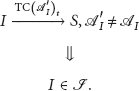
The aforementioned forge attacks (e.g., link or route spoofing attacks, sinkhole) necessitate to tamper specific message fields while keeping this message syntactically correct. More generally, bogus control messages can be forged, hence creating an implementation-dependent effect. Generally speaking, similar tampering may be performed by an intruder that has acted as MPR prior forwarding a falsified control message.
2.2.3. Modify and Forward Attacks
Modify and forward attacks are characterized by an intermediate, which captures the victim's control message and replays, modifies, or drops this message before forwarding it. In the following, we depict the two former cases, ignoring the message dropping that has been already described. Replaying a control message includes delaying the emission of this message by recording and forwarding it later (potentially in another area) or repeating this message. As a consequence, routing tables are updated based on obsolete information. Note that each message contains a field indicating the period of time during which this message is considered as valid, and hence it is used to update the routing table. Both attacks can be systematic (i.e., targeting any multihops control traffic) or selective. They may also be performed in a distributed manner (Expression 9) with two intruders: one recording the control message from one region so as to replay it in another region (i.e., the one of the colluding intruder). Without loss of generality, let 
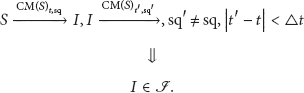
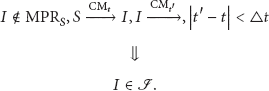
Overall, attacks targeting OLSR protocol are classified into 3 types:
drop attack that consists in totally or selectively dropping the control messages, for example, dropping TC message in order to foil route calculation; active forge attack that attempts to poison OLSR's functionalities by introducing novel deceptive control message, for example, a hello message including an incorrect neighbor set so as to foil MPR selection; modify and forward attack lies in an intruder that captures and modifies a control message before forwarding it (e.g., increasing the sequence number of a TC message; hence the subsequent TC messages are ignored).
An intruder launches the attack either in a standalone manner or in collusion with other intruder(s), constituting what so-called a Byzantine attack (e.g., wormhole), together usually coupled with masquerading. Detecting these attacks is far to be a trivial task because a minor deviation on an attack makes it undetectable. In addition, an attack can be composed of several subattacks. In order to tackle these issues, we describe/model the attack as general as possible, hence circumventing possible deviations. We then propose an intrusion detection system that detects composed attacks as much as their parties.
3. Intrusion Detection
We propose a distributed, log- and signature-based intrusion detection system named IDAR. In addition to providing a high detection accuracy, IDAR aims to maintain the available resources in MANET. For this purpose, the evidences of attack are extracted from the log and further classified according to their level of gravity. Such classification helps in planning the diagnostic and henceforth minimizing the computation overhead related to attack identification. During the diagnostic, evidences are matched to predefined intrusion signatures. The establishment of an intrusion signature and further the diagnostic operation are exemplified with the link spoofing attack we purposely developed.
3.1. Resource-Aware Evidence Gathering
IDAR distinguishes itself from other IDSs by extracting the signs of attack from the logs instead of sniffing the traffic. Thus, the consumption of energy and computational power resulting from evidence gathering and analyzing is minimized. In fact, sniffing traffic necessitates that the wireless network interface stays in mode promiscuous at all time, thus, the node can overhear all the packets within its transmission range. But promiscuous mode leads to consuming more energy and hence reducing rapidly the lifetime of the node/network. Indeed, a nondestination node in the radio range of either the sender or the receiver overhears some or all of their traffic. For the IEEE 802.11 MAC protocol, a nondestination node in discarding (i.e., nonpromiscuous) mode can enter into a reduced energy consumption mode and discard others' traffic [35]. Such mode requires less energy than the idle mode, which is the default mode in ad hoc network. While a nondestination node operating in promiscuous mode listens to all the traffic, whether or not it is the intended destination. The traffic is further received as if it was a broadcast traffic; thus, additional energy consumption is associated with promiscuous mode operation. Figure 1 represents a part of the experimental measurements realized in [19] about the energy consumption of an IEEE 802.11 2 Mbps wireless card. It shows the significant difference in energy consumption between promiscuous and nonpromiscuous modes. Note that the consumption in the nonpromiscuous mode is negative because it requires less energy than the reference idle mode. Besides increasing the amount of consumed energy, sniffing traffic imposes a huge computational overhead [20]. Indeed, the packet-level analysis, which is applied on the sniffed packets, strains significantly the available resources, that is, memory and CPU processing. Moreover, since all the traffic in the radio range is sniffed, many of the analyzed packets would be redundant and add nothing to the detection. In order to avoid this permanent strain of resources, IDAR does not sniff the traffic but it rather collects periodically the local logs. In particular, it focuses on the portion of logs that characterizes the activities of the routing protocol (e.g., packet reception, MPR selection). Note that additional logs, for example, system-, security-related logs, could be integrated and correlated. Once parsed, a log is used so as to detect a sign of suspicious activity. This consists in matching the log against a predefined intrusion signature. An intrusion signature is thought as a partially ordered sequence of events that characterizes an intrusion. Such procedure is potentially not only memory but also bandwidth consumer. Indeed, it involves examining local logs as well as performing an in-depth diagnostic where other nodes are requested so as to collect additional attack evidences, correlate, and match them against the defined intrusion signatures. The in-depth diagnostic offers a global view about the suspicious nodes, and therefore it increases the accuracy of the detection. But, it is a costly operation in terms of resources. Thus, the in-depth diagnostic must be carefully planned, that is, should be initiated only when a sufficient degree of suspicion exists and terminated as soon as a result is obtained. For this purpose, we propose to classify attack evidences so that depending on their level of gravity, the in-depth diagnostic may be performed. According to our classification, an evidence falls into one of the following four groups.
Initial-evidence group contains the evidences that lead to launch an in-depth diagnostic over the network. Suspicious-evidence group contains the evidences that lead to identify a node as suspicious. Confirmed-evidence group contains the evidences that confirm the occurrence of an attack. This results in terminating the diagnostic and declaring the suspicious node as intruder. Cancel-evidence group contains the evidences that eliminate the suspicion and stop the diagnostic.
These groups are populated with the evidences that are extracted from the log. If an evidence belonging to the initial-evidence group is discovered, then an in-depth diagnostic is launched so as to confirm (i.e., discovering an evidence belonging to confirmed-evidence group) or infirm (i.e., discovering an evidence belonging to the cancel-evidence group) the intrusion; both lead to the termination of the diagnostic. Relying on these groups, the evolution of any attack and its related detection is easily followed. In addition, its compact form facilitates the lightweight discovering of long-term intrusions.

Energy consumption in promiscuous and nonpromiscuous modes.
3.2. Link Spoofing Attack
A link spoofing attack lies in falsifying hello message(s) so as to modify the local topology perceived by adjacent nodes. This attack influences the MPR selection. In particular, this attack owns a global impact: the MPR position provides to the intruder the possibility to eavesdrop, tamper, misrelay, or drop the traffic. As discussed in Section 2 (and further detailed in Expression 4), an intruder realizes a link spoofing attack through one of the following three cases.
It advertises a non-existing and symmetric node. Thus, the intruder guarantees (unless another attacker advertises the same non-existing node) being selected as a MPR because this non-existing node is uniquely covered by the intruder. It advertises existing but nonneighboring node(s). The intruder is selected as a MPR if the advertised node(s) is (are) not already covered by another (well-behaving or malicious) MPR. It keeps under wraps neighboring and symmetric node(s). In this case, the connectivity of the intruder and consequently its chance of being selected as a MPR are both decreased. Used in a standalone manner, this attack aims to decrease the connectivity of one or several nodes; a complete isolation necessitates that no other (well-behaving) MPR covers that node(s).
We develop an attack (Expression 12) wherein an intruder falsifies a hello message that contains both a non-existing node (Case 1) and existing but non-neighboring nodes (Case 2). The reason that motivates this choice is twofold. First, by advertising a nonexisting node N, I ensures being selected as a MPR by the victim S (
3.3. Signature Establishment
As mentioned before, a link spoofing attack aims to inflect the MPR selection; such selection is triggered upon a change in the symmetric 1- and 2-hops neighborhood. Rather than launching an in-depth diagnostic upon every change in the 1- or 2-hops symmetric neighborhood, we keep to a minimum the number of these diagnostics, and henceforth the amount of consumed computational power and bandwidth, by initiating it only at the occurrence of an event related to a link spoofing attack. More precisely, we ignore the changes in the 1-hop neighborhood (e.g., apparition of 1-hop neighbor) because they are observed by the node itself. Thus, they are not subject to the remote falsification which is the cornerstone of a link spoofing attack. In contrary, changes in the 2-hops neighborhood are considered as long as they impact the MPR selection. In practice, the evidences that reveal a link spoofing attack (Table 2) are broken down into:
a MPR replacement (Evidence 1 or No MPR replacement takes place but an already selected MPR is detected as misbehaving node. For instance, a misbehaving MPR may drop, falsify, or misrelay the control messages ( a MPR is the only one that covers one or several nodes ( a MPR covers partially its adjacent neighbor(s) ( a MPR provides connectivity to a nonneighboring node (
The occurrence of either 
Evidence characterizing a link spoofing attack.

3.4. Cooperative Diagnostic
The in-depth diagnostic of a link spoofing attack consists in verifying the existence of a symmetric and neighboring relationship between a suspicious MPR and its advertised 1-hop neighbors (Algorithm 1). More precisely, this diagnostic follows the following steps. First, the MPRs that have been replaced by other MPR or 1-hop neighbor are identified (lines 1-2) because such replacement represents the initial evidence of a link spoofing attack (
(1) OldMprs = GetReplaced-Mpr(); (2) SuspiciousMprs = GetReplacing-Mpr(); (3) (4) InterrogatedNodes = GetCommon2HopsNeighors (suspicious, OldMprs); (5) (6) false) (7) Generate-Alarm (suspicious); (8) (9) (10) Cancel-Suspicious (suspicious); (11)
4. Architecture and Performance Evaluation
In this section, we introduce the key architectural components of IDAR (Section 4.1). Then, we present the evaluation of IDAR performance (Section 4.2) and further discuss the obtained result (Section 4.3).
4.1. IDAR Architecture
In order to cope with the dynamic nature of MANET, IDAR is both distributed and cooperative. The proposed architecture (Figure 2) requires that every device participates in the detection (The delegation of some detection operations (e.g., logs analyzing) may be shared among devices. But, it will not be necessarily less expensive in terms of resources consumption.) More precisely, each device contains an instance of IDAR, which independently detects the signs of suspicion and cooperates with other instances so as to conduct the diagnostic in a broader range. IDAR is implemented in Perl (http://www.perl.org/) and conceptually structured into 4 components.
Coordinator that orchestrates all the components. As such, it constitutes the hearth of IDAR. In practice, it parses dynamically the OLSR logs so as to extract signs of suspicion and match these latter against predefined intrusion signatures. The intrusion signatures are represented as conditional rules (if condition then state). Furthermore, it triggers the communication and the alarm notification in order to launch advanced diagnostic. Communication manager that gathers information about, for example, the adjacent links as required by the diagnostic manager. Meanwhile, it answers the diagnostic requests. This component runs into a separated thread so that other IDAR operations are not blocked. Knowledge database includes the information that is extirpated from the logs and is provided by the communication manager. This database is realized in Mysql (http://www.mysql.com/). Stored information encompasses, for example, the 1-hop and 2-hops neighbors and the MPRs. Alarm notifier is responsible for alarming the network when an intrusion is detected. Note that we are planning to include more countermeasures in the future, for example, eliminating the routes containing an intruder.
All the above components have been developed so as to support intrusion detection, offering a high rate of detection along with conserving the resources.
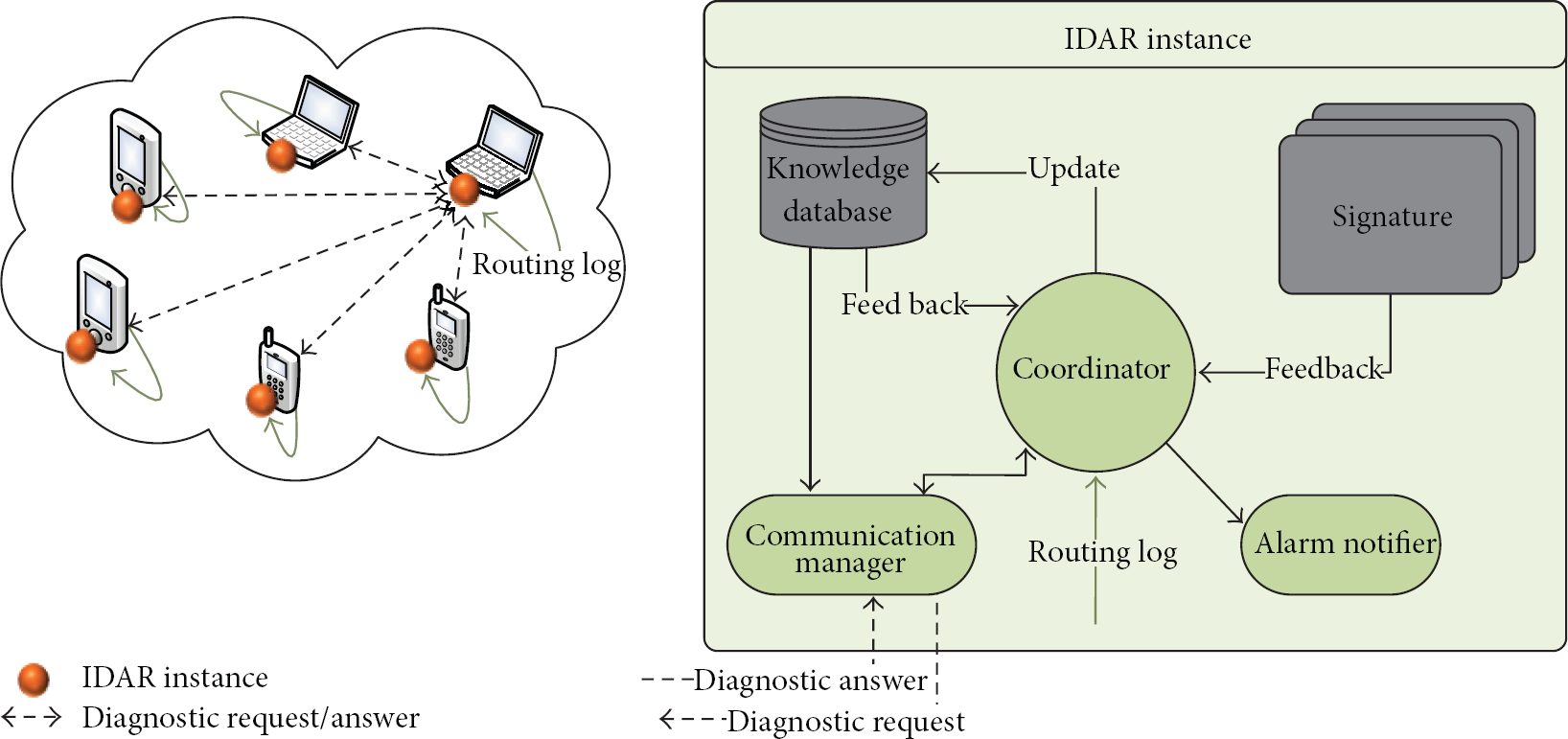
IDAR architecture.
4.2. Performance Evaluation
In order to evaluate the performance of IDAR, a mobile ad hoc network has been simulated using the network simulator NS3 (http://www.nsnam.org/) [36]. Each node in the simulated network is further coupled with a Linux Container (LXC) virtual machine (http://lxc.sourceforge.net/) [37]. The reason that motivates this coupling is twofold. First, NS3 offers the possibility to simulate a large-scale mobile ad hoc network. Second, LXC, an operating-system-level virtualization tool, permits to run multiple isolated machines (also called containers) on a single modified hosting kernel (up to 1024 containers over a single hosting kernel). Each container owns its proper resources (e.g., process tree, network interface, and IP address). Thus, the resource consumption (e.g., memory usage) can be isolated and measured. In practice, an instance of IDAR is installed on each container that appears as a standalone/separated machine. Figure 3 exemplifies the coupling between nodes in NS3 and LXC containers. From the IDAR perspective (as well as from any application installed on the container), the emission and reception of packets is done through the network interface (eth0). While the container contains a simulated ethernet card (
Simulation parameters.


Experiment platform.
For each experimental scenario, the simulation is launched intrusion detection rate that reflects the capacity of detecting successful intrusions (a successful intrusion causes the replacement of a legitimate MPR of the victim by an intruder); false positive rate that measures how many times a legitimate node is wrongly designated as an intruder; detection overhead which represents the additional network traffic that is generated because of IDAR. Note that further benchmarks are also provided in terms of memory usage.
Based on those performance indicators, IDAR is further evaluated with regard to the network density (Section 4.2.1) and node mobility (Section 4.2.2).
4.2.1. Network Density
In order to evaluate the scaling properties of IDAR, we vary the density of the network. The density of the network corresponds to the average number of neighbors, which is defined as in [40] by

Intrusion detection rate (a), false positives rate (b), memory usage (c), and traffic (d) depending on the network density.
4.2.2. Mobility
In order to isolate the influence of the mobility, the network density is set to
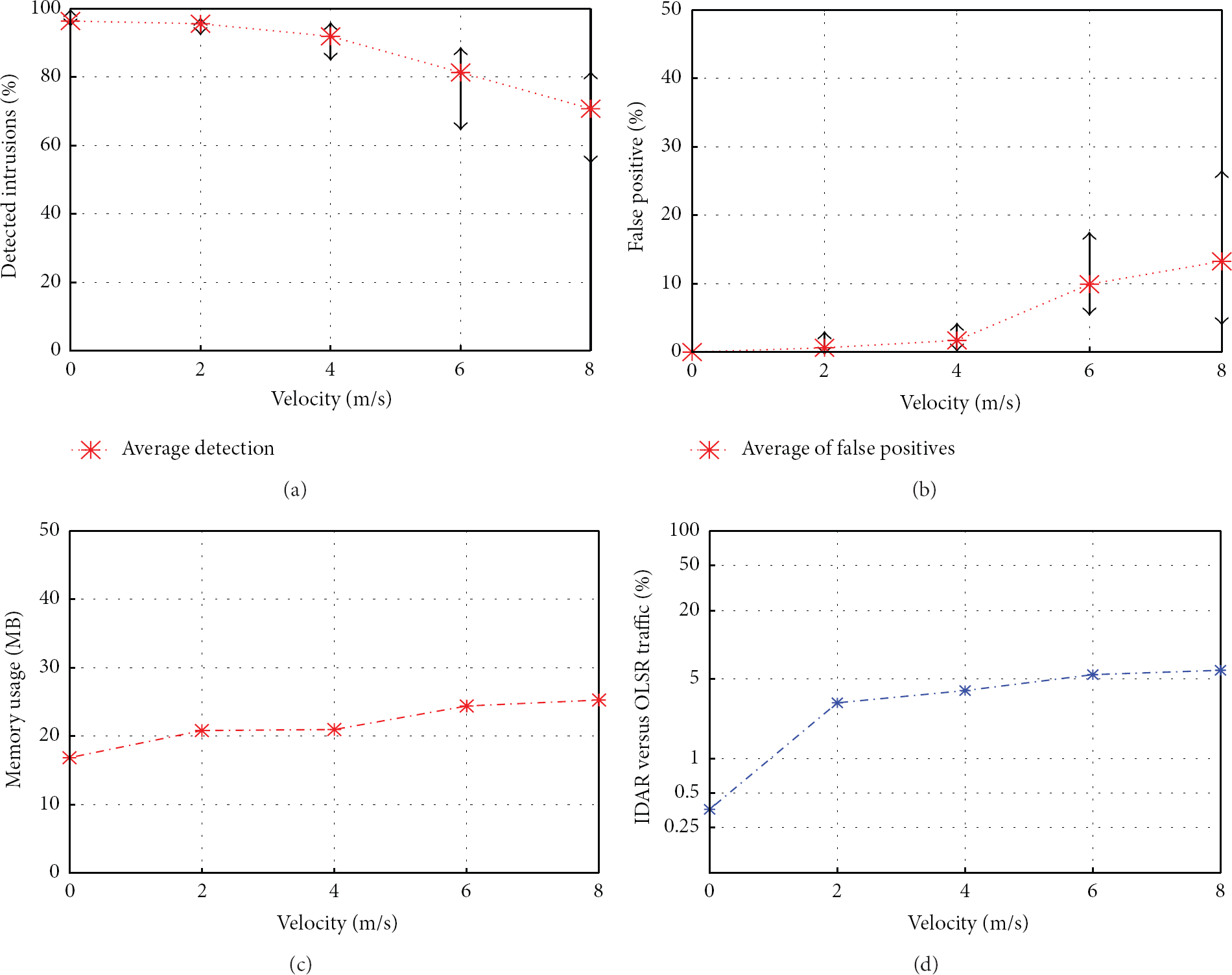
Intrusion detection rate (a), false positives rate (b), memory usage (c), and traffic (d) depending on the network mobility.
4.3. Performance Discussion
It is clear that the density of the network holds less influence than the mobility on our IDS. More mobility in MANET causes more dropped diagnostic packets, and hence less diagnostic is concluded with a final result, that is, confirming or refuting the suspiciousness. However, comparing the launched attacks to the discovered suspicious events shows that the majority of attacks are tagged as suspicious events and considered for further diagnostic. Note that the mobility has a negative influence on all the IDSs especially the cooperative ones where there is an exchange of evidences/alerts. Table 4 provides a short performance comparing between IDAR and other known IDSs that are dedicated to ad hoc routing protocol. Like the majority of these IDSs, the performance of our system is challenged against a specific attack: link spoofing attack, in a simulated MANET (According to [42], around
Comparing IDAR performance with other IDSs.

5. Related Work
Systems that detect intrusion targeting ad hoc routing protocol are extremely diverse in the way they analyze intrusion. They fall into the three key categories.
Anomaly detection system defines the correct behavior of the node/network so as to detect deviations to this behavior. This correct behavior is automatically built during an attackless training phase. The detection accuracy depends on the ability to (i) describe the correct behavior and (ii) distinguish between anomalous and unexpected behaviors. Specification-based detection system hand-codes the legitimate function/operation and then searches for a violation to this operation. Signature-based detection system first describes the way an intruder penetrates the system by defining an intrusion signature. Then, any behavior that is close to this predefined signature is flagged as intrusion.
Hereafter, we detail examples of each of these categories. Anomaly-based detection constitutes the main approach used to detect attacks. The IDS proposed by Zhang et al. [7] constitutes a de facto standard in MANET. It aims at detecting the attempts to falsify the routes provided by the AODV [61], DSR [62], and DSDV [63] routing protocols. During the training phase, the impact of movement on the percentage of changes in the routing table is analyzed. Note that this movement (i.e., velocity, direction, and position) is provided by a Global Positioning System (GPS). Then, during the operation phase, an actual percentage of changes differing from the predicted one, is defined as anomaly. In practice, the distinguishing between anomalous and normal behaviors is provided by the Support Vector Machine (SVM) Light [64] classifier or by RIPPER [15], a rule-based engine. The hierarchical IDS proposed in [47] detects blackhole and routing request flooding attacks targeting AODV protocol. Here, MANET is arranged into clusters, whereas the node with the highest residual energy and number of connections is elected as a cluster-head. Each cluster-head monitors the traffic inside its cluster so as to identify the abnormal values of (i) the percentage of changes in the routing table and (ii) the propagation of routing/data packets. Such abnormalities are identified thanks to (1-SVM) classifier [65], a deviation of SVM that needs to be trained with either normal or abnormal scenario but not both of them. In [48] (resp., [66]), a blackhole (and resp., dropping) attack targeting AODV protocol (resp., a secured version of AODV protocol including authentication and reputation estimation) are detected by investigating features, for example, the number of route requests and route replies as well as the average difference of sequence numbers (Largely increased sequence numbers are known as a sign of blackhole attack). Then, simple anomaly detection is applied: if the distance between the actually observed features and the average ones that are recorded during the training exceeds a given threshold, then an intrusion is detected. More sophisticated cross-features analysis (CFA) [67] is applied to detect both blackhole and packet dropping on AODV and DSR protocols. Features including, for example, the reachability between 2 nodes and the number of delivered packets, are analyzed within time windows. This analysis attempts to quantify the relation existing between one feature
Rather than establishing automatically a correct behavior, specification-based detection system hand-codes the correct behavior of the routing protocols based on the protocol specification (IETF draft or RFC). Then, the system attempts to detect a violation of constraints circumventing this behavior. Four key constraints define the correct behavior of OLSR ([14, 70]).
Neighbor relation must be reciprocal (i.e., 2 neighbors must hear the hello message sent by each other). The MPRs and the nodes that select the MPR (i.e., the MPR selectors) must be adjacent. A node that finds itself advertised as a MPR selector in a TC message must be adjacent to the originator of this message. Nodes receive TC messages without modifications from MPR(s).
Each node sniffs the traffic in its radio range so as to discover the violations of any of the above constraints. These constraints are modeled by semantic properties in [70] (resp., rules in [14]) so as to detect link spoofing attack on TC (and resp., hello messages); both experiment an ability to detect a link spoofing by observing a violation of the third condition over a simulated network composed of 11 nodes. Finite-state machines are used to describe similar constraints on OLSR [41] and the behavior of AODV protocol [52, 71]. In [41], a centralized detection of link spoofing, man-in-the-middle, and deny of service attack, is performed. While in [52, 71], incorrect hop counts/sequence numbers are analyzed by distributed sensors, which sniff and group the packets per request-reply flow so as to estimate the forwarding path per flow. If a route request/reply is illegally modified or forwarded via a nonexpected path, then an alarm is triggered. In [60], similar FSMs are used to define constraints on, both, the route discovery in AODV and the packet forwarding operations.
A signature-based system distinguishes itself by modeling the misbehavior (rather than the correct behavior) so as to identify if a sequence of observed events matching an intrusion signature. AODVSTAT [54] uses state-based signatures in order to detect dropping and spoofing attacks along with network flooding. Few sensors sniff the traffic and match it against predefined signatures. They also exchange periodically MAC and IP addresses so as to detect an identity spoofing which is characterized by a node emitting a packet identified by MAC and IP addresses differing from those registered for this node. A dropping attack refers to a node that fails to replay route request/reply. Finally, a node sending a number of packets exceeding a given threshold is identified as willing to exhaust resources. In [45], intrusion signatures are specified in opposition to the legitimate behavior of OLSR depicted in conjunction with specification rules similar to those defined in [70]. In particular, a node N mistrusts two neighbors L and M that conform to the following rules: M advertises L as a neighbor while L does not advertise M as a neighbor (or reciprocally), both L and M send TC messages while L's neighbors are a subset of M's neighbors (or reciprocally). In addition, N mistrusts M if N which is not a neighbor of M finds itself as a MPR selector in a TC of N (constraint 3). In [44], a FSM is employed to model the signature of hello message fabrication in OLSR protocol in an agent-based IDS. In practice, each node uses a Simple Network Management Protocol (SNMP) agent so as to collect audit data from the Management Information Base (MIB). After that, events are extracted from the collected audit data and are matched to the attack signature. The addressed attack aims at breaking the link between a victim node and its neighbors, and thus, a DoS takes place. To that end, the attacker impersonates the identity of the victim and sends a fake hello message advertising one of the victim symmetric neighbors with lost link status. Upon receiving the fabricated message, the neighbor changes the status of its link with the victim to “heard” and stops routing packets through the victim.
5.1. Synthesis and Discussion
A great majority of the literature is focused on anomaly detection while scarce effort investigates specification- and signature-based intrusion. This naturally calls for consolidating the effort on specification- and signature-based detection while following the habitus of wired network which consists in coupling these detection systems with one another, for example, in [72] wherein a combination of anomaly- and signature-based detection is realized so as to increase the detection rate. Almost all of the IDS focuses only on the detection accuracy, that is, providing a high detection rate along with limited false alarms. However, they do not consider the criticality of maintaining the resources and henceforth extending the lifetime of the node/network. Our IDS takes into account the necessity of reducing to minimum, both the communication and computation overload related to intrusion identification. The absolute majority of the IDSs is simulated (including the system we are proposing) rather than being either developed or experimented on testbeds or relying on empirical data. The reason that explains this situation is twofold. First, the deployment of critical MANET is limited/not advertised. Second, to the best of our knowledge, experiences of intrusion in MANETs are not reported: intrusions are in fact developed/simulated as proofs of concept. Nevertheless, not only routing protocols but also the characterization of the intrusion together leverage on the experience gained in designing routing protocols for wired networks and dealing with related misbehaviors. In particular, the similarity existing between the OSPF and OLSR protocols implies that many threats (e.g., sequence numbers, identity spoofing) are shared. In other words, intrusion may be inspired from the one targeting wired networks. Meanwhile, the development of intrusion detection and the envisioning of attacks are accelerated.
6. Conclusion
We survey and classify the attacks that target ad hoc routing protocols focusing on the OLSR protocol. In order to facilitate the definition of intrusion signatures, we extend a description model—an attack is expressed as the preconditions and the resulting consequences—and enrich it with temporal annotations. Once hand-coded, these signatures are utilized by IDAR, a log-based, distributed intrusion detection system dedicated to operate in mobile ad hoc networks. IDAR distinguishes itself by analyzing the logs generated by a routing protocol and extracts intrusion evidences so as to compare these latter against predefined intrusion signatures. For this purpose, evidences are categorized into four groups according to their degree of suspicion/gravity and hence to their ability to activate/deactivate the diagnostic. We further develop a link spoofing attack on the OLSR protocol, build the related detection rules, and evaluate the performances of IDAR relying on the NS3 simulator coupled with LXC virtual machines. Overall, the experiments figure out a high rate of intrusion detection and low false positives rate even under increased mobility and density. Meanwhile, resource consumption and network overhead result from the diagnostic are low and adapted to the resource-constrained devices. Note that ongoing effort is provided as to evaluate IDAR in a real MANET consisting of resource-constrained devices. Still, detecting intrusion is not a trivial task due to the large number of evidences to tackle and the resource-consuming diagnostic. A compromise between detection accuracy and resource consumption could be found. For this purpose, we are working on a new statistical mechanism for gathering the evidences. This mechanism aims at enhancing the scalability of our system by restricting the interrogation to a limited subset of nodes during the diagnostic. Moreover, until now, we assume that honest parties are passive; they alarm others but do not react. We are considering the coupling with countermeasures (e.g., blacklisting) and the exploring of lightweight binary consensus and trust establishment among the nodes that participate in the intrusion detection.