



Abstract
If wireless sensor network was deployed in electric power plants to provide equipment health data, it is essential that the data should be accurate and reliable. Nodes of wireless sensor network are different than wired test units, for they need to be distributed and have some constrains. Then online validation method is important to ensure data of networks to be reliable in important and safety related fields. It has been proved that calculation (such as FFT) can be validated by two orders functional (e.g., energy) in time and frequency domain, and with doing different number of times time-frequency signal analysis, the principle of test signal measurement validation method has been introduced. And with steady state signal, metastable signal, and the nonstationary signal the different online validation method is presented. And this method has been proved to be highly reliable and less uncertain in theory and experiment.
1. Introduction
1.1. The Challenge of Online Validation Method for Wireless Sensor Nodes
Wireless sensor networks can be applied in electric power plants (EPPs) to provide equipment health data, for their advantages of being easy to install, cost effective, self-healing, built-in redundancy, noninvasion, and so on [1–7]. The difference between nodes used in WSN and test units used in wired systems is shown in Table 1.
Difference between nodes in WSN and wired test unit.

In WSN, the reliability and accuracy of test data are mainly concerned issues [8]. And validation is an effective way to improve these performances.
The validation is defined as the process of checking whether a node of a WSN satisfies its specifications. And online validation is typically focused on software functional and nonfunctional executed properties that need to be ensured under different environmental and other dynamic conditions [9, 10]. In the meantime, physical models such as dynamic stochastic process signal, complicated random process signal, and complicated noise come.
Now existing online validation or self-test method typically focuses on following fields: the first are embedded processors and non-core components online software test SBST (software-based self test technology), using functional and structural test methods to cover with static faults, slightly dynamic faults and so on [11–16]; the second is automated sensor self-validation algorithm, using approximate reasoning techniques such as fuzzy logic to process the sensor measurement in industry harsh environment (normally slowly change signal, such as temperature) and make it have high confidence before using these test data [17–19]. The third is redundancy online covalidation method, which is one of the principal ways against the negative effects of random failures; however, as systems age, the likelihood of simultaneous failures of redundant safety systems becomes more compelling [20–26].
On other related researches, traditional hypothesis testing can be used by establishing confidence bounds and critical values for PIT [27, 28]. The distribute control algorithms with all-to-all and limited communications based on source seeking can be applied in order to use communication resource effectively [29].
So the challenges of online validation methods include distributed dynamic data validation, no-redundancy node or simultaneous failures of redundant safety systems validation, and resource limited algorithm design.
1.2. Main Contributions of This Paper
This paper presents online multidomain validation method, which uses frequency domain and time domain processing arithmetic (multi domain online validation method) with the same data source, having the following characteristics.
The distributed node (vibration sensor node) test results have effective meaning to reflect the equipment health or faults status. The test data can have high confidence even if the test signal is dynamic and the environmental stressor noise is complicated. The reliability and accuracy of test data in boundaries of the acceptance can be obtained.
Currently, the Multidomain (MD) method is often used in online learning, adaptation, and sampling, such as confidence-weighted parameter combination, classifiers, and domain-based representations with the MD sampler [30–34]. The main methods of MD are FEDA (frustratingly easy domain adaptation), MDR (multidomain regularization), MTRL (the multitask relationship learning), and so on. Unfortunately these methods are not suitable for the distributed sensor test data validation processing.
The main contributions of this paper are as follows.
An MD method validates correctness and trend prediction of test data, so that the data meets specified test requirements, and also meets the constraints of distributed sensor nodes. The proposed approach can handle the dynamic data acquired of distributed wireless sensor nodes. Compare it with concurrent domain, frequency, time-frequency filter in harsh noisy environment. And a prototype of different number of times time and frequency domain signal analysis is discussed Simulation results demonstrate that method can meet accuracy and reliability demands, while the traditional filter and validation used in wireless sensor nodes is typically unable to achieve this.
The remainder of this paper is organized as follows. In Section 2, the related background information and some assumptions of wireless nodes are given. Section 3 discusses the principle, formula, and analysis of MD method. The simulation results are presented in Section 4, and the conclusion is given in Section 5.
2. Distributed Sensor Assumptions and Background Review
2.1. Construction Characteristics of Wireless Sensor Network Nodes
Here the construction characteristics of wireless sensor nodes are analyzed and three assumptions are given. As Figure 1 there are two different construction forms of wireless sensor network system.

The construction in different wireless sensor network systems.
Construction I. Like System 2, there are three different units; every unit has no or very less impact on other parts and it can do its task completely and independently.
Construction II. Like S ystem 1, every unit has some impact on other parts or every unit that accomplished its task needs other units running rightly.
Definition 1.
“Dependence of system” means if parts A, B, C have task A, task B, task C, the degree that each one fulfills its task should depend on other tasks running or undertaking.

In a serial system, 

In this assumption, if dependence of system increases, the reliability of system will decrease. So distributed function completeness is needed.
Assumption 2.
Every node in system should have distributed function completeness (like system 2).
As energy issue, data compressed is an important means to decrease energy consume and meanwhile improve throughput of networks (as Figure 2).

The transmitting power and data compress of nodes in wireless sensor network.
For example, if the RF power and throughput of received data were not considered, then

M is compressed rate, P is power, and TH is throughput.
The other two assumptions are as follows.
The second assumption of wireless vibration network node is that it should have high data compression rate.
The third assumption of wireless vibration network node is expounded from to the other part, which is to arrange task to every node, as every node should have meaningful output, real time mark, and precision.
For instance, here is given a vibration sensor example. With those assumptions, the wireless vibration sensor nodes should acquire data, process data, and output data which have meaningful format. The simplest way to do it is following the ISO 10816 and ISO 7919 where every node calculated the vibration density (for constrains of sensor nodes as Table 1). Consider

2.2. Online Industrial Automated Sensor Self-Validation
Deployed wireless sensor networks in EPP can continuously monitor and assess the health of EPP structures, systems, and components (SSC).
It is well known that noises of sensor measurements contain
harmonic noise; sudden large deviations (often caused by electromagnetic interference or external disturbances); component noise under environment stressors; measurement noise of improper installation and methods; unpredicted noise.
For active component wired online monitor system in EEP (for our example, vibration sensor nodes should be used), data analysis is based on pattern recognition for anomaly detection and so on.
(1) Sensor Self-Validation Algorithm. In an automated sensor self-validation system for cupola furnaces, the digital outputs are removed of noise and invalid data by the median filter, and then every sensor obtains a set of parameters that represent the temperature reading, its rate of change, and its variance. Secondly all these data are sent to the fuzzy logic system to do self-validation, and then an output that represents the self-confidence in the parameter set of this sensor is produced.
In this method, the temperature, the rate of change in temperature, and the variance of change in temperature are three inputs of fuzzy system. But they are not suitable for vibration test, for vibration signal is dynamic, and its noise is more complicated [35]; the wireless vibration sensor nodes have constrains as Table 1.
(2) Online Multidomain Learning, Adaptation, and Sampling. Multi-domain learning combines characteristics of both multi-task learning and domain adaptation and drawing from both areas.
And the multi-domain sampler can construct domain-based representations for an arbitrary multimodal distribution. And it can be applied to a wide range of Bayesian inference problems and it is particularly powerful in tackling problems with complicated posterior distributions.
For its learning and sampler ability, it may be predicted that this method may be effective in online validation.
3. Online Multidomain Validation Method
3.1. Calculation Validation and Measurement Validation
The feature of validation is often regarded as using different methods to compute the same data in order to get high confidence.
From this, we here define calculation validation and measurement validation in online test.
Definition 3 (calculation validations).
For a calculation process P, it stands for using function F to calculate input data 
And another calculation process V stands for using function 
If processing V can be done only if the calculation of P is correct in every step, then the process of V is calculation validations process.
Definition 4 (measurement validations).
Because of test error, application demands, and so on, there are acceptance limits of calculation validations in measurement application.
When the input data is converted to a signal, there is an error between output data
Extension of measurement validations is using different independent way to process data in order to obtain the high precision and reliability.
The difference between the validation and data fusion is that data fusion has multiple different data sources and validation has only single data source.
3.2. Online Multidomain Validation Method
Here we refer to calculation validation and measurement validation during software executing.
In this section, the theory or formula of online multi-domain validation is presented.
(1) Functional Analysis. In signal space, the input signal will be denoted by
Then seeking the function
The different map from 
Then inner production and orthogonal properties get
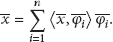
In frequency domain, Fourier series form orthogonal basis.
As Fourier Transform is unitary transformation, its time domain two orders Functional can convert to its frequency domain two orders Functional. And it is same for the invert convert. And so does the invert convert.
For energy function being two orders functional, the calculation validation can be done from two different domains using this relationship.
The important relationships between these are the following.
Parseval's theorem usually refers to the result that the Fourier transform is unitary; loosely, the sum (or integral) of the square of a function is equal to the sum (or integral) of the square of its transformation
Uncertainty principle limits the simultaneous time-frequency resolution one can achieve without interference, for real signal. Consider


Although formula (5) is two orders functional, unlike formulas (10) and (11), the definition of vibration density (measurement validation) is not intrinsic propensities concept (i.e., energy and uncertainty have no difference in different domains). Here come stochastic process signal and different number of times time and frequency domain signal analysis.
(2) Different Number of Times Time and Frequency Domain Signal Analysis. In ergodicity random process, some statistic value of signal calculated from space domain is the same as calculated from time domain.
To do measurement validation, we should first understand test signal properties. Signal can be divided into steady state signal, metastable signal, and the nonstationary signal, and so on.
For example a simple random simulated vibration signal (plus random noise) is

To compare the simulated signal with real test signal, two different test figures were put together (as Figure 3); the left is simulation figure and the right is real test signal. They are very similar.

Waveform comparison of simulated and test signals.
Then a simulated vibration random process signal can be obtained by random phase or random noise amplitude, and so on. That is,

And this signal may be more precise than first simulated signal.
Even simulated signal as (12), calculation process P, and validations process V are changed at different time (for random noise is changed); or in other mean, different measure times the two process are all different.
When doing validation (or obtain high precise), the steady value of output data set (may be eigenvalue vectors of input signal set) should be found. Then the space, time, frequency domain properties of signal should be considered. So does the signal (13). Consider space properties of signal and give an assumption that the output data from time domain and frequency data have same distribution (for unitary transformation and antithesis basis property).
(1) In Single Time or Frequency Domain
If it were steady state signal, owing to its random error properties, the simplest way to obtain stead value is averaging output data. If it were metastable signal, owing to its stochastic process properties, the powerful way to get stead value is using windows (continuous sliding) averaging output data. And this arithmetic is not fit for non-stationary signal.
(2) In Time-Frequency Domain. For non-stationary signal, the hidden Markov chain or KL distance should be considered.
(3) An Online Multidomain Validation Method for Vibration Sensor Nodes
When doing FFT, use (10) to do calculation validation. As steady state signal, when doing measurement validation (is not suitable for shock or violent vibration test), first calculate moving average of vibration density and maximum peak-peak value, if validation is true, output mean value and validated flag 1; else output maximum value and validated flag 0. As metastable signal, observe new data in every single domain, and obtain the trend of data from its versus domain, if its change trends were same as prediction then use new data as output, or use the mean data as output like steady state signal. And in the meantime the data relationship of each domain will be similar. Then recursion can be done. As nonstationary signal, as discussed in Section 2.2, if domain-based representations for an arbitrary multimodal distribution are obtained, hidden Markov chain can be used to charge march or not like metastable signal.
Like Figure 4, that in harsh environment or other situation, the uncertain noise, uncertain condition of device working and calculation, and other unpredicted elements, the multi domains parallel testing can improve its reliability and uncertainty.

Calculation diagram in time domain and frequency domain.
As it is obvious, if the different domains test data can be validated independently, the reliability of system will increase to be double.
And as analysis in error theory, for the test free degree increasing two times, the uncertainty of system will decrease
Generally, if n domains to test increase, the reliability will increase n times, and uncertainty of system will decrease
4. Simulation and Test Results
4.1. Noise Influence Vibration Intensity Calculation
To estimate noise influence the vibration intensity calculation, simulate signal 

Different noises influencing the vibration intensity calculation.
Conclusion 1. There may be a relationship between noise intensity and vibration intensity. Consider

Conclusion 2. Vibration intensity is increased when noise intensity increased
This result is same when noise is impulse noise, not Guess white noise and so on.
4.2. Shift Average of Noise Influence Vibration Intensity Calculation
As an example to decrease noise, a method of shift average (accumulate) is simulated, both in time domain and frequency domain.
Conclusion 3. As shown in Figure 6. When using average the uncertainty decreases in two different domains. Its application fields are steady state signal test.

Shift average in time domain and frequency domain.
4.3. Time-Frequency Domain Signal Simulation
Figure 7 shows two-signal change trend with time-frequency analysis. One is mechanic fault signal and the other is normal signal. Consider


Two-signal change trend with time-frequency analysis.
Figure 7 is different from Figure 8. Figure 8 shows only same signal test in different time. (do tfrstft transform).

Time-frequency domain analysis of same signal.
4.4. Experiment on Rotation Lab
The uncertainty of test results only using formula (5) and plus windows technology is 15% or more.
When using shift average the uncertainty of test results is less than 5%. And if method of median average pre-filter had been used, the absolute error is also less than 5%.
The vibration module used for test is shown in Figure 9 (includes ADUC7060 and ADUC345). And the multidomain validation method has been tested in the device. Steady state signal and sudden change signal validation had been tested. Uncertainty of test results is less than 5% also, and sudden change can be predicted and validated by different domain.
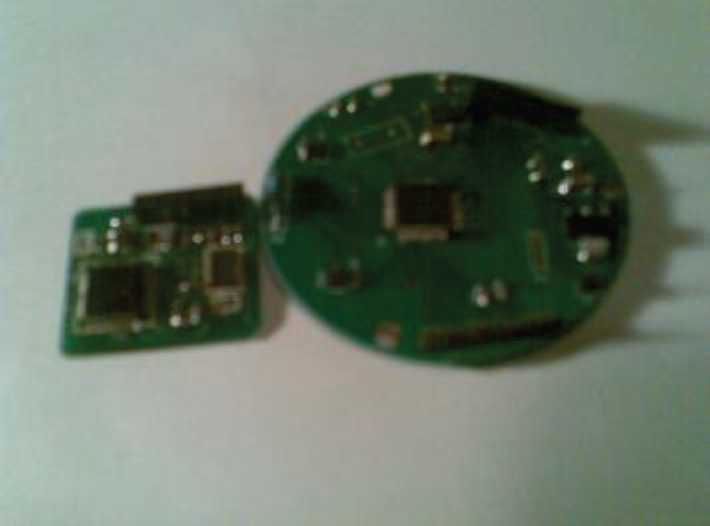
Nodes used for vibration test.
5. Conclusions
In the paper, characteristics of wireless sensor network nodes are discussed firstly, and three assumptions are obtained; that is, every node in system should have distributed function completeness, and every node should have high data compression rate, and every node should have meaningful output, real time mark, and precision.
Calculation validation can be done by their two orders functional, for example, using Parseval's theorem.
Moving average, windows and sliding average are proved to be useful to validate steady state signal and to judge the variation trend of metastable signal by simulations and experiments. According to these methods, when new test data of metastable signal were obtained, recursion calculation and the validation in multi domain can be done.
Footnotes
Acknowledgments
This paper is supported by the Fundamental Research Funds for the Central University (Project no. XDJK2012C019) and China-Canada Joint Research Project (Project no. 2009DFA12100). For support, contributions to discuss the authors staff would like to thank the rest of mobile computer center (MCC) of University of Electronic Science and Technology of China (UESTC), Canada partner of ISTP, as well as Mr. Li Yuan and Mr. Wei Jie, among others.