




Abstract
Currently, many injection machine controllers in the market involve PC-based architecture, so engineers can conduct simple and quick operation on the controller via a human-machine interface. However, when there are too many machines in a factory, mining algorithms for multimachines and development of rear-end applications are often trivial and complicated. The operation systems of the machines in factories are different, and different machine models need different transfer protocols for data mining. Therefore, we need to develop different information platforms and machine production information mining systems for cross platform controllers. This research proposed an agent based remote monitoring system for injection machines to solve this problem. The agent-based production remote monitor system framework in this research has the following advantages. (1) It can transmit machine information cross platforms regard of constraints of different operating systems. Controlling frameworks can process data mining and transmission. (2) It can send back machine information actively to the manager without operation of machine operators, mine specific information effectively, and screen unnecessary machine information. (3) It can categorize the required information, filter extra information, and elicit data the user needs.
1. Introduction
Electric injection machines, which can be called revolution in plastic injection machines, are of high-speed, and accurate, quiet, energy-saving, and clean. The market is extensive, including areas of plastic injection products. However, injection machines in factories must be maintained and adjusted frequently by engineers due to tool breakdowns, tool overheating, or parameters adjustment. Generally speaking, when a machine issue occurs, the operator has to request an engineer to resolve it. Since an adjustment of parameters must be done on every machine manually, commonly belated presence of the engineer results in a lack of immediate solution and a waste of time. Therefore, information monitoring system design plays an important part in controlling injection machine monitoring. Generally speaking, when there are too many machines in factory, the mining algorithm for multimachines and development of rear-end applications are often trivial and complicated. The operation systems of machines in factories are different, and different machine models require different transfer protocols for data mining. Many vendors have developed systems based on client-server architecture and web-based systems. However these platforms are sometimes inflexible and often centralize much of the system functionality without the ability of multiple source integration [1]. Therefore, it is necessary to develop different information environments and machine production information mining systems for cross-platforms. Determine a method by which to construct a machine information mining system has become a major task for system developers. As a result, this research develops an information mining agent based on injection machines to solve this problem. According to Wooldrige's definition of agent, an agent is “a software (or hardware) entity that is situated in some environment and is able to autonomously react to changes in that environment.” Some characteristics are also proposed in the research above. (1) Reactivity: an intelligent agent can change their manners based on certain time interval. (2) Proactiveness: agents can automatically do some behaviors for achieving certain goals. (3) Social ability: agents are able to interact with each other in a cooperative manner. This characteristic is based on agent communication language (ACL) [2]. Buse defined that “an agent is a software entity that is situated in some environment and can sense and react to changes in that environment.” Otherwise, agents are capable of operating autonomously and in a goal directed manner [3]. Some other researchers have proposed that agents can have the ability to cross platform and perform tasks beyond platforms. Moreover, agent-based manufacturing systems can offer distributed manufacturing functions with communication, cooperation, and synchronization capabilities that can cover the behavior specifications of components fulfilled by the manufacturing system [1]. More researchers have verified that the multi-agent technology can be helpful for traditional system transform. The multi-agent technology has some common characteristics, such as distribute ion, autonomy, interaction, and openness [4]. Based on the advantages of agent mentioned above, the proposed framework has three major mechanisms with the following advantages. (1) It can transmit machine information across platforms, so that different operational systems and controlling frameworks can execute data mining and transmission. For instance, many PC-based controlling systems like Windows XP and Linux will no longer be limited to operation systems, and different controllers can be integrated for the purpose of effective monitoring. (2) It can send back machine information actively to the manager without a machine operator, can effectively mine specific information, and can screen unnecessary machine information. In the past, the user has had to control via a remote monitoring system, elicit the needed information, and calculate the results via a human-machine interface. (3) It can categorize the required information, filter extra information, and elicit the data the user needs. For example, the information that the equipment engineer needs is that regarding diagnosis, warning, and abnormalities. The agent can judge the user's identity and offer the information that this user needs. A cross-platform information mining agent for an injection machine is developed based on a PC-based controller of an FAE allelectric injection machine for F Company. The research method is administrated using the following three steps for investigation and exploration:
design of a system framework for a cross-platform information mining agent based on an injection machine, which can transmit machine information across platforms using different operating systems;
the adoption of a TCP/IP-based service oriented architecture communication protocol, connection of the client end and the server end, and implementation of a packet format setup and transmission test;
designing of heterogonous platform, conducting an agent experiment, including monitoring transmitting time and packets, and constructing a human-machine interface.
According to the three research procedures mentioned above, a system prototype is designed and implemented in this research, and the results verify that the cross-platform information mining agent for injection machine developed in this research can effectively raise the cross-platform properties of various PC-based controllers as well as system availability. Experiments are conducted on the basis of packet transmission and connection stability.
2. Literature Review
2.1. Application of Agent Technology to Manufacture Systems
A control system based on agent technology has become a successfully manufactured model in recent years [5, 6]. An agent-based system consists of a set of agents in which each agent negotiates with others to resolve conflicts in a cooperative, compromised, or competitive manner [7]. Researchers proposed an agent-based open e-remote monitoring system framework to adjust to various manufacturing systems with different platforms. The system framework is based on service oriented architecture and can continue to develop flexibly according to different business models. The main purpose is to develop new functions effectively and quickly in accordance with user demand [8]. In addition, it focuses on direct control of the machines in the factory under consideration. As a result, in respect of system design, an agent can play a role in quick and effective development. Also, Colombo et al. also proposed an agent-based smart platform. (1) This framework can integrate different process systems and programs [9]. Via a work piece agent, a machine agent, and a transport agent, different heterogametic process systems can process configurations through a PC. We therefore discover that agent technology can be brought to a full play in regard to the integration of cross-platforms. Da'na et al. proposed an agent-based remote control system model (ADCMCS). (2) The results of this research were focused on application of object-oriented technology and agent technology to machine control in a factory. The results also explain that the research framework can involve control and operation in factories. Furthermore, in the research content, each agent's framework was analyzed using the UML model, and the agent's communication model was constructed [10]. This research also implemented an injection machine's remote monitoring system using this method. We can therefore see that agent-based framework is extensively applied to manufacturing systems. The monitoring system designed in this research allows many users to monitor multimachines at the same time without causing overloading the machines' connection. The advantages of the framework proposed by this research include the following.
Exchange and transmission of machine information can occur across platforms; different operation systems and controlling frameworks can conduct data mining and transmission as well.
It can send back machine information actively without the need for a machine operator, and it can effectively mine specific information and screen unnecessary information.
2.2. Application of Agent Technology to Remote Monitoring Systems
Da'na et al. designed a PLC-based controlling TCP/IP remote monitoring system, which used an industrial-compatible TCP/IP protocol. Each PCL module had a set of IP's by which the system could transport the packet to the destined IP using TCP. Then, different TCP headers were formulated, and industrial equipment was controlled by different process parameters. The design of the system emphasized robustness, a high degree of scalability, extensibility, sophisticated communication capabilities, and a powerful development environment [11]. This research extended and implemented that research framework by means of agent technology to carry out the five major characteristics. It referred to the packet content in that research and determined the most proper packet length via packet transport test in order to formulate the packet format suitable for an injection machine controller [11]. Gruhler proposed the use of TCP/IP and CAN to control a FESTO robot. This system connected a web server via the Internet (TCP/IP), connected FESTO via CAN, and further achieved a remotely controlling server driver to change the robot's position [12]. In addition, by remotely monitoring the existing ordinate and the track, people could monitor the machine conducting processing effectively via TCP/IP protocol without being limited by a firewall. The system is mainly used in monitoring image streaming. Based on the proposed concept of this research, application of this research primarily focuses on actual information elicitation and mining. ARBURG uses a TCP/IP framework to remotely monitor injection machines. This remote monitoring service is called the ARBURG Remote Service (ARS) and enables the user to check the machine's condition on a PC easily via this service [13, 14].
3. Research Methods
The PC-based controller for this research is for allelectric injection machines. Generally speaking, the client can operate the injection machine at the remote easily via human-machine interface. In the research methods, we begin with analysis of the system framework for an actual application situation. Next, two major frameworks, the machine connection agent and the information mining agent, are designed to achieve five major characteristics, that is, robustness, a high degree of scalability, high degree of scalability, extensibility, sophisticated communication capabilities, and a powerful development environment. For different interfaces of different types of injection machine software, we applied service oriented architecture (SOA) for the purpose of developing a formal standard based on XML data type. Different injection machine controllers are driven by different device drivers with their respective standards or communication networks. Moreover, the development of different functions for manufacturing or monitoring machines requires different methods or APIs. In this regard, SOA can provide system experts a way to integrate and develop different drivers or software. Based on the following literature review, we summarized some functionality of agent based manufacturing systems as follows.
Knowledge Reasoning. An agent based manufacturing system can have knowledge-based and reasoning functions. Manufacturing rules and factors are stored with connection and communication networks in it.
Object-Oriented. Agent-based manufacturing system has the features of object-oriented concept, for example, class, inheritance, method, instances, and so forth.
Cross-Platform. It can interact with each other to the development of flexible, extensible, and open architectures for cross platform.
Business Process Lead. It can process business task for directly or non-directly decision making for business process or system frameworks. Some methods can be performed without human.
Loading Balance. It can balance resources of networks, memories of developed platforms to keep the stability of executing manufacturing tasks.
Handshaking. It can communicate with each other's based on multi-agent architecture. Information can be shared by an optimization manner.
Self Learning. It can summarize its experiences from tasks performed in the history. Constructing own knowledge base and improving the ability of solving problems or issues.
3.1. System Framework
A cross-platform injection machine remote monitoring system framework based on agent technology is shown in Figure 1. This research carries out agent and applies agent technology to injection machine remote monitoring system design. We categorize data forms sent out by the injection machine into a prototype name, system time, temperature warning, product quantity, and accepted goods quantity. Additionally, an information mining agent has been designed to regularly receive and send back information required by a specific user to human-machine controller interface. Regarding information classification, we group according to the model names, so that information such as the quality management and mode order management record for each injection machine can be sent to the cloud database in a timely manner. In this manner, the manager can use a cloud application to observe the production condition of various products anytime and anywhere and can give an order or demand on a timely basis. For example, if a certain injection machine's production quantity does not meet the demand, or the products' quality is poor, an engineer can be assigned to maintain it immediately. This system can also provide a user to control multimachines in order to conduct the same movement at the same time and prevent the engineer from wasting time and labor by repeating the same movement. This research schemes a system framework on the basis of the hardware requirement of e-injection machines, including three parts: the injection machine, the client (PC, PDA, and Notebook), and data center (MES database or CIM database). Web Services can be abstracted with different functions when needed. Different controller of injection machines and different operating systems of users can be integrated with the capability of integration for agents. End users can monitor, manage through different platforms and devices with the information filtered by agents respectively. Judgments can be proactively made before the information send to the users. Production parameters tuning can improve more efficiently and dynamically. In this framework, services are saved as web services, which allow software developments to develop their new software interfaces for difference usages. The proposed framework can have following advantages.
All Electric Injection Machines (F70i-Server Controller). To read injection machine information the computer must be connected by the Ethernet of the controller, data must be transmitted via the Ethernet network, and a client/server framework must be used for the client end to monitor the production information of multimachines at the same time.
Client. The system user can look up machine information quickly and remotely through the software developed by this research. Machine information is displayed by an graphic user interface that only lists information that the user needs based on the decision of agents.
Data Cloud. The functions of the system are developed by web service, so that the developed service can be used repeatedly. The agent framework proposed in this paper can coordinate the operation of each service pool effectively, which will be explained later. Data regarding machine, maintenance, limit of authority, and machine parameters and machine temperature are stored in a cloud server.

Cross-platform injection machine remote monitoring system framework based on agent technology.
3.2. Machine Connect Agent
A machine connection agent mainly transmits data for the client end (PC) and injection machine controller via the Ethernet (TCP/IP) connection mechanism to allow the system to read the machine conditions and control the machines. The agent frameworks proposed in this research are a machine connection agent and an information mining agent, and the framework of proposed agent communication model is shown in Figure 2. The machine connection agent can positively listen to the TCP/IP continuously and can also transmit data steadily. Function judgment can proceed according to the content of the packet, and different TCP headers can be regulated to control the function library. The machine connection agent mainly provides the following functions.
Data Transmission of Cross-Platform Injection Machines. Different machines usually develop the controllers with different operating systems. The machine connection agent proposed in this research can transmit cross-platform TCP/IP packets and regulate a TCP header without being limited by the controller's operating system.
A Packet Listening Mechanism with an Automatic Fix Function. Machine connection agent can positively judge whether information is complete or not. When the machine is too busy or there is even a shutdown or missing data, the machine connection agent will recombine the information, restore its completeness, and effectively fix the missing information.
Unblocking of Timely Information. The machine connection agent can quickly monitor the condition of the injection machines. When the machine crashes or is maintained, the machine connection agent can report the condition on a timely basis and inform the information mining agent to conduct handshaking to achieve effective unblocking of information.

Framework of proposed agent communication model.
3.3. Information Mining Agent
Machine Connection Agent. The framework for the information mining agent receives data decoded by the machine connection agent according to the system format of all electric injection machines. The information mining agent in this research has the following main functions.
Information Elicitation. The agent can read data on the memory of the injection machine using the agent system program on the controller. The information mining agent can actively decode the machine's packet information and can divide it into different segments for the purpose of classifying different kinds of information.
Data Filter. The mining agents are designed with data filter functions. Information is elicited by information mining agents, which is translated to the administrator may want to understand, such as mode name, mode order management, and quality management. For example, data are divided into many word strings and combined with preposition string for users to understand. In different conditions, different information is displayed according to the judgment of information mining agents.
Unification of Word Strings. In order to fix the packet's format and for the client end's convenience regarding assessment, the string of words to transmit the packet must be mode “name + system,” “time + mode,” “order management (record of entering the factory and maintenance),” and “warning and message display line” (warning record and temperature warning) and quality management (product quantity, accepted goods quantity, defect goods quantity, and continuous defect goods quantity).
Dynamic IP Coordination Mechanism. When the controller's IP changes, the IP of the connection controller in the remote monitoring management system must change as well, so that the packet can be received correctly. The information mining agent proposed in this research can change the IP of the controller. After modifying the IP, it updates the IP to the database immediately. This system autodetects whether the IP changes every second and will update it upon any change. Such mechanisms can make connection even more stable and can also prevent the packet from disappearing after the IP is modified by the controller.
Handshaking Mechanism. Information mining agents are able to exchange data in a flexible manner. By mining the production database (Production DB), production records are transmitted and receive through agents. The information mining agent can change its status dynamically (SEND/RECEVIE/LISTEN), which means that all the agents are able to have several characteristics. Data filter function is also designed for information mining agents. Therefore, end users can acquire filtered data, which is close to their needs.
4. System Implementation
4.1. Machine Connection Agent Packet Transmission Algorithm
The machine connection agent packet transmission algorithm in this research mainly communicates on the basis of a client server framework. Three major functions are adapted in this algorithm. First, a parameter ProtocolType Client is denoted by setting the type of the connection. The socket connection is established with the function SocketFunction. The machine connection agent can have the ability for unblocking timely information mentioned in Section 3.2 with the function UnblockingFunction. AutoFixFunction is used to positively judge whether information is complete or not. When the machine is too busy or there is even a shutdown or missing data, the machine connection agent will recombine the information, restore its completeness, and effectively fix the missing information. The primary rationale is to establish a TCP connection channel from the client to the server and to send the required information at the client end by a packet command. To announce and substantiate the socket, the IP version, socket type, and protocol type must be determined. For example, the IP version is the 4th IP address version; the socket type is intended to support a reliable, bidirectional, and digital set of data flow that connects the framework, and the protocol type is TCP, so the substantiated client socket's code segment is as Algorithm 1.

4.2. Information Mining Agent Packet Sniffing Algorithm
The method to establish the information mining agent's packet mining algorithm is to designate the program IP and network communication port at the server for client data acquisition. A CallSniffingFunction is implemented for mining data from a certain information mining agent. For instance, the local agent IP can automatically acquired and determined through IPDynamicallySearchFunction. TCP channel is established to connect to the server with CallSniffingFunction. For example, 3 second stiffening interval is adapted by setting up CallSniffingFunction (IPClient, 3000). Agents set up the connection between server and client with ClientSocketConnectFunction. Moreover, announcing and substantiating socket, IP version, socket type, and protocol type with SocketFunction. For example, the IP version is the 4th IP address version, the socket type is intended to support a reliable, bidirectional, and digital set of data flow that connects the framework, and the protocol type is TCP, so the substantiated client variable is declared as Socket ServerSocket . Finally ServerSocket. BindMethod and ServerSocket. ListenMethod are used to bind client-server and set up the maximum amount of client-server pairs, respectively. See Algorithm 2.

4.3. Agent-Based Injection Machine Remote Monitoring Experimental System Development
The system in this research can simultaneously connect 32 injection machines to read information. Online operators can select the machine that they would like to monitor for monitoring information transmission. Machine connection agent's human-machine interface in the experimental system is shown in Figure 3. Alarm messages are displayed when machine connects agents and information mining agents are communicating. Machines statuses are able to change automatically while connection agents make decisions based on the information summarized by information mining agents. The following information will be summarized as shown in Figure 4.

Interface of agent connection status.
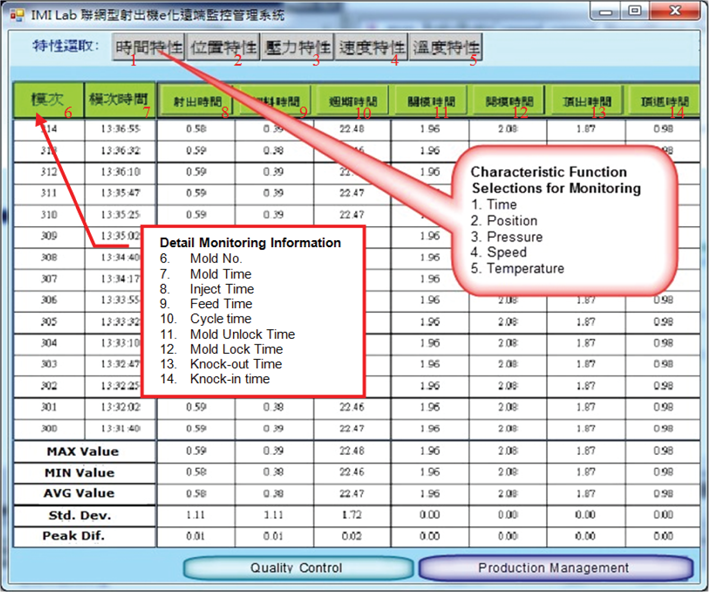
Report summarized by machine connection agents.
Microsoft Windows 7 was used as the experimental operating system to verify the efficiency of the proposed system. Details of the simulation environment are listed in Table 1. The programs were implemented in the C# language. The machine connection agent's experimental system can set up all automatic capturing machine information taking 0.1 second to read the message once. The size of the packet transmitted by the system and the machines is 276 bytes. When the machine number reaches 10, the information return time of each packet is about 35 mini-second. The information mining agent's experimental system is workable.
Machine connection agent's experimental system simulation environment.

5. Conclusions
Based on a system framework for a cross-platform information mining agent for injection machines, this research was aimed at information mining technology and transmission procedures for an information mining agent for the purpose of analysis and implementation for injection machine monitor system. Additionally, a TCP/IP communication protocol was adopted to connect the client and the server and to undertake packet format setup and transmission tests. Finally, for a heterogametic platform system, we conducted an agent's experiment aiming at monitoring transmitting time and packets and established a human-machine interface. The framework proposed by this research has the following advantages.
It is able to transmit machine information cross platforms and is able to conduct data mining and transmission among different operational systems and controller frameworks.
It is able to return machine information required by the manager without operation by the machine operator. It is also able to mine specific information effectively and screen out unnecessary information. In the future, we focus on more complete and thorough development of the system in addition to raising the reliability and quality of service of the agent for experiment and analysis, and we will apply such technology to the production line of injection machines.
Conflict of Interests
The authors declare that there is no conflict of interests regarding the publication of this paper.
Footnotes
Acknowledgments
The authors thank the High Technology Equipment Pioneer Technology Development Plan no. 302205501 and Science Council no. NSC 102-2221-E-006-107-, who sponsored this research and provided related technology support. Due to support from the National Science Council and Foxnum Technology Co. Ltd., this research could proceed smoothly. They wish to express their sincere appreciation.