




Abstract
Data broadcast is a fundamental operation in wireless sensor networks (WSNs). The existence of wireless interference makes it nontrivial to design a minimum-latency broadcast scheme, which is known to be NP-hard. Existing works all assume strict time synchronization and provide centralized TDMA scheduling algorithms. However, WSNs in practice are more likely to be distributed asynchronous systems. In this paper, we investigate the problem of data broadcast with minimum latency for distributed asynchronous WSNs. To this end, we propose a Distributed Asynchronous Broadcast (DAB) algorithm which crucially leverages an elaborately optimized carrier-sensing range together with collision-backoff schemes to coordinate the transmissions among the nodes on a predetermined broadcast backbone. Theoretical analysis shows that DAB is order-optimal and achieves constant factor approximation to the optimal delay. We then conduct extensive simulations to evaluate the practical capability of DAB in asynchronous WSNs and the results corroborate our theoretical analysis.
1. Introduction
Data broadcasting is probably one of the most fundamental operations in wireless sensor networks (WSNs) in which a message needs to be disseminated from its source to all the other nodes in the network. Broadcast plays an important role in implementing many networking protocols such as routing, information distribution, and resource discovery. In many applications of WSNs, for instance, military surveillance, industrial control, and object tracking, the time of utilizing the data is critical and a broadcast task often comes with a stringent delay constraint, which leads to the demand for low-latency broadcast scheme. Generally, a major challenge in achieving fast broadcast is how to deal with the interference in wireless networks effectively [1]. Due to the broadcast nature of wireless channel, two or more nodes transmitting data at the same time may interfere with each other, resulting in potential transmitting or receiving failures. To avoid wireless interference, the transmission requests within the network should be carefully scheduled, and such a requirement brings out the extensive research of Minimum-Latency Broadcast Scheduling (MLBS) in the literature [1–8]. MLBS aims to find an interference-free transmission schedule for data broadcast subject to interference constraints, while minimizing the total latency.
Ever since the NP-hardness of MLBS was established by Gandhi et al. in [1], a large amount of research has been conducted towards designing efficient broadcast algorithms with favorable approximation performance. Based on the assumption that interference exists among transmitters within a certain distance from each other (termed protocol or graph-based interference model [9]), numerous polynomial-time scheduling algorithms are proposed to generate collision-free transmission schedules for broadcasting and meanwhile achieve broadcast latencies whose upper bounds are approximate to the optimum [2–8]. Nevertheless, to the best of our knowledge, most of the existing works study MLBS under an ideal condition where the time is slotted and the entire network is strictly synchronized. In such a case, the transmissions in the network can be elaborately arranged to be scheduled during different time-slots and moreover nice bounds of broadcast latency can be calculated, which offers convenience for evaluating and comparing the theoretical performance of different broadcast schemes. However, in practice, it is rather difficult and not realistic to achieve strict time synchronization in wireless networks due to clock drift, unstable deployment environment and other technical limits, especially WSNs comprising large numbers of nodes [10, 11]. For the more practical asynchronous WSNs, unfortunately, little research on MLBS has been carried out.
In this paper, we are desired to fill this gap in order to better understand the performance of data broadcast algorithms in practical asynchronous WSNs. Such work is nontrivial yet rather challenging for that in asynchronous WSNs, it is impractical to acquire the overall information of all the nodes in the network and thus optimal schedule of data transmissions cannot be easily computed. Furthermore, in asynchronous WSNs, each node starts data transmission based on its own time clock and local information, which inevitably results in many data collisions and retransmissions, incurring latency performance degradation. To address the above challenges, we propose an interference-free and low-latency broadcast algorithm named DAB with favourable performance guaranteed by theoretical analysis and experimental evaluation for MLBS in asynchronous WSNs. DAB bases its design idea on CSMA/CA in the IEEE 802.11 standard and crucially uses the physical carrier sensing as a key ingredient. By carefully setting the carrier-sensing range and backoff timer, we make sure that each node can successfully broadcasts a message to its neighbours without suffering from any interference. Through propagating the broadcast message among the nodes on a preconstructed Connected Dominating Set- (CDS-) based broadcast backbone, all the nodes in the network are ensured to receive the message within a duration whose length is shown to achieve constant factor approximation to the theoretical minimum time. In other words, DAB achieves constant factor approximation on the optimal broadcast latency. Additionally, DAB focuses on the physical interference model [9] which is known to capture wireless interference more accurately and realistically than the widely used graph-based models. In the physical model, a signal is received successfully if and only if the Signal-to-Interference-plus-Noise-Ratio (SINR)—the ratio of the received signal strength to the sum of the interference caused by nodes transmitting simultaneously, plus noise—is above a hardware-defined threshold. The adoption of the physical model brings about another challenge as the interference among simultaneous transmissions is no longer a localized relationship and all the potential interference from the other (even very far-away) nodes should be taken into account. In all, we make the contributions summarized as below.
We derive the minimum interference-free carrier-sensing range, named minICR, for the nodes involved in the broadcast task under the physical interference model. The value of minICR is elaborately designed to make sure that (a) each node can conduct a successful broadcast to the nodes within distance of Based on the obtained minICR, we propose a distributed CSMA-like algorithm DAB for data broadcasting in asynchronous WSNs. Taking an existing CDS-based routing tree as the broadcast backbone, DAB propagates the broadcast message among the nodes on the backbone using carrier-sensing and collision backoff. Through coordinating the transmissions effectively, we make sure that the broadcast task is accomplished within We conduct extensive simulations to evaluate the practical capability of DAB in asynchronous WSNs. The results reveal that DAB does have comparable performance as the latest centralized and synchronized data broadcast algorithms in terms of latency under various network configurations.
The rest of the paper is organized as follows: Section 2 reviews the related work. Section 3 presents the network model and problem definition. Section 4 introduces the derivation of the minimum interference-free carrier-sensing range under the physical interference model. Section 5 serves as one of the main parts of this paper which presents the detail of DAB and its performance analysis as well. Section 6 provides the simulation results. Finally, Section 7 concludes the paper.
2. Related Works
2.1. Minimum Latency Broadcast Scheduling
MLBS in arbitrary undirected graphs has been extensively studied in the literature. Chlamtac and Kutten [14] established the NP-hardness of MLBS in general graphs. For the same problem, Elkin and Kortsarz investigated the hardness of approximation algorithms in [15, 16]. They proved a logarithmic multiplicative inapproximability (unless
For MLBS under the Disk-graph model, in which the transmission and interference range of a node equipped with an omnidirectional antenna is thought of a disk centered at this node with some radius, large amount of research has emerged in recent years. Gandhi et al. [1] showed that the MLBS problem restricted to unit-disk graphs in wireless networks is NP-hard and presented an approximation algorithm whose approximation ratio is as great as 600. Under the same model, Huang et al. [4] presented three progressively improved approximation algorithms with latencies at most
The comparison of different algorithms on the minimum-latency broadcast scheduling problem.

2.2. Asynchronous WSNs
Due to the difficulty of strict time synchronization in WSNs, more and more research has been carried out towards designing efficient communication protocols for nodes in asynchronous WSNs. Borbash et al. [21] proposed a probabilistic and asynchronous neighbor discovery algorithm that permits each node in the network to develop a list of its neighbors. Jang et al. [22] presented an energy efficient MAC protocol for WSNs that avoids overhearing and reduces contention and delay through asynchronously scheduling the wakeup time of neighboring nodes. In [23], a dynamic traffic-aware MAC protocol for energy conserving in asynchronous duty-cycled WSNs was proposed which can provide better data transmission rate when nodes are with high traffic loading and save energy when nodes are with low traffic loading.
2.3. Physical Interference Model
In recent years, physical algorithm, that is, algorithm for the physical interference model, has attracted a lot of attention both in the algorithm community and in the communication community. Much efforts have been paid in developing efficient physical algorithms for a wide range of topics in wireless network, including capacity [24], link scheduling [25], data collection, and aggregation [26–28], topology control [29], and so on. For recent results and references we refer the readers to the survey [30].
3. Network Model and Problem Definition
3.1. Network Model
We consider a set V of n nodes deployed in a 2D plane where 
Under the physical model, we can compute the maximum transmission range r of each node as
3.2. Problem Definition
Considering a network containing a set V of nodes, and a source Each node can only be scheduled to transmit after it has received m from some other nodes. At any time instant, the scheduled transmissions must be interference-free, which means that at each of the intended receivers, the SINR value should satisfy the SINR Inequality (1). All the nodes within the network must have received m at least once. The total time needed to accomplish the broadcast task should be minimized.
4. Interference-Free Carrier-Sensing Range
Since we study data broadcasting in distributed asynchronous WSNs, each node in the network will sense the activities of the other nodes within its carrier-sensing range (CR) before it transmits some data. Only when there is no ongoing transmission within its CR can a node carry out a new data transmission. Intuitively, the value of CR is of great importance on the performance of a distributed broadcast scheme. Specifically, CR should be chosen properly to make sure that when only one node is transmitting within its CR, the transmission will certainly be successful no matter how many nodes beyond its CR are transmitting simultaneously. In such a case, we say that the sensing range is an interference-free CR (ICR), the formal definition of which is presented below.
Definition 1.
The carrier-sensing range CR of a WSN is an interference-free carrier-sensing range (ICR) if each node in the network can conduct a successful transmission to its neighbours in the reduced graph when the node is the only transmitter within its CR.
Under the physical interference model, we have the following theorem which shows the condition that guarantees a carrier-sensing range CR of a WSN be an interference-free carrier-sensing range (ICR).
Theorem 2.
With the physical interference model, a carrier-sensing range CR is ensured to be an ICR if
Proof.
Assuming that node u is a transmitter and node v is one of its neighbours in the reduced graph, we have 
Subsequently, all the nodes 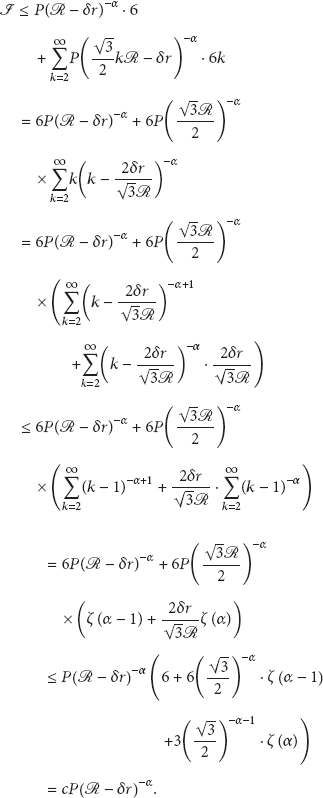
Here 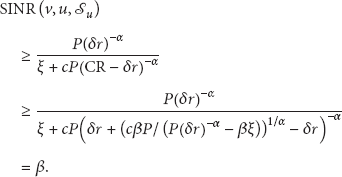
Thus, node v can successfully receive the message from node u and the carrier-sensing range CR is surely an interference-free carrier-sensing range (ICR). This finishes the proof.

The hexagon packing of nodes.
Intuitively, the smaller the CR, the higher the degree of spatial reuse will be. Therefore, we set CR as

The impact of α, β, and δ on the degree of spatial reuse.
5. Algorithm Design
In this section, we present the algorithm design for data broadcasting, which takes advantage of the derived minICR in Section 4 as a core ingredient. In our algorithm, we first construct a broadcast backbone which will serve as the routing of message propagation using an existing method and then present our broadcast scheduling algorithm which coordinates the node activities on the backbone in order to accomplish the broadcast task efficiently.
5.1. Broadcast Backbone
For a WSN represented by a reduced graph Perform a breadth-first search (BFS) on G, beginning at the sink Select a Maximum Independent Set (MIS) 𝒟 from the nodes in V. Specifically, we first add Select some connectors to interconnect the dominators in 𝒟 and hence form as a CDS-based broadcast tree. In specific, for each dominator in 𝒟, we pick its parent in
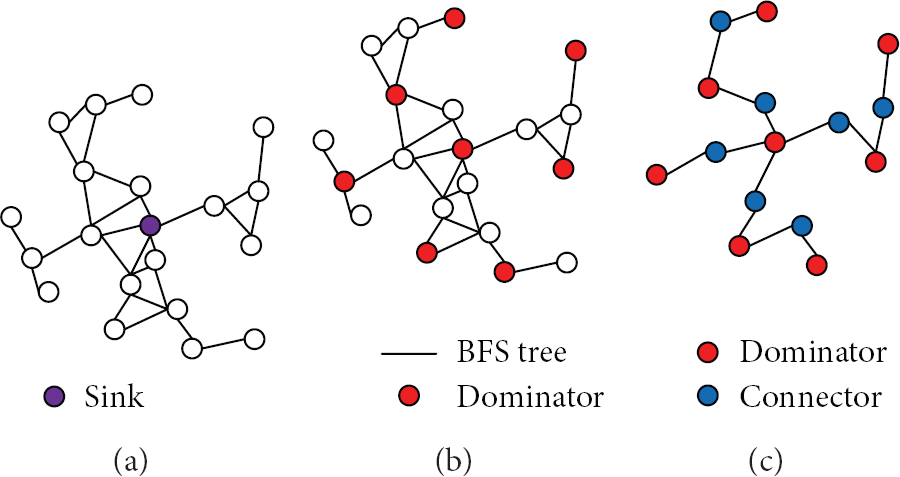
An example of the construction of broadcast backbone (a) the graph G, (b) the selection of MIS; (c) the constructed CDS-based backbone.
Apparently, to accomplish the broadcast task, it is unnecessary for every node in G to participate in the message propagation. Instead, we only need to deliver the broadcast message among the nodes on the backbone. In particular, after each node in
5.2. Distributed Asynchronous Broadcast
Our Distributed Asynchronous Broadcast (DAB) algorithm works in a CSMA fashion, except for the RTS/CTS working mode and the necessity to reply an ACK packet after receiving a data packet. Such elegance is owing to the fact that we have carefully set the carrier-sensing range for each sender which guarantees the data transmission be certainly interference-free under the physical interference model.
We present the pseudo-code of DAB in Algorithm 1. At the beginning, the sink broadcasts a message and then turns to asleep. For each dominatee in the network, it will turn to asleep after receiving the broadcast message at the first time. For each dominator or connector, it will try to relay the broadcast message immediately after receiving it. Before transmitting, the node (say u) randomly sets a backoff timer
1 Initially, each node sets its carrier-sensing range as and turns to be asleep; 2 3 4 u turns to be asleep; 5 6 u randomly sets a backoff timer window; 7 8 u senses the channel with 9 10 u freezes the backoff timer and stops the countdown process until the channel becomes free again; 11 12 13 14 15 16 turns to be asleep; 17 18 19
It is essential to clarify that in CSMA/CA of the IEEE 802.11 standard, each node has a limited carrier-sensing range and a node knows that the wireless channel is busy when another node in this range is transmitting by the way of a power-threshold carrier-sensing mechanism [33]. However, as we could see, the value of minICR is usually larger than the original carrier-sensing range. That means minICR is inherently not compatible with the conventional power-threshold carrier-sensing mechanism as used in IEEE 802.11. Specifically, the absolute power sensed by a node in the conventional mechanism does not contain enough information for it to derive its distances from other concurrent transmitter nodes. Fortunately, for the case where a lager carrier-sensing range is needed, a new carrier-sensing mechanism called Incremental-Power Carrier-Sensing (IPCS) proposed by Fu et al. in [31] can realize it in a simple way. To be more specific, instead of monitoring the absolute detected power, the IPCS mechanism monitors every increment in the detected power. This means that IPCS can separate the detected power of every concurrent transmitter and map the power profile to the required distance information [31]. Using such a method, a node will be able to determine whether it is within minICR of a transmitter in the distributed asynchronous broadcast algorithm DAB.
5.3. Latency Analysis
We now analyze the latency performance of DAB, which is of great importance on the efficiency of our algorithm. To begin with, we introduce a classic geometric result on disk packing.
Lemma 3 (Groemer inequality [34]).
Suppose that C is a compact convex set and U is a set of points with mutual distances at least one. Then

Based on Lemma 3, we are able to bound the number of dominators and connectors within the CR of each node.
Lemma 4.
Let
Proof.
For node u, its carrier-sensing range is a disk of radius CR centered at u. Moreover, the mutual distances of the dominators in 𝒟 are not longer than
According to the construction of the broadcast backbone, for each dominator, we add a corresponding connector to interconnect it with some other dominator. Then consider a disk of radius
Now we are able to acquire the latency bound of DAB, for which we have the following lemma.
Lemma 5.
Algorithm DAB accomplishes broadcast in
Proof.
For each node (dominator or connector) on the backbone, there are at most
Observe that it takes at least
Theorem 6.
DAB is a constant approximation algorithm for data broadcasting, when we only consider a reduced graph of the original network.
6. Simulation
6.1. Setup
In this section, we evaluate the practical performance of DAB using simulations. In all simulations, we consider the WSNs consisting of one source node and n sensor nodes that are uniformly and randomly deployed in a square region with side length l. All the nodes in the network have fixed and equal transmission power P and share a common wireless channel with limited bandwidth. The compared algorithm for DAB is the Centralized Broadcast Scheduling (CBS) algorithm proposed by Wan et al. in [6], which is the most recently published data broadcast algorithm under the more practical physical interference model. Unlike DAB, CBS is a highly centralized algorithm and works in a TDMA fashion. Specifically, the broadcast schedule is made at a control center with the assumption that the information at individual nodes are known prior and during each time slot, as many transmitters are scheduled as possible without violating the SINR requirements at all the corresponding receivers. Since our primary concern is the total latency of broadcast, we assume that the transmission duration of a single data packet is normalized to 1 time unit. Specifically, we set the transmission time of the broadcast message (i.e.,
Based on the parameters P, ξ, α, and β, we can obtain the maximum transmission range r of each node. For both algorithms, we consider a reduced graph consisting of edges with length at most
6.2. Impact of Network Radius
Firstly, we evaluate the effect of network radius R on broadcast latency. We set

Broadcast latency of different algorithms in terms of the number of nodes when (a)
6.3. Impact of α, β
We evaluate the effect of SINR parameters α and β. We set

The impact of SINR parameters α and β on broadcast latency.
6.4. The Best Choice of δ
Finally, we conduct simulations to see the impact of δ in different scenarios. We set
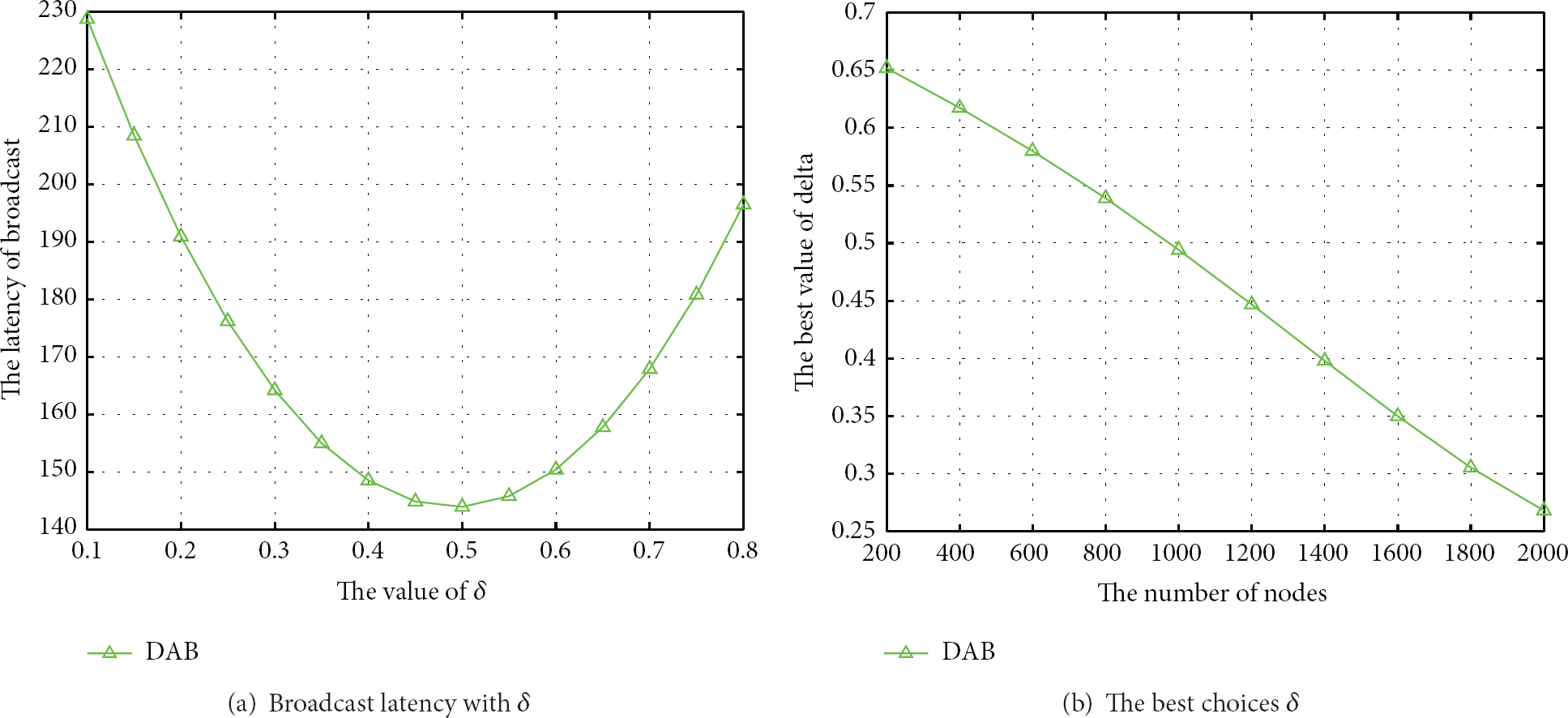
The impact of δ on broadcast latency of DAB.
7. Conclusion and Future Work
We study the minimum latency data broadcast problem in distributed asynchronous WSNs, which is more practical yet rather challenging compared with centralized and synchronized sceneries. To avoid transmission interference, we derive the minimum interference-free carrier-sensing range (termed minICR) under the physical interference model to make sure that by taking minICR as its carrier-sensing range, each node can conduct a successful broadcast to its neighbors. Meanwhile, the largest degree of spatial reuse can be achieved. Based on the obtained minICR, we propose a distributed algorithm DAB for data broadcasting in asynchronous WSNs. DAB takes a CDS-based routing tree as the broadcast backbone and propagates the messages among the nodes on the backbone using carrier-sensing and collision backoff. Theoretical analysis shows that DAB is order-optimal and achieves constant factor approximation to the optimal delay. We also conduct extensive simulations to evaluate the practical performance of DAB and the results reveal that DAB has similar performance to the latest centralized data broadcast algorithm. Several interesting questions are left for further research. The first one is to improve the approximation ratio of DAB. The second one is to design efficient broadcast algorithms with favourable performance for the original communication graph instead of the reduced one. The third one is to extend DAB for the more general Gaussian channel model [35].
Footnotes
Acknowledgments
This work was partially supported by the National Program on Key Basic Research Project of China (973 Program) under Grant no. 2011CB302906 and the National Science and Technology Major Project of the Ministry of Science and Technology of China under Grant no. 2010ZX03006-004. The authors would also like to thank the reviewers for their helpful comments and advices to improve the presentation of the paper.