




Abstract
The rise of the Internet of Things promotes adopting wireless sensor networks (WSNs) in daily life. In WSNs, the ZigBee standard has gradually become the dominant communication protocol. ZigBee supports various network topologies, including tree structures. Regarding the address assignment of the tree topology, a distributed address assignment mechanism (DAAM) is specified by the ZigBee standard. Using DAAM yields a simple tree routing method; however, network parameter constraints cause the unpreventable orphan problem. Therefore, an innovative address contention approach was proposed based on a time-division multiplexing address assignment (TDMAA) mechanism, which utilizes the ZigBee beacon intervals for address contention. TDMAA outperforms conventional DAAMs in uneven node distributions, sometimes assigning 20% more addresses.
1. Introduction
Rapid advancements in sensors, embedded systems, and wireless communication technologies have fostered increasing research of wireless sensor networks (WSNs). The development of the Internet of Things is expected to ensure that WSNs are prevalent in future life. Numerous WSN-related studies have explored routing [1], localization [2], and sensor deployment and coverage [3]. Moreover, multiple applications have been developed such as those for industrial automation [4], health monitoring and prognosis [5], agricultural environment monitoring [6], and ecological observations [7].
Currently, ZigBee is the dominant communication protocol used in WSNs [8]. ZigBee is a wireless protocol that is designed for low power use and low data transmission rates. The ZigBee Alliance collaborates with the IEEE 802.15.4 committee to specify the complete ZigBee protocol stacks. The IEEE 802.15.4 defines the standard of the lower MAC/PHY layer, and the ZigBee Alliance designs the upper network and application layer standards. The IEEE 802.15.4 belongs to the category of personal area network (PAN) standards. ZigBee supports a large amount of sensor devices to work with flexible network topologies such as peer-to-peer, star, tree, and mesh topologies. Two types of devices, full-function devices (FFDs) and reduced-function devices (RFDs), are currently available in the marketplace. ZigBee networks comprise ZigBee coordinators (ZCs), ZigBee routers (ZRs), and ZigBee end devices (ZEDs). The ZC initiates a PAN and enables the ZRs and ZEDs to connect to the ZC. Because ZRs can route and forward packets, they can accept network join requests. In a tree topology, ZEDs can only function as leaf nodes. The ZC and ZRs are FFDs, whereas ZEDs are typically RFDs; however, FFDs can be converted into RFDs and function as ZEDs when necessary.
Two address assignment schemes, distributed address assignment mechanism (DAAM) and stochastic address assignment mechanism (SAAM), are specified in the ZigBee standard. DAAM works on a hierarchical tree structure; therefore the use of routing tables is not required. On the other hand, devices can independently and randomly select their addresses in SAAM and the network topology is not limited to tree structure in SAAM. Because the addressing in SAAM is not hierarchical, additional efforts are required to detect and resolve address conflicts. The tree-based routing method is not compatible with SAAM; therefore, an ad hoc on-demand distance vector- (AODV-) like protocol is used to find routes.
DAAM has some characteristics which are favorable in a WSN, such as efficient and simple routing algorithm. To achieve simplicity, DAAM preallocates the addresses by using three parameters, the maximal number of child devices (
In this paper, an innovative address contention method was proposed based on time-division multiplexing (TDM). The proposed time-division multiplexing address assignment (TDMAA) mechanism outperforms the standard ZigBee DAAM in the node join ratio. This research yielded two crucial contributions. First, TDM was introduced to the ZigBee address assignment scheme, providing a mechanism for scheduling devices based on the extensibility. Because of the limitations of the network parameters (
The remaining sections are organized as follows. Section 2 introduces background information and related research. Section 3 presents the proposed approach. Selected experimental results are given in Section 4, and the final section provides the conclusion and a discussion of future work.
2. Preliminaries
2.1. Distributed Address Assignment Mechanism
In DAAM systems, three parameters (
Each ZR including ZC can compute Cskip, a parameter that can be used to calculate the addresses of the child devices. The Cskip is defined as follows:

The ZC is at depth
In DAAM, the assignment address can be calculated from the Cskip(d). Suppose that the address of a ZR is
Two kinds of addresses are used in ZigBee, 16-bit short addresses and 64-bit long addresses. The long address is assigned at the time of device manufacture, and the short address is assigned when a device joins a PAN. Because short addresses are only 16 bits long, only
Figure 1 illustrates an orphan node example. The (

Orphan node example.
2.2. Tree Routing Protocol
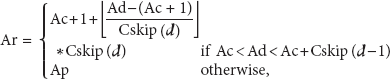
An advantage of using DAAM is the simplicity of its tree routing mechanism. The ZCs and ZRs can forward the packets along the tree without using a routing table. When a packet is received, a ZC or ZR first verifies whether the destination is itself or one of its child ZEDs. If the ZC or ZR is the destination, it accepts the packet. If one of its child ZEDs is the destination, the ZC or ZR forwards the packet to the child accordingly. Otherwise, the ZC or ZR determines the address of the relay ZR, Ar, according to (2). Assume that the address of ZC or ZR is Ac and its depth is d:
2.3. Beacon Interval
The IEEE 802.15.4 can operate in two modes, (1) the beacon enabled mode and (2) non beacon-enabled mode. In nonbeacon-enabled mode, the medium is ruled by non-slotted CSMA/CA, and on the other hand the beacons are periodically broadcasted by the ZC to synchronize devices connecting to the PAN. In the paper, we utilized the time-division multiplexing mechanism to WSN address assignment, so we mainly focus on the beacon-enabled mode network in which the time can be divided into a sequence of beacon intervals.
In beacon-enabled network, a superframe structure is defined (see Figure 2) and the time between two subsequent beacons is the beacon interval (BI) [10]. The superframe duration (SD) is the active portion of the BI and active portion can be divided into two periods, contention access period (CAP) and contention free period (CFP). The time slots in CFP can be reserved and form guaranteed time slots (GTS). The BI and SD are determined by two parameters, the Beacon Order (BO) and superframe order (SO), and thus the low duty cycles can be configured by setting a small value of SO. In this research, BIs are utilized in a Time-Division Multiplexing manner to perform the address assignment.

Superframe structure.
2.4. Related Work
Since the orphan problem has been identified and has been proved to be a NP-complete problem, several heuristic solutions have been proposed for different purposes. After identifying the orphan problem as a NP-complete problem, the orphan problem was divided into two subproblems, the bounded degree and depth tree formation (BDDTF) problem and end device maximum matching (EDMM) problem [9]. A two-stage algorithm which spans the tree first and then prunes the tree to fit the ZigBee parameter definition was proposed for the BDDTF problem and a bipartite maximum matching algorithm for EDMM problem [9]. Although the proposed algorithm in [9] can reduce the orphan nodes, the approach is purely based on the graph theory and to make the approach comply with ZigBee standard is difficult.
Some solutions are based on the idea of address borrowing [11–14] to reduce the orphan nodes, but all these address borrowing-based approaches need to maintain extra information for the routing or extra overhead for tree reorganization. In [14], a single level address reorganization (SLAR) was proposed, and when a parent node did not have sufficient address space, the maximum depth is increased by one level to adjust the asymmetric nature of the tree to increase its capacity for new nodes. A hybrid address configuration (HAC) was proposed by [11], and a parent node can apply for extra addresses from the PAN coordinator when it does not have enough room for the new nodes. Although the address borrowing-based methods can increase the node join ration, they also increase the complexity in the routing protocol design since the borrowed addresses might need to be treated differently.
To the best of our knowledge, only [15] focused on the tree formation instead of tree adjustment. In [15], three mechanisms, 2DAAM (2 layer DAAM), LDAAM (Location aware DAAM), and (RSSI DAAM) received signal strength indicator DAAM, were proposed for address assignment and, among the tree mechanisms, RSSI DAAM which uses the received signal strength to calculate the distance between two nodes has good performance with least cost and thus is the most recommended mechanism by the authors. Although RSSI DAAM showed better performance than the original DAAM, a scheduling approach complying with ZigBee is missing. In this paper, we compared our approach TDAAM with the original DAAM and RSSI DAAM [15].
There is some research which is focused on special types of network topology. In [16, 17], the authors showed that the original DAAM performs poorly in the long-thin topology in which a number of linear paths of nodes connect to each other. A cluster-based approach was proposed for the address assignment of long-thin topology in [17] and the nodes are divided into 4 types, coordinator, cluster head node, bridge node, and network node. Therefore, it is not uncommon to design a new address assignment mechanism that can work properly in a special type of topology.
2.5. Problem Statement
In the standard ZigBee DAAM, a ZC or ZR periodically broadcasts beacon frames when operating in the beacon-enabled mode. The beacon frame contains the information regarding the PAN to which the ZC or ZR belongs. A nearby device can scan for beacons and discover the PAN. To join the PAN, the device sends association requests to the ZC or ZR. If the association request is approved, the device receives an association response frame that contains the assigned address from the ZC or ZR. A device can join the PAN at any time if it can obtain an address from a ZC or ZR.
The standard DAAM device-joining procedure was not designed to prioritize certain devices. Therefore, devices that exhibit low extensibility (e.g., devices that comprise no surrounding neighbors) may join the PAN, thereby impeding devices that exhibit high extensibility (e.g., devices that comprise sufficient surrounding neighbors) from joining the network. Figure 3 shows two device joining scenarios. Suppose that the (

Two different join scenarios.
Since the standard ZigBee DAAM is not designed to prioritize the device join order according to the extensibility, two problems of the original DAAM are identified as follows.
Problem 1.
Given a set of ZigBee devices, how is the extensibility of each device quantified?
Problem 2.
Given a set of neighbor devices with quantified extensible scores, how is the join order scheduled?
3. Time-Division Multiplexing Address Assignment
A formal definition of the time-division multiplexing address assignment (TDMAA) mechanism consisted of two parts, an address-loss function and a scheduling approach. The address-loss function is for quantifying the extensibility of a device and the scheduling approach is for selecting the highly extensible devices. To the best of our knowledge, this is the first time that time-division multiplexing mechanism is applied to WSN address assignment.
Given the network parameter

When
The algorithm for calculating the
To preserve tree extensibility, devices on the tree must first allow highly extensible nodes to connect. Therefore, the study proposes using a TDMAA approach at the beginning stage of ZigBee network formation. The range of currently allowed

TDM address assignment (TDMAA) example.
The TDM (time-division multiplexing) mechanism which can operate in accordance with the beacon interval forms the second part of our TDMAA. The currently allowed
Algorithm TDMAA Input Network Parameters Begin Integer Send_Message(Hello); While (Still Warm Up) { If Receive_Message(Hello); } If Else While (Not Connected to PAN) { Send_Message(Join_Request( } Currently_allowed_ While (Connected to PAN) { If (Receive_Message(Join_Request( If (Currently_allowed_ Send_Message(Accept); Else Send_Message(Reject); If (Receive_Message(Beacon) && Currently_allowed_ Currently_allowed_ If (The network parameters Exit; } End
In this paper, two performance metrics, number of orphan nodes and the join ratio, are employed to measure the address a preassignment schemes. The join ratio is calculated using the following formula:

4. Experimental Results
A simulator was implemented using JAVA and a molecular structure visualization tool called PyMOL [18] was used to render the output results. The experiments were performed on two node distribution setups, random and uneven node distribution setups. The nodes were placed in an area of 400 m2. In the random distribution setup, the coordinators of the nodes were randomly assigned. In the uneven distribution setup, two high-node-density squares were added to the top right and bottom left areas. The communication range was set as 30 m in all experiments. For simplicity, let
The TDMAA did not substantially improve in the random node distribution setup. Figure 5 shows the tree structures of the DAAM and TDMAA obtained using the random node distribution setup. The spreading areas of the two trees are fairly similar. This is probably because of the ineffectiveness of the one-level address-loss function in randomness. Future studies should pursue improvements of the address-loss function.

The tree structures of DAAM (a) and TDMAA (b) from random node distribution.
Although the TDMAA did not outperform the DAAM in the random distribution setup, it performed much more satisfactorily than the DAAM did in the uneven distribution setup. The TDMAA located larger high density areas than the DAAM did, eventually yielding higher address assignment ratios. Figure 6 shows the results of the DAAM and the TDMAA in the uneven node distribution setup. The network parameter (2, 2, 14) was used to perform the simulations.

The tree structures of DAAM (a) and TDMAA (b) from unevenly distributed nodes.
The RSSI DAAM from [15] was also implemented to provide some comparisons with our method, and the name of RSSI DAAM is shortened as RSSI in the remaining text. Figure 7 shows the number of orphan nodes in the DAAM, TDMAA, and RSSI results, using various network parameter configurations in the uneven node distribution setup. The low
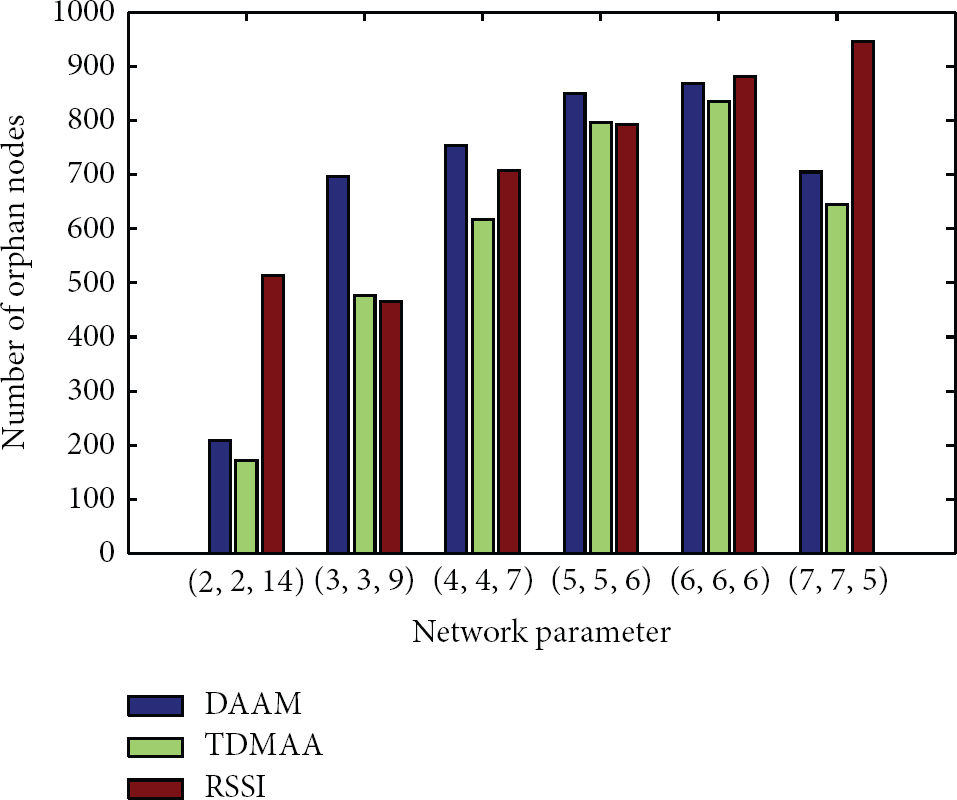
The number of orphan nodes of DAAM, TDMAA, and RSSI with different network parameters.
Figure 8 shows the trends in the join ratios of the DAAM, TDMAA, and RSSI compared with the number of nodes in the uneven distribution setup. The join ratios were calculated using formula (4). A substantial difference was observed between the DAAM and TDMAA results when the number of total nodes reached 1200 and the join ratio of the DAAM dropped to less than 10%, whereas the join ratio of the TDMAA remained at 38%. Because the heuristic of the TDMAA was to choose nodes that possessed numerous surrounding neighbors, the TDMAA tended to locate high density areas. Therefore, when the node density increased, the TDMAA performed steadily; however, the DAAM formed linear chains around the neighbors and

The join ratio comparison of the DAAM, TDMAA, and RSSI.
The RSSI approach performs better than TDMAA when the number of total nodes is small and performs worse than TDMAA when the number of total nodes is larges in Figure 8. Given the same 400 m2 area for all settings, the large number of total nodes means dense node coverage and the small number of total nodes means sparse node coverage. Therefore, RSSI is more suitable for spare node distribution and TDMAA is more suitable for dense node distribution. The performance of TDMAA and RSSI is nearly the same when the total number of nodes equals 600.
Figure 9 displays the join ratios of the TDMAA, using various network parameter configurations and numbers of total nodes. The join ratios of all network parameter configurations steadily increased as the number of total nodes increased. The (

The join ratio of the TDMAA method with different network parameters.
5. Conclusion and Future Work
DAAM, the standard ZigBee address assignment scheme, provides a simple means to assign addresses to tree-connected devices and enables the forwarding of packets along the tree structure without using a routing table. However, because of the constraints of the network parameters (
Two types of node distributions were conducted, random and uneven. The TDMAA did not outperform DAAM in the random distribution setup; this was attributed to the ineffectiveness of the one-level address-loss function. Future research exploring effective address-loss functions should be conducted. The TDMAA performs more satisfactorily than the DAAM does in the uneven distribution setup. The simulation results show that the join ratio of DAAM rapidly drops to less than 10% when the number of nodes increases to 1200 in the uneven distribution setup, but the join ratio of TDMAA remains steady at 38%.
Footnotes
Acknowledgment
This research was supported by funding from the National Science Council of Taiwan (NSC101-2218-E-415-002-MY2 and NSC102-2221-E-415-012).