




Abstract
The prevalence of Internet of Things (IoT) requires flexible and fine-grained controls over the IoT devices. Existing works rely on specific controllers or programs to remotely control IoT devices, which is inefficient to support intelligent control in IoT environments. In contrast, utilizing a common portal device, for example, smart phone, to control variant IoT devices is a promising solution. However, it is challenging to guarantee the security when transferring the control of IoT devices. In this paper, we design a lightweight protocol to enable secure control transfer among the IoT devices, portal devices, and backend server. We demonstrate the effectiveness of our protocol in defending against mainstream attacks. Experimental results show the efficiency of our protocol in the authentication and key-updating during the control transfer.
1. Introduction
With the rapid development of electronics, existing electronic devices, such as the TV, refrigerator, electromagnetic oven, and even electric lamp, become intelligent such that they can enable adaptive control to meet time-varying needs of users. With the emergence of the Internet of Things (IoT), many IoT devices have been equipped with IoT technology [1–5], which provides more intelligent services to users.
Remotely controlling these devices is essential for supporting the intelligent IoT service. Most of existing devices adopt the former patterns, which is cost-inefficient. Some recent solutions are designed to adopt portal devices, for example, smart phones or portal tablets, to control IoT devices. Those works still depend on the specific program designed for targeted devices; however, they are sufferring from inefficiency and poor scalability.
To enable more flexible and fine-grained controls over the IoT devices, we are motivated to design a common control management system, which allows users to leverage their portal devices, for example, smart phones, to control variant devices in IoT environments. Imagine a scenario of smart space in hotels. When passengers check in, they can use their own smart phones or iPad-like devices to control the IoT devices in the room. In this way, the service will be more convenient to the customer and the cost of maintenance for the hotel will be significantly reduced. Our control system consists of IoT devices, portal devices, and backend server. The control over IoT devices should be managed by the backend server. For each user, his portal device plays the role as a single access entry to control different IoT devices. After validating the user, the backend server will transfer the control on the targeted devices to the user's portal device. The user then employs his portal device to control different targeted devices, including operating on a TV, controlling the air condition, or selectively playing CDs on a HiFi.
However, using a portal device to safely control IoT device is nontrivial in IoT applications. In particular, it is challenging to guarantee that the control can be securely transferred from the backend server to a validate user's portal device, considering the insecure IoT environments. For example, a host would like to allow his close friends to control his main door while an intruder should not be allowed to open it. Obviously, effective authentication or verification is of importance to transfer controls among IoT devices, portal devices, and backend server. Nevertheless, IoT devices are usually source limited. Thus, it is difficult and cost-inefficient to directly adopt complex asymmetric key-based algorithms for authentication. It is also challenging to securely control IoT devices with low overhead.
In this paper, we propose a secure and efficient control transfer protocol to allow users to control IoT devices using their portal devices, for example smart phones. We use a lightweight cryptographic hash function as the cryptobuilding block to support authentication in source-limited IoT devices. Each IoT device will share a transfer key We propose a common control transfer scheme, in which the control over IoT devices does not depend on specific controllers. The user can leverage his portal device as a common controller to control different IoT devices. To our knowledge, our work is among the first steps towards secure control transfer over IoT devices. We perform a lightweight hash function as the cryptographic component, which significantly improves the authentication efficiency with sufficient security guarantee. We conduct comprehensive analysis on the security of proposed protocol and demonstrate its effectiveness in defending against existing attacks. We also perform simulations to evaluate the performance of our protocols. The results show that our protocols can achieve secure control transfer with low overhead and latency.
The rest of the paper is organized as follows. In Section 2, we discuss related works. We outline the requirements of secure control transfer in Section 3. In Section 4, we present our protocol design. We analyze the privacy and security of protocol in Section 5. Section 6 reports the simulation result and Section 7 concludes the paper.
2. Related Work
In this section, we discuss the related work in authentication and ownership transfer in IoT environments.
Authentication. In RFID systems, the identity of tag (TID) is easily traced and cloned. Many solutions, such as [6–10], have been proposed to employ traditional cryptographic methods to enhance the IoT systems. However, these protocols are not often compatible with commercial industrial standards, for example, EPC C1G2 specifications [2]. Due to the extremely limited resource, RFID tags require lightweight solutions, such as hash functions [3] or PRNGs [11], in the authentication. Chabanne and Fumaroli [12] propose a noise-based protocol, in which they adopt a Bit Pair Iteration scheme to correct transmission errors and prevent passive eavesdropping. Juels' protocol [13] generates a PINSet to provide reader-to-tag authentication. After hiding the correct access password (the correct PIN value) in a set containing k values, the probability of a correct guess is
Ownership transfer has two fundamental requirements. First, the former owner should not obtain the secret of new owner after the transfer. Second, the new owner should not deduce past transactions as well as the secret related to former owner. There are also a few solutions to address the ownership transfer problem. Some of them rely on hash functions or symmetric encryption functions [15, 18–25]. The authors in [26] propose a two-party ownership transfer protocol, which is based on the security of the backwards channel. The authors in [27] design a mutual authentication protocol for secure ownership transfer. Their work is based on minimal hardware Physical Unclonable Functions.
The work proposed in [28] presents a detail survey on the security requirements, such as indistinguishability, forward security, resistance against replay attack, resistance against tag killing, and ownership transferability. In order to securely deliver the services to the user devices, the authors in [29] propose a technique “secure three way authentication (STWA),” intending to protect the user privacy and accomplish ownership authentication.
3. Control Transfer Protocol Requirements
In this section, we first present our system model and assumptions. We then introduce the requirements of privacy, security, and performance relevant to control transfer protocol design.
3.1. System Model and Assumption
The control transfer protocol considered in this paper operates with the following model and assumptions.
The communicating parties include a server, a portal device, for instance a phone, and an IoT device. The server also plays the role as a trust center (TC). The portal device acts as a common controller, denoted as P. We denote the IoT device as IoD. P and IoD communicate via an unsecure wireless channel. In this paper, the wireless protocol is Zigbee. TC and P communicate via a WiFi connection protected by WPA/WPA2. TC maintains a database containing the secure information for IoD and P. IoD is source limited and hence can only afford lightweight cryptographic operations, for example, hash functions. We assume that such a device usually has a rewritable memory that is tamper resistant.
3.2. Privacy Requirements
There are two major threats to the user privacy in remote control systems [2, 3, 18, 19, 27].
Control Leakage. In a typical remotely controlling system, when TC queries a device D, D responds with its profile. If unauthorized entities obtain its profile, they may be able to obtain the control on P from the TC's database. The essential requirement of the control privacy is that only authorized entities are able to access the information and control associated with IoDs.
Device Tracking. If the responses of an IoD are distinguishable from those of other devices, the device can be tracked. Even worse, the social interactions of the individual user carrying the IoD may be disclosed while the user is unaware of the risk of being traced. Remotely controlling systems should be able to resist the device tracking attack by making the messages from devices indistinguishable from others. In detail, the track resistance should meet two guarantees. (a) New controller privacy: once the control on an IoD has been transferred to a new P, only the new P can identify and control the device. The previous controller of the device should no longer identify or control the device. (b) Old controller privacy: when the control on an IoD has been transferred to a new P, the new P should not trace past interactions between the IoD and its previous controller P.
3.3. Security Requirements
Communications between a controller and a device via an insecure wireless channel are susceptible to attacks. We outline the major attacks threatening remotely controlling systems. Due to the cost constraint, IoT devices usually cannot afford complex cryptographic algorithms to provide privacy and security. Therefore, remotely controlling schemes should meet the following requirements [2, 12–14, 18, 19].
Resistance to Device Impersonation. The attacker can impersonate a targeted IoD to a P, without knowing the device's internal secrets. If the attacker succeeds, it will be authenticated as the targeted device. In our work, an adversary should not be able to impersonate an IoD by compromising attacks.
Resistance to Controller Impersonation. The attacker can impersonate a legitimate P to a compromised IoD. In this case, the attacker may need the knowledge of the device's internal state. If the attacker succeeds, the attacker may ask the IoD to update its internal state. As a result, any legal P will no longer be able to successfully communicate with IoDs [17]. We should resist such an impersonation, even if the adversary compromises the IoDs.
Resistance to Replay Attack. The attacker can replay messages previously exchanged between a legitimate P and IoD. If the attack succeeds, the attacker may conduct a successful authentication between a device and a controller. We should prevent the adversary from building a session with a legitimate P and IoD by replaying their previously exchanged messages.
Resistance to Man-in-the-Middle (MITM) Attack. The attacker can interfere with messages exchanged between a legitimate P and IoD (e.g., by insertion, modification, or deletion). The purpose of MITM is to impersonate the legitimate P or IoD to cheat another communicating party. Our solution should prevent the manipulation of the messages exchanged between a legitimate P and IoD to perform MITM.
Resistance to Desynchronization Attack. The attacker can block messages transmitted between a legitimate P and IoD; they would no longer be able to authenticate each other. Thus, blocking the messages transmitted between a legitimate P and IoD should not lead to a desynchronization.
Backward Traceability. An adversary should not be able to trace the prior transactions between a legitimate P and IoD, even if it compromises the devices [6, 20, 21, 27].
Forward Traceability. An adversary should not be able to deduce future transactions between a legitimate P and IoD, even if it compromises the devices.
3.4. Performance Requirements
Small Storage: the volume of data stored in an IoD should be minimized. Low Computation Complexity: the complexity of computations, especially those for cryptooperations, should be minimized. Efficient Communication: the number and size of messages exchanged between a legitimate P and IoD should be minimized.
4. Control Transfer Protocol
In this Section, we present our protocol, control transfer (CT). The basic idea of CT is that a P can obtain the control on an IoD from TC. CT is realized by authentication and key-updating among three major parties: TC, P, and IoD. CT is comprised of three phases: initialization, control transfer, and control confirmation. In the initialization phase, TC will issue two keys to IoDs. One is the control key
Note that the communication between TC and P is via a secure WiFi connection, for example, protected by WPA/WPA2. While the communication channel between P and IoDs is not secure, we employ Zigbee as the communication protocol between P and IoDs in this paper.
4.1. Initialization
First, we define the system parameters as follows.
l is the bit length of a key. The concatenation operator is represented by ∥. h is a lightweight hash function,
4.2. Control Transfer
The phase of control transfer is comprised of two steps: authentication and key-updating. Figure 1 shows the entire authentication process.

Control transfer protocol.
4.2.1. Authentication
When a user wants to use his portal device P to control an IoD, P first generates a P concatenates TC generates a
4.2.2. Key Update
P forwards the
4.3. Control Confirmation
When P receives
One challenge is that the control confirmation might be interrupted if attackers block the delivery of
5. Privacy and Security Analysis
In this section, we analyze the privacy and security of our protocol based on the requirement raised in Section 3.
5.1. Privacy
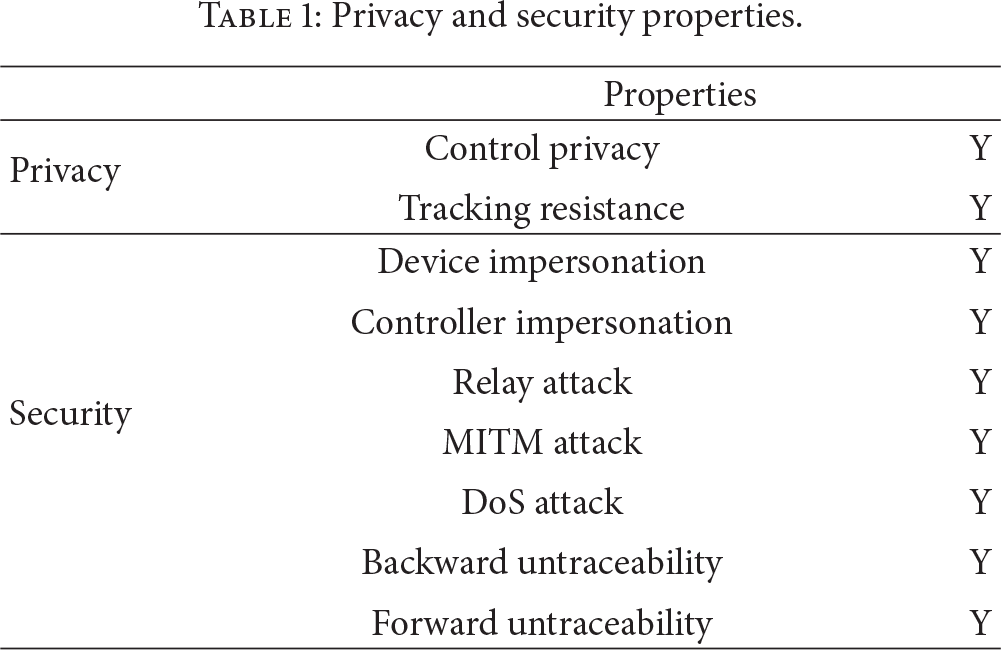
Control Privacy. In our protocol, the control indeed is represented as the control key and transfer key shared among TC, P, and IoD. All these keys are not delivered in plaintext. We employ cryptographic hash function to generate ciphers for secure transmission. As a result, only TC knows the secret keys of P and IoD, and only legal P and IoDs can successfully conduct the control transfer protocol. Therefore, our protocol is resilient to control leakage.
Tracking Resistance. As we analyzed in control privacy, the messages delivered in our protocol are encrypted using cryptographic hash function. The usage of random numbers further enhances the security. Due to the properties of hash function, the hash value of inputs will be evenly mapped to the output space. Thus, it is negligible to distinguish two devices from each other based on their messages, that is, the hash values computed from the involved keys and random numbers. In particular, P will never know the transfer key shared between TC and IoDs. As a result, a P cannot reveal the new transfer keys of IoDs only based on its control key after a control transfer. On the other hand, the P will only get its control key from TC but have no idea of the control key used by the previous P. In short, our protocol can achieve privacy for both the old and new P.
5.2. Security
Resistance to Device Impersonation. For a legitimate P, a malicious IoD can launch the impersonation attack by manipulating
Resistance to Controller Impersonation. A P can only control a legitimate IoD after it obtains the control key from TC. Since the communication between TC and P is protected by WPA/WPA2, which supports TC to verify P a malicious party thereby cannot impersonate a legitimate P without the permission from TC.
Resistance to Replay Attack. Our protocol encrypts the messages using the time-varying random number as inputs. As a result, an adversary cannot relay messages previously exchanged between a legitimate P and IoD to successfully build a session between them.
Resistance to MITM Attack. Again due to the usage of hash functions on the components contained in the message, an adversary should not be able to manipulate messages exchanged between a legitimate P and IoD to perform cheating.
Resistance to DoS Attack. In our protocol, blocking most likely happens in the control confirmation phase, since the attacker can block the transmission of
Backward Untraceability. For an IoD, its new control key
Forward Untraceability. Because of the use of cryptographic hash function and key-updating during each control transfer, it is difficult for attackers to deduce future transaction messages of a given IoD. The most severe case is that an old P is malicious. Such a P can get
Privacy and security properties.
6. Performance Evaluation
6.1. Experiment Setup and Metrics
Zigbee is a mainstream short-distance wireless communication technology with attractive features such as near distance, low complexity, low power consumption, low data rate, low cost, and flexible communicating mode. Those features make Zigbee suitable for the intelligent control IoT devices, especially for those nonintelligent devices, such as lights, air conditioners, and refrigerators. On the other hand, we can also adopt other communication protocols or schemes, such as NFC or Bluetooth, in our solution. In this way, a concern about the usability or scalability may be raised considering the implementation of variant IoT device.
We set up a testbed to examine the performance of our control transfer protocol. The testbed simulates the real IoT environment. We employ a notebook to simulate TC. The portal device is by a combination of a cellphone (HTC Diamond) and a TelosB Node. TC and portal device communicate through IEEE 802.11.b/g in a WPA mode. We simulate IoDs using 10 TelosB nodes. The purpose of using TelosB nodes is twofold. First, the TelosB node is suitable for reflecting the limited resource of IoT devices. Second, TelosB nodes communicate with each other via Zigbee, which is a mainstream communication protocol in remotely controlling systems. The detail information of experiment setup is summarized in Table 2. We choose BKDR as the hash function and program it over the TelosB node. We conduct 1000 round tests over 10 simulated IoDs, say 100 times per IoD. In each test we perform a complete control transfer procedure.
Experiment setup.

Performance Metrics. We evaluate the performance of our protocol via three critical metrics, storage, computation overhead, and communication latency. The storage reflects how many bits one needed for storing
Performing authentication is important to ensure the security among control transfer processes. The authentication in our protocol is mainly based on the cryptographic hash functions. On the other hand, the efficiency of authentication is also important because most IoT devices work with weak capacity of computation and storage. Considering these, in order to analyze the efficiency of our protocol, we make a comparison with the schemes proposed in [30, 31]. The front protocol works in WSN and provides a two-factor user authentication before the legitimate users access data in the sensor/gateway nodes. The latter one is a bidirectional efficiency-privacy transferable (BEST) authentication protocol which can balance the privacy and communication efficiency dynamically.
6.2. Experiment Result
In our control transfer protocol, the storage mainly consists of the space for storing the keys on the sides of IoDs and TC. The length of hash value is 128 bits if using BKDR hash function, which determines the key size of our protocol. Since each IoD will have two keys,
A complete control transfer involves 10 hash computations among TC, P, and IoD. In particular, the IoD undertakes 5 hash computations. It is necessary to investigate the overhead of hash computation of each party, which indicates the computation complexity of our protocol. In Figure 2, we plot the average time for conducting one hash function in TC, P, and IoD, respectively. From the result, we can find that the IoD has lowest computation speed, 0.78 in average. This value is acceptable because the system can still afford more than 100,000 control transfers per second in this case. Considering the rapid configuration update on the hardware on the portal and IoT devices, the computation overhead of our protocol will be trivial in future.

Hash time.
We also check the communication latency when performing our protocol. The communication latency is mainly caused by the message exchange. We examine the time consumed to send
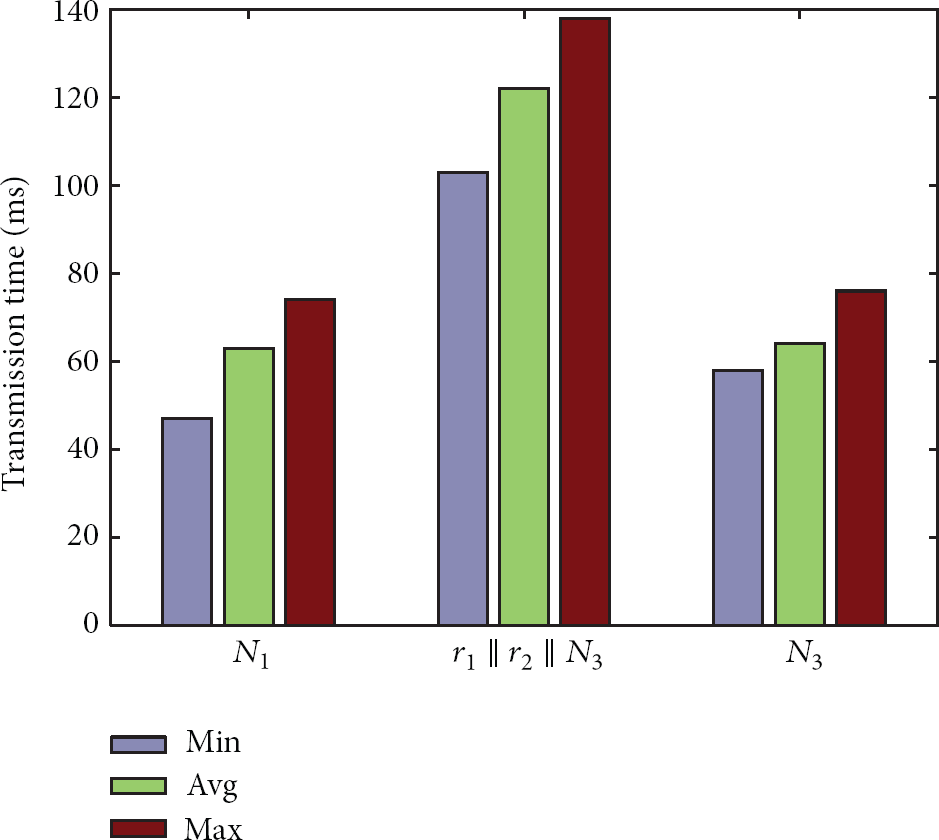
Transmission time.
Computation Cost. From Table 3, it is easy to find that in our protocol IoD requires 2 hash operations for authentication, which is the same as Qi's work, whereas the sensor node needs only 1 hash operation in M. L. Das' protocol. But from Figure 2, in our protocol, 2 hash operations are completed in 2 ms, which is acceptable for IoT devices and meets the requirements of controlling the device in our applications. In addition, M. L. Das' protocol does not provide mutual authentication between the sensor and gateway node, also Qi's protocol suffers from the DoS attack, while our protocol achieves higher security.
Computation cost of the protocols.

Communication Cost. Due to the cost constraint and limited source of IoT devices, we need an efficient communication between IoD and the controller. We compare the communication time and the size of exchanged messages in an authentication process. Three messages are exchanged for a successful authentication in M. L. Das', Qi's and our protocols. However, we observe that the total data size of three exchanges is different. In M. L. Das' protocol, about 532 bits are required. In Qi's protocol, a successful single tag authentication needs about 266 bits. However, the existence of inevitable conflicts enlarges the required size of message to be transferred. The demand size of message in our protocol is 512 bits. In summary, without a reduction in the performance, our protocol achieves better security enhancement.
7. Conclusions
In this paper, we propose a control transfer protocol to enable common portal devices to control large-volume IoT devices. The protocol leverages lightweight hash functions to achieve secure and efficient control transfer among resource-limited IoT devices. We analyze the privacy and security guarantee of our protocol. We also conduct simulations over real IoT devices to evaluate the performance. The results demonstrate the effectiveness of our protocol. Our future work includes releasing the constraint of using secure channel and conducting our protocol in large scale IoT applications.
Footnotes
Acknowledgments
This work is partially supported by the National Natural Science Foundation of China (NSFC) under Grants nos. 61033015 and 61170220, the Fundamental Research Funds for the Central Universities of China under Project no. 2012jdgz02 (Xi'an Jiaotong University), and the Research Cooperation Special Funds of Guangdong under Project no. 2011B090400563.