




Abstract
A visual sensor network (VSN) is a distributed system of a large number of camera nodes and has useful applications in many areas. The primary difference between a VSN and an ordinary scalar sensor network is the nature and volume of the information. In contrast to scalar sensor networks, a VSN generates two-dimensional data in the form of images. In this paper, we design a heterogeneous VSN to reduce the implementation cost required for the surveillance of a given area between two altitude limits. The VSN is designed by combining three sub-VSNs, which results in a heterogeneous VSN. Measurements are performed to verify full coverage and minimum achieved object image resolution at the lower and higher altitudes, respectively, for each sub-VSN. Verification of the sub-VSNs also verifies the full coverage of the heterogeneous VSN, between the given altitudes limits. Results show that the heterogeneous VSN is very effective to decrease the implementation cost required for the coverage of a given area. More than 70% decrease in cost is achieved by using a heterogeneous VSN to cover a given area, in comparison to homogeneous VSN.
1. Introduction
Visual sensor networks (VSNs) are the image sensor based distributed systems. They consist of a large number of low-power camera nodes which collect image data from environment and perform distributed and collaborative processing on this data [1, 2]. These nodes extract useful information from collected images by processing the image data locally and also collaborate with other neighboring nodes to create useful information about the captured events. The large amount of image data produced by camera nodes and the limited network resources demand the exploration of new techniques and methods of sensor management and processing and communication of large data. It demands interdisciplinary approach with the disciplines such as vision processing, communication, networking, and embedded processing [3]. Camera sensor nodes with different types and costs are available in the market today. These nodes have different optical and mechanical properties. They have varied ranges of computation capabilities, communication powers, and energy requirements. The choice of camera nodes to design a VSN depends on the requirements and constraints of a given application. Depending on the type of the camera nodes, VSNs can be divided into two major categories, homogeneous and heterogeneous VSNs [4]. A homogeneous VSN uses similar types of nodes while a heterogeneous VSN uses different types of nodes.
VSNs have a large number of potential applications. They can be used in surveillance applications for intrusion detection, building monitoring, home security, and so forth. These applications capture images of the surroundings and process them for recognition and classification of the suspicious objects [5, 6]. Visual monitoring is being used in retail stores and in homes for security purposes [7]. Modern VSNs can provide surveillance coverage across a wide area, ensuring object visibility over a large range of depths [8, 9]. They can be used in traffic monitoring applications [10–14] for vehicle count, speed measurements, vehicle classifications, travel times of the city links, and so forth. VSNs have a number of applications in sports and gaming field [15, 16]. They can collect statistics about the players or the game to design more specific training to suit the individual players. VSNs have applications in environment monitoring to collect data about animals and the environment which can be helpful to solve the nature conservation issues [17, 18]. Video monitoring has important applications in searching empty parking lots [19]. The PSF application [20] is designed to locate and direct a driver to the available parking spaces, near a desired destination. Video tracking techniques are used for people tracking [21].
A homogeneous VSN is formed by combining similar camera nodes. In contrast to this, a heterogeneous VSN contains different types of nodes [4, 22]. A heterogeneous VSN provides many advantages over homogeneous VSN such as resolution of conflicting design issues, reduction in energy consumption without degrading surveillance accuracy, higher coverage, lower cost, and reliability. The tasks allocation strategy in heterogeneous VSNs is designed such that the simpler tasks are assigned to resource-constrained nodes while more complex tasks are assigned to high performance nodes. For example, in a surveillance application, a motion detection task can be assigned to lower-resolution nodes while object recognition task can be assigned to high-resolution nodes. This strategy results in optimized use of node resources. This optimization in heterogeneous VSNs results in maximization of network lifetime as compared to homogeneous VSNs. In designing homogeneous VSNs, the sensor selection and node design are finalized on the basis of most-demanding application tasks. Assigning such a node to simpler tasks wastes precious node resources. A homogeneous VSN design is unable to provide all the desired features, such as higher coverage, low cost, reliability, and energy reduction, at the same time. It optimizes one or more parameters at the expense of other parameters [9, 23].
A single camera has limited field of view and is unable to provide coverage of a large area. To cope with this problem, arrays of cameras are used. The decreasing cost and increasing quality of cameras have made the visual surveillance of an area common by using a network of cameras [24]. An important research area is the placement of visual sensors to achieve a specific goal. A common goal is to place the image sensors in the arrays for complete coverage of a given area. The other goal can be to minimize the cost of visual sensor arrays, while maintaining the required resolution. Currently, the designers place cameras by hand due to the lack of theoretical research on planning visual sensor placement. In future, the number of cameras in smart surveillance applications is expected to increase to hundreds or even thousands. Thus, it is extremely important to develop camera placement strategies [25, 26]. In recent years, a large number of smart camera networks are deployed for a variety of applications. An important design issue in these distributed environments is the proper placement of cameras. Optimum camera placement increases the surveillance coverage and also improves the appearance of objects in cameras [24].
This paper discusses the design of a heterogeneous VSN, to be used for application of monitoring large birds, such as eagle, in the sky. The heterogeneous VSN will be able to provide coverage of each point in the area with the required minimum resolution. The heterogeneous VSN is designed by combining three sub VSNs for the surveillance of an area between two altitude limits. The VSN will be implemented with real monitoring nodes, which will be designed by following the model. Images will be captured and measurements will be performed to verify the full coverage at the given lower altitude and minimum achieved resolution at the given higher altitude. The heterogeneous VSN will reduce the implementation cost in comparison to homogeneous VSN.
The remaining of this paper is organized as follows. Section 2 describes the necessary theory for designing homogeneous and heterogeneous VSNs. Section 3 discusses the camera models and optics used in the experiment. Section 4 describes the heterogeneous VSN coverage model. Section 5 discusses the experimental measurement performed to verify VSN parameters. Section 6 discusses the results, and finally Section 7 describes the conclusion.
2. Theory
This section describes a brief theory about designing VSNs and discusses the homogeneous and heterogeneous VSN models. The heterogeneous VSN is a combination of a number of homogeneous VSNs and is effective in reducing the implementation cost for the surveillance of an area. An example of heterogeneous VSN is presented, and cost comparison between homogeneous and heterogeneous VSNs is made to see the cost reduction capability of the heterogeneous VSN.
2.1. Homogeneous VSN Model
The design of a VSN for the surveillance of golden eagles is presented in [27]. The VSN is formed with a number of cameras. A 3D visualization of the coverage with a matrix of cameras is shown in Figure 1. A sharp tip at the bottom of the figure represents a camera node. A number of such nodes form a matrix which is used to monitor eagles in the sky between two altitude limits above the ground, the higher altitude

3D visualization of coverage with a matrix of cameras.
As the altitude of an eagle is increased from camera nodes, the resolution of its image on the camera sensor is decreased. A minimum image resolution is necessary to recognize an object moving at altitude
The first step to design a VSN is the selection of a camera sensor. A number of camera sensors are used in this study, and the details about their type, resolution, and size are given in Table 1. The second step of VSN design is the calculation of focal length of lens to be used with the chosen camera, which ensures the minimum required resolution at altitude

where

where K is the chosen length (horizontal, vertical, or diagonal) of the camera sensor and f is the lens focal length. The combination of camera and lens forms an individual node, and a number of such nodes are required to surveil a given area.
Camera sensors used in study.

The third step of VSN design is the placement of nodes which ensures full coverage at the given lower altitude

The fourth step of VSN design is to calculate the total number of nodes n (called cost) to cover a given area. The cost to cover a given area A, can be calculated by the following equation:

where
By using camera sensors given in Table 1 and the equations from (1) to (4), a VSN can be designed to cover a given area in the given altitude ranges. The favorable VSN design objective is to increase the coverage of an area but decrease its implementation cost. However, in actual practice, the cost of a VSN is greatly increased when the covered area is increased. For example, to cover an area of 1 km2, between altitude limits from 3000 to 5000 m above the ground, a homogeneous VSN requires a cost of 20 nodes. This cost calculation assumes minimum resolution of 10 pixels per meter and 14 Mp camera sensor. If the area of 1 km2 is increased by extending the altitude limits from 500 to 5000 m, the cost of the VSN is increased to 694. In this example, the increase in area is about 2.25 times, but the corresponding increase in cost is about 35 times. This result indicates the need for a new technique which is able to increase the area coverage but at the same time decreases the implementation cost. In the following paragraphs the design of a heterogeneous VSN is presented which fulfills this purpose.
2.2. Heterogeneous VSN Model
The input parameters to design a heterogeneous VSN include the area A to be covered, lower altitude
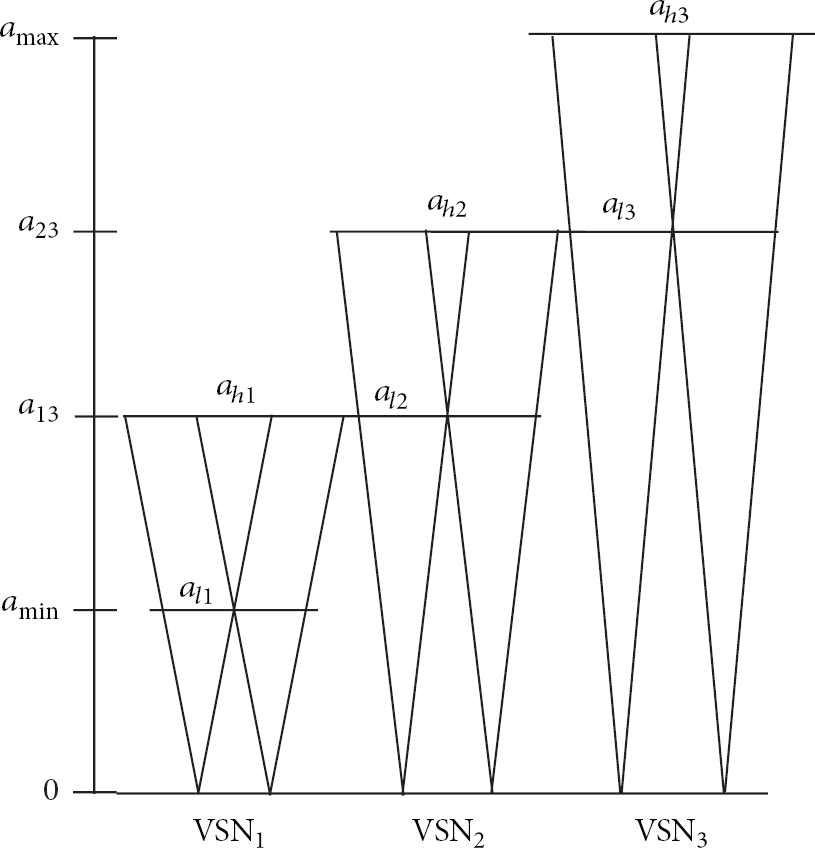
Heterogeneous VSN model.
The given higher altitude
The VSN2 is designed to cover an area A between the higher altitude

The VSN2 will cover the altitudes range from

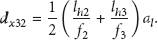
If the same camera sensor is used for both VSN1 and VSN2, then the above equation is reduced to the following equation:

The VSN3 is designed to cover the altitudes range from

where
The lower altitude value

After describing the theory to design homogeneous and heterogeneous VSNs, an example of heterogeneous VSN is designed in the following paragraphs, by using the concepts described above.
2.3. Example of Heterogeneous VSN
Suppose coverage of an area is required between altitudes range from 293 to 47.3 cm. Thus, the values of

Bird to be monitored by VSN.
Suppose the components chosen to implement the nodes for VSN2 are 5 Mp image sensor and lens with focal length 8.5 mm. The value of the altitude
After discussing the design of VSN2, the design for the network VSN3 is considered. This network is designed to cover the altitudes range from
The summary of the sub-VSNs parameters, discussed above, is given in Table 2.
Summary of sub=VSNs.

2.4. Cost Reduction by Heterogeneous VSN
Suppose an area of 1000 cm by 1000 cm is required to be covered between altitude limits from 293 to 47.3 cm. The area is covered by using two different types of VSNs: homogeneous VSN and heterogeneous VSN. Suppose 5 Mp image sensor is used to implement both types of VSNs. The cost required to implement the homogeneous VSN is calculated by using (4) and is found to be 793 nodes. In case of heterogeneous VSN, the cost required to implement VSN1 for altitudes range from 293 to 208.6 cm is 40 nodes, for VSN2 from 208.6 to 86.5 is 117 nodes, and for VSN3 from 86.5 to 47.3 is 69 nodes. The total cost required to implement the complete heterogeneous VSN is 226 nodes. If we compare the costs for homogeneous VSN and heterogeneous VSN, it is obvious that heterogeneous VSN is offering more than 70% decrease in cost. Similar results can be verified by using WVGA image sensor in place of 5 Mp sensor. Although in case of using WVGA sensor more cost will be required to implement the same ranges of altitudes, but the decrease in cost will be more than 70% in case of using heterogeneous VSN.
In the remaining of this paper, the heterogeneous VSN which is described in the above example, is implemented by using actual cameras and optics.
3. Camera Models and Optics
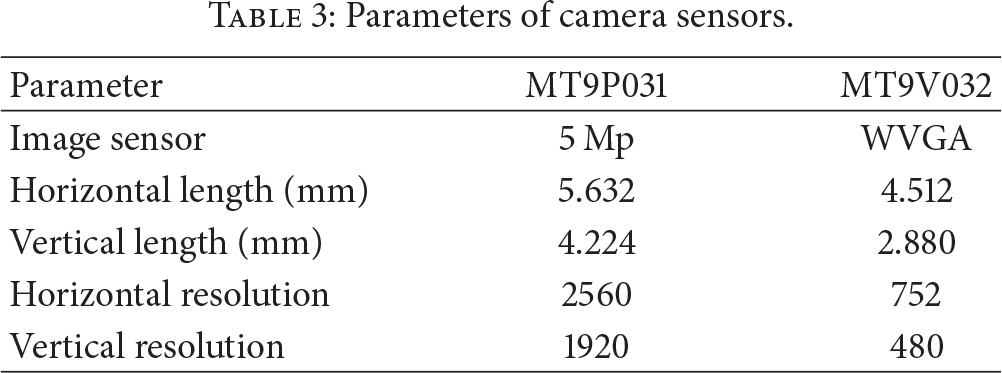
The image sensors chosen to implement the monitoring nodes for sub VSNs in the above example include 5 Mp and WVGAs. The 5 Mp image sensor MT9P031 is used in camera model UI-5480CP-M from UEye and is shown in Figure 4. The horizontal length
Parameters of camera sensors.
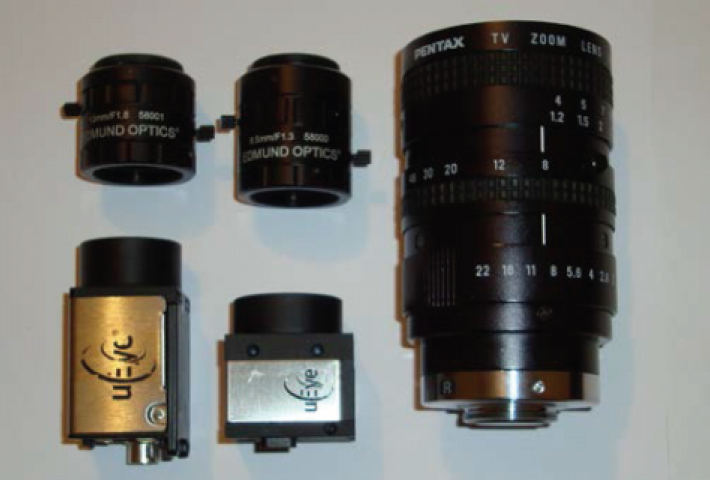
Cameras and lenses used in VSN design.
The WVGA image sensor MT9V032 is used in camera model UI-1220SE-M from UEye and is shown in Figure 4. The horizontal length
The cameras and the accompanied optics used to implement the heterogeneous VSN are shown in Figure 4. The combination of a camera and the accompanied lens of relevant focal length form a monitoring node. An individual laptop machine is used with each monitoring node as data gathering and analysis platform. The 5 Mp camera module is connected to the laptop by using CAT 6 Ethernet cable. The power is supplied to the camera module by using 6 pin Hirose connector. The camera is connected to the laptop as client while the laptop is used as server. The WVGA camera is connected to the laptop by using a USB cable. The power to a camera node and laptop is supplied by using a 12 Volt rechargeable battery. A complete node is shown in Figure 5. The images of the bird are captured by UEye cockpit software. This is the camera interface to capture images/videos or to change the controlling parameters of the camera.

A complete camera node.

VSN model.
4. Coverage Model
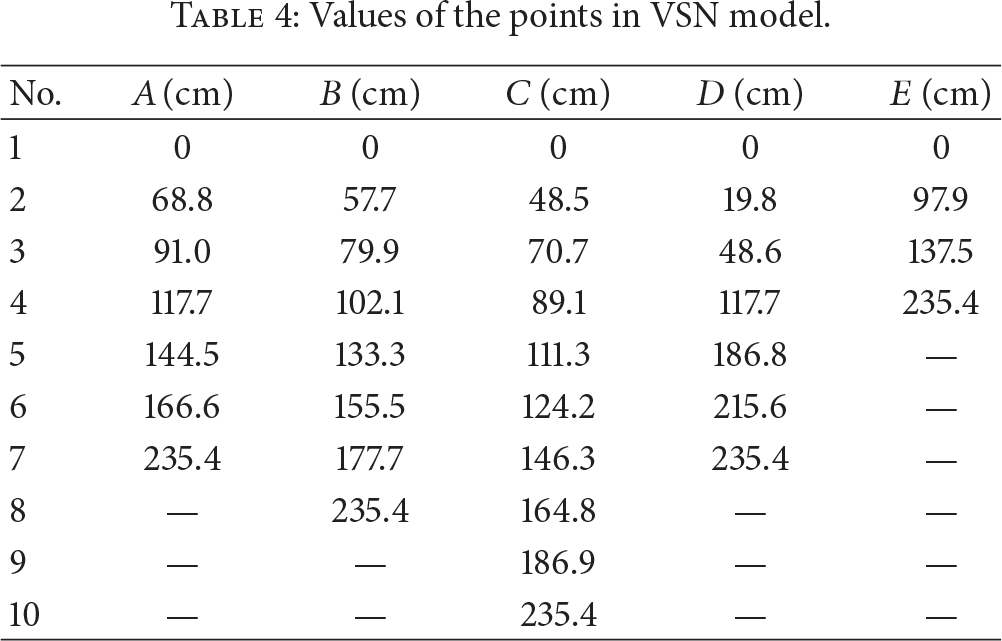
The camera coverage model based on all the above design parameters is shown in Figure 6. The model contains five altitude lines A, B, C, D, and E. The altitude line A represents the ground plane and monitoring nodes are placed on this line. This line contains seven points from
To perform coverage and resolution measurements, it is necessary to find the altitudes of the lines above ground and the distances of the points from the edge of the relevant lines. The altitude line A represents the ground so it has altitude 0 cm. The altitude line B is the lower altitude for VSN3; it is at the altitude 47.3 cm above the ground, as calculated before. The altitude line C is the higher altitude for VSN3 or the lower altitude for VSN2. Thus, it is at altitude 86.5 cm above the ground. The altitude line D is the higher altitude for VSN2 or the lower altitude for VSN1. Thus, it is at the altitude 208.6 cm above the ground. The altitude line E represents the higher altitude for VSN1. Thus, it is at the altitude 293 cm above the ground. All these altitudes are summarized in Figure 7.

VSN altitudes.
After finding the altitudes of the lines, the distances of the points from the edge of the respective altitude lines are calculated. For altitude line A, the distance of point
Similarly, the distances of the points on other altitude lines are calculated. For altitude line B, the distances of the points
Values of the points in VSN model.
5. Measurements of VSN Parameters
Two important parameters of a VSN which must be ensured are the full area coverage at a given lower altitude and the minimum required image resolution for an object, when moving at the given higher altitude. The remaining part of the paper describes the measurements to verify these parameters. The measurements are performed in a room. To measure all the distances, a 240 cm long scale is constructed on a long strip of paper. The markings on the scale are marked after every 5 cm. The scale is glued on a wall of the room. The wall is treated as sky for this experiment. A bird of size (1.08 × 0.54) cm, shown in Figure 3, is printed on a card board and is used to measure the minimum required image resolution.
5.1. Coverage Measurements
This section measures coverage at lower altitude of a given sub-VSN to verify whether this network is able to provide full coverage or not. The measurements are performed for altitudes D, C, and B, which are lower altitudes for the networks VSN1, VSN2, and VSN3, respectively. For coverage measurement, the images are captured at the respective altitude line with the concerned camera nodes. The coverage of each node is measured and compared with the calculated coverage for that node to verify whether these nodes are covering the complete required area or there is some gap in the coverage.
5.1.1. Altitude D
It is the lower altitude of VSN1, where full coverage of this network is assumed. For more clear visualization of this altitude, a separate model which is extracted from heterogeneous VSN model (Figure 6) is shown in Figure 8(a). To perform measurements for coverage verification at lower altitude of VSN1, the wall is treated as altitude line D. The ground line A of length 235.4 cm is drawn parallel to the wall, 208.6 cm away from the wall. The points

VSN models, (a) VSN1, (b) VSN2, and (c) VSN3.

VSN installation.
The image captured by node 1 is shown in Figure 10(a). The pixel measurements in this figure show that about 131 pixels represent 5 cm distance. There are about 145 pixels from the left edge of the figure to the 25 cm point, which represents about 5.5 cm distance. Thus,

VSN measurements at different altitudes with different nodes: (a–c) VSN1, altitude D node 1, altitude D node 2, and altitude E, node 1; (d–f) VSN2, altitude C node 1, altitude C node 2, and altitude D node 1; (g–j) VSN3, altitude B node 1, altitude B node 2, altitude B node 3, altitude C node 1.
The image captured by node 2 is shown in Figure 10(b). The pixel measurements in this figure show that about 131 pixels represent 5 cm distance. There are about 66 pixels from the left edge of the figure to the 120 cm point, which represents about 2.5 cm distance. Thus,
Coverage measurements details.

5.1.2. Altitude C
It is the lower altitude of VSN2, where full coverage of this network is assumed. For more clear visualization of this altitude, a separate model which is extracted from heterogeneous VSN model, is shown in Figure 8(b). To perform measurements for coverage verification at lower altitude of VSN2, the wall is treated as altitude line C. The ground line A of length 235.4 cm is drawn parallel to the wall at a distance of 86.5 cm away from the wall. The points
The image captured by node 1 is shown in Figure 10(d). The pixel measurements in this figure show that about 317 pixels represent 5 cm distance. There are about 108 pixels from the left edge of the figure to the 50 cm point, which represents about 1.7 cm distance. Thus,
The image captured by node 2 is shown in Figure 10(e). The pixel measurements in this figure show that about 220 pixels represent 5 cm distance. There are about 264 pixels from the left edge of the figure to the 95 cm point, which represents about 6.0 cm distance. Thus,
5.1.3. Altitude B
It is the lower altitude of VSN3, where full coverage of this network is assumed. For more clear visualization of this altitude, a separate model which is extracted from heterogeneous VSN model is shown in Figure 8(c). To perform measurements for coverage verification at lower altitude of VSN3, the wall is treated as altitude line B. The ground line A of length 235.4 cm is drawn parallel to the wall at a distance of 47.3 cm away from the wall. The points
The image captured by node 1 is shown in Figure 10(g). The pixel measurements in this figure show that about 573 pixels represent 5 cm distance. There are about 276 pixels from the left edge of the figure to the 60 cm point, which represents about 2.4 cm distance. Thus,
The image captured by node 3 is shown in Figure 10(h). The pixel measurements in this figure show that about 149 pixels represent 5 cm distance. There are about 9 pixels from the left edge of the figure to the 80 cm point, which represents about 0.3 cm distance. Thus,
The image captured by node 2 is shown in Figure 10(i). The pixel measurements in this figure show that about 403 pixels represent 5 cm distance. There are about 250 pixels from the left edge of the figure to the 105 cm point, which represents about 3.1 cm distance. Thus,
5.2. Resolution Measurements
After measuring the coverage at respective lower altitudes of the sub-VSNs, the measurement of the minimum achieved image resolution is performed for the given object, when moving at the higher altitude of the respective sub-VSN, to verify whether this resolution fulfills the minimum resolution criterion. The measurements are performed for altitudes E, D, and C, which are higher altitudes for the networks VSN1, VSN2, and VSN3, respectively. For resolution measurement, the images are captured at the respective altitude line with the concerned camera nodes. The resolution of the object image obtained by each node is measured for verification.
5.2.1. Altitude E
It is the higher altitude of VSN1 (Figure 8(a)) where minimum required object image resolution is assumed. To perform measurements for resolution verification for VSN1, the wall is treated as altitude line E and the bird image of Figure 3 is fixed on the wall. The ground line A of length 235.4 cm is drawn parallel to the wall at a distance of 293 cm away from the wall. Both nodes 1 and 2 are placed the same way as for measuring the full coverage, and images are captured by these nodes. One such image captured by node 1 is shown in Figure 10(c). For more clear observation, a small portion of Figure 10(c) which contains bird image is shown magnified in Figure 11(a). The bird pixels are measured along the width side by using segmentation. The number of pixels obtained is 19. This value is very near to the calculated value of 20.
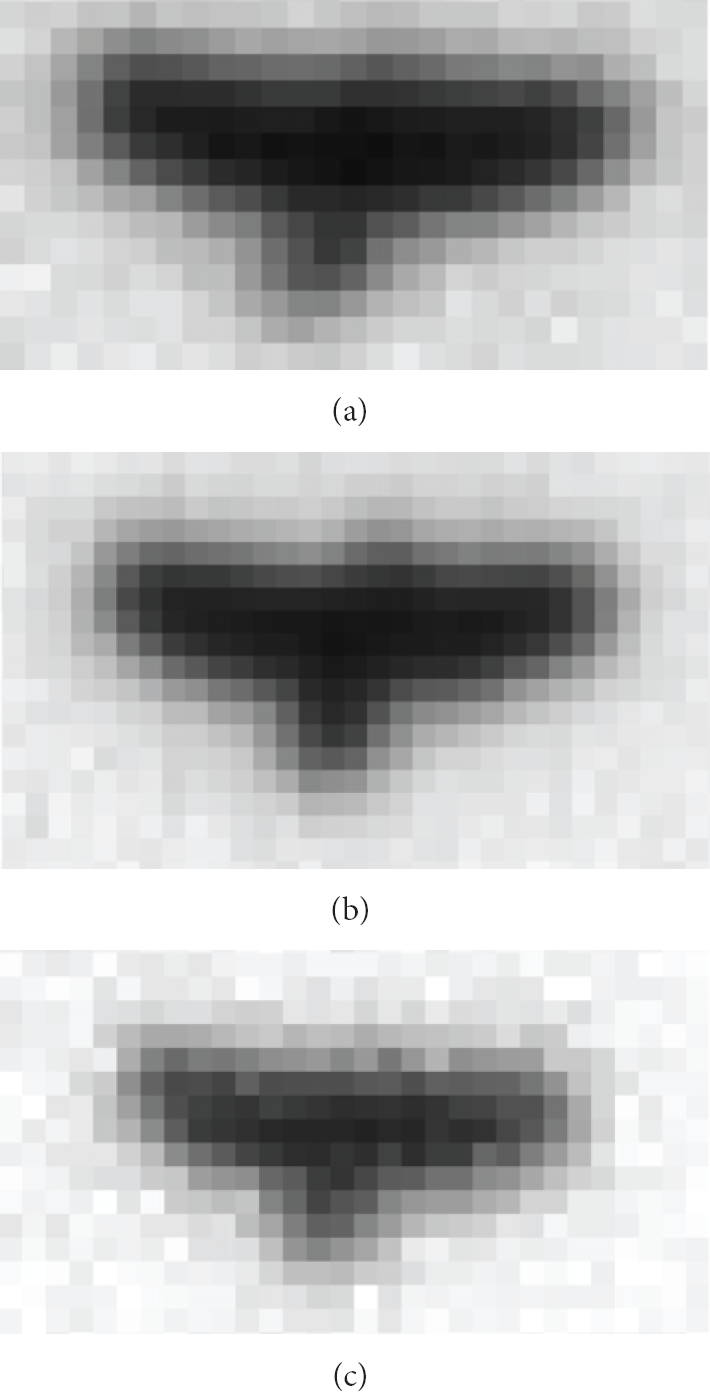
Bird resolution at the highest altitude: (a) VSN1, (b) VSN2, and (c) VSN3.
5.2.2. Altitude D
It is the higher altitude of VSN2 (Figure 8(b)) where minimum required object image resolution is assumed. To perform measurements for resolution verification for VSN2, the wall is treated as altitude line D. The ground line A of length 235.4 cm is drawn parallel to the wall at a distance of 208.6 cm away from the wall. Both nodes 1 and 2 are placed the same way as for measuring the full coverage, and images are captured by these nodes. One such image captured by node 2 is shown in Figure 10(f). For more clear observation, a small portion of Figure 10(f) which contains bird image is shown magnified in Figure 11(b). The bird pixels are measured along the width side by using segmentation. The number of pixels obtained is 19. This value is very near to the calculated value of 20.
5.2.3. Altitude C
It is the higher altitude of VSN3 (Figure 8(c)) where minimum required object image resolution is assumed. To perform measurements for resolution verification for VSN3, the wall is treated as altitude line C. The ground line A of length 235.4 cm is drawn parallel to the wall at a distance of 86.5 cm away from the wall. The nodes 1, 3, and 2 are placed the same way as for measuring the full coverage, and images are captured by these nodes. One such image captured by node 3 is shown in Figure 10(j). For more clear observation, a small portion of Figure 10(j) which contains bird image is shown magnified in Figure 11(c). The bird pixels are measured along the width side by using segmentation. The number of pixels obtained is 19. This value is very near to the calculated value of 20.
6. Results
The coverage measurement results in Table 5 show that the measured values for different points are in accordance with the values calculated by heterogeneous VSN model. Even the measured values are broader than the calculated values. For example, the analysis of the range covered by node 1 at altitude line D between
7. Conclusion
This paper discusses the design of a heterogeneous VSN for the surveillance of a volume between two altitude limits. Images are captured and measurements are performed to verify full coverage and minimum achieved resolution at lower and higher altitudes, respectively. The measurements verify that the heterogeneous VSN is able to provide full volume coverage between the given altitude limits. The core advantage of heterogeneous VSN over homogeneous VSN is the higher cost reduction.