




Abstract
Nowadays, in order to have some featured products, many customers tend to buy customized products instead of buying common ones in supermarket. The manufacturing enterprises, with the purpose of improving their competitiveness, are focusing on providing customized products with high quality and low cost as well. At present, how to produce customized products rapidly and cheaply has been the key challenge to manufacturing enterprises. In this paper, an intelligent modeling approach applied to supporting the modeling of customized products is proposed, which may improve the efficiency during the product design process. Specifically, the product gene (PG) method, which is an analogy of biological evolution in engineering area, is employed to model products in a new way. Based on product gene, we focus on the intelligent modeling method to generate product schemes rapidly and automatically. The process of our research includes three steps: (1) develop a product gene model for customized products; (2) find the obtainment and storage method for product gene; and (3) propose a specific genetic algorithm used for calculating the solution of customized product and generating new product schemes. Finally, a case study is applied to test the usefulness of our study.
1. Introduction
Satisfying customer requirements is more and more crucial in current manufacturing mode. Most manufacturing enterprises put their customers' satisfaction in the top position to improve their competitiveness. Meanwhile, an increasing number of customers tend to purchase customized products with their personal characteristics, rather than buying those common ones from the market [1]. Due to these requirements, enterprises adopt customer-driven strategy to produce small number but wide-variety products to offer customers maximize satisfaction [2]. The notion of consumer-driven design [3] was firstly rooted in Japan's Kobe shipyard in the 1970s [4]. Now, many new principles and approaches, such as quality function deployment (QFD) [5] and axiomatic design (AD) [6], have been introduced to help designers identify the relationship between customer requirements and design characteristics [7]. Zhou et al. proposed a STEP-compliant knowledgebase to support the customized-product development [8, 9], which has a potential of providing the designers and managers with an online access environment to access the product's design history in an easier and faster way. In addition, this knowledgebase can reduce the amount of rework. However, in the process of designing customized products, evaluation of design alternatives is still heavily reliant on designers' experience and knowledge, which are time consuming as well.
The characteristics of the customized products include: (1) low number and multitype. As most of these products are designed for specific requirements of customers, with a low number, their structure is always more complex than common ones. (2) The customers' requirements are difficult to express. As the specific requirements of customized products are sometimes illustrated by customers with fuzzy natural language, designers have to translate these requirements to standard expression. (3) Low repetitiveness is also one of the characteristics of the customized products. The function and structure of customized products are usually different with common products, so high cost and high risk rate may exist in the design process of customized products. Traditional manufacturing methods, such as product family design [10], adaptive design [11], modular design [12], and variant design [13], cannot effectively satisfy this trend because the talent of experts may be wasted in endless orders. In this paper, we propose a PG method to fulfill the modeling process of customized products rapidly and automatically.
In recent years, many scholars have found that PGs, which are similar to biological genes, exist in manufacturing products, especially in mechanical products. As creatures are created by nature through complex physical and chemical actions, products are produced by manufacturers through physical and chemical actions after they have been designed. Thus, the essences of their origins are very similar. Feng et al. compared biological genetic engineering with the design of product principle scheme [14, 15]. They defined PG as genetic knowledge of product function. Chen et al. raised a genetics-based approach for the conceptual design [16]. In this paper, PG is employed to index product solutions to facilitate the mapping between functions and product solutions. Wang and Ai [17, 18] concluded former PG theory, defining PG as a collection of standard information that controls the growth process of products and regulates each aspect of product attributes. Meanwhile, heredity, variability, self-organization, and self-adaptation must be included in the characteristics of PG that will determine its application. However, these studies are still in the initial stage and can hardly be applied in manufacturing or design activities. More problems are still existing and need to be solved.
In this paper, Section 2 proposes a model of PG to support the customized products modeling. In Section 3, the whole intelligent modeling process of customized products is illustrated. And a case study used for exemplification of the effectiveness of the proposed method is provided in Section 4. Finally, the paper is concluded in Section 5.
2. PG Model and Its Composition
2.1. Definition of PG
Creatures are created by nature through complex physical and chemical actions. Similarly, products are also produced by manufacturers through these actions after they have been designed. Therefore, the essences of their origins are similar, although creatures are created randomly by nature, while products are produced by human beings intentionally.
The corresponding relationship between creature growth and product design is found as follows: DNA → PG, RNA → product solutions, protein → parts, and living creature → human product. As shown in Figure 1, the whole process from PG to entity product is (1) product schemes are obtained via the transcription of PG; (2) parts are captured through the translation of product solutions; (3) parts constitute entity products. In this paper, we mainly focus on the transcription process from PG to product schemes.

Relationship between creature growth and product design.
In biology, gene is a nucleotide sequence in a DNA molecule that possesses some genetic effects. It is the minimum function and structure unit of a genetic material. Similarly, the PG contains function characteristics, principle information, and structure data, which are defined as function gene (FG), principle gene (PCG), and structure gene (SG), respectively. We defined PG and its relative attributes as follows.
PG. A basic unit that controls the growth process of products and regulates each aspect of product attributes. It contains FG, PCG, and SG which determine the product function, principle, and structure, respectively. PG is the minimum unit of design process and fulfills part of the product's function.
FG. A basic information unit that describes the function and characteristics of products.
PCG. A basic information unit that describes the physical effects of products.
SG. A basic information unit that describes the structure and material of products. Since structure information and material information are closely correlative, SG contains both structure information and material information.
Product Genome (PGM). As a product often contains many functions which are enforced by different principles and structures, it usually contains many PGs. A PGM is defined as the collection of all the PGs in a product.
Subgenome (SGM). A SGM is subunit of a PGM. It is composed of more than one PG and can be viewed as a module which fulfills some specific function.
PG Model. The structure of PG. It is used to store the PG information and formal expression of PG content.
2.2. PG Modeling
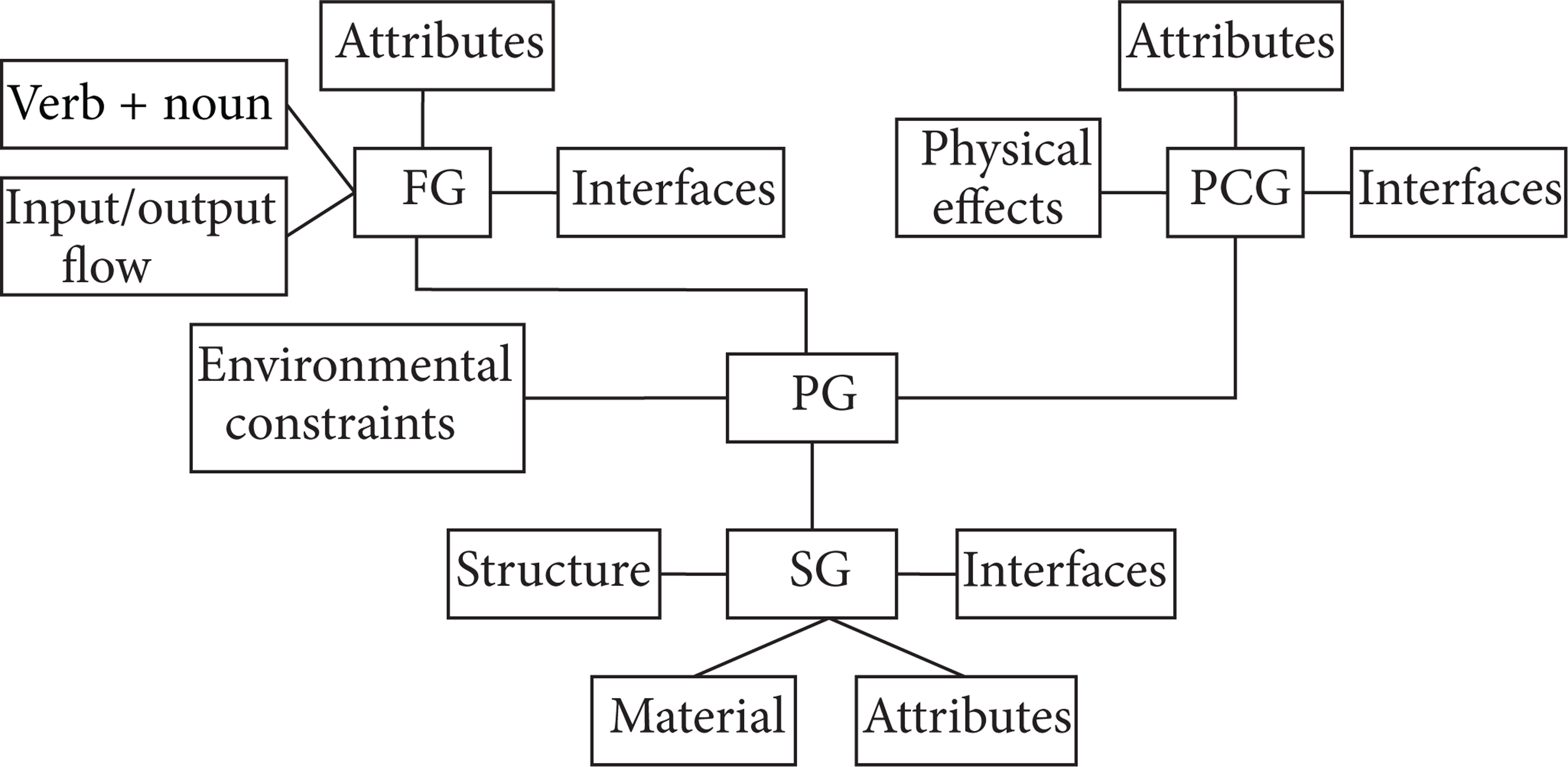
Based on the definition of PG, we proposed a PG model to express its attributes. As shown in Figure 2, our PG model consists of FG, PCG, SG, and environment constraints.
PG model.
Information of FG, PCG, and SG contains their representative methods, attributes, constraints, and interfaces with each other. FG includes a verb + noun pair, input/output flow, relative attributes of the function, and its interfaces with other genes. PCG includes the physical effects, relative attributes of the physical, and interfaces with other genes. SG includes the information about physical structure and material, relative attributes of them, and interfaces to other genes. To be more specific, the detailed information of these genes will be discussed in Sections 2.4, 2.5, and 2.6.
The environmental constraints determine the suitable environment of the PG. Each type of products has its own work environments, which can affect the performance and working life of products. Considering these effects, an environmental constraint table is established and shown in Table 1 [19].
Factors of environmental constraint effect.

2.3. PGM Tree Structure
In order for PGM and PG to correspond to products and components, we built up the PGM tree structure as shown in Figure 3. In this tree structure, the PGM stands for the whole product and contains a set of PGs. Generally, a PGM includes more than one SGM, which consists of more than one PG as well. The formulas of PGM are described as follows:


Genome tree structure.
In (1), PGM stands for a genome, the SGM i stands for the ith SGM in this PGM, and PG ij stands for the jth PG belonging to SGM i :
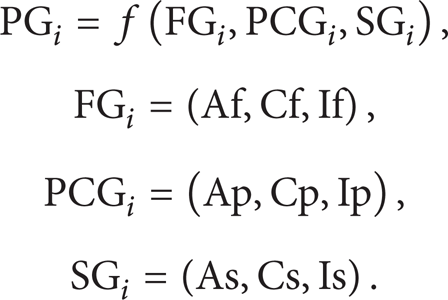
The exact meanings of variables in (2) are shown in Table 2. In addition, the specific information of them will be introduced in Sections 2.4, 2.5, and 2.6.
Meaning of variables.

2.4. FG Model
As discussed in Sections 2.1 and 2.2, FG is a unit that is used to represent function information. There is only one FG that exists in each PG and includes the semantic function description based on improved VNP (verb-noun pair) method, power transmission description IOFT (input and output flow transformation), and some relative attributes.
The VNP method is easy to express and is similar to the way of designer thinking, but it lacks precision and objectivity. In order to overcome these disadvantages, we proposed a developed VNP method, which adds a verbmodifier before the verb. In this method, the traditional “verb + noun” pair has been transformed to “verb modifier + verb + noun” group to describe the function more precisely and specifically. In addition, some key attributes of the noun are contained in the FG to describe the object in more details. For instance, we can represent a sports bottle's function as follows: screw + enclose + plastic, and its key attributes are “durable, round.”
IOFT is used to represent the transmission of power, and it is a proper complement to the developed VNP. The representation of IOFT includes two types: (1) when the types of input and output power are different, a set of input and output types is adopted to represent the function. For example, the function of electromotor can be represented as (I, W). I and W stand for the electric current and power, respectively. (2) When the function needs power transmission in the same type, a set of vectors of the input and output power is employed to represent the difference between them. As the simply semantic description in the developed VPN still has some weakness, such as low accuracy and unspecificity, we use IOFT as a complement of it.
Other attributes of PG include its fitness, which will be used in PG's selection and recombination in Section 3. In addition, other related constraints and interfaces of the function are contained in FG as well, such as the constraints of verb, noun, input, and output, and interfaces to other genes. The specific content of FG is shown in Table 3.
Specific content of FG.

2.5. PCG Model
The PCG is a unit used to represent the principle effects in products, which are the basis of most product solutions in manufacture. As most mechanical products are realized by physical effects, our PCG mainly represents the physical effects on products. In addition, as a function is sometimes assured by different physical effects, a PG sometimes contains more than one PCG. Meanwhile, the same PCG may exist in different PGs because a physical effect sometimes assures varied functions.
Physical effects can be described by the physical laws and their relative parameters. For example, the coulomb law of friction can be expressed by the following formula: FR = μ*FN. In addition, the constraint information of the physical effects should be included in the PCG model, such as the range of each parameter and the relationship between different parameters. For instance, the lever principle can be expressed by the formula Fa*a = Fb*b, Fa, Fb, where a and b are relative parameters. Its constraints are a > 0, b > 0, and a > b.
In addition, a physical effect must be matched to its corresponding functions. So, we put the input/output fitness in the PCG model to evaluate input and output type. Meanwhile, as each physical effect has its suitable application environment, we should consider the constraints from external environment, so we adopt the environmental constraints to represent the environmental effects.
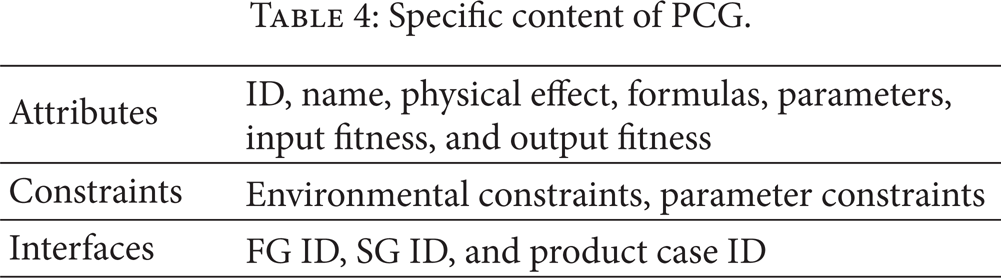
In conclusion, the specific content of PCG is shown in Table 4.
Specific content of PCG.
2.6. SG Model
The SG is a unit that represents structure information and material information. It includes geometrical characteristics, motion characteristics, material characteristics, and their constraints. Sometimes, as a function is achieved by different structures, a PG sometimes may contain more than one SG. Meanwhile, the same SG may exist in different PGs because a structure is sometimes realized by varied functions.
The geometrical characteristic is adopted to describe the products' basic appearance and shape. So, its content includes the structure's type, shape, location, size, and number, which are shown in Table 5.
Geometrical characteristics.

Similarly, in order to determine the motion direction and range, we express the motion of structure in similar way to geometrical characteristic. The motion characteristics content includes its motion type, mode, direction, speed, and number. Some common motion characteristics in our database are shown in Figure 4.

Relationship between motion characteristics tables.
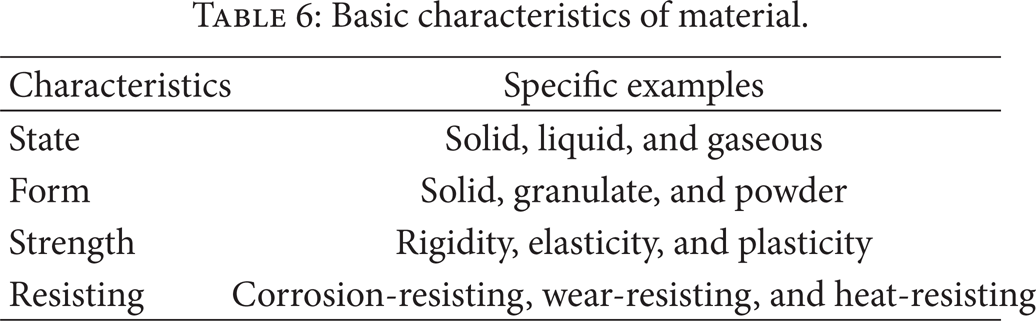
After the geometrical and motion characteristics have been determined, the basic structure of a product has been constructed. However, we can hardly get the final function until the product's manufacturing material has been determined. The major characteristics of material information are shown in Table 6.
Basic characteristics of material.
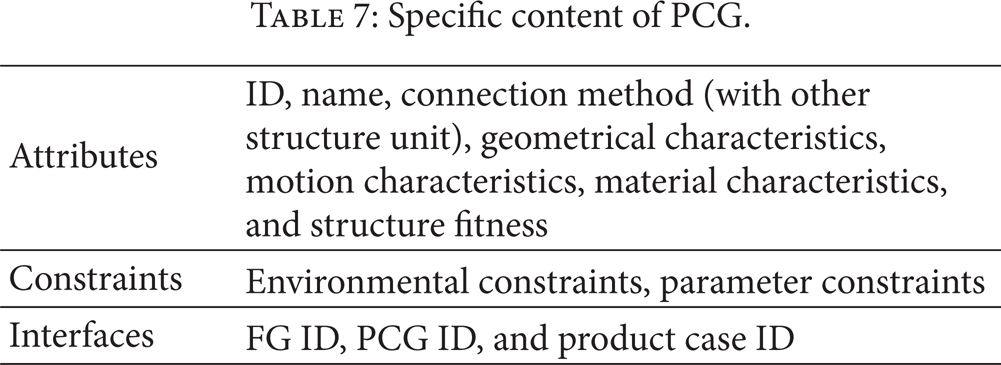
In addition, SG model still contains its constraints and interfaces. The specific information of SG is shown in Table 7.
Specific content of PCG.
2.7. PG Relationship and a Case
As mentioned in Section 2.2, PG consists of FG, PCG, and SG, which express the characteristics of product's function, the physical effects related to this function, and the characteristics of structure and material, respectively. Since a PG contains only one function and a function can be assured by more than one effect and structure, a relationship exists between FG, PCG, and SG, respectively. This relationship is shown in Figure 4. In addition, an example of relationship is shown in Figure 5.

Relationship between PG and other genes.
In Figure 6, we can find PGs of 3 types of cup. Specifically, PG of stainless steel insulation cup, which contains the function of heating insulation and enclose, consists of SG1 (double-deck stainless steel body), SG2 (screw stainless steel lid), PCG1 (vacuum insulation), PCG2 (screw effect), FG1 (heat insulating), and FG2 (enclose). The PG of plastic sport bottle, which contains the function of enclose and antithrow, consists of SG3 (plastic screw lid), SG4 (tough plastic body), PCG2 (screw effect), PCG3 (toughness of material), FG2 (enclose), and FG3 (anti-throw). The PG of Ordinary tough plastic cup, which contains the function of anti-throw, consists of FG4 (tough plastic body), PCG4 (toughness of material), and FG3 (anti-throw). In this figure, the multi-to-multi relationship between each type of genes is illustrated and explained.

Example of relation between PG and other genes.
3. Intelligent Modeling Process of Customized Products
The modeling process of customized products can be implemented via three processes, which are (1) PG obtainment, which extracts PG from existing products and constructs PG database; (2) PG recombination, which modifies PG via the operation of PG selection and crossover based on recombining rules; (3) PG expression, which transforms PG into product schemes. As shown in Figure 7, the main framework of PG modeling consists of PG obtainment, recombination, and expression.

Main framework of PG modeling process.
3.1. PG Obtainment
PG obtainment, also called reverse transcription, indicates the method that extracts PG from products. The PG obtainment process includes: (1) extract function, principle, and structure information from product cases; (2) transform the information into genes; and (3) save PG into PG database.
Steps 1 and2, which extract PG from existing products, are shown in Figure 8. Firstly, the total function is divided into several subfunctions, which can realize parts of the total function, respectively. Secondly, the physical effects and structures which assure these functions can be found in the product cases. Thirdly, the FGs, PCGs, and SGs are obtained via the transmission of function, principle, and structure information. Finally, the PGs are obtained via the combination of FGs, PCGs, and SGs.

Extract PG from existing products.
After extraction, PG should be saved into the PG database. The major tables of PG database are shown in Figure 9, which includes ProductGene (ID of genome and other genes are stored in), Product (information about a product case of the PG), FunctionGene (VNP + IOFT description and constraints of the FG), PrincipleGene (information about PG), and StructureGene (information about SG).

Major tables of PG database.
3.2. PG Recombination
PG recombination is the key of the whole process. In this paper, we try to achieve this process via the genetic algorithm. Here, because of the difficulty in PG mutation, we abandon the mutation operator in the genetic algorithm and leave the selection operator and crossover operator only. Selection operator can select excellent PGM from the PG database, while the crossover operator can exchange PG in two different PGMs to obtain new PGMs. Based on this algorithm, the recombination of PG can be achieved via the crossover operator.
3.2.1. Design of Selection Operators
The selection operator determines the choice of the first generation. In this paper, we use selection operator to find the excellent PGMs in the PG database and put them into the cross PGM collection. Here, according to the fitness in PG model, the fitness proportion method has been applied in the selection operator.
If a population's size is n, then the PGM's selective probability p k is

In (3), f k is the fitness of PGM k , which will be illustrated in Section 3.2.3. After all PGMs' selective probabilities have been determined, we will select n PGMsand put them into the cross PGM collection Sc. The specific operating process is as follows.
Step 1. Calculate the accumulated selective probability q k :

Step 2. Generate a random number r k in range [anjan30].
Step 3. If r k < q1, we select PGM1 and put it into the Sc. If r k > q1, we select PGM i which makes qi – 1 < r k ≤ q i , 2 ≤ i ≤ n, and put it into the Sc.
Step 4. Repeat Steps 2 and 3 until n PGMs have been put into Sc.
After the selection operating, there will be n PGMs in the Sc. The PGMs with high probability will be selected for several times, and some PGMs with low probability will be abandoned.
3.2.2. Design of Crossover Operators
In the crossover operation, two PGMs are randomly selected to exchange part of their PGs and generate two new descendant PGMs. The crossover operation of genomes, as shown in Figure 10, can occur at the nodes of PGM trees.
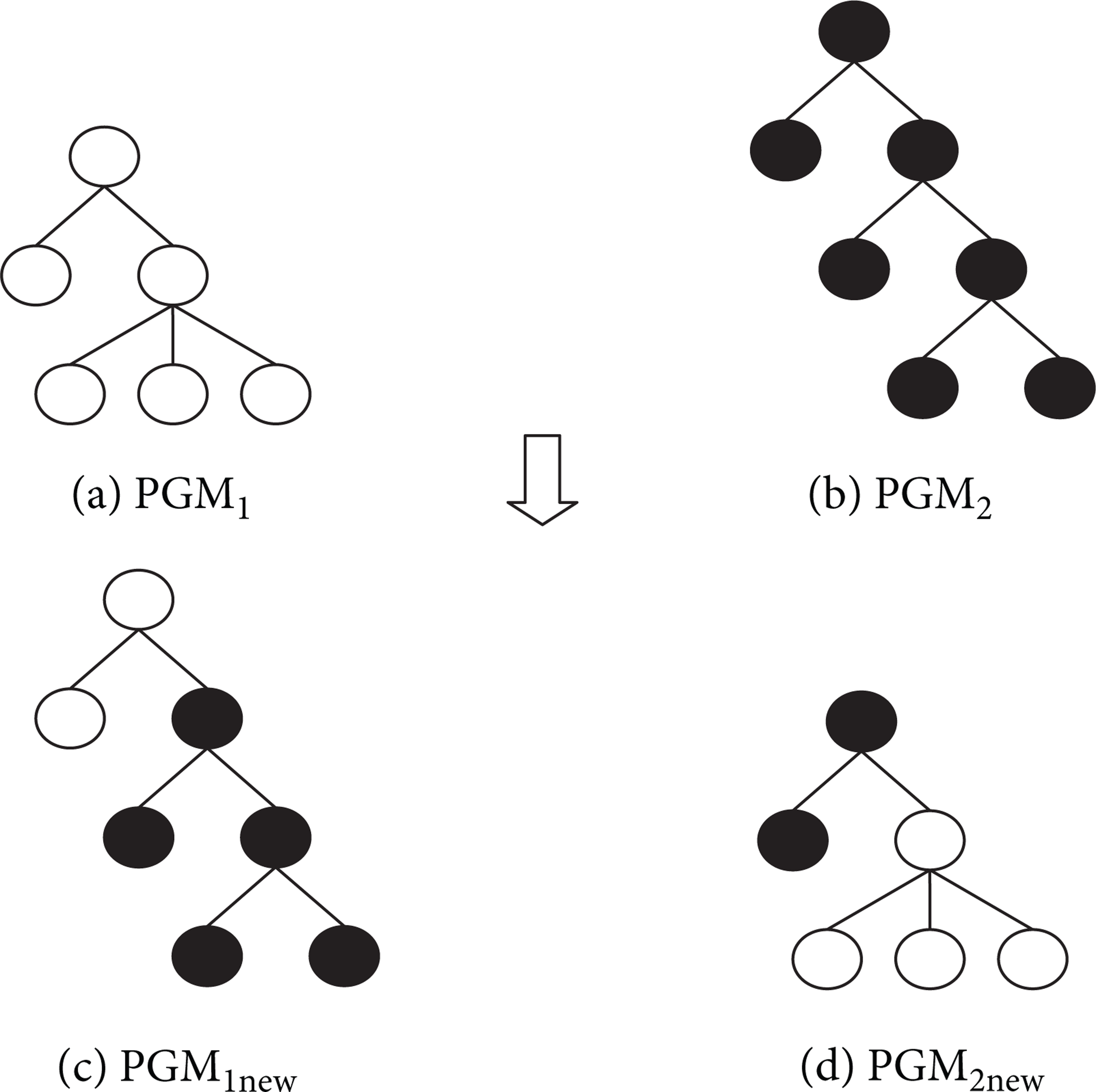
An example of crossover.
If the crossover probability is pc, crossover times are n, and then the process of crossover is described as follows.
Step 1. Select two PGMs, PGM1 and PGM2, from Sc randomly. For PGM1 and PGM2, if they are the same one, reselect them; otherwise select them as the crossover PGMs and take them out of Sc.
Step 2. Choose a crossover node P at a similar location in both PGM1 and PGM2.
Step 3. Exchange the subgenomes and PGs under P (including node P itself) and generate new genomes PGM1new and PGM2new.
Step 4. Compare the fitness of PGM1, PGM2, PGM1new, and PGM2new, select the highest two, and put them into the next cross-generation.
Step 5. Repeat Steps 2 and 4 until all the genomes in Sc are processed.
Step 6. If the new cross-generation is the nth generation, stop crossover and output the final result; otherwise replace the Sc by the new cross-generation.
3.2.3. Design of Fitness Function
As discussed in Sections 2.4, 2.5, and 2.6, fitness functions are included in attributes of each gene. As the design of customized product is a multioptimization process, we adopt the weight factor to optimize the multiobjective targets. For different SGMs, we set different weights and different types of fitness, and the sum of these types of fitness is the final fitness of one PGM. The PGM fitness calculating equation is
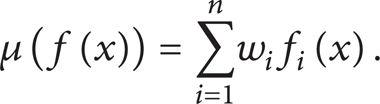
In (4), f i (x) is the fitness function of each PG, and the weight w i ≥ 0 shows the importance of each gene, and

If we set μ(f(x)) as the fitness of the PGM, then the multioptimization process transformed to a single-optimization process. According to the specific design process of customizing products, we defined 3 types of fitness functions, which are FG fitness function, PCG fitness function, and SG fitness function. Before the recombination, designers should decide the weight of each fitness functionand then start the select and crossover operation.
FG Fitness. The purpose of product design is satisfying the function requirement of customers. The fitness function of FG, which evaluates the satisfying level of function requirement, is

where
Principle Fitness. The choice of physical principles determines the method of function achievement. Generally, we tend to choose those principles which are simple and suitable to the environment. Similar to the FG, the fitness function of PCG, which evaluates the satisfying level of physical principles, is

where
Structure Fitness. In order to achieve the function and principle requirements, a proper structure should be found. The structure should satisfy two factors: (1) being proper to the functions and principles and (2) low cost. The fitness function of SG is

where
Generally speaking, we should consider the synthetic effect of function, principle, and structure elements, so the fitness function of a PG is

3.3. PG Expression
After PG recombination, new PGs, which are suitable to function requirements, are obtained. The next process is transforming these PGs into product solution. We need a standard format to express these PGs, to illustrate PG in a formal and easy way. In this paper, we use an example to show how the PGs are expressed.
Now we will discuss the expression of the plastic sports bottle's PGM introduced in Section 2.7. This plastic sports bottle includes two parts: bottle lid and bottle body. In bottle lid, its function description is “screw enclose bottle”; physical effect is “spiral principle,” and structure is a cycle with thread inside. The standard format of the PG of bottle lid is shown in Table 8.
Example of PG of bottle lid.

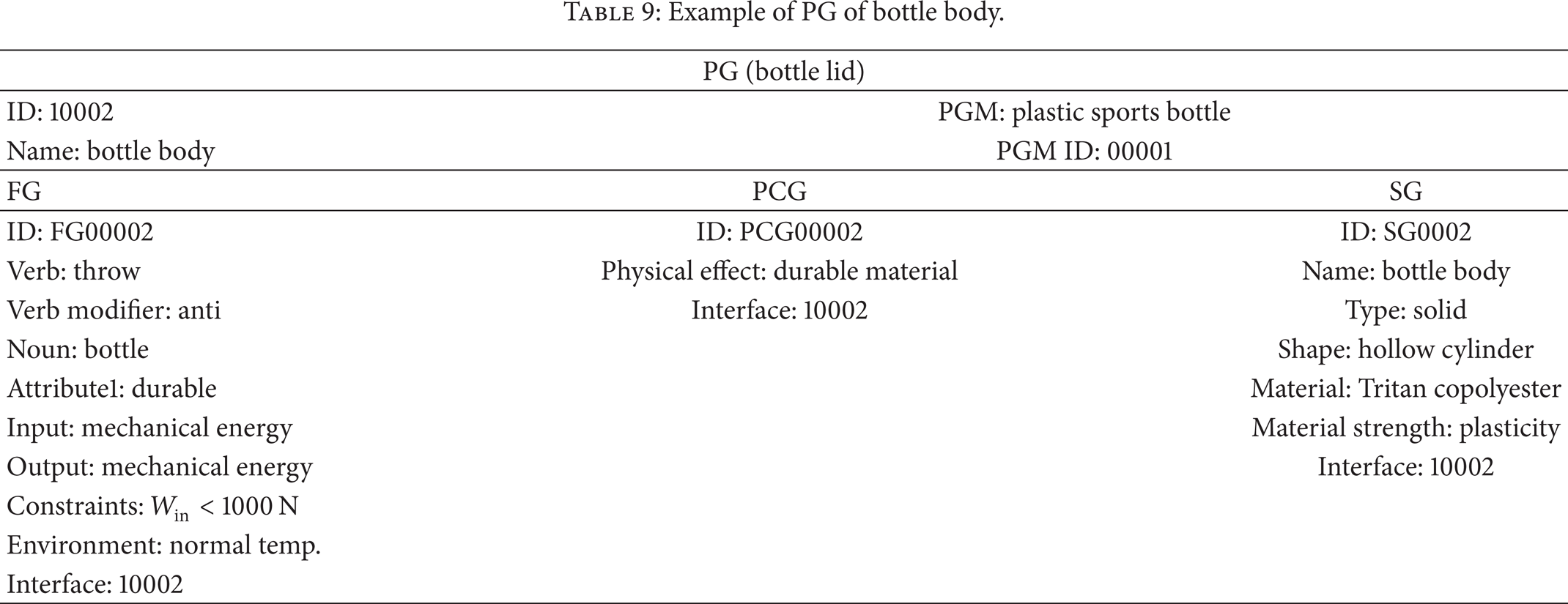
In bottle body, its function description is “anti-throw body”; physical effect is “durable material”; and structure is a cylinder. The standard format of the PG of bottle body is shown in Table 9.
Example of PG of bottle body.
4. Case Study
In this section, we will introduce an example of the intelligent modeling process based on PG. First, we proposed a Customized Products Intelligent Modeling System (CPIMS) based on Visual studio 2010 and SQL 2008. And then we suppose an order for a special sport bottle, which requires the bottle can be easily enclosed, anti-general throw and insulating heat (from −10°C to 100°C).
The modeling process is shown as follows.
Analyze the customer's requirements: “enclose”, “anti-throw,” “insulating heat,” and “anti skidding” (Considering the practical purpose of bottle, we add this function for the product, although it is not included in customer's requirements.)
Retrieve product in current bottle's database: in the database, we cannot find any bottle with all these four functions, so we need to recombine current PGMs.
Input the requirements in our modeling system: as shown in Figure 11, we choose the product requirements in CPIMS as “Enclose + insulate heat + anti-skid + anti-throw.” The recombination type is “sub-genome type” and recombination families are (sports bottles and thermos families). Then, we can get the initial design scheme in the edit box below, which is “Screw enclose + double layer + finger hollow + Durable material.”
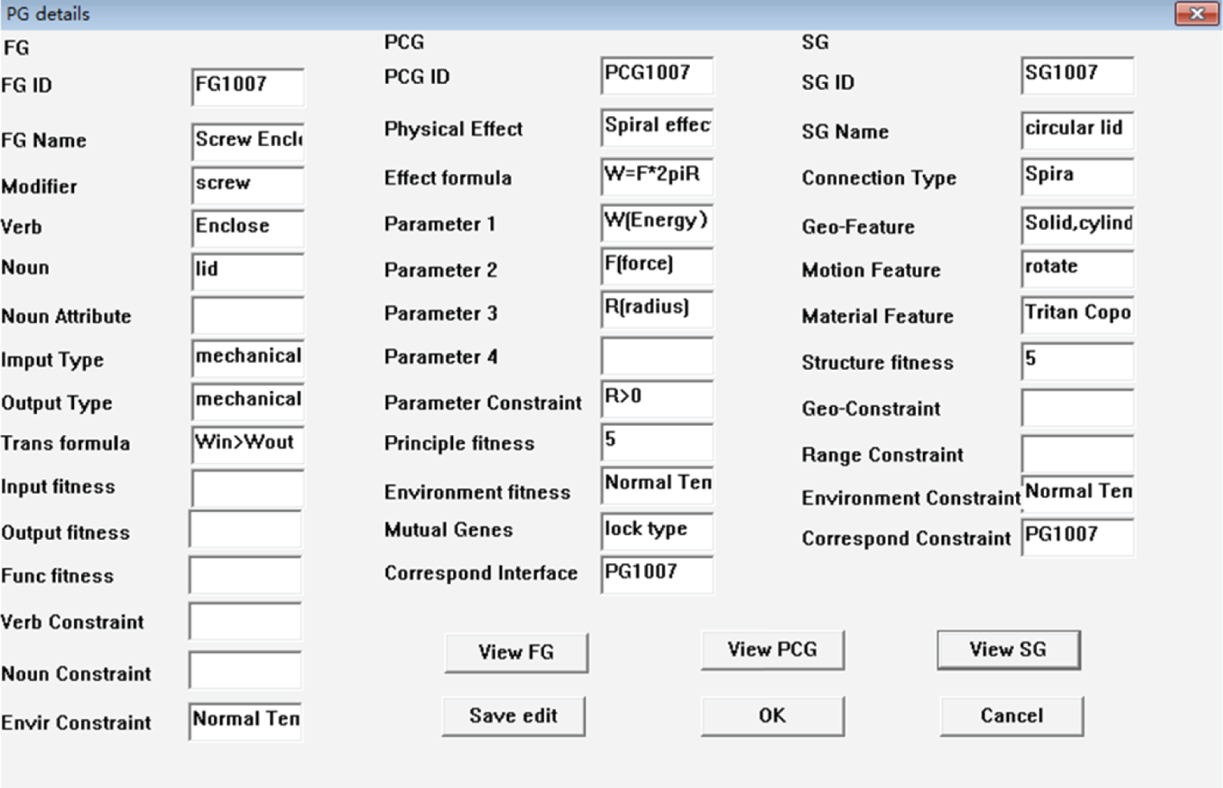
Retrieval in the PG database:after the initial design scheme is generated, we may retrieve them in the PG database, the final result is shown in Figures 12, 13, 14, and 15.
Generate consequence: after the retrieval, we can design the required sports bottle based on the product genes. The design results of the bottle's structure are shown in Figures 16 and 17.

Intelligent modeling.
Bottle lid.

Body anti-throw.

Body anti-skid.

Insulating heat.

Bottle lid.

Bottle body.
5. Conclusion
Enlightened by biogenetics, this paper presents a genetics-based approach for increasing efficiency in creating designs of customized products. Likened to the role of biogenes in biogenetics, the conception of PG is employed to build the product model and control the design process. The PG model is designed to represent different information of products and to assist the customized products modeling. PG's operations, which include obtainment, recombination, and expression, are illustrated in Section 3. An intelligent modeling approach based on these operations of PG has been proposed to help manufacturing organizations develop customized products rapidly and easily. Finally, a case study of the sports bottle's design is provided to evidence the effectiveness of our approach.
In the future, we may have future research on the following aspects.
Our system is a prototype system only, and it lacks the support of design knowledge. We will explore developing a new system that can be used in business design.
The main aspect we are currently concerned with is product scheme design. In the next step, we will try to apply this approach in the whole process of product design.
Our recombination algorithm is simple, which neglects many details in design. It still needs a more specific algorithm to calculate the fitness of each gene before it can be applied in business use.
Footnotes
Acknowledgments
This research is funded and supported by the National Natural Science Foundation of China (Grant no. 50905133), the Natural Science Foundation of Hubei Province, China (Grant no. 2009CDB255), and the Wuhan Planning Project of Science and Technology (201171034314).