




Abstract
Limited availability of hydrologic data is a major hurdle for implementation of detailed hydrologic models. In cases where available data is limited, simple hydrologic models such as linear Muskingum model consisting of a minimum number (one or two) of model parameters are more desirable. As an alternative to the conventional mathematical approaches, this paper applies a new hybrid metaheuristic algorithm based on charged system search and particle swarm optimization for identifying the parameters of the linear Muskingum model. In order to evaluate the new algorithm, a numerical example is utilized and the results are compared to those of other algorithms. The results reveal the performance of the algorithm to optimize parameter estimation of the Muskingum model.
1. Introduction
Charged system search (CSS) is a relatively new metaheuristic optimization algorithm inspired by the governing laws of electrical physics and the Newtonian mechanics. In electrical physics, the electric charge can generate the electric field and exerts a force on other electrically charged objects. The electric field surrounding a point charge is specified by the laws of Coulomb and Gauss. Utilizing these principles, the CSS algorithm defines a number of solution candidates each of which is called charged particle (CP) and is treated as a charged sphere. Each CP can exert an electrical force on the other agents (CPs). These forces can change the position of other CPs according to Newton's second law. Finally, considering the Newtonian mechanics, the new positions of CPs are determined [1, 2]. Also a hybrid CSS and PSO (particle swarm optimization) algorithm is proposed by Kaveh and Talatahari [3]. The hybrid CSS-PSO has shown good performance in solving optimization problems in different areas such as optimal design of large-scale structures [4] and optimal design of laminated composite structures [5].
For the first time we apply this hybrid algorithm for optimal parameter estimation of Muskingum model. The Muskingum model is a popular model for flood routing which is basically an extension of the reservoir routing methods taking into account that the storage (S) in a channel is a function of both the inflow (I) and the outflow (O). This means that in addition to the prism storage there is a (positive or negative) wedge storage. However, the application of the model still suffers from an absence of an efficient method for parameter estimation. There are various mathematical techniques which have been used for estimating the parameters of the Muskingum model. These mathematical methods use gradient information to search the solution space near an initial starting point [6]. In order to evaluate the proposed method, a numerical example is utilized and the results are compared to those of other algorithms.
2. Charged System Search Algorithm
2.1. General Aspects
The charged system search (CSS) algorithm is a relatively novel metaheuristic based on the Coulomb and Gauss laws from electrical physics and the governing laws of motion from the Newtonian mechanics [1]. This algorithm can be considered as a multiagent approach, where each agent is a charged particle (CP). Each CP is considered as a charged sphere with radius a, having a uniform volume charge density and is equal to

where fitbest and fitworst are the best and the worst fitness of all the particles, fit (i) represents the fitness of the agent i, and N is the total number of CPs.
CPs can impose electric forces on the others, and their magnitude for the CP located in the inside of the sphere is proportional to the separation distance between the CPs, and for a CP located outside the sphere is inversely proportional to the square of the separation distance between the particles. The kind of the forces can be attractive or repelling and it is determined by using ar ij , the kind of force parameter, as
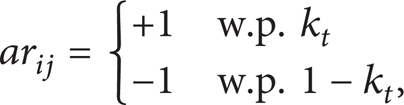
where ar ij determines the type of the force, + 1 represents the attractive force and −1 denotes the repelling force, and k t is a parameter to control the effect of the kind of force. Therefore, the resultant force is redefined as

where
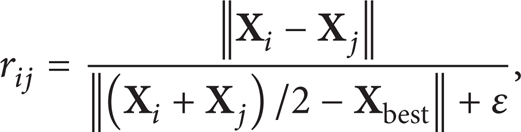
where

At the movement stage, each CP moves toward its new position under the action of the resultant forces and its previous velocity as

where k a is the acceleration coefficient; k v is the velocity coefficient to control the influence of the previous velocity and here both are equal to 0.5; and randj1 and randj2 are two random numbers uniformly distributed in the range (0, 1). If each CP moves out of the search space, its position is corrected using the harmony search-based handling approach as described in [7]. In addition, to save the best design, a memory (charged memory) is utilized.
2.2. Hybrid PSO and CSS
The particle swarm optimization (PSO) involves a number of particles, which are initialized randomly in the space of the design variables. These particles fly through the search space and their positions are updated based on the best positions of individual particles and the best position among all particles in the search space which corresponds to a particle with the smallest weight. Also considering the position of a particle selected randomly from the swarm (passive congregation) can improve the performance of the algorithm.
The update moves a particle by adding a change velocity V j k + 1 to the current position X k j as follows:
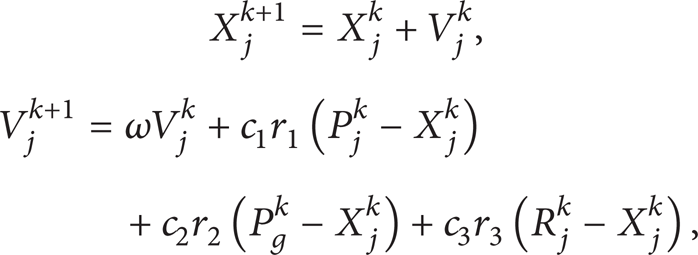
where ω is an inertia weight to control the influence of the previous velocity; r1, r2, and r3 are three random numbers uniformly distributed in the range of (0, 1); c1 and c2 are two acceleration constants; c3 is the passive congregation coefficient; P j k is the best position of the jth particle up to iteration k; P g k is the best position among all particles in the swarm up to iteration k; and R k is a particle selected randomly from the swarm. In order to increase the exploration ability, in this paper the velocity of the particles is defined as

where c4 is the exploration coefficient; r4 is a uniformly distributed random number in the range of (0, 1); and Rd k is a vector generated randomly from the search domain.
Compared to PSO, the CSS algorithm can be considered as a generalized form of the PSO containing its superiorities, but avoiding its disadvantages. Both are population-based algorithms and find optimum solutions by changing the position of the agents. However, the movement strategies are different for the CSS and PSO. The PSO algorithm utilizes the local best and the global best to determine the direction of the movement, while the CSS approach uses the governing laws from electrical physics and the Newtonian mechanics to determine the amount and the direction of a charged particle's movement. CSS can distinguish the local search and the global search phases and utilizes suitable relationships in these phases resulting in a good balance between the exploration and exploitation, while the greatest disadvantage of the PSO approach is the existence of some difficulties in controlling the balance between the exploration and exploitation.
In the present hybrid algorithm [3], the advantage of the PSO consisting of utilizing the local best and the global best is added to the CSS algorithm. The

Considering the above new
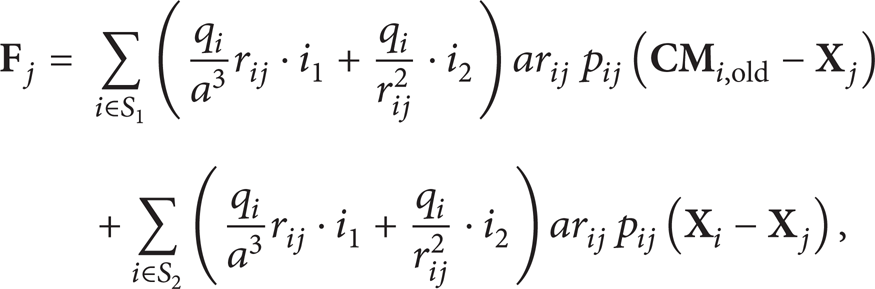
where subtitles S1 and S2 denote two sets of the numbers which determine the number of the agents utilized to calculate the resultant force by employing the agents sorted in the

then the resultant force formulae can be simplified as

where the subtitle g denotes the number of the stored so far good position among all CPs. Therefore the first term directs the agents towards the global best position. When i = j, then the
3. Determining the Muskingum Model Parameters
3.1. Linear Muskingum Model
Hydrologic modeling plays a key role in water resources planning, development, and management. Limited availability of hydrologic data is a major hurdle for implementation of detailed hydrologic models. In cases where available data is limited, simple hydrologic models consisting of a minimum number (one or two) of model parameters are more desirable [8]. A simple conceptual model like the Muskingum model is very effective in the estimation of the hydrograph of the rise and fall of a river at any given point on the river during the course of a flood event.
The problem is solved by the techniques of flood routing, which is a process for calculating the shape of a flood wave along a river channel. McCarthy [9] analyzed the data from the Muskingum River in Ohio and found certain relationships: storage is proportional to outflow; and storage is also proportional to the difference between inflow and outflow [10]. In the linear Muskingum model, the following continuity and storage equations are used:
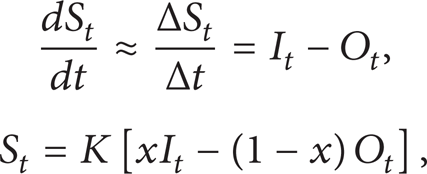
where S t represents the storage volume within the reach at time t (L3); I t and O t are rates of the inflow and outflow at time t (L3 T−1), respectively; K is the storage-time constant for the river reach (T), which has a value close to the flow travel time through the river reach; x is the dimensionless weighting factor commonly varying between 0.00 and 0.30 for stream channels and between 0.00 and 0.50 for reservoir storage; and Δt represents time step (T).
Choosing a suitable time interval for the routing period, the continuity equation in its finite difference form becomes

using the linear Muskingum model:

where

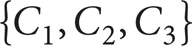
in which O i and I i represent the outflow and inflow discharges at time t i , respectively; and C1, C2, and C3 are the Muskingum parameters where C1 + C2 + C3 = 1. The routing procedure consists of the following steps.
Step 1. Assume the values of two parameters (K and x).
Step 2. Calculate the coefficients C1, C2, and C3 using (16).
Step 3. Compute the magnitude of the outflow at the next time (Oi + 1) using (15).
Step 4. Repeat Step 3 for all times.
In the conventional method, the parameters K and x in the linear Muskingum model are graphically estimated by a trial and error procedure. After assuming x, the values of [XI t + (1 – X)O t ] are computed using observed data in both upstream and downstream and then they are plotted against S t . The value of x that minimizes the width of the plotted loop can be chosen as the correct value of x, and the slope of the straight line fitted through the loop gives K [11]. There are some disadvantages of the conventional trial and error method.
The satisfactory results obtained often need calculations of several times, rather than one time.
Because two parameters K, x are got through trying and error artificiality, the introduction of human errors will be unavoidable.
The results cannot be proved theoretically optimum solution of the Muskingum parameters and therefore cannot ensure the global optimum of C1, C2, and C3.
This method not only increases the manual workload but also declines the accuracy of solution and it is difficult to programming.
Another traditional approach for determining Muskingum model parameters is the least square method (LSM). The LSM is a scientific solution for the Muskingum model under the condition of sufficient historical data. Because of its reliability and practicality, this method has been widely accepted. The biggest shortcoming of the LSM is the heavy dependence on historical data. If the historical data are complete and the time intervals are nearly equally distributed, the results of this approach will be good. On the contrary, if the historical data are incomplete, time intervals are too long or unequal, the results will be error greatly.
3.2. An Optimization Approach
In (15), C1, C2, and C3 are hydrologic parameters of the model. The main challenge is to find a set of parameters that give a representative response. These parameters are determined using optimization techniques by obtaining a good match between the observed and calculated discharge. Choosing of a suitable objective function plays an important role in optimization problems. Here, we use the following objective function which is based on minimizing the sum of squares of deviations between observed and computed values of outflow:
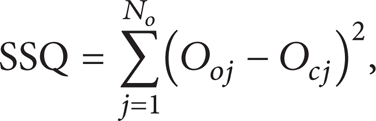
where O oj is observed value of the outflow at time t j ; O cj is the computed value of the outflow at time t j ; j is an index varying from one to N o , where N o is the number of hydrograph ordinates of the observed hydrograph. Thus, the optimal parameter estimation for Muskingum model may be expressed as follows:
Find
To minimize

Subject to

4. Example of Hydrologic Parameter Estimation for Muskingum Model
To investigate the performance of applying the new algorithm to solve the parameter estimation problem of the linear Muskingum model, a typical problem is used as an example. The algorithms were implemented using MATLAB to run on a computer with an Intel Core i5 CPU, 2.53 GHz processor, and 3.00 GB RAM; also the penalty method is used to handle the constraint. In this paper, the model is applied to the south canal between Chenggou and Linqing rivers in China. The length of the river course (from Chenggou to Linqing) of South Canal in Haihe Basin reaches 83.8 km. There is no significant effect of the branches. The time interval in the calculation is taken as 12 hr. The data set from [13] is considered for illustration purpose. This example has been studied previously by Wang et al. [14, 15], Zahn and Xu [16], and Yang et al. [17] for testing different parameter estimation methodologies. Also Zhengxiang and Ling [12] applied and compared several intelligent algorithms on Muskingum routing model using this example. Therefore, the performance of the proposed algorithm can effectively be compared with the previously reported results obtained with this example.
In Tables 1 and 2, the optimum parameters and the objective function of the solutions obtained by the least squares method (LSM), GA, SA, PSO [12], ICA [6], and the proposed CSS-PSO are presented. For the proposed algorithm, a population of 10 particles is used. The results show that the SSQ is attained using new algorithm. It has been demonstrated that the new algorithm gets better results than those of other methods. The computed outflow hydrograph and the observed outflow hydrograph are shown in Figure 1. The plot depicts that the resulting outflow hydrograph, using the parameters estimated from the proposed method, closely follows the observed outflows.
Comparison of best SSQs from various methods.

Comparison of the observed and computed outflows (cm).


Observed and routed hydrographs.
5. Conclusion
In this research a powerful algorithm is developed by combining the CSS and PSO. The new algorithm in the CSS formulation introduces the PSO concept of local best and global best. The main advantages of the PSO consisting of directing the agents toward the global best (obtained by the swarm) and the local best (obtained by the agent itself) are added to the CSS algorithm to improve its performance. In the present approach, similar to the original CSS, each agent is affected by other agents considering the governing laws of electrical physics. However, the kind of the forces can be repulsive and attractive. For the proposed algorithm, when the calculations of the amount of forces are completed for the CPs and the new locations of agents are determined, the
Here, the hybrid CSS-PSO method has been proposed in order to improve the computational accuracy for parameter estimation of Muskingum model. The Muskingum method ignores the momentum equation and is based solely on the continuity equation. The proposed optimization approach found the best value of parameters in terms of the minimal sum of the square deviation between the observed and routed outflows. The performance of this approach was compared with those of other common methods such as GA, SA, PSO, and ICA. The results demonstrate that the new algorithm can achieve a high degree of accuracy to estimate the parameters. This method appears to offer good applicability in the hydrology field and further applications should be explored.