




Abstract
Laminar mixed convection in the entrance region of horizontal and inclined semicircular ducts has been investigated. The governing momentum and energy equations were solved numerically using a marching technique with finite control volume approach following the SIMPLER algorithm. Results were obtained for thermal boundary condition of uniform heat input axially and uniform wall temperature circumferentially, incorporating Pr = 7, Re = 500, inclination angles (α = 0° and 20°), and a wide range of Grashof numbers. These results include velocity and temperature distributions at different axial locations as well as axial distribution of local Nusselt number and local wall friction factor. It was found that Nusselt number is close to the forced convection values near the entrance region, then decreases to minimum value as the distance from the entrance increases, and then rises due to the effect of free convection before reaching a constant value (fully developed). As Grashof number increases Nusselt number and wall friction factor increase in both developing and fully developed regions for horizontal and inclined ducts. A comparison with the experimental data in the thermal entrance region was also conducted and the comparison was satisfactory.
1. Introduction
Laminar combined forced and free convection flows in ducts received much attention in the recent years because of their wide range of applications, such as compact heat exchangers. This paper is concerned with the problem of laminar mixed convection in the entrance region of horizontal and inclined semicircular ducts with axial uniform heating. Due to the large amount of literature on fully developed laminar mixed convection for different cross sections and inclination angles, consideration will be given to the geometry of semicircular ducts only. Nandakumar et al. [1] studied numerically the problem of fully developed laminar mixed convection flow in horizontal semicircular ducts for the H1 thermal boundary condition with the flat wall at the bottom. Lei and Trupp [2] solved the same problem considered in [1] with the flat wall on top. They reported approximately the same results of Nusselt number as for the flat wall at the bottom [1]. Chinproncharoepong et al. [3] studied the effect of orientation by rotating the horizontal semicircular duct from 0° (the flat wall on top) to 180° (the flat wall at the bottom) with incremental angle of 45°. Busedra and Soliman [4] investigated the effect of duct inclination on laminar mixed convection in inclined semicircular ducts under buoyancy-assisted and opposed conditions. They oriented the flat wall of the duct in vertical position using two thermal boundary conditions H1 and H2; H2 thermal boundary condition is defined as a constant heat flux axially and circumferentially.
The literature on combined free and forced convection in the entrance region is few in comparison with the fully developed case. Most of the results for laminar mixed convection in the entrance region are available for vertical rectangular ducts [5–7] and for vertical circular tubes [8, 9]. Other results for horizontal duct are also available for rectangular ducts [10], concentric annulus [11], and circular tubes [12]. The available numerical solution for laminar mixed convection of upward airflow in the entrance region between inclined parallel plates with uniform wall temperature are those of Naitu and Nagano [13] and Morcos and Abou-Ellail [14] for inclined multirectangular channel solar collector under the thermal buoyancy condition of uniform upper wall heat flux and insulated lower wall. Experimental data for the case of laminar mixed convection of water through inclined circular ducts with H1 thermal condition have been obtained by Barozzi et al. [15]. They reported that the variation of Nusselt number with α from 0° to 60° was very small. Morcos et al. [16] investigated experimentally the entrance region in inclined rectangular channels. They found that the axial variation of the local Nusselt number was similar to that reported in [15] for the inclination angles of α = 0°, 15°, 30°, and 45°. Maughan and Incropera [17] obtained experimental results for laminar air flow between inclined parallel plates up to α = 30°. The local Nusselt number variation along the heated length was similar in trend to that reported in [15, 16]. For the case of laminar mixed convection in the entrance region of horizontal semicircular duct was experimentally investigated by Lei and Trupp [18]. The heat input was uniformly generated along the duct test section with the flat wall on top. They obtained results for the local and fully developed Nusselt number for a wide range of flow parameters. Busedra and Soliman [19] studied experimentally the same problem considered in [18] by inclining the semicircular duct upward and downward with α = ± 20° while the flat wall was in vertical position. They noted that the axial variation of Nusselt number followed the trend observed in [18] for the horizontal and upward inclinations. These values of Nusselt number increased with Grashof number and angle of inclination.
Numerical investigations for the case of laminar mixed convection in the entrance region of horizontal and inclined semicircular ducts are, to the knowledge of the author, nonexistent. The present investigation was, therefore, concerned with buoyancy effects on laminar mixed heat transfer of simultaneously developing hydrodynamically and thermally for horizontal and inclined semicircular ducts with the H1 thermal boundary condition. These effects are examined over a wide range of Gr and α = 0°, 20°. The calculated parameters are the local Nusselt numbers and the average wall friction factors as well as the development of the axial velocity and temperature profiles. Flow instability and the occurrence of bifurcation can be promoted by orienting the flat wall of the duct horizontally [1]. Therefore, no flow instability existed for the geometry adopted here.
2. Mathematical Model
Figure 1 shows the geometry of a semicircular duct with radius r
o
inclined at angle α from the horizontal with the flat surface always falling in a vertical plane. The fluid enters the duct with uniform velocity equals to u
e
and a uniform temperature equals to t
e
. The heat rate per unit length is assumed to be constant at any cross section along the flow axis of the duct and equals to

where
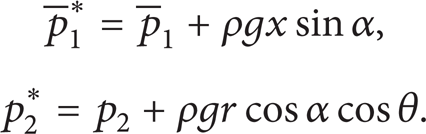
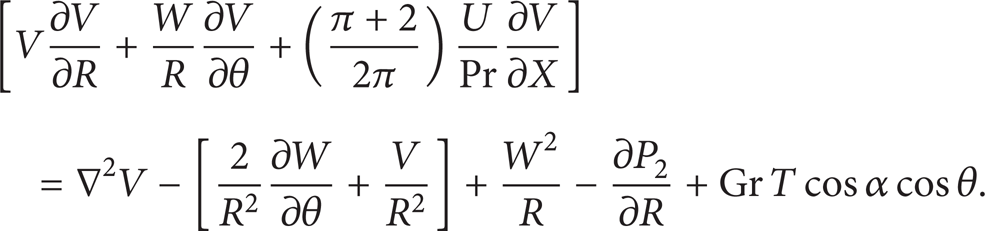
This decoupling of pressure makes it possible to solve the three-dimensional problem by using the marching technique in which the solution is progressed stepwise in the axial direction with a two-dimensional elliptic system (in the r and θ directions) to be solved at each axial step. The governing Navier-Stokes equations and the energy equation in cylindrical coordinates can be written in the following nondimensional form:

Geometrical configuration of the semicircular duct.
Continuity:

Axial Momentum:

Radial Momentum:
Angular Momentum:

Energy:

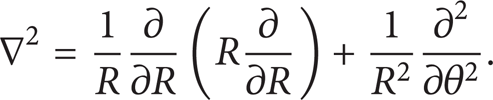
where
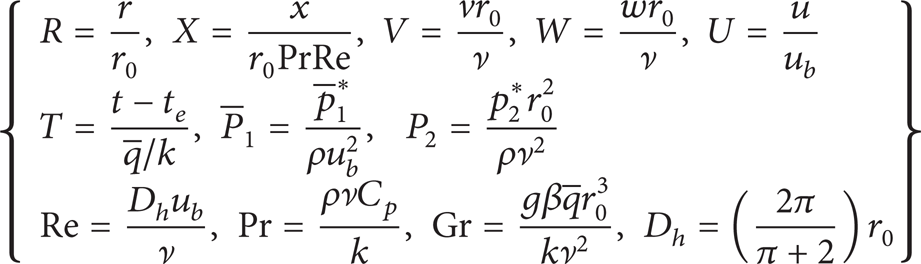
With dimensionless parameters of
the dimensionless initial conditions are:

The dimensionless boundary conditions are

Starting from uniform flow at the inlet of the duct (defined by (10)) the solution for
Some important engineering relations have been put in dimensionless form:

The product fRe x , where the friction factor f is defined by

The parameter

3. Solution Procedure
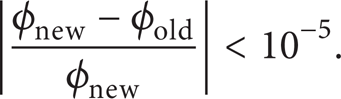
A uniform staggered grid on the cross plane and nonuniform divisions in the axial direction were utilized to discretize the governing equations. The analytical formulations were performed by using the finite control volume approach. The axial step size was taken as ΔX = 10−5 near the duct inlet. Then ΔX was increased by 5% for each consecutive step until ΔX reaches the value of 10−3 which was then kept constant, while the subdivisions for R and θ were kept the same along the duct. The solution of the governing equations ((3) through (7)) was progressed along X, by employing the SIMPLER algorithm of Patankar [21]. These equations were solved for each radial line using the tridiagonal matrix algorithm (TDMA), and the domain was covered by sweeping line by line in the angular direction. In each run, iterations were continued until the three velocity components and the temperature at all nodal points as well as the values of fRe x and Nu x satisfied the following convergence criteria:
The decision about the mesh size was guided from the results of pure forced Nu o and fRe o in the developing and fully developed regions at Gr = 0. After extensive experimentation, the grid 30 × 50 was selected since it appears to be adequate for this study. Comparing the exact solution of Nu o = 4.088 as in [22] and fRe o = 15.767 as in [23]. With this grid, the present numerical results are within 0.12% and 0.1% for (Nu o )fd and (fRe o )fd, respectively.
For the given value of Gr (e.g., Gr = 107) and Pr = 4, the fully developed Nufd and fRefd for mixed convection were compared with [3, 24] for horizontal and inclined semicircular ducts, respectively. Table 1 shows the comparison for both horizontal and inclined semicircular ducts at Gr = 107.

Figure 2 shows a comparison between the present results and those of Lei and Trupp [25] and Hong and Bergles [26] of the axial variation of Nu x for the case of forced convection (Gr = 0). The present results are in good agreement with the results of [25, 26]. The noticeable difference is limited to a very small region near the entrance where, X < 7 × 10⁻⁴. This is due to the fact that our model assumes simultaneously developing the temperature and velocity profiles, while [25, 26] assume fully developed velocity profile and developing temperature profile.

Variation of Nu x for forced convection (Gr = 0).
4. Results
The numerical investigations were carried out with Pr = 7, Re = 500, α = 0°, 20° and a wide range of Gr. These investigations include the development of velocity and temperature profiles and the development of overall quantities fRe x and Nu x with the axial coordinate.
4.1. Axial Velocity Development
Figure 3 shows the development of the axial velocity contours for the case of forced convection (Gr = 0). The flow is symmetric due to the absence of free convection, and the maximum velocity is moved toward the center of the duct cross section as the flow approaches the fully developed state. The development of axial velocity contours for the case of Gr = 107 and α = 0° is shown in Figure 4. In the absence of buoyancy effects, the isovels are seen to be very much similar to those of pure forced convection. The velocity is constant in most of the flow domain with sharp changes very near the duct walls as shown in station (I). As the flow precedes further downstream in stations (II) and (III), the effects of buoyancy begin to appear. As it can be seen that, the maximum velocity shifts downward towards the lower part of the duct cross-section due to the secondary flow motion generated by the effect of free convection and significant velocity gradient developed in the middle part of the duct. In station (IV), the velocity profile has almost reached the fully developed state and the maximum velocity confined in the lower part of the duct. In station (V) the boundary layer is completely established and the fully developed state has been reached.

Axial velocity contours at different axial stations for Gr = 0.

Axial velocity contours at different axial stations for Gr = 107 and α = 0°.
Figure 5 shows the development of isovels for the case of Gr = 107 and α = 20°. The flow in station (I) is similar to the one of the horizontal case. As the flow proceeds to station (II), the buoyancy effects begin to appear by distorting the symmetry of the flow and moving the maximum velocity towards the lower part of the duct, and part of the flow with high momentum moves upward due to the axial component of the buoyancy force. In station (III), higher momentum fluid continues to move upwards. Stations (II) and (III) are characterized with high velocity gradient all over the duct walls. Thus the flow in these two stations produces higher friction factors than those of the horizontal case, as it will be shown later. As the flow reaches station (IV) the maximum velocity moves upward with greater velocity gradient in the upper part of the duct cross section. The flow then becomes fully developed as it reaches station (V) and the maximum velocity confined in the upper part of the duct.

Axial velocity contours at different axial stations for Gr = 107 and α = 20°.
4.2. Development of Temperature Profiles
Figure 6 shows the development of temperature contours for the case of the forced convection (Gr = 0). The flow is symmetric and the minimum temperature moves toward the center of the duct as the flow proceeds toward the fully developed state. Figure 7 shows the development of (T – T w ) contours for the case of Gr = 107 and α = 0°. In station (I), the temperature contours are seen to be very much similar to those of pure forced convection. The temperature is constant in the most of the flow domain with sharp changes very near the duct walls. As the flow moves further downstream, station (II), the symmetry of the temperature distribution is distorted indicating a free convection effect. As the flow proceeds further downstream in stations (III) and (IV), the minimum (T – T w ) temperature shifts downward towards the lower part of the duct, and the area occupied by the cooler fluid is reduced indicating a higher heat transfer rate than that of station (II). When the fluid reached station (V) downstream which is far from the entrance, the flow is fully developed with a minimum (T – T w ) located in the lower corner of the duct.

Temperature contours, (T – T w ) at different axial stations for Gr = 0.
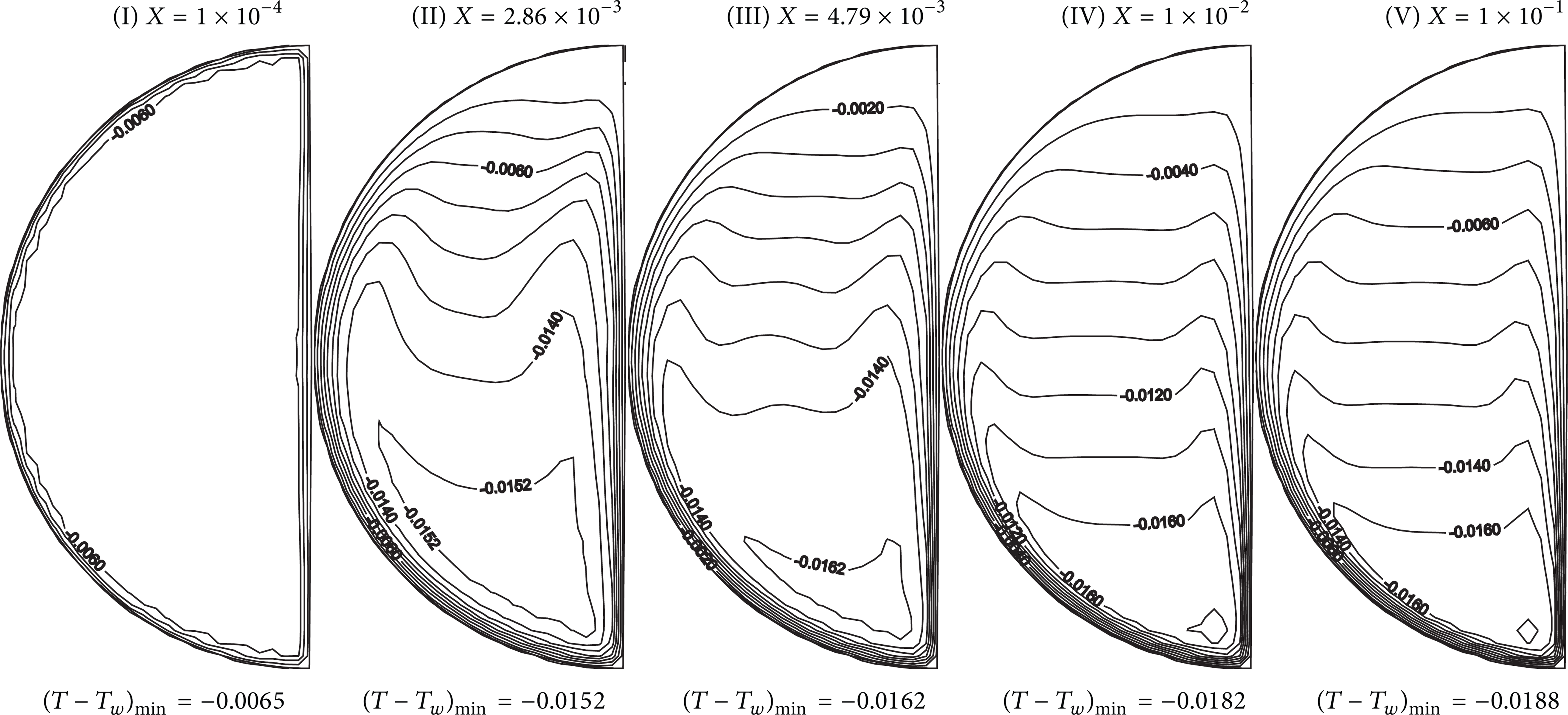
Temperature contours, (T – T w ) at different axial stations for Gr = 107 and α = 0°.
Figure 8 shows the development of (T – T w ) temperature contours for Gr = 107 and α = 20°. The development is similar to that of horizontal case except that the area occupied by the cooler fluid is reduced as compared with the horizontal case, particularly in the last two stations. This is because of the higher strength of the secondary flow for the upward inclination resulting in higher heat transfer rate, as it will be shown later.
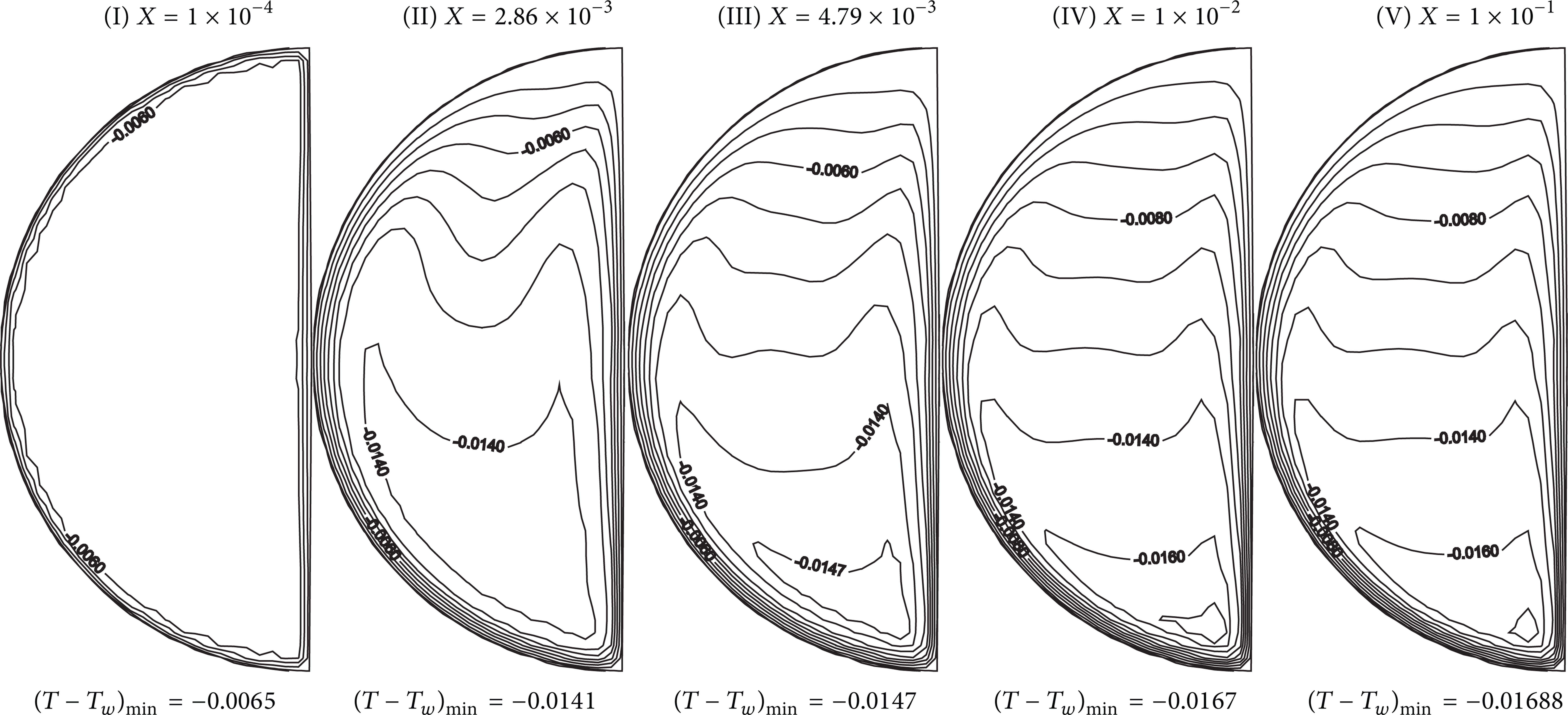
Temperature contours, (T – T w ) at different axial stations for Gr = 107 and α = 20°.
4.3. Effect of Grashof Number
The effect of Gr on the Nu x is presented in Figure 9 for α = 0°. At smaller values of X, Nu x values are very close to the forced convection values due to the absence of free convection. As X increases, Nu x decreases to a local minimum and then rises up to the fully developed value. This is due to the generation of strong currents of the secondary flow. Further, as Gr increases the minimum Nu x value shifts upstream. This behavior is predicted experimentally by Maughan and Incropera [17] for horizontal and inclined parallel plates, Busedra and Soliman [19] for inclined semicircular ducts, and numerically by Mahaney et al. [10] for rectangular ducts. The increase in Gr enhances Nu x in the developing and fully developed regions. The corresponding values of Nu x at stations (III) and (V) for Gr = 1 × 10⁷ are 18.9631 and 20.4597, respectively, which are 243%, 491% higher than those of forced convection at the same axial stations. Figure 10 shows the effect of Gr on Nu x for the case of α = 20°. The trend is quite the same as that of α = 0° with enhancement in Nu x for both the developing and fully developed regions. At Gr = 107, the corresponding values of Nu x at stations (III) and (V) are 21.4944 and 21.5734, respectively, which are 275.5%, 518% higher than those of forced convection at the same axial stations.
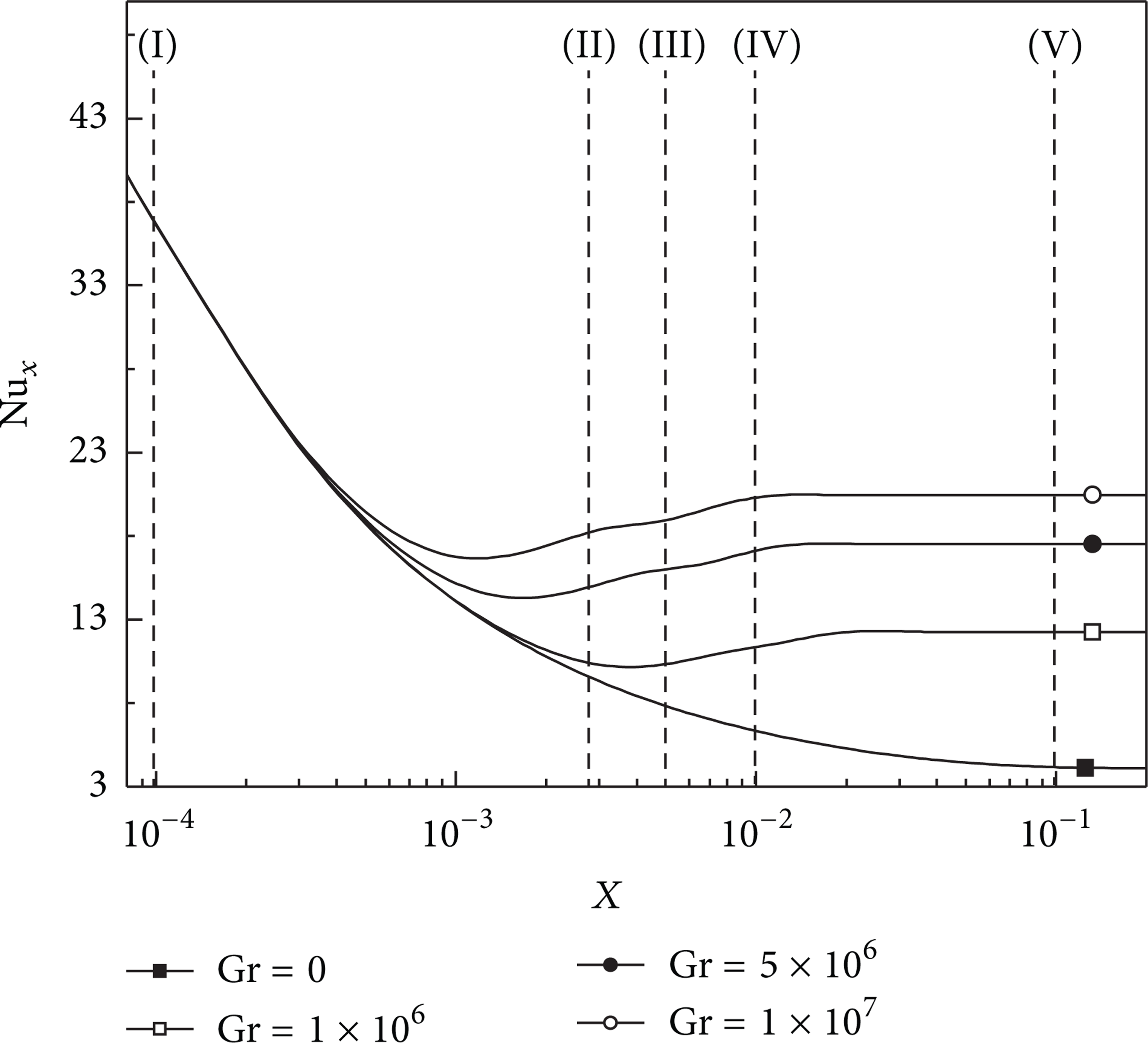
Effect of Gr on Nu x for α = 0°.

Effect of Gr on Nu x for α = 20°.
Figure 11 shows the effect of Gr on fRe x for the case of α = 0°. Generally, fRe x increases in the developing and fully developed regions with Gr, but the increase is much higher in the developing region. Again due to the absence of free convection, the values of fRe x near the entrance are close to the forced convection values. As X increases downstream, the values of fRe x start deviating from the forced convection values due to the active secondary flow currents. As X increases further, the values of fRe x decreases until it reaches a constant value (fully developed). The values of fRe x are higher in the developing region than those in the fully developed region. Figure 12 shows the effect of Gr on fRe x for α = 20°. The trend is similar to that of the horizontal duct. Beyond station (IV), however, fRe x drops as Gr increases up to a critical value, and then it increases as Gr increases until it reaches the constant fully developed value.

Effect of Gr on fRe x for α = 0°.
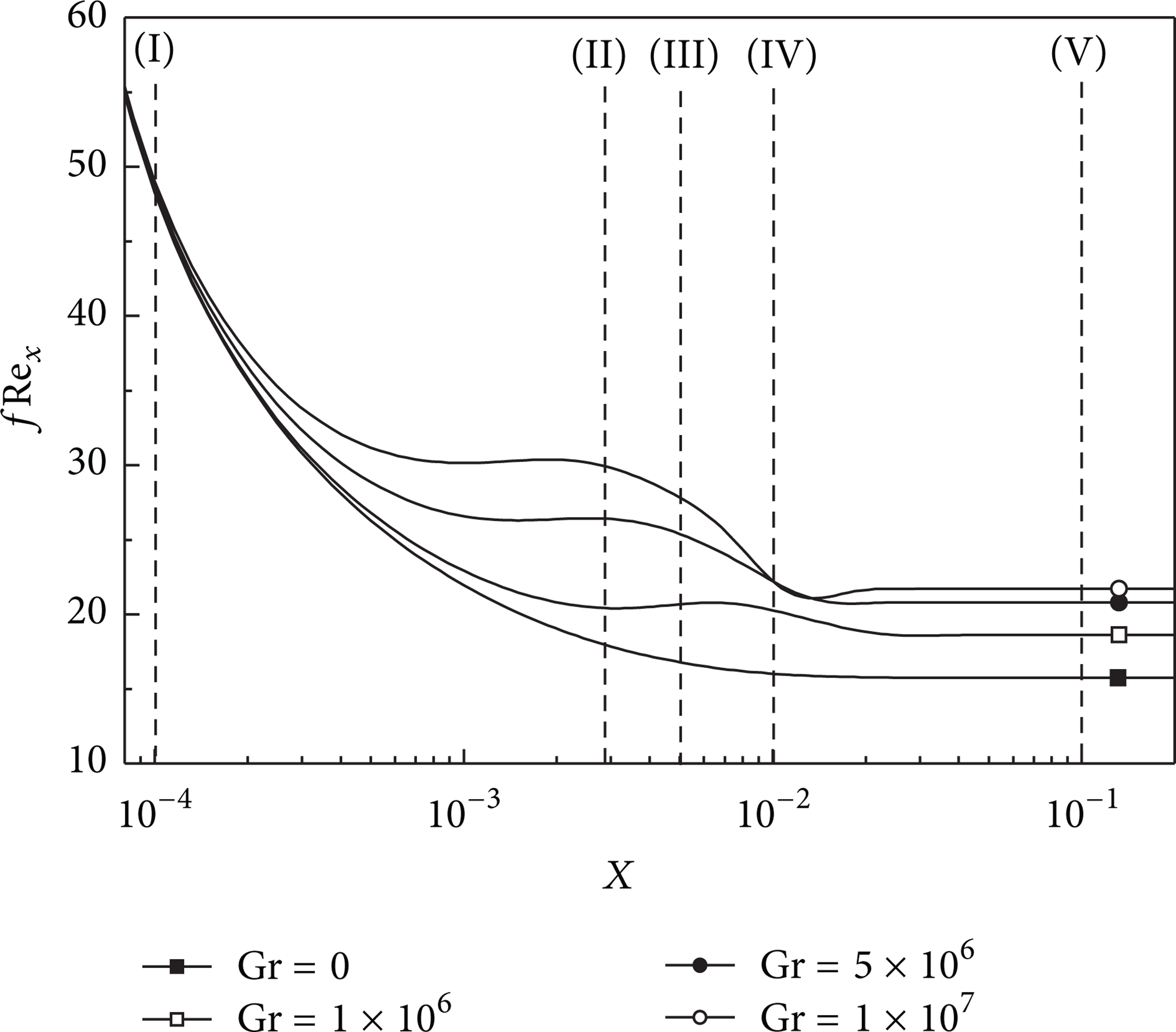
Effect of Gr on fRe x for α = 20°.
4.4. Comparison between Horizontal and Inclined Ducts
Figure 13 shows the effect of inclination angle on the development of Nu x . The values of Nu x for α = 20° are higher than that of α = 0° in most part of the duct length. This can be contributed to the fact that the axial component of the buoyancy in the flow direction accelerates the fluid which results in higher heat transfer rate. In addition to that, the inclination effect is more pronounced in the developing region than in the fully developed region.

Effect of inclination angle on Nu x for Gr = 107.
The effect of inclination on fRe x is shown Figure 14. The values of fRe x are much higher for the inclined duct than those of horizontal duct in the developing region because of the axial velocity profiles characterized by high velocity gradient near the walls for almost all the duct cross section. However, as the flow proceeds further fRe x decreases until it approaches the curve of the horizontal duct in the fully developed region. In this region, the values of fRe x for horizontal and inclined ducts are almost equal. This is due to the fact that the velocity gradient for the two cases is distributed around the wall in a similar fashion, with a difference in the location of maximum velocity being at the upper half of the duct section for the inclined and at the lower half of the duct for the horizontal case, as shown previously. The axial temperature distribution for the case of horizontal and inclined duct is presented in Figure 15. The wall temperature to fluid bulk temperature differences are always lower for α = 20° than that of α = 0° for most of the duct length. This indicates that Nu x is always higher for α = 20° than that of α = 0°.

Effect of inclination angle on fRe x for Gr = 107.
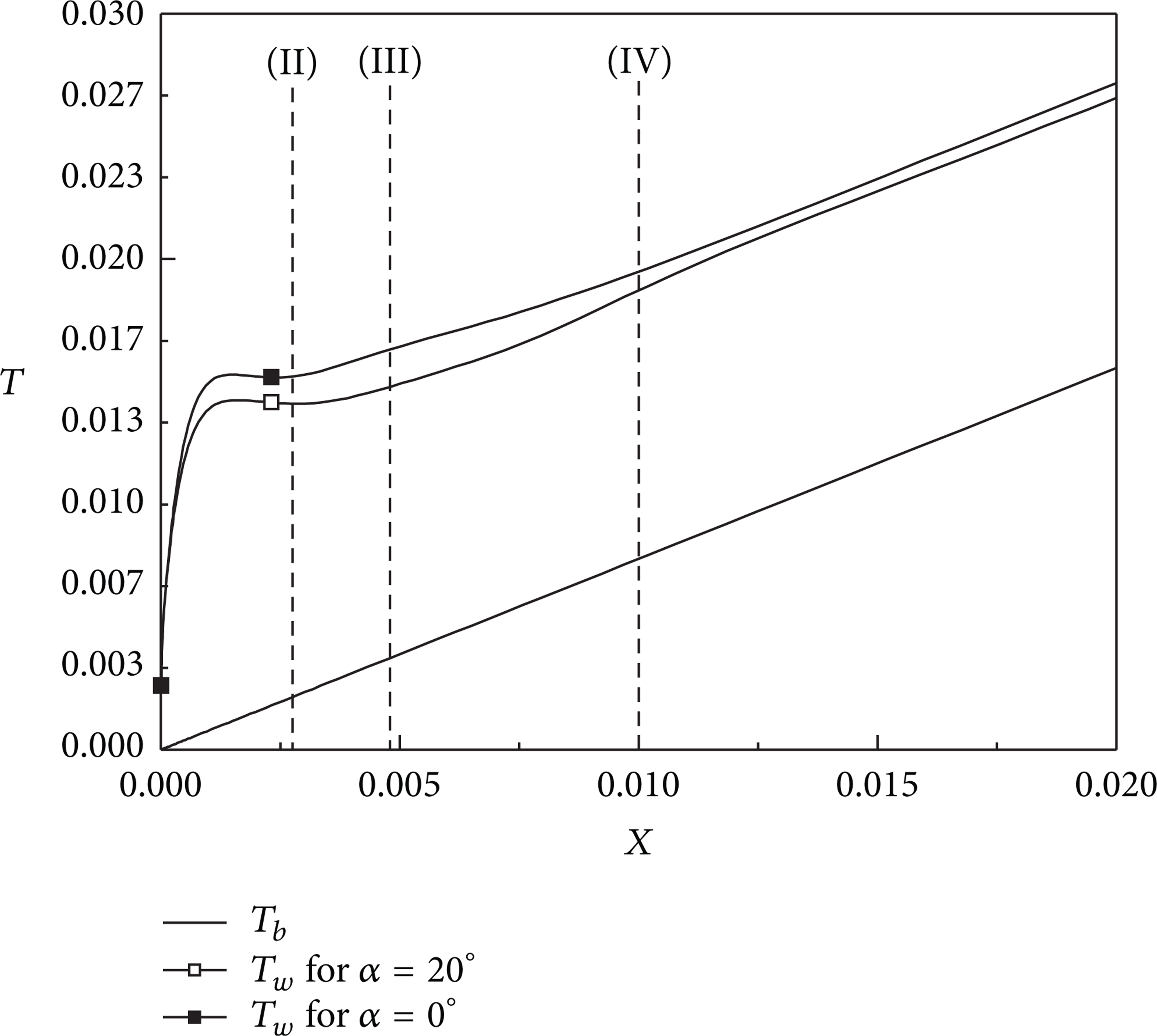
Variation of T w and T b along the duct for Gr = 107.
4.5. Comparison of Present Prediction with Experimental Results
The present work is compared with the experimental results of [19] for thermally developing and fully developed regions. All theoretical predictions are generated for the average Pr and Gr for the respective experimental data set with Re = 500. The general trend of the present results for the horizontal and inclined cases is consistent with the experimental results of [19], as shown in Figures 16 and 17. Figure 16 shows that the present results, for the case of α = 0°, approach well the experimental results in the early part of the duct, where the effect of free convection is weak while in the fully developed region the theoretical results slightly deviate from the experimental data. However, at high Grashof number, (e.g., Gr = 1.24 × 10⁷) the deviation is more pronounced in the developing region, as shown in Figure 16. This may be attributed to the assumption of simultaneously developing and uniform wall temperature circumferentially. This may not be achieved accurately as in the experiments especially with high Gr due to some heat loss and circumferential variation in wall temperature. The maximum deviation between the theoretical and experimental results is 15% at X = 0.0034 for Gr = 1.24 × 10⁷ with Pr = 5.74. The inclined case is represented in Figure 17. The trend is similar to that of the horizontal case. It can be seen that some of the experimental data exceeds the theoretical curves in the fully developed region. The maximum deviation between the theoretical and the experimental results is about 18% at X = 0.0034 for Gr = 1.22 × 10⁷ with Pr = 5.76.

Comparison of present results of Nu x with the experimental results for α = 0°.

Comparison of present results of Nu x with the experimental results for α = 20°.
5. Conclusions
An investigation of laminar mixed convection has been utilized for solving the entrance region of simultaneously developing hydrodynamically and thermally in horizontal and inclined semicircular ducts for H1 thermal boundary condition. The test matrix for which the results were obtained included two inclination angles (α = 0° and 20°), Re = 500, Pr = 7.0, and wide range of Gr. From these results, the following conclusions can be made.
Nu x and fRe x increase in the developing and fully developed regions with Gr.
Nu x decreases in the developing region up to a critical value. Beyond that, it starts increasing in both developing and fully developed regions. The general trend of the axial variation of Nu x is similar to those noted in the previous work for horizontal and inclined ducts.
The axial variation of fRe x is different from that of Nu x . fRe x is found to be decreasing along the duct length in the developing and fully developed regions. In addition, fRe x values in the developing region are higher for α = 20° than that of α = 0°.
The inclination angle has a stronger influence in the developing of the axial velocity profiles rather than the temperature profiles.
The inclined duct produces higher Nu x in the developing and fully developed regions and higher fRe x values in the developing region, while in the fully developed region the fRe x values are the same as in the horizontal case.
The present results of Nu x are consistent with the experimental results of [19] for both horizontal and inclined semicircular ducts. For both cases of α = 0° and 20°, the present work approaches the experimental results well in the early part of the duct, while in the fully developed region the theoretical results deviate from the experimental data, particularly at higher Gr.