




Abstract
In order to achieve an efficient usage on a limited spectrum for aeronautical machine-to-machine (M2M) communications, in this paper, a space division multiple access- (SDMA-) based architecture is proposed, where the random access of short messages noisy (SMN) M2M communications is considered between autopilot systems onboard and the ground control center for the air traffic precise control, that is, full 4-dimensional trajectory management. It shows that using a zero-forcing beamforming combined with a low complexity aircraft grouping strategy, the SDMA-based mechanism is able to improve the spectrum efficiency under signal to interference plus noise ratio (SINR) constraints.
1. Introduction
To ensure the continuous safety and efficiency improvement of air traffic flows, the accurate trajectory surveillance and control abilities are highly required for the advanced air traffic control (ATC), that is, 4-dimensional trajectory- (4DT-) based management (The “4D-trajectory management” concept improves the ATC by using “time” with early traffic sequencing based on the aircrafts way-point passage predictions. It is planned to be deployed from 2017 and allowed to enter into services beyond 2020), which has already been scheduled and will be employed in the following decade [1, 2]. Therefore, the future air to ground (A/G) datalink is foreseen to support continuous interactions between the flight management system (FMS) onboard and the ground ATC system for real-time automatic monitoring and control [3–6]. Since an ATC message payload generally contains only hundreds of bits (e.g., position coordinates and timestamps) [7] and needs to be updated frequently (e.g., 16 times per second) [8, 9], future aeronautical communications can be considered as typical short messages noisy (SMN) machine-to-machine (M2M) communications.
In order to support 4DT services, the next generation aeronautical datalinks will be developed by taking into account the SMN-M2M communications. For the sake of safety-of-life related issues [10], two crucial characteristics have to be considered as follows:
all aircraft should maintain seamless connections with the control center; each connection has to support a primary rate for real-time interactions.
Here, a primary rate is defined as the basic achievable data rate to provide essential communication services for 4DT management.
Unfortunately, the existing aeronautical datalinks may not be able to satisfy both two objectives from above efficiently [11, 12]. On the other hand, considering the limited aeronautical spectrum [13], the spectrum efficient strategy of aeronautical M2M communications can be reconfigured under the primary rate constraint. In summary, the future aeronautical M2M communication system can be demonstrated as follows:
a spectrum should be reused by multiple airborne station (AS) nodes; aircraft could transmit or receive short messages at real time, without extra resource allocations; a primary rate should be guaranteed for reliable M2M communications.
Since an interval in distance has to be guaranteed between different aircrafts (e.g., 4~8 nautical miles separation along with a flight course [14]), space division multiple access (SDMA) could be an efficient means [15, 16] to improve the aeronautical spectrum efficiency. Based on SDMA, a spectrum will be multiplexed by multiple AS nodes naturally. Also, real-time A/G interactions could be supported by SDMA assisted random access. With the help of SDMA, potential conflicts of random access will be mitigated easily.
In particular, beamforming over multiple-antenna systems can be an efficient approach to perform the SDMA [17]. Among different beamforming techniques, dirty paper coding (DPC) [18] has been developed to provide the optimal performance by separating combined spatially selective signals. However, DPC is impractical due to its prohibitively high complexity.
As a low complexity linear beamforming approach, orthogonal beamforming [19] is able to support hierarchical priority guaranteed SDMA in M2M communications over cellular networks [20], while it may not be appropriate for aeronautical SMN-M2M communications as an equal, performance of different 4DT management services is required on safety-of-life level. Combined with a semiorthogonal users selection (SUS) scheme [21], zero-forcing beamforming (ZFBF) has been proposed in [22] to provide equitable performance for all selected users. Thus, we may consider ZFBF as a good candidate technique for SDMA-based aeronautical M2M communications. However, unfortunately, SUS cannot achieve the SNR or rates to a certain desired level at each iteration of user selection. Therefore, ZFBF-SUS cannot guarantee the reliability of connections with the safety-of-life related 4DT management.
In this paper, we propose an SDMA-based approach for the future L-band continental A/G communication systems [23, 24]. By using ZFBF over antenna arrays equipped in a ground station (GS), one frequency spectrum is able to support M2M random accesses without conflicts for multiple AS nodes, simultaneously. Moreover, in order to guarantee the primary rate for A/G communications, we propose a low complexity user selection strategy for the ZFBF under signal to interference plus noise ratio (SINR) constraints to exploit the SDMA gain.
The rest of the paper is organized as follows. Section 2 provides the system model. Our proposed SDMA-based mechanism for aeronautical M2M communications is introduced in Section 3. After the impacts of feedback reliability discussion in Section 4, the simulation results are presented in Section 5 to analyze the performance. Finally, we conclude this paper in Section 6.
Notation. The superscripts T and H stand for the transpose and Hermitian transpose, respectively. Denote by
2. System Model
Consider a section of the continental A/G communication system with K aircraft randomly located in a macrocell. Let
Let the index of a certain spectrum be

The geometry model for A/G communications over the GS equipped with multiple antennas array in a macrocell.
Let
In aeronautical A/G communication scenario, a wireless channel is generally characterized by a Rician fading with a strong line of sight (LoS) component and a weak diffusion path [25, 26]. If the Rician factor is given by
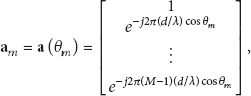
Considering all M elements of the ULA are placed at the direction of 𝒵-axis, the ARV of the AS-m is given by
Denote by
Let

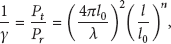
The transmission power of
3. Primary Rate Guaranteed SDMA
In this section, the main solution of SDMA-based mechanism for aeronautical M2M communications is presented. As aforementioned, antenna array beamforming and multiple users selection are coupled issues. Lets first consider the beamforming problem.
3.1. Zero-Forcing Beamforming
Let

Since


The ZFBF beamforming for A/G communications.
Since ATC services are safety-of-life related, the proposed system should be able to provide a primary rate for each selected AS node. Here, the primary rate is defined as


By taking into account the path loss in a macrocell, assuming all the AS have the same noise variance (i.e.,

Apparently,

The received SNR with
As Figure 3 illustrates, the received SNR of AS nodes with smaller absolute AoAs is higher than those nodes located at the edge area of a macrocell. Since
Using ZFBF, a spectrum can be multiplexed among inner and fringe AS nodes. In order to measure the advantage of ZFBF-SDMA, the improvement of performance can be described as an SDMA gain [28–30]. Let the SDMA gain be the ratio of the spectrum efficiency with and without the SDMA applied. If the primary rate constraint of M2M communications for different aircraft is identical and represented by
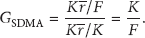
It shows in (11) that smaller F leads to higher SDMA gain. Then it is desired to develop a user selection method to perform ZFBF-SDMA with a small F. Since positions of AS nodes (including AoAs and propagation distances) may cause significant impacts on SINR, AS nodes cannot be grouped randomly due to the SINR constraint. Therefore, the multiuser selection plays a crucial role in the primary rate guaranteed SDMA, which results in improved and reliable overall performance.
3.2. Low Complexity User Selection
The optimal user selection is the exhaustive search, which is impractical due to the prohibit high complexity. The greedy algorithms, such as semiorthogonal user selection (SUS) [22] could be efficient but suboptimal. However, since the SUS may not secure the SINR of each candidate, the primary rate or SINR constraint cannot be guaranteed. If the pseudoinverse operation is carried out on channel matrix of selected users iteratively, SNR may be traceable but the computational complexity, that is,
In order to avoid pseudoinverse operations (which lead to high complexity) in the process of user selection, we focus on the expression of the received SINR in (6). Apparently, the best pairing candidate is to choose the one that maximize the SINR as follows:

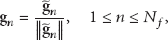
The orthonormal basis of the subspace spanned by
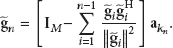


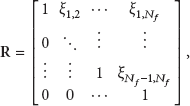

According to (4) and (6), the denominator of the SINR expression, which is directly affected by ECG, can be written as

Besides, the numerator of (20), based on [22], can be decomposed as


Since

It is shown that the denominator of (24) can be obtained only by taking vectors multiplication. Based on (24), the matrix-inverse free selection (MFS) for all K AS nodes is summarized in Algorithm 1.
(1) (2) (3) (4) (5) (6) Generate (7) (8) Generate (9) (10) Generate (11) (12) Calculate SINR( (13) (14) (15) (16) (17) (18) (19) (20) (21) (22) (23)
Based on steps
4. Impacts of AoA Reliability
So far, we have assumed that perfect AoA information can be obtained at the GS and the AoAs is unchanged within a short time slot. However, the AoAs actually change during the path of AS nodes flying over the GS. Since imperfect AoAs can seriously influence the SDMA performance, impacts of the AoA reliability (i.e., AoA accuracy and updating frequency) will be discussed in this section.
4.1. The Imperfect AoA Estimation
Note that any error or inaccurate AoA estimation will result in a degraded beamforming performance and lead to the interference in 4DT A/G data transmission, which is not desirable. It is important to investigate the impact of imperfect AoA estimations on the performance of the proposed aeronautical SDMA architecture.
While AoA estimation errors have been studied in the literature [31–33], analytical formulations to see the impact of AoA estimation errors are difficult for multiple user broadcasting with SDMA. Thus, in this section, we present a preliminary simulation result on the sensitivity of sum rates to imperfect AoAs. The estimated AoA by the GS, denoted by


We can evaluate the impact of imperfect AoA information by defining SINR degradation as

In (27),
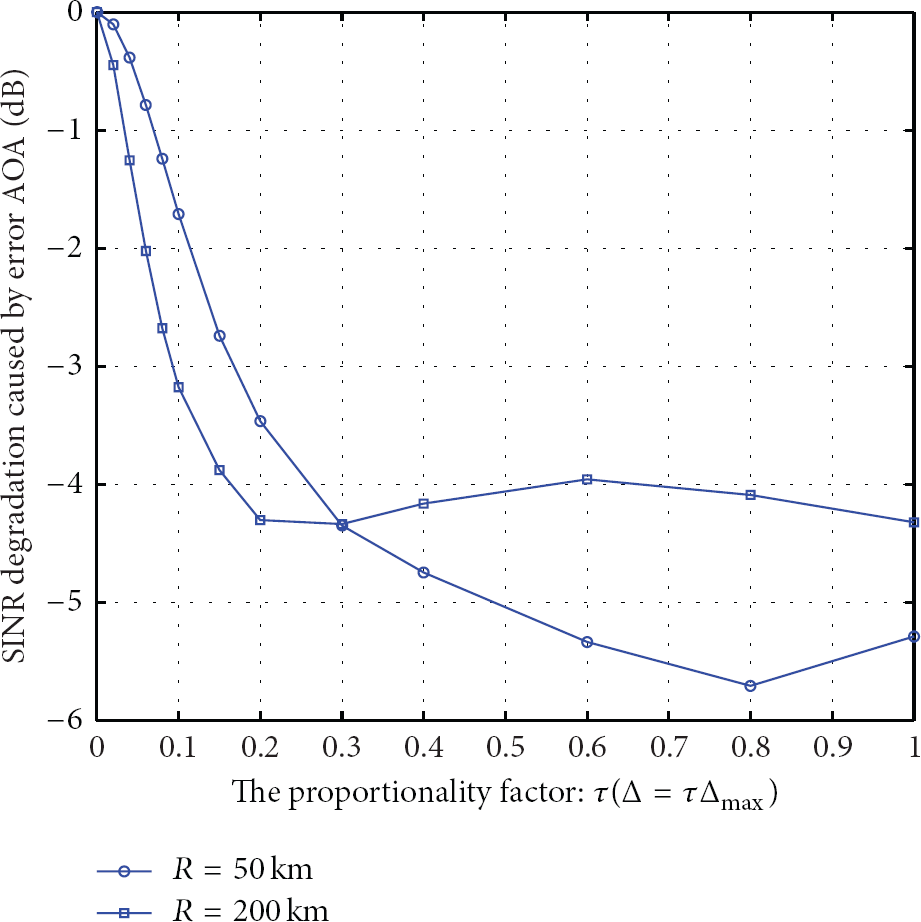
Average SINR degradation as a function of τ, where
As shown in Figure 4, the
If the AoA information is obtained over AS feedback, the updating frequency will be crucial considering the position of an aircraft changes rapidly. This issue will discuss in the next subsection.
4.2. AoA Update Frequency
In the implementation of the primary rate guaranteed SDMA, it is possible to obtain the positions or flight tracks of all AS nodes by AS feedback or positioning function of the ATC system. Consequently, the frequency of information update will affect the AoA accuracy directly and be discussed in this subsection.
Based on the geographic model in Figure 1, the AoA of an AS flying at inner area changes much more bigger than others far away from the GS; even they have the same altitude and speed. However, according to Figure 4, the AS node locates at inner area; for example,


It is noteworthy that the position tolerance for beamforming is quite different between inner and boundary areas of a macrocell. With
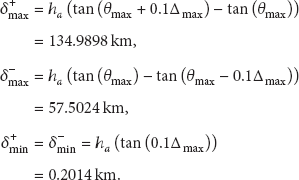
Apparently, with the position drift
Based on the promising A/G datalink protocols (i.e., L-DACS1 and L-DACS2), it is required that every AS should feedback its position or distance away from the GS in every superframe [24, 34]. Note that the superframe duration is 0.24 second in L-DACS1 or 1 second in L-DACS2, which means the feedback channel is already designed in future systems and the updating frequency will also fulfill all requirements of the proposed aeronautical SDMA system.
5. Numerical Results
In this section, numerical results are presented under assumptions that the unitary noise variance
Figure 5 shows the SDMA gain versus total number of AS nodes K for different number of antenna elements M, where

The SDMA gain versus total number of AS nodes K.
Simulation results of SDMA gain versus number of antenna elements (M) are presented in Figure 6, where

The SDMA gain comparison of increasing number M of antenna elements in the different macrocell, where
In Figure 7, simulation results of our proposed primary rate guaranteed SDMA and OBF with SINR constraints are presented with different array elements numbers; that is,

SDMA gain as a function of R, where
In general, the simulations above illustrate that the proposed ZFBF with MFS is a proper SDMA approach for 4DT services. And the ZFBF with MFS will obtain a better SDMA gain compared with OBF in [19, 20, 35].
6. Conclusion
In this paper, an SDMA-based aeronautical M2M communication system has been proposed together with a low complexity user selection approach. It has been shown that a primary rate is guaranteed for all selected AS nodes, while the same frequency spectrum can be reused by ZFBF. Using the proposed matrix-inverse free user selection, the SINR of each AS candidate is calculated with acceptable complexity, that is,
Through simulations, we have confirmed that the SDMA gain can be strongly improved by increasing the number of antenna elements, while the SDMA can be more efficient when the radius of macrocell is relatively small. Furthermore, our proposed SDMA approach is able to provide stable performance in a high density AS nodes scenario, which is desired by the future aeronautical SMN-M2M communications.
Footnotes
Acknowledgments
This work was supported by the National Natural Science Foundation of China (Grant nos. 61250001, 91338106, 61231011, 61171069, and61231013) and by the National High Technology Research and Development Program (Grant no. 2011AA110102).